
NVIDIA GTC 2026: NeMo Claw, $250K Token Budgets, and an Open-Source Bet
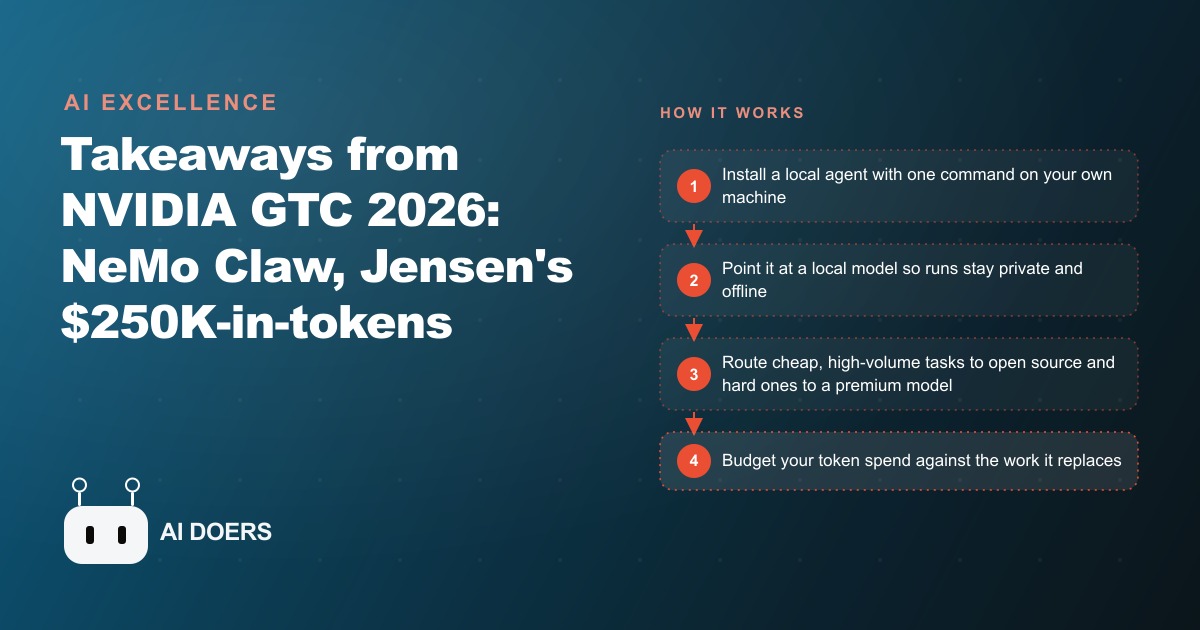
GTC 2026 was really about agents and the economics of running them. NeMo Claw installs a local agent in one command, Jensen Huang argued a $500K engineer should burn $250,000 a year in tokens, and hybrid routing quietly takes the cost off the table.

The most important thing Jensen Huang said at GTC 2026 was not about a chip.
It was about a thought experiment involving a five-hundred-thousand-dollar-a-year engineer who spends only five thousand dollars in AI tokens over a full year. The reaction described on stage to that scenario was not admiration for frugality. The reaction was alarm. The argument: if someone that capable and that expensive is spending that little on the tools available to amplify their output, they are not doing it right. Jensen floated the expectation that a highly paid professional should be running two hundred and fifty thousand dollars or more in annual token spend, treating tokens not as a cost to minimize but as fuel for work that would otherwise require more people or more hours. I am Madhuranjan Kumar. I watch these keynotes looking for the idea that will change how business owners think about what they are actually buying when they pay for AI. That framing, treat token spend as a sign of productive output rather than a bill to minimize, is the most consequential thing said at GTC 2026, and it will take a few years before most businesses fully understand what it implies.
The one-command install signals a change in who gets to run an agent
The hardware announcements at GTC 2026 were present and significant. The Vera Rubin GPU architecture and the associated data center infrastructure represent another substantial increase in the raw compute available for inference workloads. But chip announcements follow a predictable rhythm, and they matter to most business owners only when they translate into lower cost or higher capability for the tools those businesses already use. The software story at GTC 2026 was the one with immediate practical implications.
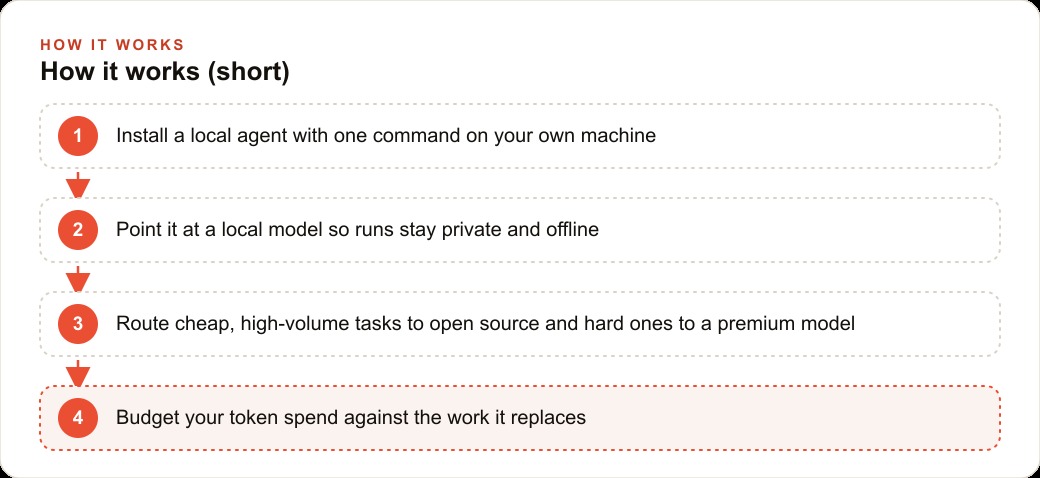
NVIDIA gave a substantial share of the keynote to Open Claw, a project that reached its GitHub star count faster than almost any project in the platform's history. NVIDIA's own implementation, NeMo Claw, installs a local agent in one terminal command on whatever machine you have. In a live demonstration on a consumer laptop, the installer detected the hardware, offered a clear menu of options including a fully local offline setup using a capable open-source model through Ollama, and completed the configuration without requiring any technical knowledge beyond the initial command. That single demo illustrates the change more clearly than any slide could. Running a real agent went from a project that required a developer, a cloud subscription, and weeks of configuration to something that takes one command and fifteen minutes.
The reason this matters is that the barrier to deploying an agent was never primarily cost in most businesses. It was setup friction and the opacity of what you were actually getting. Organizations that could write a check for a professional AI contract often still had a multi-month onboarding process before anything meaningful ran in production. The one-command install removes the setup friction for everyone. That compression of setup time is what changes who gets to use these tools, and it changes it right now rather than at some future point when the technology matures.
The open-source panel that followed the keynote made a second point I found equally useful. The CEOs of two widely used AI development companies, the founder of a newly independent AI lab, and a prominent open-source orchestration company sat together and pushed back on the notion that running a capable agent requires a premium model for every task. The consensus was hybrid routing: a cheap open-source model handles the majority of work, which is high in volume and low in judgment complexity, and a stronger model covers the small fraction of requests where quality at the top end actually matters. That architecture changes the cost structure of running a real agent from an unpredictable monthly bill to something much closer to a flat, controllable operating expense.
NVIDIA committed to keep building capable NeMoTron open models and supporting them on its hardware, which ensures there is a strong free option on the cheap side of that routing decision for years ahead. The hardware investment the keynote was really about is not just the Vera Rubin GPU announcement. It is building the token factory infrastructure that makes running a hybrid routing layer cheap enough that any business can operate one without a dedicated AI budget line.
Spend tokens like a resource that replaces hours, not like a bill to minimize
The token budget framing is where the GTC 2026 message has its deepest long-term effect on how businesses should think about AI spending. The conventional mental model treats tokens the same way it treats any variable cost: minimize it, optimize it, cut it when margins are tight. The model put forward on stage is almost the opposite. It treats token spend as the output signal, the evidence that the agent is doing real work. Low token spend, in this framing, means the agent is barely being used or is being used on work too trivial to generate meaningful output. It is the equivalent of judging a machine shop's productivity by how little electricity it uses.
The laptop analogy that surfaced during the keynote gives this a practical form. The suggestion was that token budgets might eventually come to employees on their first day alongside their laptop and software licenses. Engineers would be expected to use those tokens on real problems, and the ones spending very little would be asked why. That is a different relationship with AI spending than anything mainstream organizations have yet established, and the businesses that internalize it first will make very different resource allocation decisions than the ones still treating AI as an experiment that should pay for itself immediately in obvious cost savings.
The logic underneath this is simple and important. Every hour of work a capable agent handles is an hour freed for work only a person can do. A company that minimizes token spend is paying for an agent and then not running it on enough real work to cover the cost in recovered time. The calculation that actually matters is not spend per token or spend per month. It is value returned per dollar of token spend, and the right way to move that ratio in your favor is to run the agent on more of the real, time-consuming, judgment-light work that fills most professional days, not to optimize for lower usage.
The San Francisco self-driving demo on an L2 system gave the keynote a concrete example of what happens when inference runs at scale on real-world inputs in real traffic. The vehicle navigated actual streets in actual conditions without the kind of controlled-environment caveats that usually accompany demos of this category. NVIDIA's stated direction toward a fuller autonomous system positions it to own the inference hardware layer for autonomous systems the same way it owns it for language and image models. For the business owner, the relevance is indirect but real: the hardware and cost curves that make this viable at scale are the same ones that make running a continuous local agent on a business workstation cheaper every year without any action required from the business.
The plumbing company illustration gives this economic structure a grounded form. The owner typically carries a heavy load of small text work: estimates to type up from job-site notes, voicemails to process, supplier emails to sort through, and end-of-day job records to file before the next morning. Each task is low-judgment but time-consuming. A local agent on the office machine, connected to the incoming messages and the estimate templates, handles the routine sorting and drafting. Route the estimate drafts through the local open-source model. Route the one complicated insurance-adjacent scope question that comes in occasionally to the stronger model. The monthly token cost at that volume is a predictable number that maps directly to hours recovered from the evening schedule.
If the same plumbing company is running a Google Ads campaign that drives calls, those calls need fast follow-up to convert. An agent that processes follow-up from incoming leads quickly and consistently turns a higher percentage of that paid attention into booked jobs. The leads that enter the CRM and website stack get processed the same day rather than sitting in a to-do queue until the weekend, which changes the conversion rate on the ad spend without changing the ad spend itself.
The financial case for running the agent on real daily volume is not speculative. It is the arithmetic of recovered time at whatever rate the owner values their hours, minus a token spend that is small by comparison. The trap to avoid is the one the thought experiment was designed to illustrate: having the tool and barely using it because spending on tokens feels wasteful. That feeling is a mismatch between the old mental model of technology cost and the new one.
In the old model, software costs are fixed and you try to get value from what you have already paid. In the new model, the variable spend on tokens is proportional to the value the agent is producing, and running it harder on more real work is the correct response when the tool is working, not a reason to pull back.
What GTC 2026 actually argued, and what will prove correct over the next two to three years, is that the businesses winning with AI will not be the ones that found the cheapest way to add a chatbot to their website. They will be the ones that ran an agent continuously on real business work, let the token spend climb as the work volume justified it, and used the freed hours to do the client-facing and revenue-generating work that actually moves the business forward.
The one-command install made the starting point accessible. The token-budget framing gave the ongoing economics a coherent logic. The hybrid routing architecture made the cost structure controllable. GTC 2026 put all three of those things together in one concentrated announcement period. The plumbing company that installs a local agent this month, routes its routine estimate drafting through a free open-source model, and lets the token spend grow as the volume justifies it is not following a trend. It is following the economics that GTC 2026 made explicit. The businesses that understood what was being said are already thinking about which workflow to run first. The ones that wait two more years to find out what happened will read the case studies of the ones who started now.
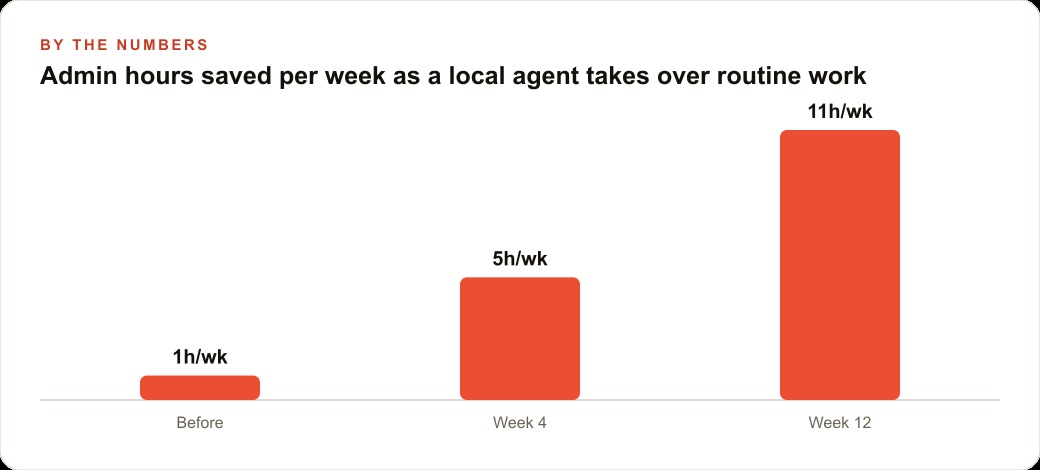
The Vera Rubin GPU roadmap matters here too, even if the owner never thinks about hardware. As compute costs continue to fall through the next product cycles, the cost per task on a local model will drop further without any additional work from the business side. Setting up local hybrid routing now means the system gets more capable and less expensive automatically as better open models release. That compounding improvement is why building the habit early pays out far more than the immediate time savings alone suggest. You are not just saving admin hours today. You are positioning the business to absorb the next wave of capability at no extra setup cost, on a system that is already integrated into the actual workflow rather than waiting to be connected to it.
The right question to ask after GTC 2026 is not whether you can afford to run a local agent. It is whether you are spending enough on the one you already have, or the one you are about to set up. Tokens are the fuel. The work that needs doing is the destination. The businesses that will look back on this period as the moment everything changed are the ones who started treating token spend as an investment in recovered capacity rather than a cost to be managed down.
The plumbing company that installs a local agent this month, routes its routine estimate drafting through a free open-source model, and lets the token spend grow as the volume justifies it is not following a trend. It is following the economics that GTC 2026 made explicit. The businesses that understood what was being said are already thinking about which workflow to run first. The ones that wait two more years to find out what happened will read the case studies of the ones who started now. That gap, between the businesses that absorbed the lesson in real time and the ones that absorbed it through retrospective, is where the structural advantage in the next phase of this technology gets built.
That is exactly what we do at AI DOERS. Book a private 30-minute call with Madhuranjan Kumar and we will map the fastest path to it for your specific business.
Book your call →
Madhuranjan Kumar
Madhuranjan Kumar brings 20 years of performance-marketing experience and has managed over $200 million in Facebook ad spend for brands across the United States and beyond. His expertise spans the full modern marketing stack: Meta, Google Ads, TikTok, email automation, CRM, and the websites that hold it together. At AI DOERS he turns that track record into lead-generation systems for businesses across every industry.