
Build a No-Code AutoGPT Assistant That Does Tasks For You
A no-code platform lets you chain search, reading, and writing into an assistant that completes real tasks. Here is how it works and how a bakery could use it for personal outreach.

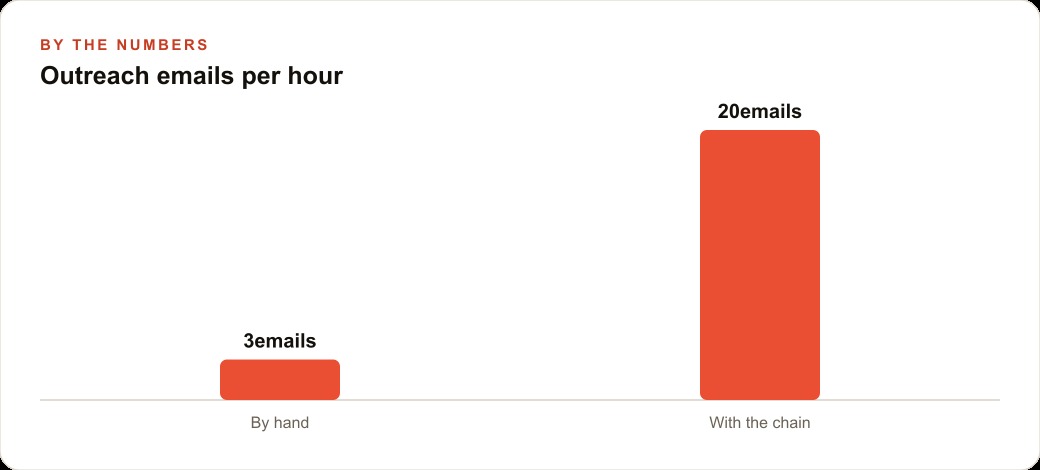
A neighborhood bakery in a mid-sized city had a wholesale problem. The cafes and office kitchens within two miles that might have placed weekly pastry orders had never been contacted, not because the owner did not want to reach them, but because writing a genuine outreach email to each one was the kind of task that always fell to the bottom of the list. At three emails per hour, written from scratch, the math did not work. The bakery needed to reach 60 potential wholesale accounts. That was 20 hours of writing time the owner did not have. I am Madhuranjan Kumar, and this is the story of how a no-code AI chain solved that problem, and what the principle behind it means for any business facing a version of the same constraint.
The Problem That Three Years of Spreadsheets Could Not Solve
The bakery had a spreadsheet. It had been accumulating business names, addresses, and rough notes since the owner first started thinking seriously about wholesale. "The coffee shop on Elm." "The coworking space on Market." "The two offices in the building by the park." The spreadsheet had grown to 80-plus names over three years. The column for "date contacted" was almost entirely empty.
The gap was not ambition or product. The bakery's croissants were genuinely excellent and the owner had heard from every new retail customer that they were the best in the neighborhood. The gap was the labor of outreach. Writing a cold email that felt warm and specific required knowing something about the recipient, which required looking them up, which required time, which kept getting displaced by the immediate demands of running a kitchen. Every morning started with production and ended with nothing sent.
The owner had tried a generic email blast twice. The response rate was low enough to be discouraging rather than encouraging: two replies from 40 sends, one of which was a polite decline. The feedback from one of the cafes that did reply was the most useful data the spreadsheet ever produced: "Your email felt like it was written to a list, not to us." That note sat in the inbox for six months before the owner found a way to act on it.
The insight behind the no-code approach is that the reason the emails felt generic was not that the owner was a poor writer. It was that writing 80 personalized emails from scratch is a task that fights human attention span at every step. Each individual email is easy. The 40th one in the same session is exhausting. The solution was not to make the owner a better writer. It was to make the research-and-draft cycle automatic so every email started from a specific foundation rather than a blank page.
Building the Chain, Block by Block Over One Weekend
The owner had never built an automation before. The learning curve for the no-code builder turned out to be a weekend, not a semester.
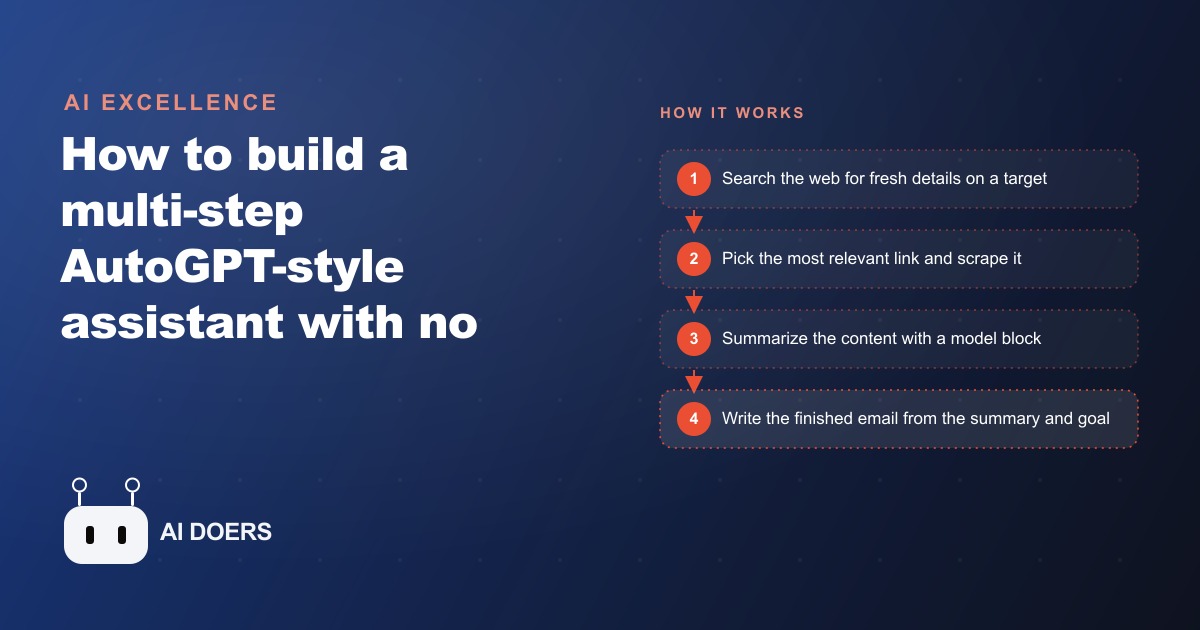
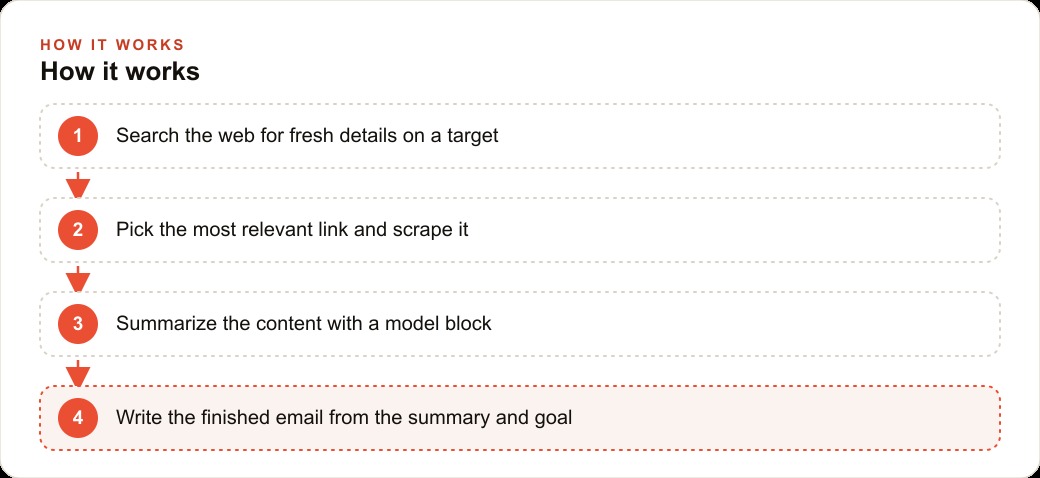
The chain works by connecting blocks on a visual canvas, where each block performs one job and passes its result to the next. The input is a business name. The first block sends that name to a web search service and gets back a page of fresh results. The second block, a small transformation, trims those results down to the three or four most relevant snippets rather than passing everything forward. The third block is a model that reads the trimmed results and identifies the single most useful link to explore further, usually the business's own website or a recent local news mention. The fourth block sends that URL to a web scraping service, which fetches the actual page content. The fifth block summarizes that content into three or four sentences: what the business is, who it serves, and any detail that might make a warm opening line feel genuine rather than researched. The sixth block, the writing block, takes that summary plus a description of the bakery and its wholesale offer, and drafts the outreach email.
The writing block is where most of the quality comes from, and the setup of that block matters more than any other. The owner gave it a specific role in the instructions: an expert at warm, direct B2B outreach who follows three strict rules. First: open with one genuine observation about the recipient's business, something specific pulled from the summary, not a generic compliment. Second: introduce the bakery in one sentence and the wholesale offer in one more. Third: close with a single clear next step, not a list of options. The numbered rules made the output dramatically more consistent than a vague instruction to "write a good email." Constrained prompts produce constrained outputs, which in outreach means professional, not sloppy.
The owner built the chain in a standard no-code builder over a Saturday afternoon. Three practical lessons emerged from the build session. First, save after every block addition before renaming any step, because some builders clear unsaved work on rename. Second, test each block individually with a sample input before connecting it to the next one, so when something goes wrong you know which block caused it. Third, the scraping block occasionally returns thin content for very small businesses with minimal web presence, so the writing block needs instructions for that case: if the summary is sparse, focus the opening line on the business type and neighborhood rather than a specific detail.
By Sunday afternoon the chain was running, tested on five real names from the spreadsheet, and published as a shareable internal app. Now any team member could type a business name, press run, and receive a draft in about 40 seconds.
The First Runs: Where It Worked and Where It Stumbled
The first live batch was 20 businesses from the top of the spreadsheet. The owner ran each name through the chain, read the draft, made light edits when necessary, and sent. The whole process for 20 emails took just under two hours, including review and editing time. The previous approach would have taken the same two hours to produce four or five emails.
The quality distribution was instructive. About 14 of the 20 drafts were very good: specific, warm, clearly written, and ready to send with minimal editing. Four required one round of light editing, usually to replace a slightly awkward phrase or to sharpen the call to action. Two produced thin drafts because the scraping block had returned very little content for businesses with minimal online presence. Those two required the owner to add a specific detail manually before the email was worth sending, which took about five minutes each.
The owner's initial concern was that AI-drafted emails would feel identifiable as AI-drafted, the same problem as the generic blast that had failed before. Reading through the batch made clear that the concern was about the wrong variable. The emails felt specific because the research was specific, not because of any particular writing style. An email that opens by noting a cafe's recent addition of a specialty tea menu before suggesting a morning pastry delivery does not feel generic regardless of who or what wrote the opening line. The specificity is the warmth, and the chain sourced the specificity automatically.
Four Weeks In: 240 Emails and Six New Wholesale Accounts
Four weeks after the first batch went out, the owner had sent 240 outreach emails. Not 80 spread across a year the way the spreadsheet had been accumulating names. Two hundred and forty in four weeks, because the bottleneck was no longer writing time. It was review time, which ran at about 20 emails per hour including reading and light editing.
The response rate was 14 percent, meaning 33 replies from 240 sends. Of those replies, 22 were interested and took a follow-up call or asked for a price sheet. Six converted to active wholesale accounts within the four weeks. At the bakery's average wholesale order value, those six accounts added a recurring revenue stream that paid for the no-code tool subscription and left substantial margin in the first month alone.
More usefully, the 33 replies gave the owner a database of interested businesses to maintain as a relationship list rather than cold-lead list. Several of the 22 interested parties who did not immediately convert noted timing issues: they had just signed a contract with another supplier, or they were not ready to add a new vendor until the next quarter. Those businesses were now warm contacts rather than names on a spreadsheet, and following up with a specific message about a seasonal product launch would no longer require starting from zero.
The comparison to the old approach is worth stating plainly. Before the chain: three emails per hour, two sent from the spreadsheet in the previous 12 months, response rate unknown because the sample was too small. After the chain: 20 emails per hour of review time, 240 sent in four weeks, 14 percent response rate, six new accounts. The output multiplier was not the AI's ability to write better than the owner. It was the AI's ability to remove the research-and-draft friction that had kept 80 solid business names sitting in a spreadsheet for three years.
For any business running /meta-ads or /google-ads campaigns alongside an outreach program, the chain provides the content layer that paid media alone cannot. An ad creates a touchpoint. A specific, warm email to a business that has already been researched creates a relationship. The two reinforce each other when both are running consistently, and consistency is exactly what the chain makes possible.
What the Bakery Learned That Every Small Business Can Use
The generalizable lesson from the bakery's four weeks is not about bakeries or wholesale outreach. It is about the class of task that chains like this are suited for.
The pattern is: research a target, understand something specific about them, produce a piece of writing that applies that understanding to a goal. That pattern covers every business that sends outreach, pitches, proposals, follow-ups, or personalized recommendations. A real estate agent researching a neighborhood before pitching a listing. A consultant researching a prospect before a discovery call. A recruiter drafting a first message to a candidate. A boutique e-commerce store writing a partnership pitch to a complementary brand. The specific domain changes. The chain structure stays the same: search, pick, scrape, summarize, write.
The chain also generalizes inside a business. The same architecture that handles outreach handles content too. Point it at a topic instead of a business name and the search, trim, pick, scrape, summarize sequence produces a research brief. Add a writing block with a different role and it drafts a newsletter section. For businesses that want to build a /seo-content program but cannot afford a full research team, the chain provides the research layer on demand rather than on a hiring cycle.
The bakery's owner now runs the chain weekly, working through new additions to the spreadsheet and following up with the contacts from week one. The /web-crm equivalent for a business this size is a simple contact list with a status column: sent, replied, interested, account, declined, follow-up-later. The chain fills the top of that list automatically. The owner manages the relationships from there.
Three months in, the owner's summary of the whole project was direct: "I spent three years not doing something that would have taken me 30 minutes to build." The build was the weekend. The value was three years of outreach that should have already been sent.
The final practical note for anyone building a similar chain: the human review step at the end is not optional. The chain handles the research and the first draft. The owner handles the read, the light edit, and the send. That division is deliberate and correct. An AI that sends without a human checking is a liability. An AI that drafts with a human reviewing is a force multiplier. The bakery's 14 percent response rate is partly a function of that review step catching the occasional draft that was thin or slightly off-tone before it reached a potential account. Keep the human in the loop at the send step and the chain performs like a very fast, very consistent researcher and first-draft writer working alongside you rather than replacing your judgment.
That is exactly what we do at AI DOERS. Book a private 30-minute call with Madhuranjan Kumar and we will map the fastest path to it for your specific business.
Book your call →
Madhuranjan Kumar
Madhuranjan Kumar brings 20 years of performance-marketing experience and has managed over $200 million in Facebook ad spend for brands across the United States and beyond. His expertise spans the full modern marketing stack: Meta, Google Ads, TikTok, email automation, CRM, and the websites that hold it together. At AI DOERS he turns that track record into lead-generation systems for businesses across every industry.