
Nano Banana Pro vs ChatGPT vs Midjourney vs Flux: The Real Winner
Google's Nano Banana Pro wins the overall 15-prompt test on realism, character consistency, and clean text, but Flux 2 Pro takes style transfer, complex scenes, and editing. For a business making its own visuals, the smart move is choosing a model per task.
The four-model shootout just crowned Nano Banana Pro, but not by a landslide
Fifteen prompts, four of the strongest image models on the market, and one clear overall winner: Google Nano Banana Pro. That is the headline result of a fresh head-to-head test that pitted Nano Banana Pro against the ChatGPT image model, Flux 2 Pro, and Midjourney v7 across the categories that actually decide whether a picture is usable. I am Madhuranjan Kumar, and I want to walk through what changed, because the ranking is less important than the pattern hiding underneath it.
The test did not measure spec sheets. It measured outcomes. Each prompt targeted one concrete skill, realism, text rendering, character consistency, style transfer, complex scenes, and editing, and every category was scored on its own before the points were tallied. Nano Banana Pro took the title, but it did not sweep. Three of the four models won at least one category outright. For anyone who makes their own marketing visuals, that split is the real news, and it should change how you pick a tool this week.
Realism, consistency, and clean text now belong to Google
Nano Banana Pro pulled ahead on the three things that make an image believable enough to publish. On an ultra-realistic 85mm portrait it produced the most natural result of the group and even preserved the window as the light source, the kind of physical detail that separates a real photo from an obvious render. On a character-consistency prompt, moving the same person from a coffee shop to a beach to Times Square, it held the face and clothing steady while others drifted. And on a dense whiteboard prompt packed with text, it rendered every word without a typo, while the ChatGPT model misspelled one word and Flux dropped most of the text entirely.
Those three wins matter because they map directly onto the most common commercial jobs: a lifelike lifestyle shot, a recurring brand character or spokesperson, and a graphic where the headline has to be spelled correctly. If your work leans on any of those, the update is simple. Google now has the edge, and the old assumption that you need a photographer for a believable portrait is weaker than it was a month ago.
Flux 2 Pro quietly took the creative categories
The surprise of the test is how much ground Flux 2 Pro held. Asked for a cat portrait in a Pixar style, it was the only model that genuinely captured the look, while the others stayed generically cartoony. On a crowded futuristic marketplace full of people and robots, Flux held the most detail and even rendered readable signage in the background. And on the editing prompt, change the text and keep everything else, Flux changed the requested text while preserving the layout and the aspect ratio, which is exactly the behavior you want when you are iterating on an existing creative rather than starting over.
Midjourney was not shut out either. On a matte black headphone studio shot, it produced the most ready-to-use product image of the group, keeping detail in the blacks without losing reflections. So the scoreboard reads like this: Google owns realism and reliability, Flux owns creative range and editing, and Midjourney owns cinematic product frames. No single tool is the answer to every prompt, which is the whole point.
The failures matter more than the wins for anyone shipping ads
The quiet dealbreakers in this test are more useful than the trophies. The ChatGPT model repeatedly failed to honor the requested aspect ratio. That sounds minor until you realize that thumbnails, vertical stories, and paid placements all live and die by fixed dimensions. A model that cannot reliably hit a 9:16 or a 16:9 frame is not a tool you can trust for ad production, no matter how nice the pixels look. Midjourney, strong on cinematic frames, struggled with text and with reference-based editing, often recreating the entire subject when you only asked it to change one thing.
One older problem is finally fading. The five-finger hand issue that plagued every model a year ago is largely solved now. All four passed a hand-heavy prompt, with Nano Banana Pro looking the most natural and the ChatGPT result showing only a slightly odd thumb. That is worth noting because it removes one of the last reasons people avoided AI imagery for anything showing people up close.
For a business running paid media, these failures translate into money. What actually moves the needle is the cost per lead on Facebook and Instagram ad campaigns, and a fresh, on-brand creative can drop that cost noticeably without touching the budget. If your image tool cannot hold the ad size or spell the offer correctly, you are shipping broken creative into a paid auction, which is the most expensive place to make a mistake.
The move to make this week: build a per-task model shelf
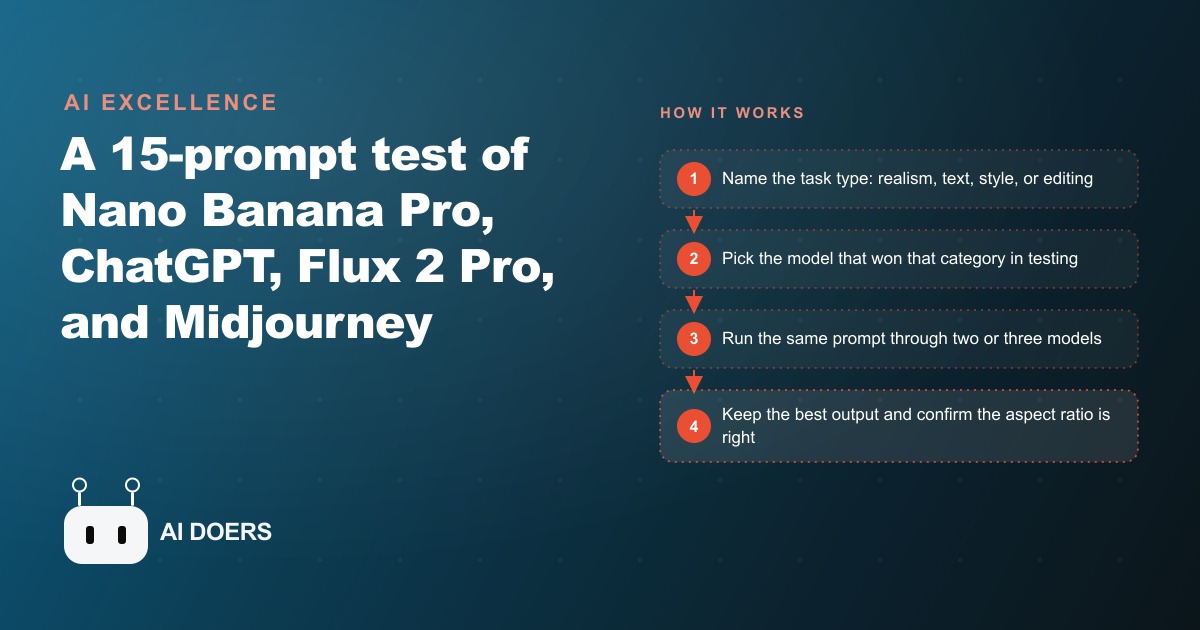
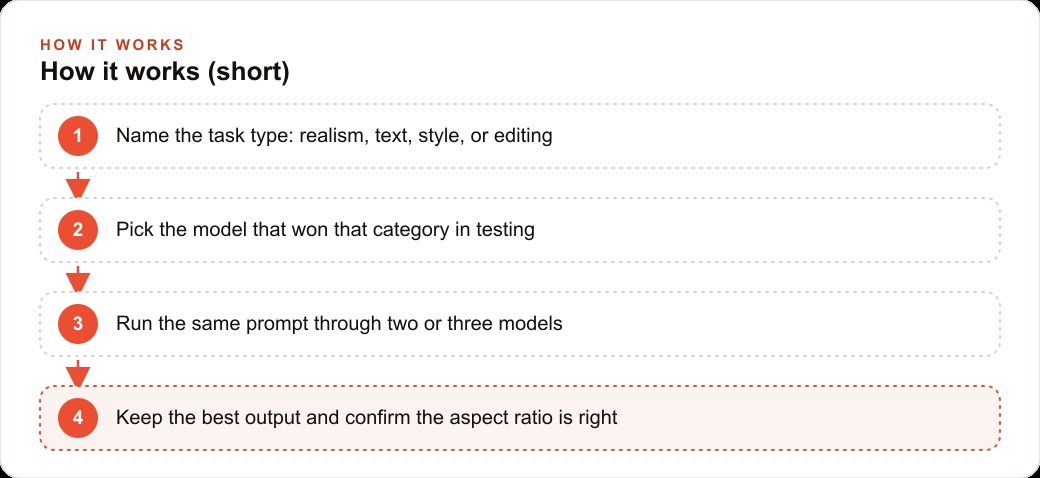
The practical takeaway is not to crown a favorite and use it for everything. It is to build a short shelf you switch between by task. Reach for Nano Banana Pro on realism, character consistency, and any graphic where text must be perfect. Reach for Flux 2 Pro on style transfer, complex scenes, and edits to an existing creative. Keep Midjourney for cinematic product and architecture frames. And before any thumbnail or ad work, verify the model can hold the aspect ratio you need, because that single check saves the most rework.
The second habit is cheap insurance: run the important prompts through two or three models and keep the best output. The cost of doing that is a few extra minutes and a few cents. The cost of publishing a weak creative is a whole underperforming campaign. When the models are this close and their strengths this specialized, the smart operator does not bet on one, they audition a few and pick the winner per job.
A worked example: a med spa that ships a week of content from prompts
Picture a single-location med spa that used to spend on a quarterly photoshoot and still ran short of fresh imagery every month. The owner wants a steady stream of on-brand visuals without booking a studio. Here is how the per-task shelf plays out, with illustrative numbers.
For treatment-room and lifestyle imagery, the studio leans on Nano Banana Pro, because realism and natural lighting are what make a clinic look credible, and its character consistency lets the same model face appear across a relaxed coffee-shop shot, a poolside glow shot, and an in-clinic shot while staying recognizable. For the monthly promo graphic where the offer headline has to be spelled correctly, Nano Banana Pro again handles the text cleanly. When a promo just needs last month's offer text swapped on an existing creative, that job goes to Flux 2 Pro, which edits the text and holds the layout instead of redrawing the whole thing. For the hero product shot of a new device or serum, Midjourney gives the most polished frame.
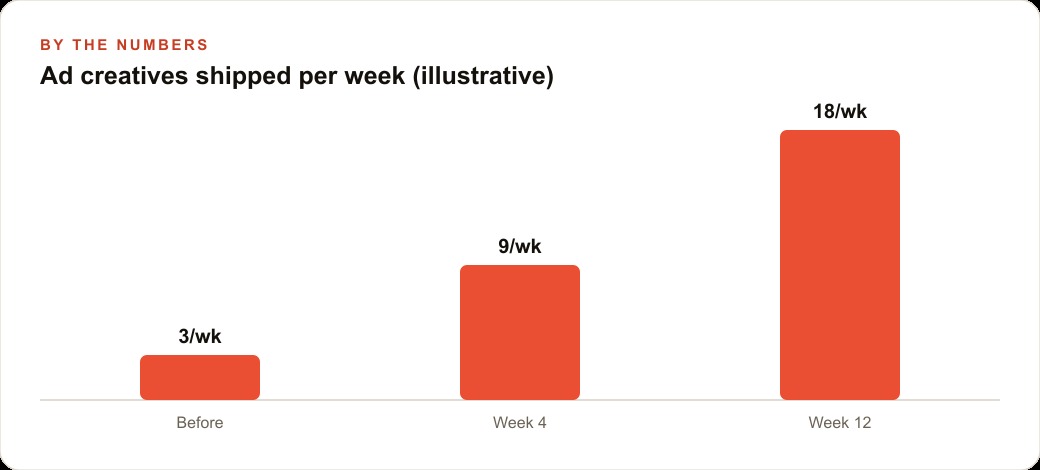
Before any of it hits Instagram, the aspect ratio is locked first, then the prompt runs through two models and the better frame wins. Say the spa was shipping around three finished creatives a week under the old photoshoot model. Within a month of running the shelf, that climbs toward nine a week, and by the twelfth week it is closer to eighteen, because the marginal cost of one more image is a prompt, not a booking. The images do double duty too: the same library that feeds paid social also props up the clinic's website and SEO and organic search pages, so a blog on a treatment can carry custom visuals instead of stock. And every lead that clicks from one of those creatives lands in the CRM and website stack, where follow-up handles the next several touches automatically.
The financial shape is straightforward. If a photoshoot ran a few thousand dollars a quarter and produced a fixed batch of shots, the model shelf costs a fraction of that per month and produces an effectively unlimited stream, with the owner's time as the only real input. Frame the return as illustrative rather than guaranteed, but the direction is not in doubt: more creative variety, lower cost per asset, and faster testing on paid channels.
The bigger shift: photography budgets are turning into prompt budgets
Step back from the scoreboard and the more important change is what this test says about where visual-content money is headed. For a decade, a small business that wanted professional imagery had exactly two options: pay a photographer and a designer, or settle for stock that looked like everyone else's. This shootout quietly announces a third option that is now good enough for most commercial work. When a model can produce an 85mm portrait indistinguishable from a real photo, keep a character consistent across three locations, and spell a headline correctly, the reasons to book a studio shrink to a specific list rather than a default habit.
That does not mean photography dies. It means it gets reserved for the moments that genuinely need it: a hero product the customer will scrutinize, a founder's real face, an authentic before-and-after where trust depends on it being real. Everything else, the endless supporting imagery that social feeds and ad tests devour, moves to prompts. The budget does not disappear, it changes shape. Instead of a few thousand dollars a quarter buying a fixed batch of shots, a fraction of that per month buys an effectively unlimited stream, and the constraint becomes the operator's taste and time rather than the shoot schedule.
There is a competitive angle here that is easy to miss. The businesses that adopt the per-task model shelf early get to test far more creative variations than their competitors, and in paid media, variation is leverage. The advertiser who can ship eighteen distinct creatives a week finds winning angles faster than the one shipping three, and finding a winner is what actually lowers cost per lead. So the shootout is not just a fun ranking, it is an early signal of a widening gap between businesses that treat image generation as a novelty and those that treat it as a production line.
The catch, and the reason the "per-task shelf" advice matters so much, is that this only works if you respect what each model cannot do. An operator who picks one tool for everything will keep hitting the failure modes the test exposed, wrong aspect ratios from one model, mangled text from another, whole subjects redrawn when they only wanted an edit. Those failures are not rare edge cases, they are the exact places commercial work lives. The winner in this new world is not the business with the best single model. It is the business with the discipline to route each job to the model that already proved it can do that job, and to verify the output before it ships. That discipline is cheap to build and expensive to skip.
What to actually do with this
The four-model test did not hand you a single tool to buy. It handed you a map. Google Nano Banana Pro is the new default for anything that has to look real or read cleanly, Flux 2 Pro is the specialist for creative range and editing, and Midjourney remains the choice for cinematic frames. The one non-negotiable habit for anyone doing ad work is to confirm aspect ratio control before you commit, because a model that fails there fails at the exact moment it costs you money.
If you would rather skip the trial and error and have a clean per-task workflow with a set of reusable, on-brand prompts handed to you, so every post and ad comes out consistent, that is a system a specialist can stand up quickly. Either way, the lesson from the shootout stands. The best AI image model is not a fixed answer. It is whichever one wins the prompt in front of you, and knowing that in advance is the whole edge.
That is exactly what we do at AI DOERS. Book a private 30-minute call with Madhuranjan Kumar and we will map the fastest path to it for your specific business.
Book your call →
Madhuranjan Kumar
Madhuranjan Kumar brings 20 years of performance-marketing experience and has managed over $200 million in Facebook ad spend for brands across the United States and beyond. His expertise spans the full modern marketing stack: Meta, Google Ads, TikTok, email automation, CRM, and the websites that hold it together. At AI DOERS he turns that track record into lead-generation systems for businesses across every industry.