
How to Build an AI Newsletter Digest That Reads 15 Newsletters and Sends You One
N8N plus Google Gemini can replace your morning newsletter routine with a single daily email. Here is how to build it and why it matters for professional service businesses.

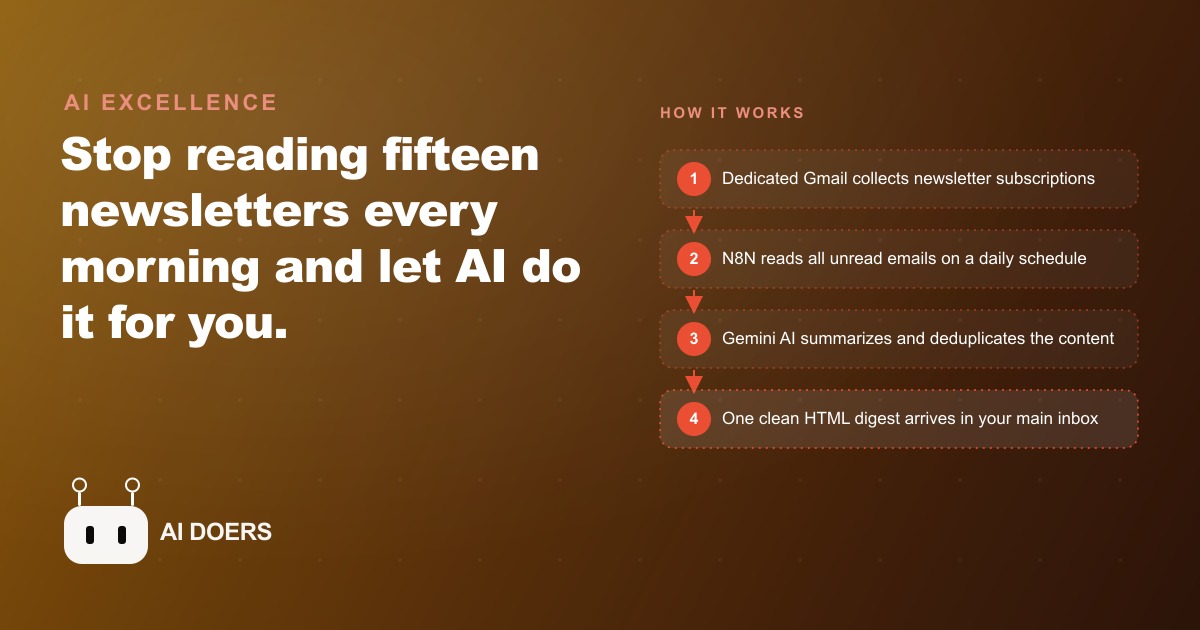
Every morning, a stack of newsletters sits unread in the inbox of a tax advisor, representing two things: essential professional intelligence and an impossible reading burden. Fifteen newsletters. Forty-five minutes of reading time before the first client call. Spread across ten partners at a mid-sized accounting firm, that is seven and a half hours of professional reading time consumed before billable work starts. Most of it covers the same three news items, just with different framing. The solution I use for clients is an automated digest that reads every newsletter, ranks the news by how many sources covered it, and delivers one email per day. This is how to build it.
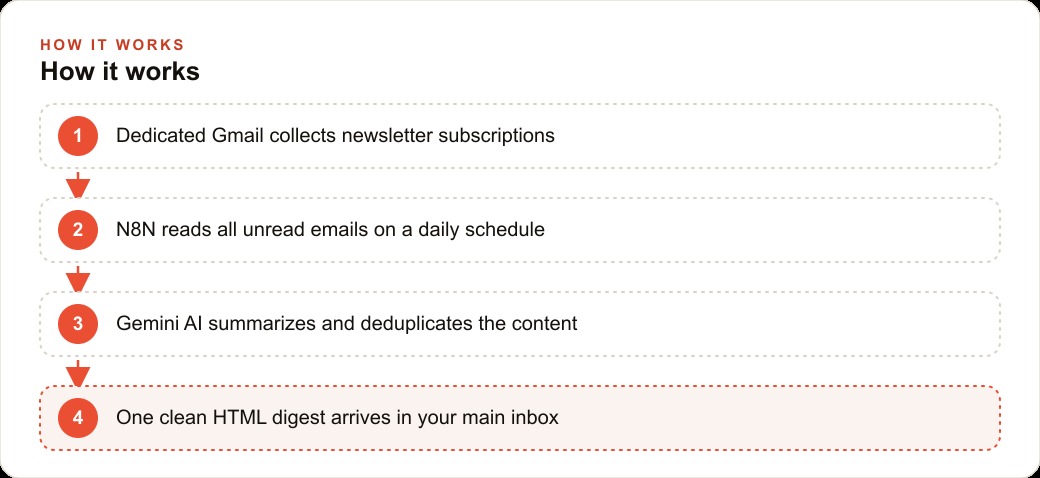
I, Madhuranjan Kumar, have set up this workflow for professional services firms and solo practitioners alike. The architecture is the same in both cases: a dedicated inbox, an N8N workflow, Google Gemini for the AI summarization, and a clean HTML email delivered to the right inbox on a schedule. The entire system costs under fifteen dollars a month to run and scales from one newsletter to two hundred without any changes to the workflow. Here are the seven specific things that make it work.
The dedicated inbox: subscriptions that never touch your main email
The first and most important architectural decision is the dedicated Gmail account that exists only to receive newsletters. No personal emails. No client messages. Just subscriptions.
This separation matters for two reasons. First, the N8N workflow reads every unread message in the inbox and processes it. If personal emails land there, they get sent through the AI summarization step along with the newsletters, which is both a privacy risk and a quality problem. Second, the dedicated inbox is what makes adding new sources effortless: when you find a newsletter worth following, you subscribe with the dedicated address and the next day's digest includes it automatically with no changes to the workflow.
Setting up a new Gmail account takes three minutes. Subscribing every relevant newsletter takes an afternoon. After that, the inbox requires no maintenance. New content shows up automatically. Old content gets marked as read by the workflow and never appears twice. The inbox is a passive collector that does exactly one job.
For a professional services firm, the source list for the dedicated inbox is typically built in two steps: start with the publications everyone already knows and reads manually, then add the secondary sources that would be valuable but never get read because there is not enough time. The digest changes the calculus. When reading everything costs five minutes instead of forty-five, the secondary sources become worth including.
Rank by coverage frequency, not by newsletter prestige
The most useful design decision in the AI summarization step is having the model rank news items not by which newsletter is most authoritative or most well-known, but by how many of the newsletters covered the same story.
A story covered by eight of your fifteen sources is almost certainly more significant than a story covered by one. Cross-newsletter frequency reflects aggregate editorial judgment, which is a better signal than any single publication's prominence. The IRS guidance change that every newsletter covered today is more important to brief on than the think piece that one prestigious publication featured exclusively.
Gemini's system prompt instructs it to extract every news item, eliminate duplicates when the same story appeared in multiple publications, rank the remaining items by how many newsletters covered them, and include a source citation for each. The output is a ranked list where the most broadly covered news appears first, and single-source stories appear later in the digest without false promotion.
This ranking logic also handles the situation where one newsletter gets a story wrong or frames it misleadingly. When twelve other newsletters cover the same story with different framing, the AI synthesizes across them, and the synthesis naturally reflects the consensus framing rather than the outlier. The digest becomes more reliable than any individual source in your reading list.
For businesses tracking competitor activity, the same ranking logic surfaces genuinely widespread market developments while filtering out single-source speculation. A development covered by one niche publication might be noise. The same development covered by twelve sources simultaneously is a signal worth acting on.
Gemini's million-token context window: the reason smaller models fail here
The aggregated content from fifteen or twenty newsletters, each with full article text, adds up quickly. A typical newsletter runs fifteen hundred to three thousand words. Fifteen newsletters means twenty-two thousand to forty-five thousand words of content that needs to be processed in a single AI pass.
Most smaller AI models do not handle this volume well. They lose track of content from the earlier newsletters by the time they are processing the later ones. The summaries become thin or start missing items from the first half of the input. The digest gets unreliable precisely on days with many active sources, which is when it needs to be most reliable.
Gemini's large context window handles this volume without degradation. The entire aggregated content from the day's newsletters arrives in one pass and Gemini processes it with full recall of everything that came in. That is the specific technical capability that makes this particular design work at scale. A digest built on a smaller model would either need to process newsletters in batches, which loses the cross-source ranking, or would produce lower-quality summaries on days with many active sources.
Accessing Gemini through its API is what allows N8N to route the content through it programmatically. Google provides three hundred dollars in free API credits when creating a new account, and the daily digest run costs a fraction of a cent in API usage. A year of daily digests across fifteen newsletters typically costs under five dollars total in Gemini API charges.
For businesses already managing SEO and organic search content production, the same Gemini API access can be used to summarize competitor content and identify topic gaps, using the same large context window that handles the newsletter aggregation.
The mark-as-read parallel step that prevents tomorrow's duplicate flood
The most common workflow error in newsletter digest setups is skipping the mark-as-read step. The workflow reads today's newsletters and summarizes them. The next morning it reads the inbox again and finds both yesterday's newsletters, now old, and today's new ones. Every day, the digest grows longer by the previous day's content, and within a week the AI is summarizing content from six days ago alongside today's news.
The fix is a parallel Gmail node that marks every processed email as read at the same moment the main workflow is reading it. Not after, in parallel. If you mark them as read after the main processing step, there is a window where a workflow failure would leave them unread and they would appear in tomorrow's run. Running the mark-as-read step in parallel means it executes at the same time as the read step, regardless of what happens downstream.
This is one of those details that seems small until it breaks. A digest that has been running correctly for two months will suddenly produce a massive email covering three weeks of news if the mark-as-read step was ever incorrectly configured. Building it correctly from the start is much simpler than debugging it after the fact.
The same principle applies to any workflow that reads from an inbox and needs to avoid processing the same messages twice. The parallel execution pattern is reusable: whatever node reads the content, a sibling node that marks it as processed should run at the same time, not sequentially after.
Retry logic: how to stop losing your digest to a 30-second API timeout
Cloud AI APIs time out. It does not happen often, but it happens, especially under high load in peak hours. A workflow with no retry logic fails silently when the Gemini API times out: N8N logs an error, the workflow stops, and you simply do not receive your digest that day. If the failure happens several days in a row during a busy period, you might not notice for a week.
Setting the retry count to three with a five-second wait between attempts handles the vast majority of transient failures automatically. Most API timeouts resolve within a few seconds, so the second or third attempt succeeds and the digest arrives on schedule. The workflow does not need a human to monitor it; it self-heals from common transient failures.
The same retry logic is worth applying to the Gmail OAuth step, which occasionally produces authorization errors after token refresh issues. Three retries with a short wait handles these automatically as well. Building retry logic into every external API call is a general principle for any automation that needs to run reliably without human monitoring. A digest that fails once a month and requires manual intervention is a digest you will eventually stop running.
Sponsor extraction: a free competitive intelligence side effect
The same AI pass that extracts and ranks news items can extract a second output: the list of every advertiser and sponsor mentioned across all the newsletters. Most professional newsletters carry sponsorships, and those sponsorships reflect active spending by companies trying to reach a specific professional audience.
For a tax advisory firm, the list of companies advertising across their fifteen accounting and tax newsletters is a real-time view of who is spending money to reach accountants. Software companies launching new accounting features, financial product providers targeting professional investors, compliance training vendors expanding their market: all of them show up in the sponsor list before they appear in any competitive intelligence report.
This output requires one additional instruction in the Gemini system prompt: after extracting news items, extract every sponsor or advertiser mentioned in any newsletter, deduplicate across newsletters, and list them with the newsletter they appeared in. The sponsor list arrives in the same email as the news digest as a short separate section, requiring no extra workflow steps and no additional cost.
For firms managing a CRM and website stack to track prospect activity and market intelligence, the sponsor list is a useful automated input that updates daily without any human curation. A competitor that starts advertising heavily across your industry's newsletters is a signal worth capturing early.
Self-hosting N8N for $15 a month instead of per-run pricing
N8N offers a cloud-hosted version with per-workflow or per-execution pricing. For a digest that runs once daily with moderate complexity, the cloud version is affordable, but the self-hosted version running on a virtual private server eliminates the per-execution cost entirely for around ten to fifteen dollars per month in server costs.
The self-hosted setup is more appropriate for firms that plan to build multiple automations, not just the newsletter digest. Once N8N is running on a server, every new automation workflow runs on the same infrastructure at no additional cost. The economics improve significantly at scale: five automations running daily on a fifteen-dollar server cost the same as one automation running on a fifteen-dollar server. The fifth automation is essentially free.
The technical setup for a self-hosted N8N instance is accessible to anyone comfortable with a virtual private server. Several hosting providers offer one-click N8N installations that have the instance running in under ten minutes. The Gmail OAuth configuration is the most technically involved step and is documented step by step in the N8N documentation. Following each step precisely saves several hours of debugging.
For organizations already running a Facebook and Instagram ads operation with an automated reporting workflow, self-hosting N8N provides a single platform to run both the newsletter digest and the ads reporting automation on the same infrastructure, reducing total operational complexity.
A worked example: ten partners, fifteen sources, six hundred recovered hours
An accounting firm with ten partners and around fifty business clients subscribes each of their fifteen primary information sources to a dedicated Gmail address. Sources include the AICPA news feed, IRS Newswire, Thomson Reuters tax updates, Journal of Accountancy, CPA Practice Advisor, state CPA society communications, and the primary accounting software vendor blogs.
The N8N workflow runs at 3 PM each weekday. By 3:15 PM, every partner has received the day's digest in their personal inbox. The digest covers the significant news across all fifteen sources, ranked by how many covered the same story, with a short sponsor section at the bottom.
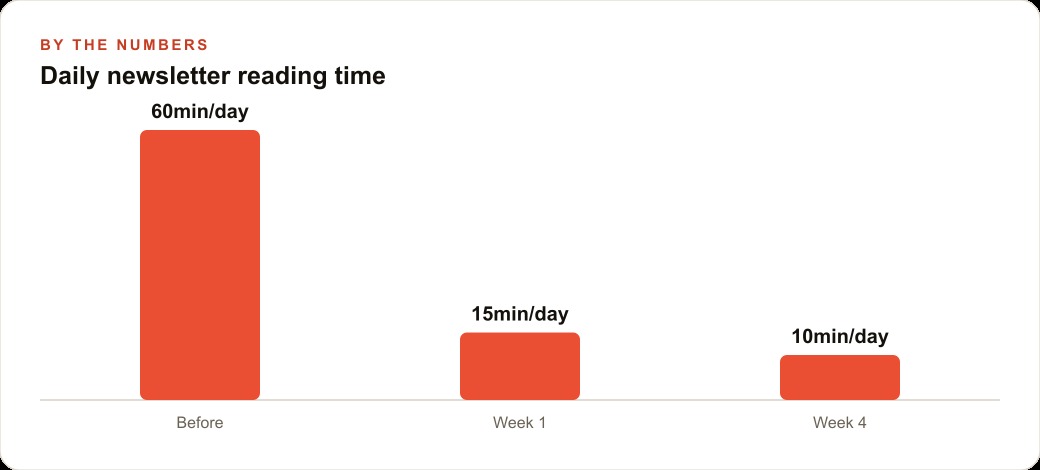
Before the digest, each partner spent an average of forty minutes per morning on newsletter reading across their individual subscriptions. After the digest, each partner spends eight minutes reading it before their first client call. Time recovered per partner per day: thirty-two minutes. Across ten partners and twenty working days per month: six hundred forty person-hours per month.
Even converting half of that time to additional client work at a modest billing rate produces a return that far exceeds the fifteen dollars per month in server costs and the negligible Gemini API charges. The quality benefit is harder to measure but equally real: partners briefed from the same sources on the same ranking make more consistent recommendations and catch regulatory changes at the same time rather than on a distributed schedule that depends on individual reading habits.
The firm identifies one immediate practical benefit in the first month: when a significant IRS guidance document drops that affects quarterly tax planning for several clients, every partner knows about it the same afternoon because the story appears at the top of that day's digest, covered by eleven of the fifteen sources. The previous workflow would have surfaced it at different times for different partners depending on which newsletters each one happened to check that week.
The automation pays for itself on the first significant story that every partner catches simultaneously. At fifteen dollars a month to run, the server cost is recovered in the first morning every partner saves ten minutes of duplicated reading.
That is exactly what we do at AI DOERS. Book a private 30-minute call with Madhuranjan Kumar and we will map the fastest path to it for your specific business.
Book your call →
Madhuranjan Kumar
Madhuranjan Kumar brings 20 years of performance-marketing experience and has managed over $200 million in Facebook ad spend for brands across the United States and beyond. His expertise spans the full modern marketing stack: Meta, Google Ads, TikTok, email automation, CRM, and the websites that hold it together. At AI DOERS he turns that track record into lead-generation systems for businesses across every industry.