
Microsoft AI CEO Suleyman Says AGI Is Years Away and Software Companies Face Existential Risk. Here Is What Financial Advisors Should Take From That
The CEO of Microsoft's AI division is more direct about AI's business impact than most executives. His framing of which industries face real risk and which face real opportunity is directly relevant to financial advisors managing client portfolios and their own practices.

Who is Mustafa Suleyman and why should financial advisors pay attention to what he says?
Mustafa Suleyman is the CEO of Microsoft AI and a co-founder of DeepMind, the AI research organization that Google acquired and that has produced some of the most significant AI breakthroughs of the past decade including AlphaFold and AlphaGo. He is not a commentator or analyst. He runs the AI strategy of one of the three largest technology companies in the world, has personal experience building AI systems at the frontier, and has made previous public statements about AI timelines that have been directionally correct.
When Suleyman says something specific about where AI is headed and what it will do to industries, it deserves more weight than a generalist's projection. He is in the room where decisions about Microsoft's Copilot roadmap, Microsoft's relationship with OpenAI, and Microsoft's enterprise AI strategy are made.
For financial advisors, Suleyman's statements are relevant on two levels. First, they inform what advice is appropriate to give clients whose portfolios include software companies, technology companies, or companies in industries that AI is disrupting. Second, they directly affect how financial advisory practices should be planning their own AI adoption.
What exactly did Suleyman say about AGI and hallucinations?
On AGI, Suleyman expressed the view that artificial general intelligence, defined loosely as a system that matches or exceeds human cognitive performance across a broad range of tasks, is on a timeline of years rather than decades. He was not committing to a specific year and was careful to note that definitions matter, but his overall framing was that the current pace of capability improvement makes it likely that systems meeting most reasonable AGI definitions arrive in the near term rather than the distant future.
For a financial advisor, the AGI question is not primarily about science fiction scenarios. It is about the realistic planning horizon for client portfolio companies and industry sectors. If a client holds significant positions in software companies that sell workflow automation software, and AGI-adjacent systems can perform those workflows without licensed software within five years, that is a portfolio risk worth quantifying now rather than after the market prices it in.
On hallucinations, Suleyman pushed back on the framing that hallucinations are an inherent limitation of large language models. His position is that hallucination is an engineering problem with active and promising solutions, including retrieval-augmented generation where the model retrieves verified facts from a database rather than generating them from training data, and constitutional AI approaches that constrain outputs to verifiable claims. He expressed confidence that hallucination rates for domain-specific professional applications will decrease to professionally acceptable levels within a reasonably short timeframe.
For a financial advisor using AI for research or communication, this is the forward-looking context: the hallucination problem that makes AI outputs unreliable for specific factual claims right now is being actively addressed. Current AI tools require verification for specific factual claims. Future AI tools in eighteen to thirty-six months will require less verification for the same category of tasks. Build the verification habits now; you will be able to relax some of them later as the tools improve.
What does Suleyman mean when he says software companies face existential risk?
Suleyman's point about software companies is specific and worth unpacking. Traditional software creates value by encoding a workflow into code that automates what humans would otherwise do manually. A CRM system encodes the workflow of tracking customer interactions. A project management tool encodes the workflow of coordinating team tasks. The software creates value because the encoded workflow is valuable, and users pay for access to the encoded workflow.
AI systems are increasingly able to perform workflows without the encoding step. Instead of purchasing specialized software that encodes a specific workflow and learning to use that software, a user can describe the workflow to an AI in natural language and have the AI perform it. The software's moat, its specific encoded workflow and the user data it accumulates, is undermined by AI systems that can replicate the workflow on demand.
For a financial advisor managing client portfolios that include software companies, this is an investment thesis question. Which software companies have moats that AI cannot easily replicate, and which are primarily workflow-encoding businesses that AI will commoditize? The software companies with defensible positions are those with unique data assets, network effects that require many users to create value, or highly regulated domains where the regulatory environment creates barriers to AI substitution.
Software companies whose value is primarily convenience and workflow encoding without proprietary data or network effects are more exposed. This is a portfolio analysis question worth running systematically for any client with significant software sector exposure.
What is Copilot Actions and what does it mean for Microsoft's enterprise position?
Copilot Actions is Microsoft's enterprise AI agent feature within Microsoft 365. It allows users to define multi-step automated workflows that Copilot carries out autonomously within the Microsoft 365 ecosystem: creating and sending emails, generating documents from templates, updating spreadsheet data, summarizing meeting notes, and scheduling follow-ups.
The strategic significance is that Microsoft 365 is the operating environment for the majority of knowledge workers globally, and Copilot Actions turns that environment into an AI-agentic platform where routine multi-step tasks are performed by AI rather than by humans. For a financial advisor who uses Microsoft 365, Copilot Actions is the nearest-term enterprise AI tool that will appear in their existing workflow without requiring adoption of a new platform.
Practical early applications for a financial advisor: setting up a Copilot Action that generates a weekly portfolio summary from a spreadsheet of holdings and sends it to the relevant client email list, automating the generation of meeting preparation documents from calendar entries and CRM contact data, and creating a document review workflow that flags specific clause types in contracts for human review.
Copilot Actions is in staged enterprise rollout rather than universally available, but it is worth identifying whether your Microsoft 365 license tier includes early access and beginning to experiment with it for one or two high-value automation targets.
Which financial advisory tasks are most exposed to AI displacement according to Suleyman's framework?
Suleyman's framework for job displacement focuses on tasks where the primary value is information processing, analysis, and decision support rather than physical presence, relationship management, or highly contextual judgment. Applied to financial advisory specifically, this maps to specific task categories.
High information processing, lower relationship: research synthesis, portfolio analysis, regulatory document review, performance reporting, tax optimization modeling, and compliance documentation are all primarily information processing tasks. AI tools already assist meaningfully with these, and Suleyman's timeline suggests they will handle them more autonomously within two to four years.
Higher relationship, lower AI substitution: ongoing client relationship management, needs discovery, behavioral coaching during market volatility, estate planning conversations that require understanding a family's values and dynamics, and crisis communication during financial emergencies are relationship-dependent tasks where AI plays a supporting role rather than a substituting role.
The practical implication for a financial advisor's own practice positioning is to shift time away from information processing tasks toward relationship-intensive tasks. Not because the information processing tasks stop being done, but because AI handles them more efficiently while you apply your time where you are most irreplaceable.
How would a financial advisor practice use AI to shift time toward relationships?
Here is a specific practice example for a fee-only financial advisor with forty clients under management, average relationship size of $750,000, and two staff members.
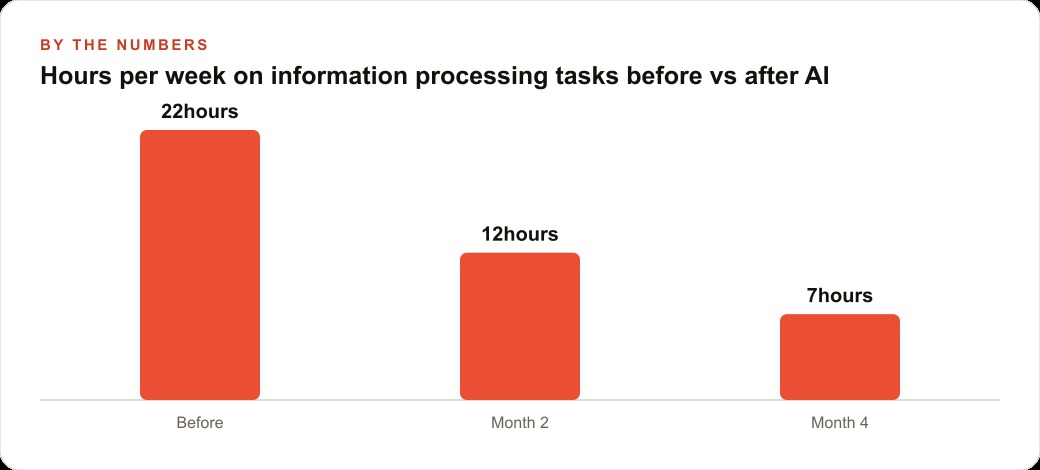
Current time allocation: roughly 40 percent of advisor time goes to information processing tasks including quarterly report preparation, research on client questions, portfolio rebalancing analysis, and regulatory documentation. 60 percent goes to client-facing activities including meetings, phone calls, and email communication.
With AI integration at the information processing layer, the target allocation shifts: 20 percent of advisor time on information processing with AI handling first passes, 80 percent on client-facing activities. The recovered twenty percent of advisor time, roughly eight hours per week, is redirected to either deeper engagement with existing clients or capacity to take on new clients without adding staff.
At an average revenue of $7,500 per client per year in advisory fees, taking on five additional clients with the recovered capacity adds $37,500 in annual revenue without proportional cost increase. Against the AI tool cost of approximately $100 to $200 per month for the tools needed to automate the information processing layer, the ROI is over 150x.
Specific tools: Claude or ChatGPT Plus for research synthesis and document drafting. Perplexity Pro for real-time research on client questions about market events, economic news, or specific holdings. Microsoft Copilot with Copilot Actions for workflow automation within the existing Microsoft 365 environment. A specialized financial planning AI if the practice uses comprehensive financial planning software that has integrated AI features.
What mistakes should financial advisors avoid with AI tools in a regulated industry?
The first and most important mistake is using AI-generated content for specific investment recommendations without proper disclosure and verification. AI tools can assist with research and communication drafting, but regulatory obligations for investment advice remain with the licensed advisor. AI output that includes specific securities recommendations, risk assessments, or suitability determinations requires the same compliance review as any advisor-generated recommendation.
The second mistake is using AI tools to handle client communication in ways that change the disclosure requirements for AI-generated content under applicable FINRA, SEC, or state regulations. Check current regulatory guidance for AI use in client communication before deploying automated AI responses to client inquiries.
The third mistake is not creating a clear internal policy about which AI outputs require human review before use with clients. The policy does not need to be complex: a simple table of task categories and whether they require no review, advisor review, or compliance review before client delivery is sufficient and creates the documentation trail needed to demonstrate proper oversight.
What should a financial advisor do this week based on Suleyman's framework?
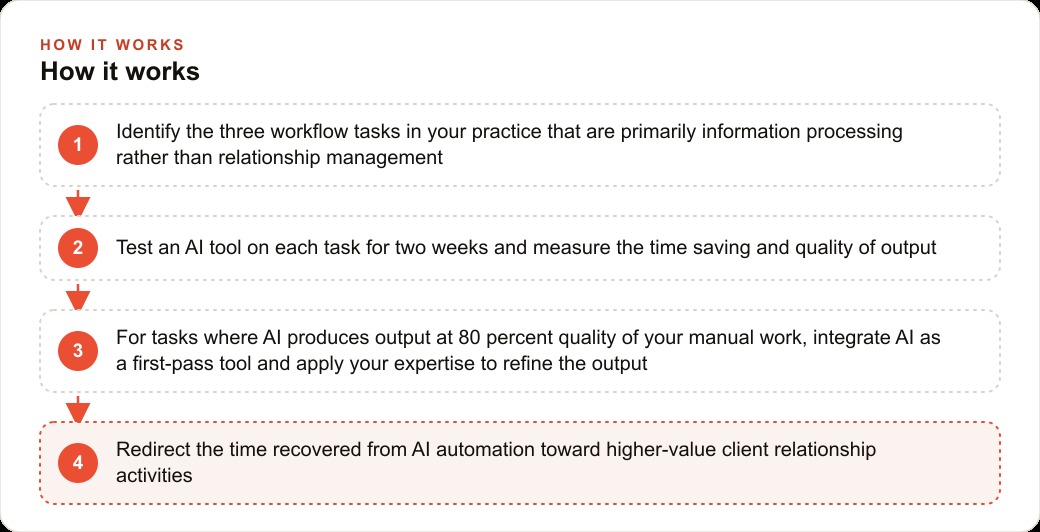
Identify the three information processing tasks in your practice that consume the most time per week. For each task, estimate the weekly hours consumed and the consequence of a quality error: low consequence (routine communication), medium consequence (analysis that informs an advisor recommendation), or high consequence (output that goes directly to clients without advisor review).
Begin testing an AI tool on the lowest-consequence, highest-time-consumption task. Run it for two weeks with your own verification of the outputs. This calibrates your understanding of the AI's accuracy level for that specific task type in your practice context.
This data-driven approach to AI adoption is more durable than adopting AI tools based on general enthusiasm or industry coverage. You are testing specific accuracy and time-saving claims in your own practice context rather than relying on vendor claims.
If you want help designing an AI integration framework for your financial advisory practice that is compliant, operationally sound, and focused on the tasks with the highest ROI, that is a project worth discussing in a structured way.
That is exactly what we do at AI DOERS. Book a private 30-minute call with Madhuranjan Kumar and we will map the fastest path to it for your specific business.
Book your call →
Madhuranjan Kumar
Madhuranjan Kumar brings 20 years of performance-marketing experience and has managed over $200 million in Facebook ad spend for brands across the United States and beyond. His expertise spans the full modern marketing stack: Meta, Google Ads, TikTok, email automation, CRM, and the websites that hold it together. At AI DOERS he turns that track record into lead-generation systems for businesses across every industry.