
How to Build a Multimodal Search Database for Your Business with Claude Code
A new multimodal embedding model plus Claude Code lets you make your documents, photos, and past projects instantly searchable, with the real source attached to every answer.

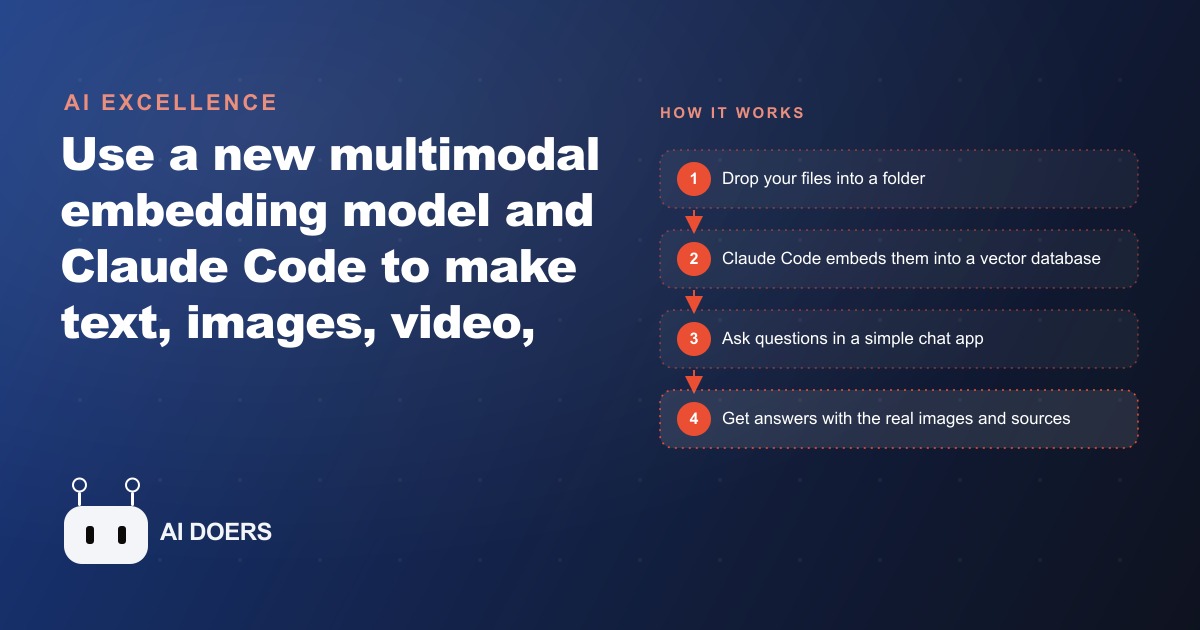
Keyword search has been the backbone of business knowledge management for thirty years, and for thirty years teams have worked around its most obvious limitation: it only finds what you already know to type. A new combination of multimodal embedding models and conversational AI code generation changes that in an afternoon, not a quarter.
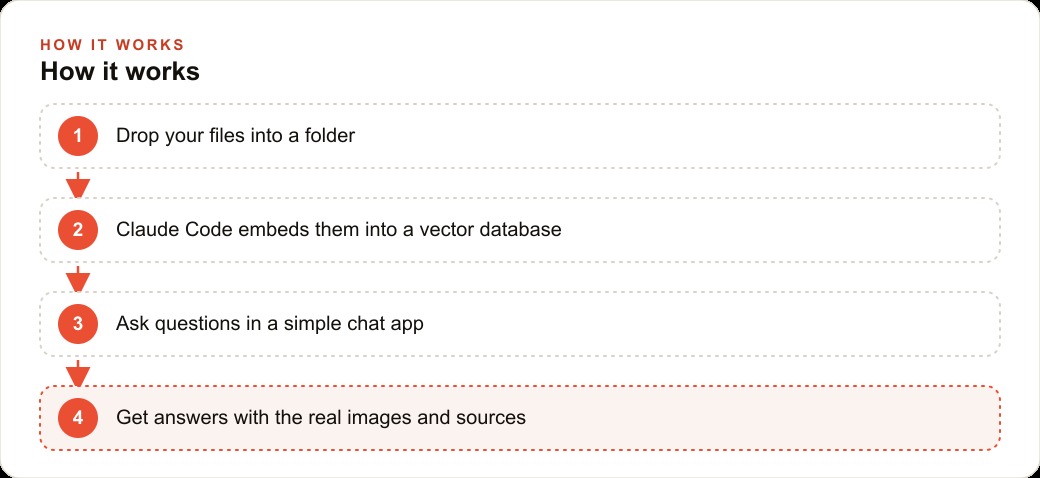
The setup is simpler than it sounds. Every piece of content in your archive -- photos, PDFs, videos, spreadsheets, written notes -- gets converted into a numerical fingerprint called an embedding. Similar things get similar fingerprints and end up sitting close to each other in a shared mathematical space. A multimodal model handles all of those content types in the same space, so a photo of a finished product and a written description of it and a short video clip of the process that made it all end up near each other, because they are about the same thing. When someone asks a question, the system finds the content closest to that question and returns it with real source links and a confidence score.
Claude Code builds the ingestion pipeline from a plain-language description of what you need: chunk the long documents, capture images with descriptions, load everything into the database, wire up the chat interface. What used to be a weeks-long engineering project is now an afternoon build.
Here is what that capability unlocks that keyword search never could.
1. Finding what you forgot you had
Keyword search finds content you can describe. A multimodal archive finds content by meaning, even when you do not have the right words for it. A bakery owner trying to find a past custom cake design does not need to remember whether they tagged it "floral" or "botanical" or "garden party." They upload the customer's reference photo, and the system finds the closest matches from the archive, with the original price, hours, and serving count attached.
This is a fundamental shift from retrieval to discovery. The archive goes from being a place you store things you might need to search for later, to being an active resource that surfaces relevant history automatically. The content that was buried because no one remembered the exact search term becomes findable for the first time.
Businesses that have been accumulating files for years find this particularly valuable. The value was always there in the accumulated knowledge. The access mechanism was the bottleneck. A multimodal search database removes that bottleneck without requiring anyone to re-tag or reorganize what already exists.
2. Answering physical questions with actual images, not just text
The most important thing multimodal search enables for hands-on businesses is the ability to answer a question about a physical thing with a photo of that physical thing. A maintenance technician asking "what does a failing bearing look like before it seizes" does not get a text description. They get an annotated photo from the archive of the last time a bearing failed, tagged with the model number and the date of the repair.
This cannot be replicated with a text-only system regardless of how carefully you write the documentation. Text can describe what a failing bearing looks like. An image shows it. For visual problems -- equipment faults, quality control issues, design comparisons, installation reference -- the image is the primary source of truth, and a system that can retrieve images by meaning rather than by tag makes that truth accessible.
For businesses that run training programs or onboard new staff, the impact is immediate. New team members can ask real questions and get visual answers drawn from actual institutional experience, not generic documentation.
3. Creating shared institutional memory that does not leave when people do
One of the most expensive things that happens when a skilled employee leaves a business is the knowledge that walks out with them. They knew which supplier had the better lead time for rush orders. They knew which design configurations caused problems in the finishing stage. They knew which customer requests required more hours than the estimate suggested. That knowledge existed in their head, not in any system the business can query.
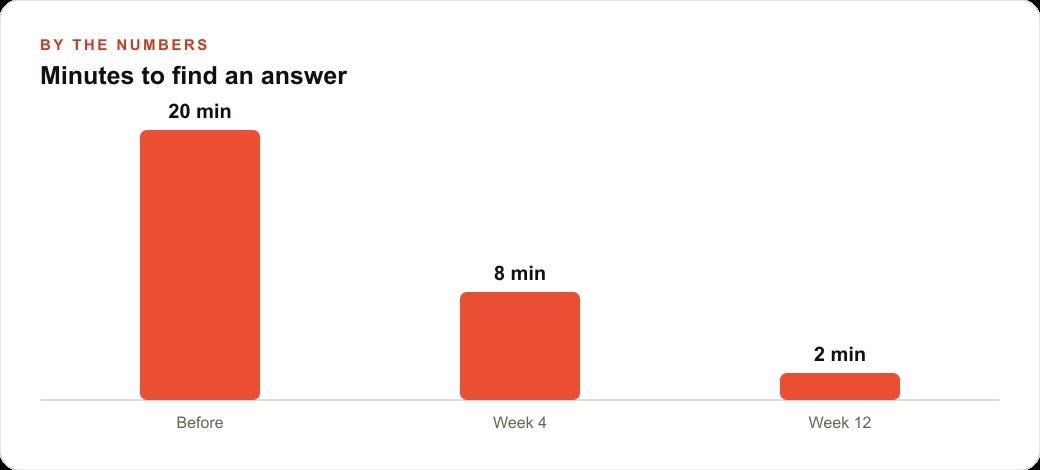
A multimodal search database is how you change that. When that employee uploads photos from each job, writes notes about what worked and what did not, and tags their observations with the relevant context, that knowledge becomes searchable by the next person to work on a similar problem. The archive becomes the memory of the business rather than the memory of individuals.
This has direct value for any business that integrates its CRM and website stack with its operational systems. Customer history, project documentation, and communication records living in the same searchable space means a new account manager can get up to speed on a client relationship in minutes rather than hours.
4. Returning answers with sources and confidence scores, not just guesses
There is a meaningful difference between a system that generates an answer and a system that retrieves relevant content and shows you where the answer came from. The first type of system can hallucinate. The second type can be audited.
A multimodal search database of the second type returns every answer with its source: the specific document, photo, or video clip that the answer was drawn from, along with a confidence score indicating how closely the retrieved content matched the question. A low confidence score tells the user that the archive may not have a good answer for this question, which is more useful than a confident hallucination.
For businesses operating in regulated industries, for businesses whose customers ask questions that carry liability, and for businesses where accuracy of historical data matters, this source-linked retrieval is essential. It means the system's answers can be verified and challenged rather than accepted on faith. It means errors can be traced back to their source and the source can be corrected. This is a different class of reliability than a generative system that synthesizes answers without citations.
5. Processing mixed content types in a single query
Before multimodal embeddings, building a system that could search across text documents, photos, and video required three separate retrieval systems connected by brittle glue code. A query had to run against each system separately, and the results had to be merged and ranked by a process that did not actually understand the content. The result was typically inferior to any one system working alone.
A single multimodal embedding model handles all of those content types in the same space, which means a single query searches across all of them simultaneously and returns a unified ranked result. A question about a product returns the relevant section of the user manual, the installation video, the FAQ entry, and the photo of the installed configuration, all ranked by how closely they match the question.
This matters for businesses running Facebook and Instagram ad campaigns for a product line. The creative team can query the archive for all previous ads that performed well for a specific product category and get back the image files, the copy documents, and the performance notes in a single search. The institutional knowledge about what works for that product category is suddenly organized and accessible.
6. Building the whole system in an afternoon with a plain language prompt
The speed at which this can be built is one of the more surprising things about the combination of multimodal embeddings and AI code generation. The ingestion pipeline -- the code that reads files, generates embeddings, stores them in a vector database, and exposes a search interface -- is not a trivial engineering problem. It used to require a developer who knew embedding models, vector databases, and API design, working across a week or more.
Claude Code builds this pipeline from a plain-language description. You describe what you want: "I have a folder of photos, PDFs, and text notes. I want to be able to ask questions in plain English and get back the most relevant items with their source links and a confidence score." The code generation handles the chunking strategy for long documents, the description generation for images, the database schema, and the chat interface.
The generated pipeline handles edge cases that would slow down a manual implementation: PDF files with embedded images, video files that need frame extraction before embedding, spreadsheets where the relevant content is in specific columns rather than the whole file. Describing those requirements in plain language is faster than writing the parsing code manually, and the resulting system is easier to maintain because the logic matches the description rather than being buried in bespoke file-handling code.
This accessibility changes who can build these systems. A business owner who has been managing a shared folder of files does not need to hire a developer to get a working search system. They need an afternoon and a clear description of what they have and what they want to find. The implementation follows from the description.
7. Turning the archive into a competitive operational advantage
Every business that has operated for more than a few years has accumulated an archive worth searching. The bakery has photos of every custom cake it has made, with client notes, pricing history, and production notes in the same folder. A florist has photos of every arrangement with the flower varieties, the occasion, and the price. A contractor has photos of every job with the materials list, the hours, and the client feedback.
That archive is a competitive advantage that most businesses are not using because they cannot search it effectively. Keyword search gets them to the right folder if they remember what they called the project. Multimodal search gets them to the right photo if they show the system a reference image, and returns the attached cost data and production notes along with it.
For the bakery, this is concrete: a customer brings in a photo of a three-tier cake with hand-painted flowers and asks for a quote. The staff member uploads the photo to the search interface. The system returns the five closest past cakes with their actual production hours, ingredient cost, and final price. The quote is based on real data from comparable work rather than an estimate from memory. The margin is more accurate. The promise to the customer is more realistic.
For SEO and organic search, a multimodal archive also changes what can be published. A business that can instantly surface its most visually compelling past work, tagged with relevant metadata, has a content library ready to turn into case studies, portfolio pages, and comparison pieces without any manual curation work. A lawyer can instantly pull every case document involving a specific clause type. A medical practice can retrieve every before-and-after photo pair for a specific procedure and build a portfolio page in minutes. A real estate firm can find every listing photo featuring a particular architectural detail and group them into a search-optimized gallery.
The depth of historical data also improves pricing. Businesses that price from memory tend to underprice complex work because they remember the outcome but not the hours it took to get there. Businesses that price from a searchable archive of comparable past jobs are pricing from data. That difference accumulates across hundreds of quotes into significant recovered margin over the course of a year.
The underlying technology -- embeddings, vector databases, retrieval-augmented generation -- has existed in research settings for years. What is new is the accessibility. The combination of a multimodal embedding model and a code generation tool that builds pipelines from plain language descriptions means a business does not need a machine learning engineer to stand this up. It needs an afternoon, a folder of files, and a clear idea of what questions it wants to answer.
The archive you have been storing without being able to search is not a liability. With the right tools, it is an asset waiting to be activated. The knowledge has always been there. The search capability is what was missing.
That is exactly what we do at AI DOERS. Book a private 30-minute call with Madhuranjan Kumar and we will map the fastest path to it for your specific business.
Book your call →
Madhuranjan Kumar
Madhuranjan Kumar brings 20 years of performance-marketing experience and has managed over $200 million in Facebook ad spend for brands across the United States and beyond. His expertise spans the full modern marketing stack: Meta, Google Ads, TikTok, email automation, CRM, and the websites that hold it together. At AI DOERS he turns that track record into lead-generation systems for businesses across every industry.