
Multi Model Orchestration: What a Single Routing API Really Buys You
An orchestration API routes one request across several frontier models. After battle testing it on dozens of tasks, here is what it actually delivers and what it costs.

Forty tasks is enough to see a pattern. Over the course of one testing week, Madhuranjan ran every job through two setups in parallel: a routing API that breaks each request across several frontier models, and a single strong model handling the same task alone. The results answered the core question that most developers and owners are quietly sitting with before committing to a more expensive, more complex architecture. Here is what the test showed, chapter by chapter.
The setup: one routing API, one strong single model, the same 40 tasks run in parallel
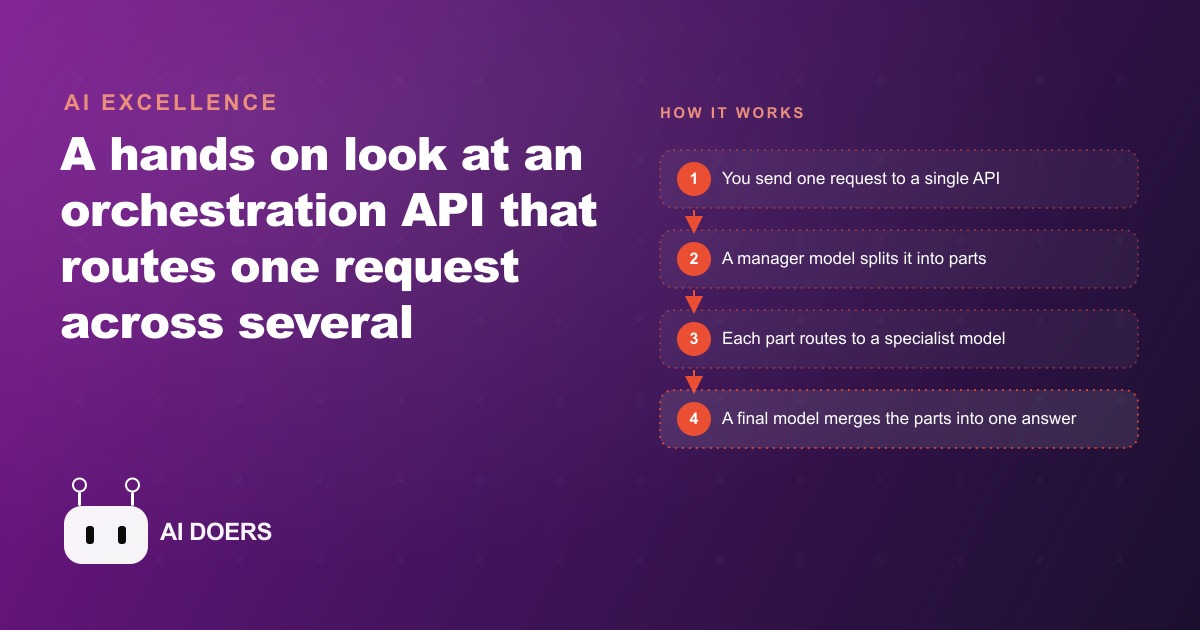
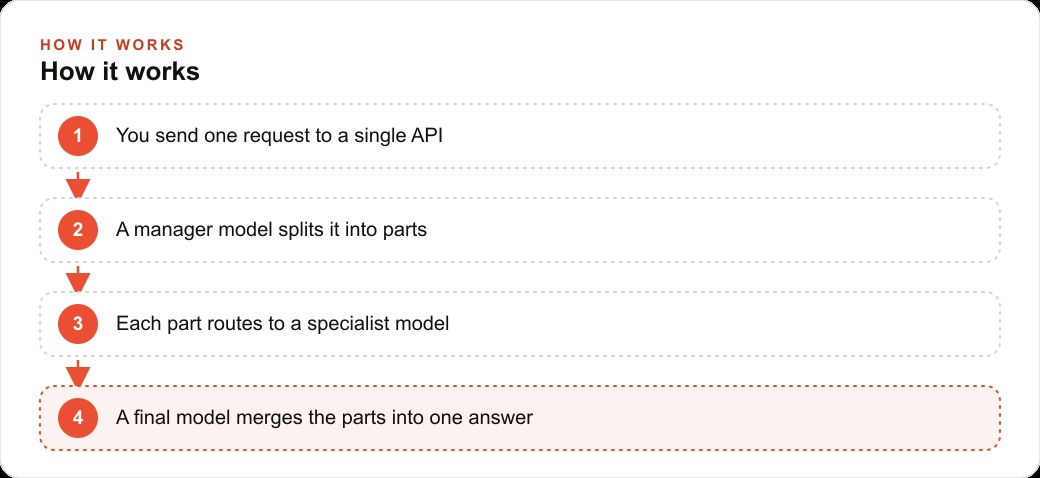
The routing API works by passing your request to a small manager model trained to analyze what a task needs and split it into pieces that go to different specialist models. One piece might route to a model with strong coding output. Another routes to one with better research performance. A third goes to one with more precise writing ability. A final merge step assembles all the pieces into one answer and returns it to you. The pitch is that a team of specialists outperforms a single generalist on tasks that span multiple disciplines.
The comparison setup was deliberately straightforward. Every task was submitted to both systems with identical inputs. The same 40 tasks covered document summarization, code review, market research, customer communication drafts, financial explanation, technical analysis, creative writing, and data interpretation. Each output was graded pass or fail against a clear standard defined before the test began. Speed was logged in seconds per response. Cost was logged in dollars per request. No adjustments were made between runs, and no tasks were excluded after seeing the results. The goal was to see what a real, varied workload looked like across both systems under identical conditions.
The routing API being tested is a real product that passes requests across several frontier models, including some of the most widely used ones available today. The single strong model chosen for comparison is one of the top-performing frontier models on general-purpose tasks. This was not a test designed to make orchestration look bad. It was a test designed to see where each approach actually earns its keep.
How the first two dozen tasks played out
Through the first 24 tasks, a consistent pattern emerged that pushed against the marketing narrative around orchestration. On tasks that fell cleanly within one discipline, both systems performed in the same quality band. A customer email summarizing a billing change came back equivalent from both systems. A code review flagging issues in a Python function came back equivalent from both systems. A summary of a 12-page research report came back equivalent from both systems. In each of these cases, the routing API coordinated multiple models, waited for their responses, and merged the answers. The single model simply answered. The outputs landed at the same quality level.
The extra coordination was not unlocking a measurably better result on these tasks. It was adding steps without adding quality. Two differences were consistent from the first task to the last. The routed system was slower on every single run, sometimes by a few seconds and sometimes by considerably more. And the per-task cost was higher on every routed run because multiple frontier models were being called per request rather than one.
The pass rate through the first 24 tasks was nearly identical for both systems. A small edge went to orchestration on a handful of tasks. A small edge went to the single model on a handful. The large majority tied. The distribution was not what the orchestration pitch suggested would happen on a representative set of real business work.
The specific task types where the routing approach actually pulled ahead
There were exceptions, and they are worth describing precisely because they define the narrow territory where paying the routing premium makes sense. On tasks that genuinely required more than one type of reasoning delivered in the same integrated response, the routed system produced noticeably better results in a meaningful minority of cases.
A task that required retrieving specific factual information, applying mathematical analysis to it, and then explaining the result in plain language for a non-technical reader showed a clear quality gap favoring orchestration. The single model handled each component adequately but the integration between the fact retrieval, the math, and the plain-language explanation was smoother in the routed output. A dedicated model handled each piece and the merge step combined them without the seams showing.
Long-form technical documentation that needed to integrate accurate code examples with precise prose explanation was a second category where orchestration pulled ahead. The single model produced serviceable output but the routed system drew on a dedicated coding model for the code sections and a writing model for the explanations, and the result needed less editing to meet a high standard.
In both cases the key characteristic was genuine cross-disciplinary demand. The task required two or more types of reasoning that different models handle at different quality levels, and it required them integrated into one coherent output. When that condition was met, the routing approach produced a measurable quality improvement. When it was not met, which was more often than not, the single model performed equivalently at a fraction of the cost and in a fraction of the time. Across all 40 tasks, the routed system clearly pulled ahead on roughly 7 or 8 runs. On the remaining 32 or 33, the systems tied or the single model matched closely enough that the difference would not change a business decision.
The speed cost measured across every test
The speed difference was not marginal. Every single run through the routing API took longer than the equivalent run through the single strong model. This held across all 40 tasks regardless of type or complexity. The additional time came from the coordination layer: the manager model analyzing the task, routing pieces to separate models, waiting for each to return, and merging the results. Each step adds latency, and because the steps are sequential, they compound.
On shorter tasks the difference was a handful of seconds. On longer, more complex tasks the routing system sometimes took four or five times longer to return a response. In a testing environment where you evaluate output after the fact, this is tolerable. In a customer-facing tool where someone is waiting for a response, it is a significant experience problem. Users calibrate their tolerance for AI response time to the fastest tools they have encountered. A multi-model orchestration system frequently sits well outside that tolerance window, and the marginal quality improvement does not recover the user experience loss.
For internal tools where a team member can realistically wait several extra seconds for a result, the speed cost is more acceptable. But the cost is always present, and it needs to be measured explicitly against the specific use case before committing to a routing architecture in production.
The cost math: five times the spend for results that were mostly equivalent
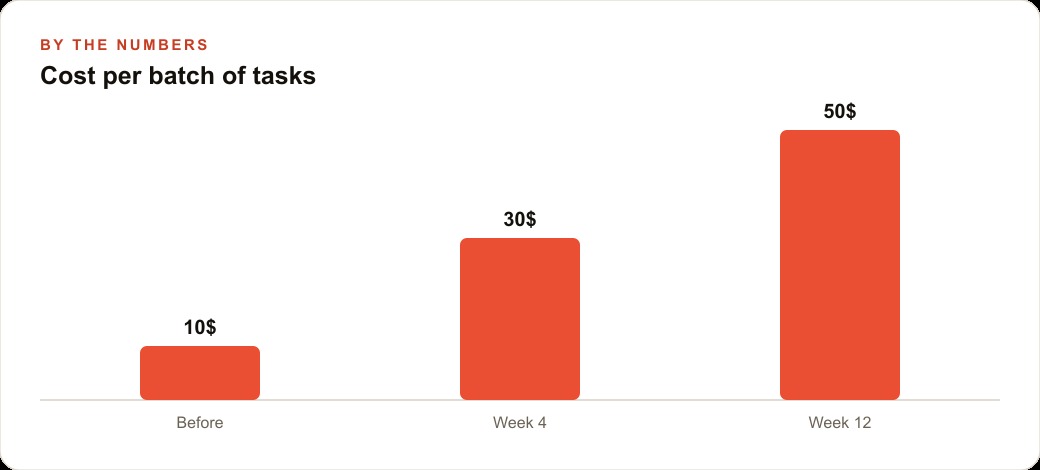
The cost comparison across 40 tasks produced a ratio consistent enough to treat as reliable. Running the orchestration API cost roughly five times as much per task as running the single strong model directly. The difference came entirely from the number of model calls. Each routed task fired the manager model, then the specialist models, then the merge step. Depending on how the manager split a task, that could mean three, four, or five frontier model calls per request rather than one. At frontier model pricing, those calls stack fast.
Across 40 tasks, the aggregate cost difference was substantial. The routed system produced roughly 7 or 8 tasks where quality was measurably better, at a per-task cost that was five times higher across the entire batch. The math does not support the routing approach for general-purpose use at any volume where cost discipline matters.
The cost case for orchestration only works when two conditions are true simultaneously: the task is genuinely cross-disciplinary in a way that no single model handles well, and the quality improvement on those tasks produces enough business value to justify the price premium. For most small and mid-size businesses, those conditions are rarely both met on the same tasks at the same time.
The verdict and the one type of business where paying the routing premium makes sense
The honest verdict from 40 tasks: multi-model orchestration is real technology that solves a real problem, and that problem is narrower than the marketing suggests. On cross-disciplinary tasks at high volume, the routing approach earns its premium. On single-discipline tasks at any volume, it does not.
The type of business where the routing premium makes clear sense is a high-volume operation with genuinely complex, multi-discipline workloads. A large software team using an orchestration API to coordinate planning, code generation, code review, and documentation in a single workflow can reduce manual coordination overhead across hundreds of jobs per day. At that scale and that level of cross-disciplinary demand, the automation is genuinely valuable and the premium is the real cost of the coordination it replaces. The same applies to any operation where tasks genuinely span multiple reasoning types and volume is high enough that the per-task coordination overhead is smaller than what a human coordinator would cost.
For a small or mid-size business running a handful of AI-assisted tasks per day, the math inverts decisively.
Here is how that plays out in concrete numbers. An HVAC company tested whether to use an orchestration API for its technician field-notes-to-customer-summary tool. Technicians write rough notes after each job: abbreviations, half-sentences, part numbers, symptom descriptions, and repair steps. The tool turns those notes into clean, readable customer summaries that explain what was found, what was done, and what the customer should watch for. That task is mostly single-discipline writing with some light technical accuracy requirements.
The test ran 20 real field notes from the past month through both systems. The orchestration API returned a summary in approximately 45 seconds per note and charged approximately $0.50 per note in API costs. The single strong model returned a summary in approximately 9 seconds per note and charged approximately $0.10 per note. Both systems processed all 20 notes without errors.
Three reviewers graded each pair of summaries blind. On 17 of the 20 notes, the two outputs were rated equivalent: both were accurate, both were readable, and the owner would have sent either without editing. On 3 of the 20 notes, reviewers rated the orchestration output marginally better, specifically on two notes with complex multi-system failures and one with an unusual repair sequence that required more careful technical explanation.
The business math: 20 notes per day at $0.10 each costs $2.00 per day or roughly $60 per month in API costs. At $0.50 per note, the same volume costs $10.00 per day or roughly $300 per month. The annual difference is $3,600 versus $720, or $2,880 in extra annual API spend. For 3 notes out of 20 that came back marginally better, that extra annual cost works out to $960 per improved note per year. The improvement on those 3 notes was a smoother description of a complex repair sequence. It was not a difference that resolved a dispute, changed a customer relationship, or generated a referral.
The verdict is straightforward: use the single strong model. Save $2,880 per year. Spend 30 minutes providing the model with 10 examples of high-quality summaries so it handles edge cases better. The routing API is solving a problem this workload does not have at the volume this business runs.
The future skill that actually compounds from all of this is not knowing how to configure a routing API. It is knowing which cheapest model clears the quality bar for each specific type of task your business actually runs. Applied consistently, that judgment reduces cost, simplifies architecture, and positions any business well for how AI pricing evolves over time. Models improve and prices fall. Knowing your quality bar lets you move to cheaper models as they reach it rather than defaulting to the most expensive option available.
That is exactly what we do at AI DOERS. Book a private 30-minute call with Madhuranjan Kumar and we will map the fastest path to it for your specific business.
Book your call →
Madhuranjan Kumar
Madhuranjan Kumar brings 20 years of performance-marketing experience and has managed over $200 million in Facebook ad spend for brands across the United States and beyond. His expertise spans the full modern marketing stack: Meta, Google Ads, TikTok, email automation, CRM, and the websites that hold it together. At AI DOERS he turns that track record into lead-generation systems for businesses across every industry.