
Meta Llama 4's 10 Million Token Context and the AI Benchmark Controversy: What Law Firms Need to Know Right Now
A 10 million token context window means you can feed an entire case file archive into a single AI session. The benchmark whistleblower means you should test the tool yourself rather than trusting published scores. Both matter for how law firms evaluate and use AI.

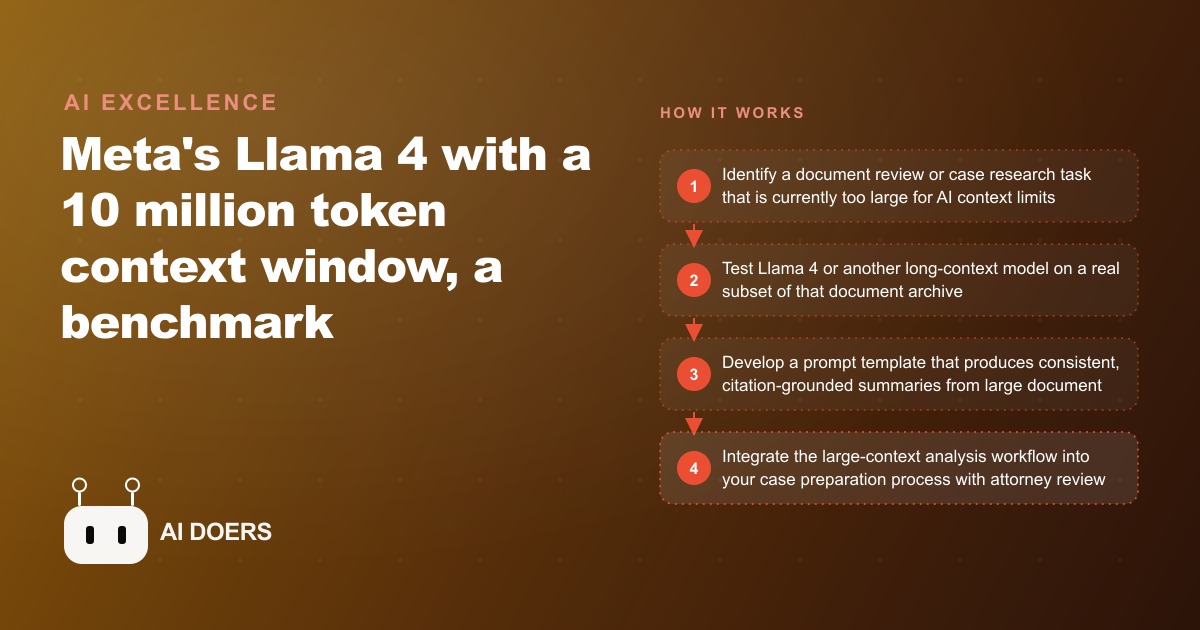
A ten million token window changes what a law firm can hand an AI
I am Madhuranjan Kumar, and a single specification from a week of AI news matters more to a law firm than almost anything else announced: a model arrived with a ten million token context window. A token is roughly three-quarters of a word, so ten million tokens means one AI session can hold and reason over roughly seven and a half million words at once. For scale, the complete works of Shakespeare run about nine hundred thousand words. This window could hold eight copies of that, or, far more usefully for legal work, the document archive of a genuinely large case. I want to take that number apart, pair it with the other story that broke the same week, a whistleblower alleging benchmark contamination, and show how the two together reshape how a firm should evaluate and use AI.
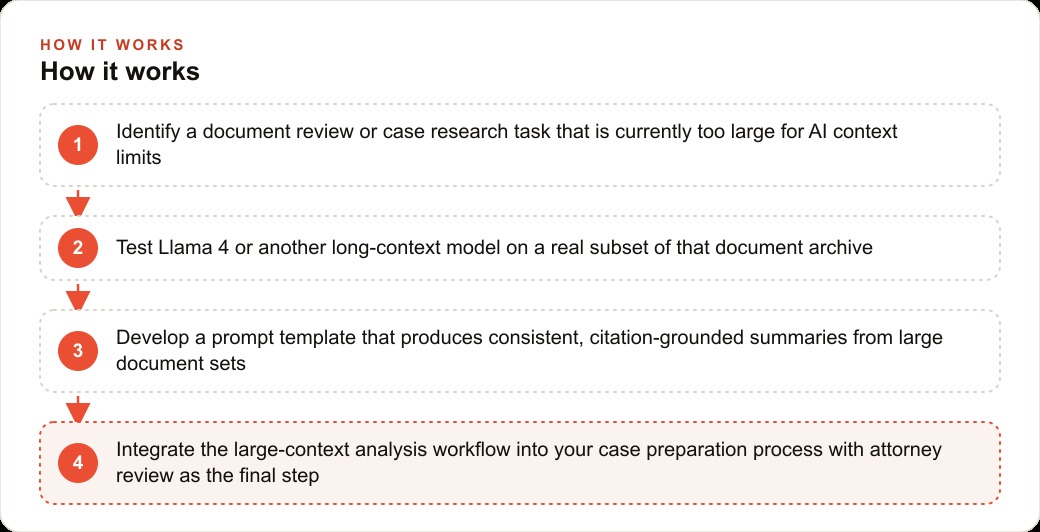
What the size actually buys you, and what it does not
The practical significance is that document review and contract analysis tasks that used to sit beyond an AI's reach are now inside it. A complex commercial matter might involve fifty thousand pages of discovery. Earlier models with a two hundred thousand token window could handle roughly five hundred pages per session, which forced an attorney to slice the archive into pieces and stitch the results back together by hand across many sessions. A ten million token window could, in principle, take the whole archive at once.
But here is the honest limit, and skipping it is how people get burned. You should not actually dump fifty thousand pages into one query. The quality of the analysis degrades when the context is enormous, because the model has to spread its attention across a vast amount of material and starts to lose the thread. What the big window genuinely buys you is the ability to load a five thousand page subset, a manageable slice of even a very large matter, and analyze it comprehensively in a single pass without the manual segmentation overhead. That is a real gain. It is just a different gain than the headline number suggests, and understanding the difference is what separates a firm that uses this well from one that trusts it blindly.
For contract work the value is sharper still. An attorney can load an entire set of related agreements, all the exhibits, schedules, and amendments to a master services agreement, into one session and ask the model to find every provision that references liability limitations, flag inconsistencies between exhibits and the main agreement, and surface any clause that was quietly modified from the standard form without being called out in the negotiation record. That kind of cross-document reading is exactly what a large window makes possible.
The benchmark whistleblower and why it should change your buying process
The same week, a researcher alleged that certain models' published benchmark scores were inflated because the models had been trained on data that included the benchmark test sets, or material closely related to them. Benchmarks are supposed to measure how well a model handles tasks it has not specifically studied. If the training data already contains the answers, the score is not measuring reasoning. It is measuring memorization, which tells you almost nothing about how the tool will behave on your actual work.
For a firm that picks AI tools by scanning a leaderboard and choosing the top score in the relevant category, this is a real problem. If the leaderboard does not track real-world performance, that selection method quietly optimizes for the wrong thing. The correct response is not cynicism, it is direct evaluation. Test the tool on a representative sample of your own legal work rather than trusting published scores. Take three to five real contract review or research tasks from closed matters where you already know the right answer, run the tool against them, and grade it on your known answers. This is the same instinct any good lawyer already has, check the claim against something you can verify, and the benchmark controversy makes that instinct more important, not less.
Two more announcements worth filing away
A few other developments from the same stretch are worth understanding as context, even if they are not tomorrow's deployment. One is a protocol that lets different AI agents and systems talk to each other, delegate subtasks, and coordinate across products from different vendors. For a firm this is mostly infrastructure to be aware of rather than a tool to install. Its real near-term effect is that legal technology vendors can build products that interoperate, so a document review tool built on one foundation can coordinate with a docketing system built on another. When you evaluate tools over the next year, asking a vendor about interoperability support is a sensible forward-looking question.
The other is a wave of AI video editing capability landing in professional editing software, including editing a video by editing its transcript, automatic scene detection, and voice isolation that separates a speaker from background noise. For a firm this touches two places: reviewing and clipping video depositions, where transcript-based editing turns a tedious hunt for timestamps into simple text editing, and producing client-education content, where clean audio separation rescues footage recorded in a noisy office. The transcript-editing feature in particular can cut the time to assemble deposition highlights dramatically. A similar note applies to fast AI image and video generation tools: useful for producing explainer visuals and timeline animations for client education, but any AI-generated depiction of a legal scenario needs careful human review before it goes near a proceeding or an official communication, because a misleading visual is worse than no visual.
A worked example: the mid-size litigation firm
Let me make this concrete with a mid-size firm handling commercial contract disputes, because that is where the large window earns its keep. A typical matter there involves eight thousand to fifteen thousand pages of discovery: emails, contracts, board minutes, financial records, and correspondence.
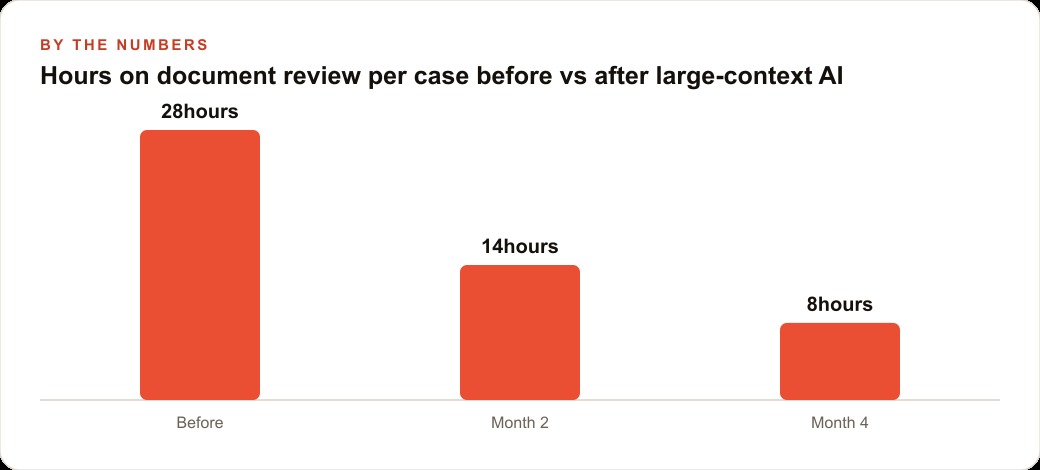
Today, associates spend roughly eighty to one hundred and twenty hours reviewing documents for a standard matter, mixing keyword search with manual reading. At a blended associate rate, that review is a meaningful slice of total case cost. Now introduce large-context AI in a disciplined way. The archive gets organized into thematic batches by document type. Each batch loads into a large-context session with a structured prompt along these lines: you are reviewing documents in a commercial contract dispute, identify and summarize every document that references the following provisions, and for each relevant document give the identifier, the date, the parties, the specific language, and any contradiction or consistency with the contract terms, while ignoring any document with no relevance.
The output is a structured, citation-grounded set that an associate verifies against the original documents, rather than reading every page independently. The work shifts from primary review to verification, which is far faster. The model reads five hundred pages in minutes; the associate confirms its relevance calls in a fraction of the time full reading would take. Framed as illustrative, the document review phase could drop from eighty to one hundred and twenty hours per matter down to roughly thirty to fifty. At a blended billing rate that is a substantial cost movement, which the firm can pass to clients as a competitive edge or keep as margin. The ethical guardrail is fixed and non-negotiable: competence standards require an attorney to review AI work product and verify its accuracy, so the AI pass is a time-saver, never a replacement for the lawyer.
The discipline that separates good use from dangerous use
I want to dwell on one practical point, because it is where firms will either succeed with this or embarrass themselves. A large context window tempts you to be lazy. It whispers that you can stop thinking about how you feed the model, because it can hold everything. That is exactly the wrong lesson. The firms that get real value are the ones that stay disciplined about how they chunk and prompt even though they no longer strictly have to.
The discipline looks like this. Organize the archive into coherent batches rather than a single undifferentiated dump, because a batch of related documents produces sharper analysis than a random pile. Write structured prompts that tell the model precisely what to look for and, just as importantly, what to ignore, so it does not waste attention summarizing irrelevant material. Ask for output in a fixed, checkable format, with document identifiers and specific language quoted, so verification is fast rather than a second reading. And always run the tool first on a matter where you already know the answer, so you can measure its error rate before you trust it on a live one. None of that is required by the technology. All of it is required by good judgment.
The reason this matters so much in law specifically is that the cost of a confident error is not a bad graphic or a wasted hour. It is a missed provision, a mischaracterized document, or a hallucinated citation that finds its way into a filing. The large window does not reduce that risk on its own. The disciplined workflow around it does. A firm that treats the ten million tokens as an excuse to stop thinking will produce worse work than one still stuck at two hundred thousand tokens but working carefully. The tool rewards the careful and punishes the lazy, which is exactly how it should be.
The obligations that sit underneath all of this
None of the efficiency matters if it breaks professional responsibility, so the duties have to be built into the workflow from the start. Competence means genuinely understanding what the tool can and cannot do. Supervision means a responsible attorney reviews AI-generated work product before it is used. Candor means not passing off AI analysis as independent attorney research without disclosure where disclosure is required. And confidentiality is the most operationally complex of the four, because uploading client documents to a commercial AI service raises real questions about where the data is processed, whether it feeds model training, and whether the vendor's handling meets the firm's duties to clients.
That confidentiality question is the one I would push hardest on before any deployment. Evaluate tools specifically on their data-processing terms and whether they offer contractual confidentiality protections. Some vendors offer private or on-premises deployment that keeps client data inside the firm's controlled environment, which costs more but may be necessary for particularly sensitive matters. A firm's own CRM and website stack and intake systems should feed these tools in a way that respects the same confidentiality rules, rather than being bolted on as an afterthought.
What to do this week, and where the marketing side connects
Here is the concrete move. Identify one document review or contract analysis task that currently sits at the edge of what your AI tools can handle because of sheer volume. Pull the relevant documents from a closed matter where you already know the answer, and test a large-context model on a structured review prompt. Then grade the output honestly: does it correctly identify the relevant provisions, does it miss anything, does it invent citations that need checking? That single evaluation tells you the real gap between what the tool does and what you would need it to do before trusting it in a live matter, and it is worth far more than any benchmark comparison or vendor demo. Run it before you spend a dollar on legal AI tools.
There is a marketing dimension too, because efficiency is only half the return. A firm that reviews documents faster can take on more matters and respond to inquiries sooner, and that capacity is worth advertising. The same reputation for speed and thoroughness that wins referrals also strengthens Facebook and Instagram ad campaigns and the firm's presence in SEO and organic search, because the story you tell prospective clients is backed by how the firm actually operates. If you want help designing an AI implementation framework that satisfies the competence, supervision, and confidentiality requirements while capturing the efficiency, that is exactly the kind of structured engagement I do for clients, and you can bring me in to handle it.
That is exactly what we do at AI DOERS. Book a private 30-minute call with Madhuranjan Kumar and we will map the fastest path to it for your specific business.
Book your call →
Madhuranjan Kumar
Madhuranjan Kumar brings 20 years of performance-marketing experience and has managed over $200 million in Facebook ad spend for brands across the United States and beyond. His expertise spans the full modern marketing stack: Meta, Google Ads, TikTok, email automation, CRM, and the websites that hold it together. At AI DOERS he turns that track record into lead-generation systems for businesses across every industry.