
Meta Harness: When the Code Around the AI Starts Improving Itself
A Stanford and MIT paper shows the code wrapped around an AI model rewriting and improving itself, and beating human built versions. Here is what it means and why it matters to a real business.

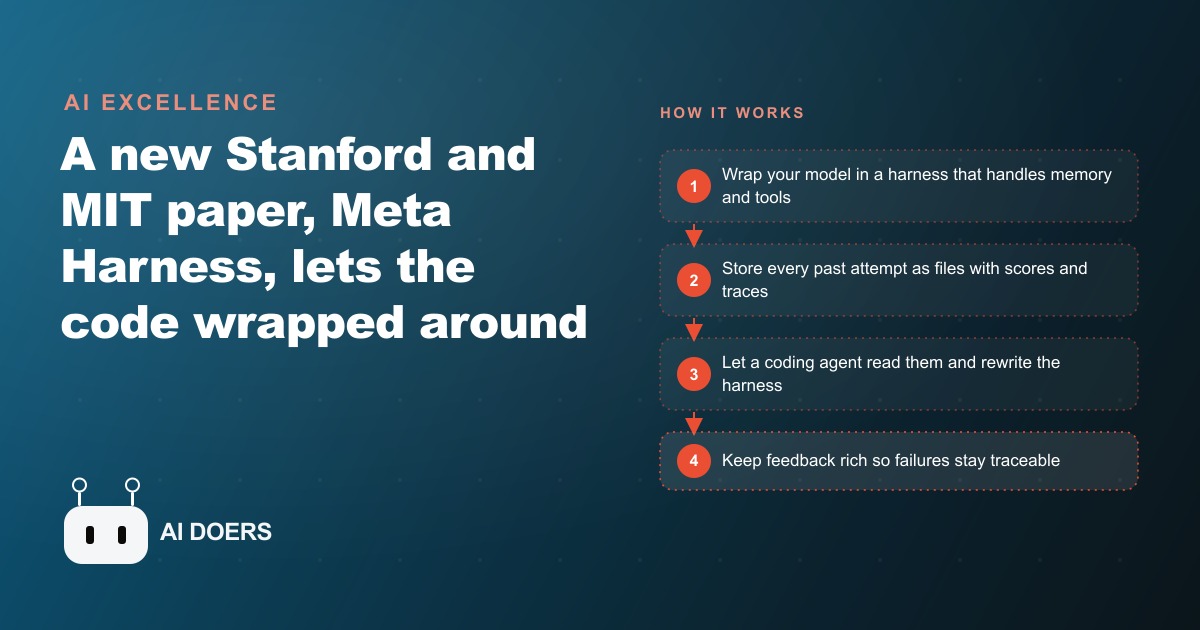
A Stanford and MIT team recently published a paper showing that changing only the scaffolding around a fixed AI model, without touching the model weights at all, can produce a six-times performance gap on the same benchmark. The model is not where the leverage is. The code wrapped around it is.
That result should change where any team building or buying an AI system allocates its attention. Most effort goes into comparing models: which version is newest, which benchmark it leads, how much it costs per token. The Meta Harness paper is direct evidence that the scaffolding layer, the code that decides what to store, what to retrieve, what context to pass to the model, and how to handle multi-step tasks, is at least as important as the model itself, and often more so.
Here is a practical path through the six stages that apply this lesson to a real business AI.
Map the Harness Before You Touch the Model
The harness is the code wrapped around the AI model. It handles everything the model does not handle by itself: how information is stored between sessions, how the relevant pieces are retrieved when a question arrives, what tools the model can call, how the model recovers when a step fails, and how long tasks stay on track without losing context.
Before selecting or configuring any model, map what the harness needs to do for your specific use case. Write out the tasks the AI will handle. For each task, identify the information it requires and where that information lives. Identify the steps the AI must complete in sequence and the failure points where each step could go wrong.
For a gym member-service AI, the harness mapping looks like this. Members ask about class times, trainer availability, membership options, and cancellation policies. Each question type requires different information. Class times change weekly, trainer availability changes daily, membership options are relatively stable, and cancellation policies are fixed. The harness must store each of these in a way that reflects its update frequency, retrieve only the relevant pieces for each specific question rather than dumping everything into every prompt, and handle multi-step tasks like rebooking a cancelled personal training session without losing the member's context midway through the steps.
Mapping this before writing any code or configuring any model reveals the real design decisions: How will class schedule updates be fed into the system? Where will member preferences be stored between conversations? What happens when the trainer availability file is stale? Those questions determine how the harness is built. The model choice comes after the harness is understood, not before, because the harness requirements often determine which model capabilities actually matter for the task.
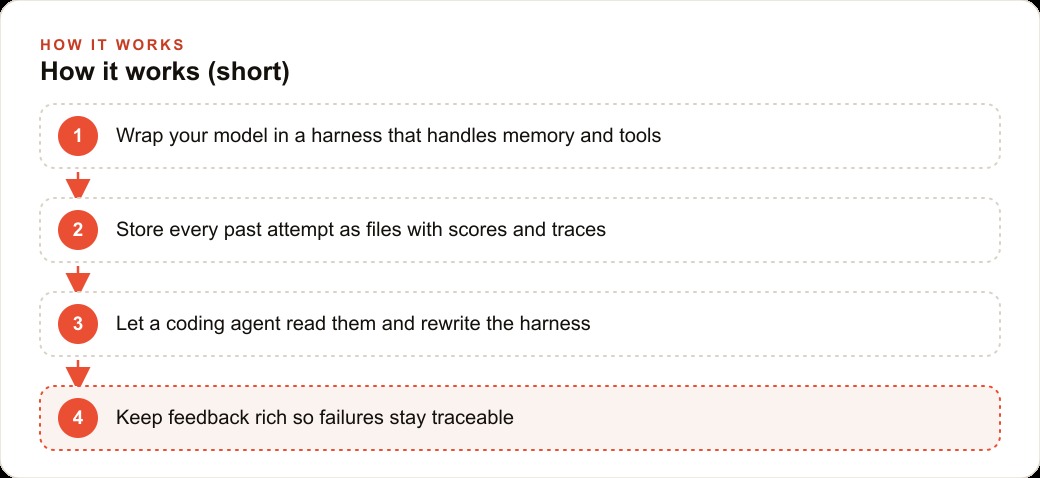
Store Every Attempt as Structured Files With Scores and Traces
The most important structural decision in the Meta Harness system is also the simplest: store everything. Every attempt the AI makes gets saved as a structured file with the inputs, the outputs, an evaluation score, and a trace of the steps the system took to produce the result.
Most teams running AI workflows discard the intermediate steps and only keep the final outputs. This makes improvement very slow because every failure is a mystery. Without the trace, you know a response was wrong but you do not know which step produced the error. Was the retrieval returning the wrong information? Was the model interpreting the retrieved information incorrectly? Was the output formatting step introducing errors? Without a trace, all three possibilities are equally opaque.
With stored traces, a wrong answer has a traceable origin. The trace might show that the class schedule retrieval returned last week's times because the update had not yet been processed. Or it might show that retrieval was correct but the model confused two members with similar names. Or it might show that both retrieval and reasoning were correct but the output format was ambiguous to read. Each of those failures has a different fix, and the trace makes the fix obvious.
For the gym AI, stored attempts look like this: a member asked about morning reformer Pilates classes, the system retrieved two files, the retrieval query and the files returned are both recorded, the model's response is recorded, an evaluation score and a structured note about what was wrong are recorded, and the full step trace is saved as a separate file. When the response was wrong, someone reading the trace can identify the failure point in under a minute.
The folder structure is simple: one subfolder per attempt, containing the input, the output, the score, and the trace. The discipline is doing this for every run, not just the ones that were obviously wrong. The attempts that were almost right often contain the most useful signal about the patterns the system is not yet handling correctly.
Use a Coding Agent to Read the Attempts and Rewrite the Scaffolding
Once stored attempts accumulate, the Meta Harness system uses a coding agent to read through them, identify failure patterns, and rewrite the scaffolding code to address those patterns. This is where the self-improving behavior emerges.
The coding agent in this context is not the member-facing AI. It is a separate AI whose job is to inspect code and edit it. The agent reads through the stored attempts, finds the cases where the output was wrong or suboptimal, traces those failures back to the step where they originated, and then modifies the scaffolding code at that specific step.
For example: if the agent reads thirty attempts and finds that eleven involved class schedule queries and eight of those eleven returned slightly wrong results because the retrieval query matched a past-week schedule entry instead of the current week, the agent can rewrite the retrieval function to prioritize the most recently updated schedule file when multiple matches exist. That rewrite then applies to all future queries without anyone having to identify and fix the same issue manually.
The key capability the coding agent needs is selective file reading. The Meta Harness paper makes this point directly: packing everything into one large context is not the right approach. The agent should use file tools to retrieve only the attempts and traces relevant to the pattern it is investigating, rather than loading the entire history at once. This keeps the agent focused on specific patterns rather than overwhelmed by the full volume of historical data.
The practical implementation is a weekly review session where the coding agent processes that week's stored attempts and proposes changes to the scaffolding. The proposals are reviewed by a human before being applied. Changes that address genuine patterns are merged. Changes that appear to overfit to individual unusual cases are flagged and set aside. Over time, the scaffolding becomes meaningfully better at the task types the gym AI handles most often, without anyone having to manually diagnose and fix each issue.
Keep Feedback Rich Enough to Trace Each Failure Back to Its Source
The Meta Harness paper argues against the common practice of reducing AI performance to a single metric. Most teams measure their AI workflow with one number: an accuracy rate, a task completion percentage, or a satisfaction score. Single numbers are easy to report and easy to compare. They are also nearly useless for improvement.
The argument is precise: compressing a complex multi-step result into a single score removes the information needed to fix it. If a member asked about class times and received wrong information, a score of zero tells you the response was wrong. It does not tell you whether the wrong answer came from a retrieval failure, a reasoning error, or an output formatting problem. Each of those requires a different fix. Without knowing which one occurred, improvement requires guessing and hoping the score goes up.
Rich feedback means breaking evaluation into stages that correspond to the steps the system takes. For the gym AI, that means evaluating separately whether the retrieval step returned the right source material, whether the model interpreted that material correctly, and whether the output matched what the member actually needed. A failure at the first stage points to a retrieval problem. A failure at the second stage points to a reasoning or context problem. A failure at the third stage, where retrieval and reasoning were correct but the output was unhelpful, points to a formatting or communication problem.
Designing the evaluation this way takes more effort at the outset. The payoff is that every failure immediately indicates its category of fix, which means the coding agent reading those evaluations can act precisely rather than inferring failure types from an opaque aggregate score. The loop between failure and fix tightens significantly when the feedback is structured rather than compressed.
Test Across Tasks the System Has Never Seen Before Declaring It Done
The Meta Harness paper validated its self-improved harness on nine separate datasets the system had never seen during the improvement phase. The discovered harness still won, averaging 73.1 compared to 70.2 for the second-best method. That generalization result is the test that actually matters, because it distinguishes a harness that found genuine structural improvements from one that memorized patterns in its training set.
Overfitting is the standard failure mode of automated optimization. A system optimized only on its training examples becomes very good at those examples and poor at anything new. A system that generalizes has found improvements in the underlying structure of the task, not just in the specific examples used during development. That structural insight is what makes the discovered harness useful on tasks it has never encountered.
For the gym AI, generalization testing means evaluating the harness on question categories it was not built for before deployment to real members. If the system was developed primarily using class schedule questions, test it on personal training booking questions, membership pricing questions, locker facility questions, and equipment availability questions. The harness should handle all of them at a reasonable baseline level without additional tuning.
Any category where performance drops sharply identifies a gap in the scaffolding, specifically in what the harness retrieves and how it formats context for that question type. Identifying and closing those gaps before deployment is straightforward. Closing them after a member has received a confidently wrong answer about a policy they acted on is substantially harder and more costly to the relationship.
Apply the Discovered Harness as a Foundation, Not a One-Off Win
The final principle is about how to use the results of harness improvement. The Meta Harness paper applies the discovered harness to new tasks and new benchmarks, treating it as a transferable foundation rather than a solution to a single problem. A harness design that works well for member schedule questions also works well for membership upgrade questions, cancellation requests, and equipment booking, if it was built around the right structural principles: selective retrieval, rich trace logging, and stage-level evaluation.
For the gym, the harness developed for member service queries provides the retrieval logic, the feedback structure, and the trace format that apply to every new AI capability the gym wants to build. When the gym later adds a personal training booking AI, it starts from the harness that already works rather than from a blank canvas. The improvement work on the first use case transfers structurally because the core decisions apply equally well to the new task type.
The compounding effect here is the strongest long-term argument for investing in the harness layer. Every structural improvement made while building the first AI use case reduces the time required to build the second, third, and fourth. A gym that spends six weeks developing a solid harness for member service queries does not just have a better member service AI. It has a foundation that accelerates every future AI capability it builds on that same foundation.
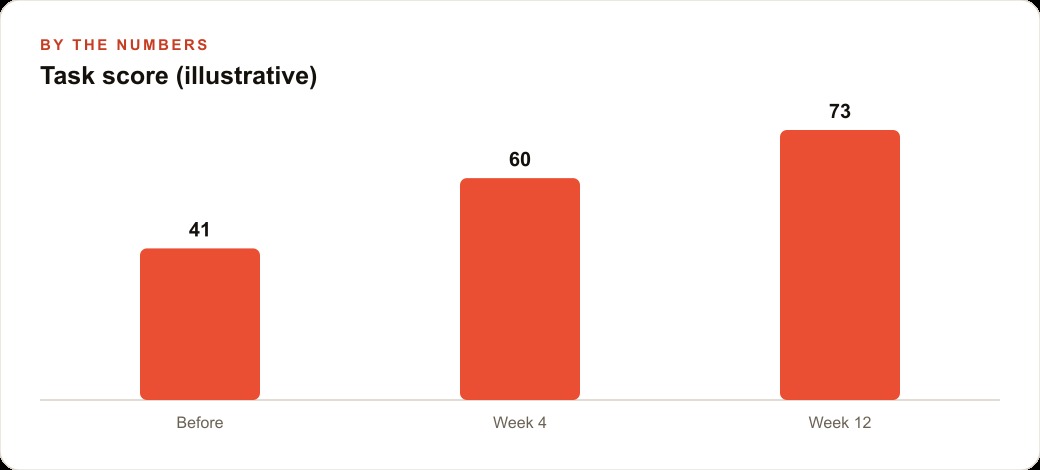
The score numbers from the gym example illustrate the scale of improvement that is available. Starting from a standard, ad-hoc harness, the member service AI scored approximately 41 on a task evaluation set covering the full range of member question types. After the harness improvement process, running the coding agent review cycle across twelve weeks, the score reached approximately 73 on the same evaluation set. Same model throughout. The improvement came entirely from better scaffolding: cleaner retrieval queries, richer trace logging, more precise stage-level evaluation, and targeted fixes to the specific steps where failures were concentrated.
That thirty-two point improvement on the same model, achieved through two days of engineering effort spread across twelve weeks rather than weeks of prompt engineering or a more expensive model upgrade, is the core lesson the Meta Harness paper demonstrates. Handwritten human rules and heuristics rarely beat systems designed to improve themselves on evidence. The harness layer is where that lesson has the most immediate practical application for any business building AI today. Investing there first, before chasing the newest model, is where the real performance leverage lives.
That is exactly what we do at AI DOERS. Book a private 30-minute call with Madhuranjan Kumar and we will map the fastest path to it for your specific business.
Book your call →
Madhuranjan Kumar
Madhuranjan Kumar brings 20 years of performance-marketing experience and has managed over $200 million in Facebook ad spend for brands across the United States and beyond. His expertise spans the full modern marketing stack: Meta, Google Ads, TikTok, email automation, CRM, and the websites that hold it together. At AI DOERS he turns that track record into lead-generation systems for businesses across every industry.