
The Meeting Summary Automation Every Owner Should Steal
Turn every meeting recording into a custom report of action items, fresh ideas, and the truths your team avoids, all running on its own in the background.

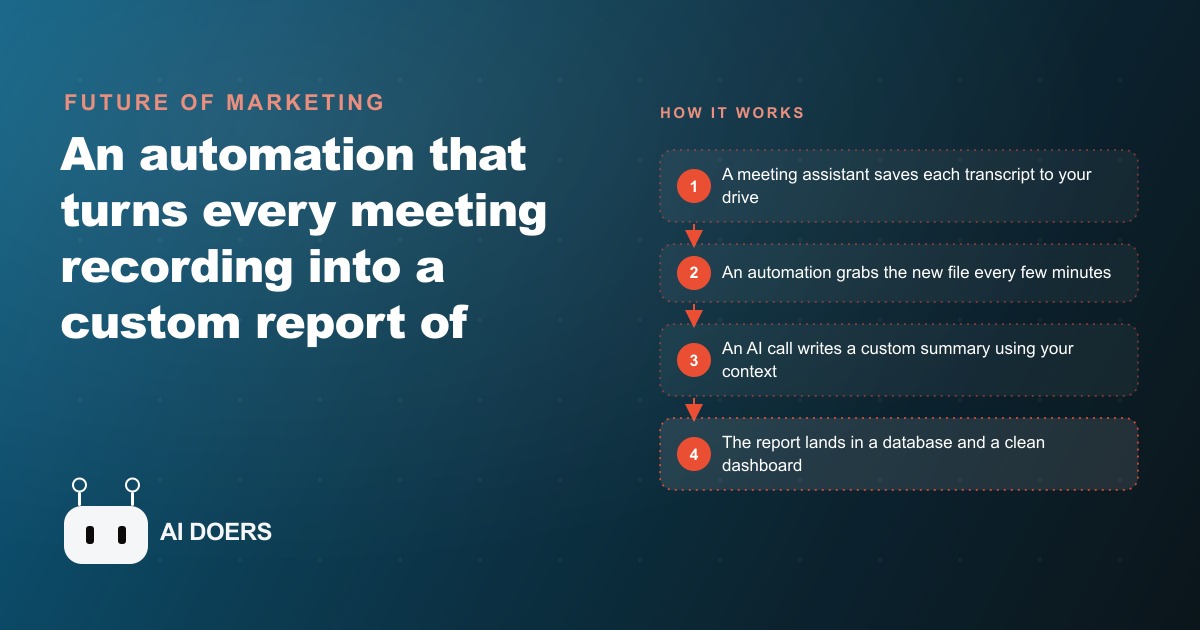
Every meeting your company records is now a searchable, minable document, and almost nobody is treating it that way. A new breed of background automation reads every transcript the moment it lands and writes back a custom report of action items, growth opportunities, and the uncomfortable truths your team keeps stepping around. I am Madhuranjan Kumar, and I think this is one of the most quietly valuable automations an owner can steal right now, because it turns a pile of forgotten recordings into a standing set of eyes on every conversation. Here is what changed, why it matters, and how I would put it to work.
The recording pile stopped being dead weight
The shift that makes this possible is boring on the surface and important underneath. Remote work made meeting transcripts normal. Almost every call now gets captured by some assistant and dropped into a folder, and that folder has quietly become the richest, least-used context store in most businesses. A transcript is just decisions and signals waiting to be read, and most of that value evaporates the moment the call ends because nobody has the time to go back and mine it by hand.
Until recently that context sat inert. The standard meeting tool gives you a generic recap that lands in a folder nobody revisits, and that is where the knowledge dies. What changed is that a no-code automation can now watch that folder, grab each new transcript, run a tuned AI call over it, and write back something far more useful than a recap. The raw material was always there. The new part is a cheap, reliable way to actually process it every few minutes without anyone lifting a finger.
The upgrade is what it extracts, not that it summarizes
Do not confuse this with the recap your meeting tool already emails you. Every off-the-shelf summarizer lists action items. The reason this automation is worth stealing is the two categories it adds that no standard tool produces.
The first is high-impact opportunities, the longer-term openings that surface across conversations but that nobody flags in the moment because everyone is focused on the immediate to-do list. The second is the uncomfortable truths, the recurring problems a team quietly avoids naming, the delivery slot that always runs late, the client who is always unhappy, the process everyone works around. Those two categories are exactly where growth usually hides, and they are invisible to a generic summarizer. Pulling them out on every meeting, automatically, is the real news here.
The reason a generic tool cannot produce these is that it has no idea what your business is trying to do. It can spot a sentence that sounds like a task because tasks follow predictable patterns, but it cannot recognize that a passing comment about a repeat customer request is actually a product opportunity, or that a polite dodge in the room is a problem being avoided. Those judgments require context about your goals and your standards, and that context is exactly what the tuned prompt supplies. Give the model your priorities and it stops transcribing and starts interpreting, which is the entire difference between a recap that gathers dust and a report a leader opens first thing every morning.
The whole flow is a chain of simple steps
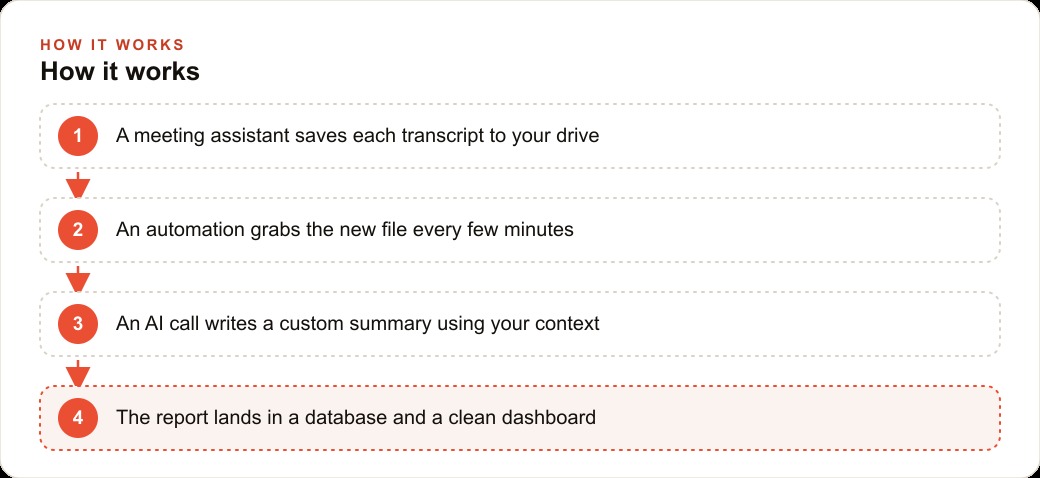
None of this requires anything exotic. The flow is a handful of plain steps glued together by a no-code automation platform. It starts with a trigger that checks a drive folder every few minutes for a new recording. When your meeting assistant drops a fresh transcript there, the automation picks it up, downloads it, and cleans the formatting so the text is ready to work with.
Then comes the core step, the AI call. A system prompt that you shape over time tells the model exactly what to extract: the action items, the opportunities, the uncomfortable truths, and a check on how well the meeting aligned with where the company is headed. The transcript goes in as context, and the model returns a tidy structured report. The final steps format that report and save it into a database, which becomes the durable home for every meeting's insights. From there a simple dashboard shows each meeting with its summary, a link to the recording, and the full breakdown, so a leader can be present in every conversation without sitting in any of them.
The prompt is the whole product
If there is one thing to take from this, it is that the tooling is not the magic. The magic is the prompt. At the end of the system prompt you paste your own mission, vision, values, and current roadmap, so the model judges every meeting against what your company actually cares about rather than against a generic template.
This is what turns a summarizer into an aligned advisor. Feed it your roadmap and every report can score how well a meeting moved the company toward its goals. Feed it your values and it can flag when a decision drifts from them. The same automation, pointed at two different businesses with two different prompts, produces two completely different and equally tailored outputs. Swap the tools underneath if you use different ones, the structure stays the same, but the prompt is where your business actually lives.
The database is what turns notes into an asset
It is tempting to treat the report as the finished product, but the database underneath it is where the real value accrues, and this deserves its own attention. A single meeting summary is useful for a week. A growing table of every meeting's summary, searchable and sortable, becomes an asset that compounds. Because each report is saved with a date, a link to the recording, and structured fields for action items, opportunities, and uncomfortable truths, you can look across months rather than one call at a time.
That longitudinal view is where patterns you could never spot in the moment reveal themselves. The same objection surfacing in five client calls is a product problem, not five separate conversations. The same bottleneck named in three team huddles is a process to fix, not a one-off gripe. A recurring opportunity mentioned and then dropped meeting after meeting is money left on the table. None of this is visible when summaries live as isolated emails in a folder. Stored in a database, the history starts talking, and a leader can query it the way they would query sales figures. The dashboard on top is simply the friendly window into that store, the single screen where every conversation shows up distilled and clickable.
Why the alignment score is the quiet star of the report
Of the four things the AI call extracts, the alignment check is the one people underrate, and I want to make the case for it directly. Action items keep the trains running, opportunities point at growth, and uncomfortable truths force honesty, but the alignment score answers a different question entirely: is the work we are actually discussing moving the company toward where it said it wanted to go.
This matters because businesses drift. A team can be busy, productive, and completely off the roadmap at the same time, and nobody notices until a quarter has slipped. When every meeting report scores how well the conversation lined up with your stated mission and current priorities, drift becomes visible early, while it is still cheap to correct. Over a month, a run of low-alignment scores on a particular team's meetings is a signal worth investigating before it becomes a missed target. Feeding the model your roadmap costs you one paragraph in the system prompt, and in return you get a standing, gentle audit of whether the company's daily attention matches its stated direction. That is the difference between a summarizer and an advisor, and it is available for the price of writing your own goals into the prompt.
Who should be stealing this right now
Any business that holds regular meetings and records them can use this, which today is very nearly everyone. A founder can scan whether the work being discussed matches the plan. A marketing lead can run it on every campaign meeting and watch for the truths the room is avoiding. A larger company with dozens of weekly meetings can give each executive a digest so they stay informed across teams they cannot possibly sit in on. Service firms, shops, clinics, agencies, and trades all run on meetings, and most of that knowledge evaporates the moment the call ends.
The concrete move is to pick your highest-signal recurring meeting, the weekly team huddle or the standing client calls, and point the automation at just that one first. Prove the value on a single meeting type before you widen it.
A worked example: the neighborhood florist
Consider a florist that runs a weekly team huddle and regular planning calls with wedding and event clients. This is the illustrative shape of the payoff. After each call, the meeting assistant saves the transcript, the automation grabs it, and the AI call returns a report tailored to the shop.
The action items capture which arrangements need ordering and which deliveries are firmed up. The opportunities section flags that three brides this month asked for the same seasonal palette, a clear signal to build a ready-made package around it. The uncomfortable-truths section notes that the same delivery slot keeps running late, the kind of thing a busy owner glosses over in the moment but that costs reviews and repeat business over a season.
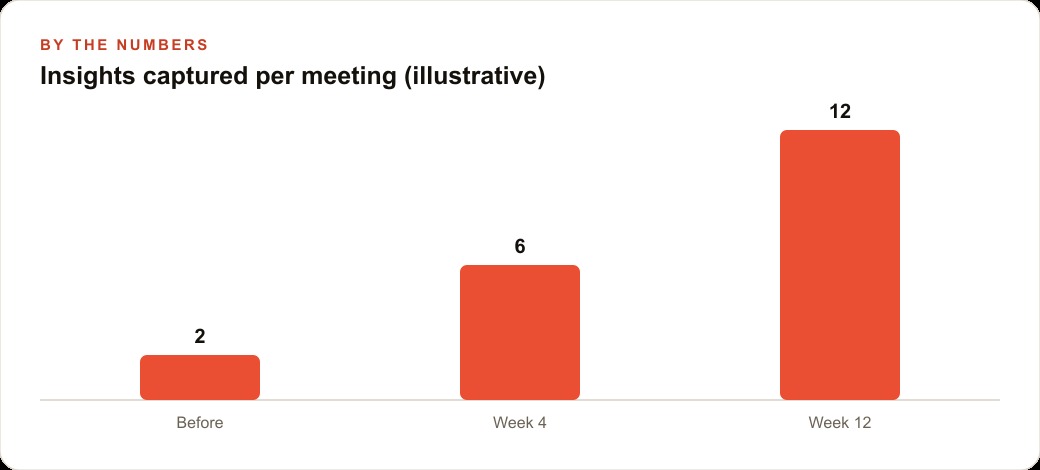
Feed the system prompt the shop's mission, its standards for quality and service, and its current roadmap, say a push into corporate accounts this quarter, and every report also scores how well the meeting moved that goal forward. The summaries land in a database and a simple dashboard, so the owner opens one screen and sees every conversation distilled. In numbers, the shift might look like two useful insights captured per meeting before the system, rising to six by week four and twelve by week twelve as the prompt gets tuned to the business. Those figures are illustrative, but the mechanism is real: none of it replaces the florist's eye or the client relationship, it just makes sure the insight from each call gets acted on instead of fading by Friday. Those captured opportunities also feed the marketing engine directly, because a recurring request for the same palette is exactly the kind of demand signal that should shape a seasonal offer and the creative behind your Facebook and Instagram ad campaigns.
How to stand it up without stalling
Start from a blueprint rather than a blank canvas. Import a ready-made template into a no-code automation platform, then change three things: your own drive connection, your own database connection, and your own AI API key. Make sure your database has the right fields, a name, a date, a link to the recording, and a long text field for the summary, then test it on one real meeting.
The most important step is the prompt. Replace the example mission and roadmap with your own, because without that the model knows nothing about you and the report stays generic. The wiring itself takes an afternoon once you have the template. The harder part is writing the prompt so it pulls the insights that actually matter to your business, and adapting the nodes if your tool stack differs from the blueprint, which is the judgment work where most people stall. It is also worth deciding early where these insights flow next, because the action items and opportunities are most valuable when they connect into your CRM and website stack so follow-up actually happens, and the recurring themes across meetings often reveal the questions worth answering in SEO and organic search.
You can follow the steps above and assemble it yourself, or you can bring in someone who has built these many times and have the whole automation handed over, tuned to your tools and your goals and already running.
That is exactly what we do at AI DOERS. Book a private 30-minute call with Madhuranjan Kumar and we will map the fastest path to it for your specific business.
Book your call →
Madhuranjan Kumar
Madhuranjan Kumar brings 20 years of performance-marketing experience and has managed over $200 million in Facebook ad spend for brands across the United States and beyond. His expertise spans the full modern marketing stack: Meta, Google Ads, TikTok, email automation, CRM, and the websites that hold it together. At AI DOERS he turns that track record into lead-generation systems for businesses across every industry.