
Manus AI Uses a Real Browser to Complete Your Research Tasks Autonomously
Manus AI is the first widely available agent that navigates real websites on your behalf, compiling research, building pages, and delivering finished outputs while you focus on higher-value work.

From AI that chats to AI that works
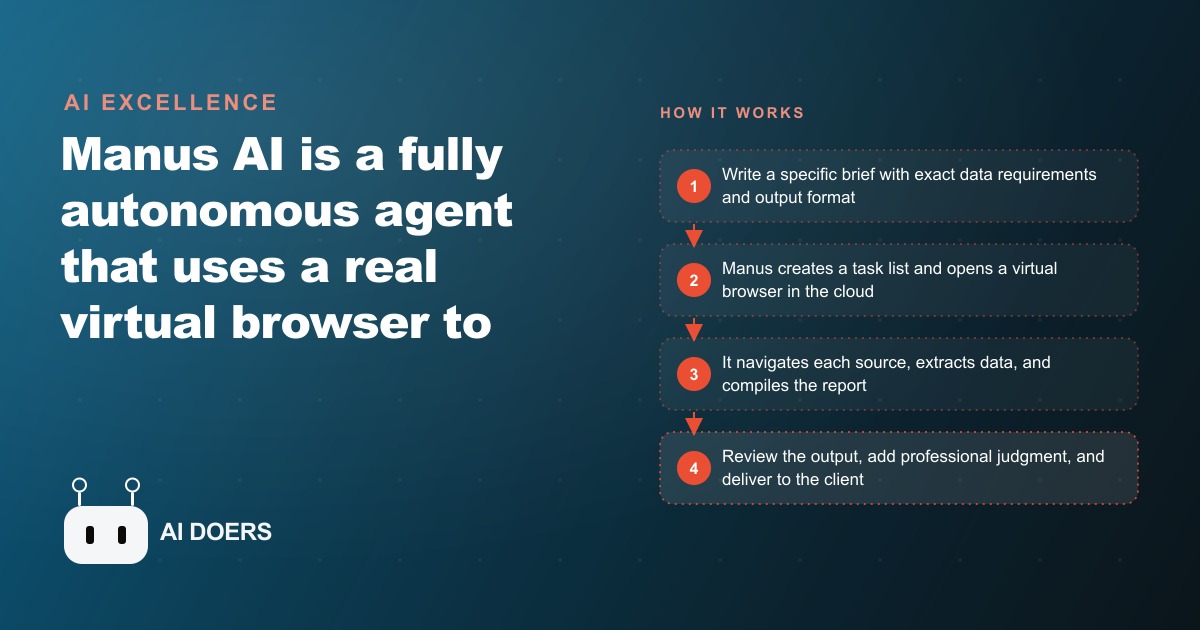
I am Madhuranjan Kumar, and I think we have quietly crossed a line that most people have not noticed yet. For the last few years, using AI has meant having a conversation. You ask, it answers, you refine, it answers again, and the whole burden of turning that back-and-forth into finished work stays on you. Manus AI is the clearest sign I have seen that this era is ending. It is a fully autonomous agent that uses a real virtual browser to complete complex, multi-step tasks from start to finish, and the shift it represents is not about a smarter chatbot. It is about a machine that does the work instead of describing it.
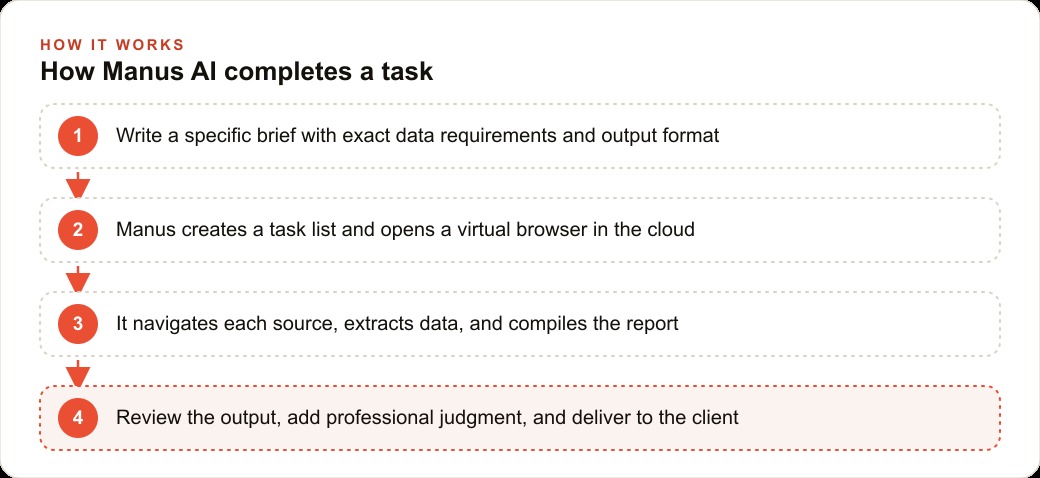
The difference sounds subtle until you watch it happen. You give Manus a task, it builds its own structured plan, and then it opens a browser it controls in the cloud and executes each step, navigating real websites, clicking links, scrolling, typing into search fields, and compiling what it finds. You can watch it work in real time, and the feeling is less like using software and more like looking over the shoulder of a focused assistant working through a research project, except this assistant never tires and does not stop to ask a clarifying question unless it genuinely needs your input. When it launched with invitation-only access, the servers were overwhelmed within hours, which tells you the demand for this shift is real, not manufactured.
Why this arrived without a new breakthrough
The most important lesson of Manus is not what it does but how it was built, and this is the throughline I want to follow, because it changes what you should expect from the next two years. A prominent tech investor put it plainly after the launch: model breakthroughs are not necessary to build genuinely meaningful products right now. Manus proves the claim with a shipped product. Under the hood it runs on Claude Sonnet combined with a couple dozen existing tools and an open-source library for controlling a browser. A small team assembled pieces that were already lying around, arranged them intelligently, and produced something that changes what people expect AI to be able to do.
Sit with that, because it matters to every business owner far more than any single feature. The gap between what the large AI labs build at the frontier and what you can actually put to work in your own operations is narrowing fast, and it is narrowing not because of some distant future breakthrough but because of clever assembly of what already exists. The practical consequence is immediate. Tasks that used to require a skilled person sitting at a computer for one to three hours, resume screening, neighborhood research, competitive analysis, content audits, can now be handed to an agent that runs in the background while you do higher-value work. This intersects with a real and rising cost, too. Every hour a skilled professional spends gathering information from public web pages is an hour not spent on judgment, on relationships, on the work that actually earns money. Manus attacks that cost directly, using technology that is already here.
The virtual browser is the thing that changes the game
If you want to understand why Manus reaches further than earlier agents, look at how it gets its information. Earlier agents searched the web through structured data feeds, which only expose what a platform chooses to publish. Manus navigates pages the way a person does. It clicks, scrolls, reads, types into search boxes, and moves to the next step. That means it can reach information with no clean public feed at all: live listings, local government records, public databases, map layers, forum discussions, competitor websites. The range of what it can touch is dramatically wider than anything built on structured feeds alone.
I want to be honest about the rough edges, because the story is more useful when it is true. I put Manus through three concrete tests. First, I asked it to research Manus itself, and it did well right up until it reached a page discussing the product's own limitations, at which point it crashed, which was a fair irony and a useful reminder that this is a newly launched tool navigating a real, constantly changing web. Second, I asked it to build an email summarizer by logging into a Gmail account, and here it did something that impressed me more than any flashy demo: it recognized that handling a login was a step it should not take on its own, paused, handed control back for me to authenticate, and then resumed once I had. That restraint is a sign of thoughtful design, not a weakness. Third, I asked it to build a complete marketing landing page for a shoe company, with social proof, testimonials, and product images, and it finished the job. Beyond my own tests, people in the community pushed it further, using it to identify suitable sites in a city through a 3D map view, to build a detailed two-month family travel itinerary, and even to generate working 3D games from single text prompts. These are not toys. They are multi-step jobs that would take a skilled person several hours by hand.
Who this actually helps
The businesses that benefit most are the ones where people regularly spend large blocks of time gathering information from public web sources, and once you see the pattern you see it everywhere. Recruiters screen and research candidates. Lawyers pull case references and public filings. Analysts track data across many platforms. Marketing teams audit competitor positioning. Real estate professionals research neighborhoods, comparable sales, zoning, and market trends. Each of those maps directly onto what Manus can do today with nothing more than a clear task brief. And the leverage does not depend on company size, because the bottleneck it removes, time spent on repetitive information work, exists at every scale. A solo operator who could never afford a research assistant can now delegate the same hours a large firm would.
A worked example: the real estate agency
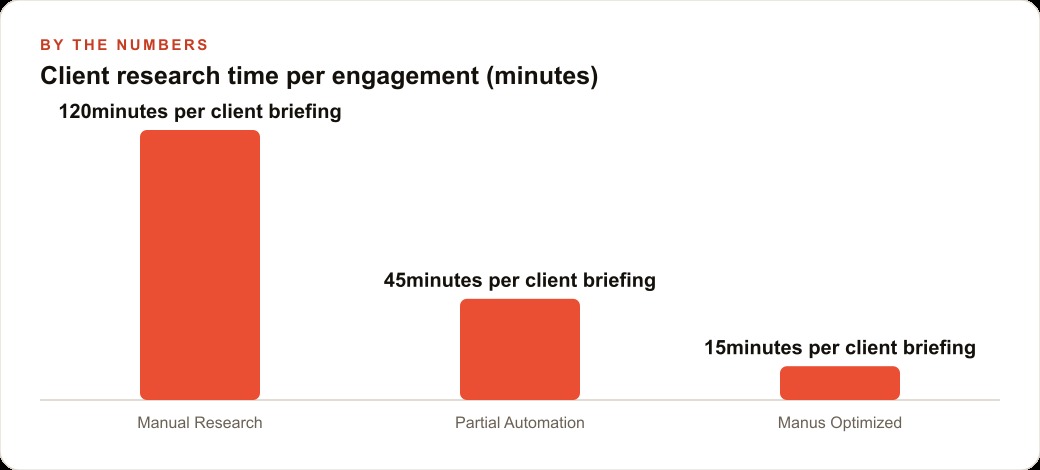
Let me follow one business all the way through, because the argument only lands when it touches a real workflow. Consider a real estate agency in a competitive market. The claim I want to make concrete is that it could cut the research phase of every new client engagement from two or three hours down to under thirty minutes without losing quality.
A family relocating to a large city contacts the agency. They have a monthly rent budget, school district requirements, concerns about neighborhood safety, and a need to commute to a central business district within a reasonable window. Traditionally an agent or an assistant spends two to three hours pulling data from many sources: school ratings from one site, transit and walkability scores from another, the city's public crime data, current inventory and pricing from listing platforms, and neighborhood forums for the qualitative texture of daily life. With Manus, the agent instead writes one specific brief: research safe neighborhoods for a family with two school-age children, a set monthly rent budget, and a commute requirement under forty-five minutes to the central district, compare the three strongest options using school ratings, walkability and transit scores, recent crime trend data, and current rental inventory, and return a formatted comparison table with a one-paragraph narrative for each. Manus builds its task list, opens its browser, visits each source in sequence, and returns a structured report.
The agent then reviews that output in ten to fifteen minutes, adds the professional judgment and local knowledge no tool can replicate, and walks into the client meeting with a polished, data-backed briefing already prepared. The afternoon that used to disappear into research now happens while the agent handles other meetings or follows up on active listings. The same logic extends to pre-listing work. Before pricing a property, the agent can ask Manus to pull comparable sales from the past ninety days within a one-mile radius, calculate average days on market, flag listings with price reductions, and identify properties with unusual features that affect comparability. The agent still makes the pricing call, but makes it faster and with fuller information in front of them.
Put illustrative numbers on the year. An agency handling forty new client engagements, each previously eating two hours of research, could recover well over two hundred hours. That time flows back into tours, negotiation, and relationships, which are the activities that actually close deals. And there is a compounding edge in responsiveness: an agency that delivers a neighborhood briefing the same day a client makes contact beats one that takes two or three days, and that speed compounds into referrals and reputation. The leads that start all of this should land in a proper CRM and website stack so no inquiry goes cold while research runs, and the polished neighborhood briefings the agent produces become genuine local content that strengthens SEO and organic search, which in turn lowers the cost of the Facebook and Instagram ad campaigns that bring the next family through the door.
The mistakes that will trip you up
Because the story is optimistic, let me be equally clear about where it goes wrong, since the difference between a useful agent and a frustrating one is almost entirely in how you use it. The first and most common mistake is a vague brief. Manus is not a mind reader. Ask it to research the market and you get something broad and mostly useless. Ask it for the ten zip codes in a specific area with median listing prices in a defined band, a minimum school rating, and fewer than a set number of average days on market, ranked by lowest days on market, and you get a specific, usable deliverable. The quality of the output is directly proportional to the precision of the brief.
The second mistake is leaving authentication-dependent tasks fully unattended. As the Gmail test showed, Manus correctly pauses at a login, so if your workflow needs a credentialed platform, plan to be near your screen when it reaches that step. The third mistake is the most dangerous: sending Manus output to a client without reviewing it. It crashed on one of my three tests. It is a new tool navigating live pages that change constantly. Treat its work the way you would treat work from a capable but junior analyst, impressive in range and in need of an experienced eye to catch the occasional error before it reaches anyone who matters.
Getting started, and where this is all heading
Setup takes under ten minutes once you have access. You apply for an invitation, create an account, and land in a straightforward interface: a task input box and a real-time view of what the agent is doing, which pages it is visiting and what it is extracting. The right first task is one you already know the answer to, a neighborhood comparison you researched manually last week, so you can grade its accuracy before you trust it with anything client-facing. After three to five tasks you will have a clear picture of where it saves the most time, what it handles reliably, and where you need a verification step, and you can turn those findings into reusable task templates for your most common research jobs.
The larger point is that this is only going to get better. The underlying model is one of the strongest available, and the open-source browser layer is actively developed by a wide community, so the version six months from now will be meaningfully more capable than the one at launch. Starting now means you build the workflow habits and the templates before competitors even recognize the opportunity. And Manus is not alone in this direction. The same week it launched, a major lab released tools that give developers web search, file search, and computer use to assemble their own agents, and a major cloud platform added support the same day, which means enterprise deployment paths already exist. Autonomous, browser-based task execution is not a niche experiment. It is becoming a standard layer of professional software, and the shift from AI that chats to AI that works is already under way. You can start experimenting yourself today, and if you would rather have someone design the agent workflows, write the briefs, and put the verification steps in the right places so it is safe to rely on, that is exactly the kind of build I do for clients, and you can bring me in to handle it.
That is exactly what we do at AI DOERS. Book a private 30-minute call with Madhuranjan Kumar and we will map the fastest path to it for your specific business.
Book your call →
Madhuranjan Kumar
Madhuranjan Kumar brings 20 years of performance-marketing experience and has managed over $200 million in Facebook ad spend for brands across the United States and beyond. His expertise spans the full modern marketing stack: Meta, Google Ads, TikTok, email automation, CRM, and the websites that hold it together. At AI DOERS he turns that track record into lead-generation systems for businesses across every industry.