
How to Build a Real Playable Game in One Day With AI and No Coding Experience
Using ChatGPT for planning, Claude Code for building, Leonardo for graphics, Suno for music, and ElevenLabs for sound effects, you can go from idea to working game in a single day. Here is the complete process.

Something changed in the relationship between an idea and a finished product sometime in the last year, and I want to try to describe exactly what changed and what that means for anyone who builds things for a living. I am Madhuranjan Kumar, and the specific thing that changed is not a model release or a benchmark result. It is the cost of starting from nothing.
For most of the history of software, the gap between having an idea for an app and having a working version of that app was measured in months and thousands of dollars. You needed a developer, or you needed to become one, or you needed to accept that your idea would stay in a notebook. That gap did not close gradually. It collapsed. The question I want to think through here is what that collapse actually means, not in the abstract, but for the specific person sitting in front of a laptop with an idea and no coding background.
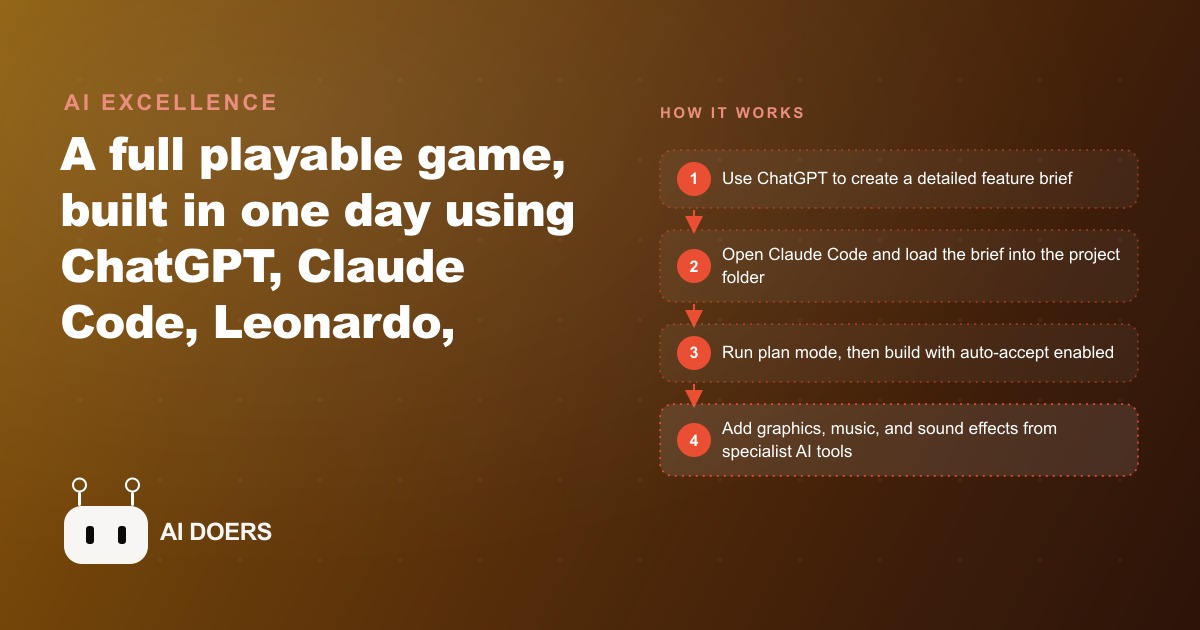
The example I keep returning to is a playable game called Library Survivors. The concept is a librarian trying to maintain order while kid NPCs actively pull books off shelves. The game has a chaos meter, stamina mechanics for sprinting, multiple powerup types, character animations, and increasing difficulty. It was built in one day by one person with no prior coding experience, using ChatGPT for planning, Claude Code for the actual code generation, and specialized AI tools for the graphics and audio. The total development cost in money was less than thirty dollars. The total development time in hours was roughly eight to twelve.
I am not describing this to make it sound easy. I am describing it to make a point about what kind of skill is actually valuable now.
The skill that used to be scarce is no longer the bottleneck
For twenty years, the most valuable skill in software was the ability to write code. That is still valuable. But it is no longer the scarce resource it was. When an AI tool can generate, debug, and iterate on code in response to plain English instructions, the bottleneck shifts somewhere else. It shifts to the ability to know what you want to build, describe it with enough precision to be actionable, and evaluate whether what you got is right.
That is a different skill. It is closer to product thinking and editorial judgment than to programming. It is the skill of a marketer who knows what the customer needs, or a designer who knows what experience should feel like, or a business owner who has watched the same problem cost them time every week for three years. Those people can now build the tool that solves the problem, and they can build it faster than it would have taken to find a developer and explain the problem to them.
The game example makes this concrete in a specific way. The builder's job was to describe the mechanics clearly enough that the AI could implement them. Chaos meter goes up when kids pull books off shelves, goes down when the librarian puts books back, game ends when it hits 100 percent. Kid NPCs run away when the librarian gets close, so the challenge increases at higher difficulty when multiple kids are active at once. Stamina drains when sprinting, regenerates when walking. Powerups spawn randomly and include temporary speed, a study quiet zone that freezes nearby NPCs, and a book magnet that pulls nearby books back to shelves.
That description, and the judgment required to recognize when the implemented version does not match what was intended, is the productive input. The code that implements it is largely the AI's contribution. The eight hours were mostly spent on the human side of that equation: thinking through edge cases, testing the feel of the mechanic, deciding what to add and what to cut.
Planning in writing is not extra work; it is the highest-leverage step in the whole process
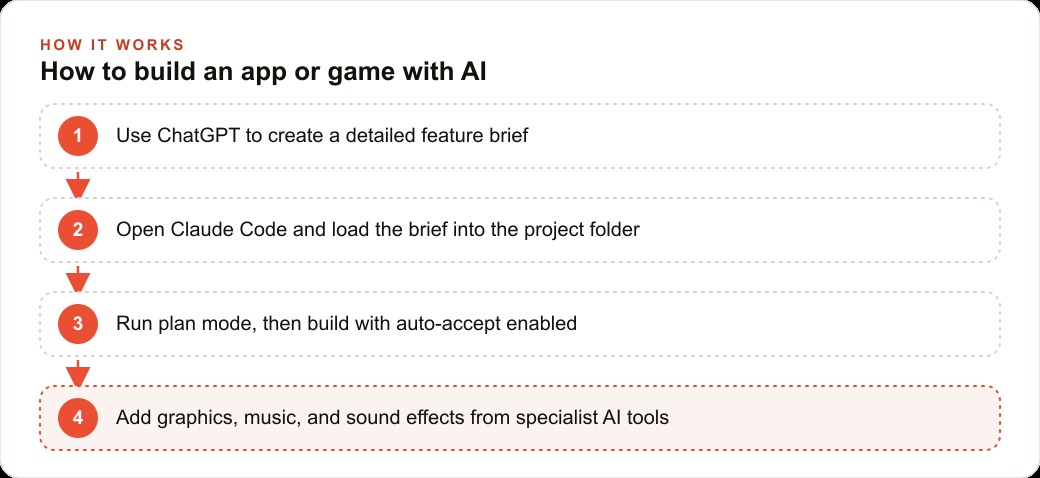
The most counterintuitive part of this workflow is that the planning phase, the part that feels like overhead before the interesting work starts, is actually the work. The quality of the output from Claude Code correlates directly with the quality of the brief it receives. A vague starting point produces a vague result. A brief that describes the user experience, the win condition, the edge cases, and the specific mechanics the app needs to handle produces a result that is substantially closer to the intended product on the first generation.
The practical approach is to write the brief before opening Claude Code. Use ChatGPT or any other tool to think out loud about what the app should do, and ask it to help identify things you have not thought of: what happens when a user tries to do something the system does not support, what the game feels like at the hardest difficulty level, what the minimum viable version includes versus what can be added later. Save the output as a text file in the project folder. That file becomes the context the AI references throughout the build, which keeps decisions consistent across the hours of development.
This is worth making explicit because the temptation in an AI-assisted build is to start generating code immediately and then figure out what it should do as you go. That approach works for tiny experiments. For anything with more than two or three features, it produces a codebase where different parts make different assumptions, and the debugging time to reconcile those assumptions far exceeds the time that would have been saved by writing the brief properly.
Graphics, music, and sound effects each take twenty minutes and the results are professional
The polish layer of the game, the part that determines whether it looks like a finished product or a prototype, came from three tools that each take roughly twenty minutes per session.
Leonardo AI's Lucid Realism model generated all the character sprites and background tiles. The approach is to write a base style prompt that locks the visual aesthetic, something like top-down view, pixel art style, 16-bit color palette, warm lighting, then generate each asset using that prompt as a prefix. Using the same base prompt across all assets means the characters, backgrounds, and UI elements have a visual relationship to each other that makes the game feel designed rather than assembled. If you generate each asset with a completely different prompt, the visual inconsistency makes the game feel unfinished regardless of how well the mechanics work.
Suno generated the background music. The approach is instrumental mode and a style description that matches the emotional tone you want for the game state: upbeat and slightly frantic for active gameplay, quieter and more ambient for the menu screen. Suno generates multiple options from a single prompt, and downloading two or three for each game state gives you enough material to select the right fit without being locked to the first result.
ElevenLabs generated the sound effects from text descriptions. Book being picked up off shelf. Librarian's footsteps on hardwood floor. Chaos meter alarm sound when approaching maximum. The tool produces professional-quality audio from specific, physical descriptions, and the output drops directly into the project's assets folder.
The reason all three of these tools matter is that the gap between a playable prototype and a finished-feeling product is almost entirely in the audio-visual layer. The mechanics can be tight and interesting, but a game with placeholder colored rectangles for characters and no audio does not communicate its own quality to someone encountering it for the first time. The twenty minutes per tool is the investment that closes that gap.
The same workflow builds any custom business tool, not just games
Library Survivors is a legible, memorable example of what this process produces, but the workflow is entirely general. The same process, plan in writing, brief Claude Code with that plan, use specialized tools for the asset layers, applies to any software project where the builder can describe what the output should do and evaluate whether it does it.
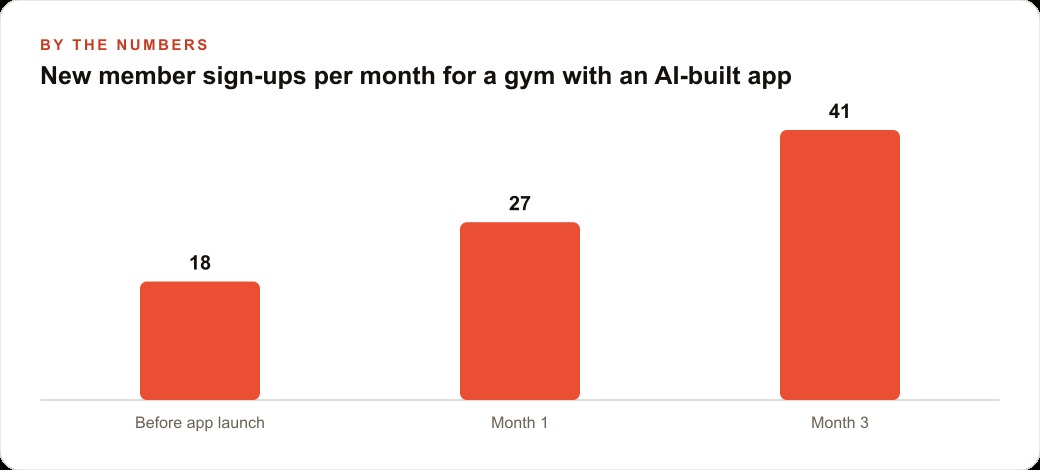
A gym wanting a 30-day challenge app with a member leaderboard and badge system can build it in a day using this workflow. The workout logging interface, the point system, the badge unlock logic, and the leaderboard display are all describable in a brief, all buildable by Claude Code from that brief, and all testable in a browser within hours of starting. A fitness studio with 100 active members that retains even five additional members per month because of an engagement app the members interact with daily gains four thousand to eight thousand dollars in annual recurring revenue from a tool that cost less than fifty dollars and one day to build.
A landscaping company wanting a field-to-proposal workflow, where a technician fills in a mobile form during a site visit and the office receives a structured quote ready for approval, can build that in a similar timeframe. A tutoring center wanting a progress tracker with parent-facing reports. A salon wanting a booking tool integrated with a loyalty point system. These are all software projects that previously required a developer and weeks of work, now buildable by someone who can think clearly about what the tool should do.
The point is not that the AI-assisted build is perfect or that it replaces every scenario where a professional developer is needed. It is that the threshold for when a custom tool makes economic sense has dropped dramatically. The business problem that used to need twenty thousand dollars in development cost to justify now needs fifty dollars and one day. At that cost structure, a much larger category of business problems becomes worth solving with a custom tool rather than with a workaround or a generic SaaS product that does not quite fit.
What this means for the decision you are probably already considering
If you have had an idea for a custom tool, a booking system that works the way your business actually works, a customer-facing calculator, a tracking tool for your specific workflow, the argument I am making is that the right time to test whether that idea is buildable is now, not after you find a developer or learn to code yourself.
The test is low risk. Set up a Claude Code environment in Windsurf or Cursor or VS Code, both of which have free tiers. Spend an hour writing the brief for the simplest version of the tool: one core feature, the minimum that makes it useful. Run the build and see what it produces. The worst case is that you spend a few hours and learn that the project is more complex than you thought, which is still faster and cheaper than hiring a developer to make the same discovery. The best case is that you have a working prototype of a tool that changes how your business operates.
That same content foundation also informs how your business shows up in SEO and organic search if you build a public-facing version of the tool. A calculator or quiz tool on your website that solves a real problem for potential customers is both a business utility and a source of organic search traffic from people searching for exactly that solution.
The leads generated by a tool like this, and the customers it retains, eventually flow through whatever follow-up and relationship management system you are running. Connecting the new tool to the CRM and website stack that handles follow-up is the step that turns a feature into a growth engine rather than a standalone curiosity.
The gap between having an idea and having a working product is now an afternoon. Whether you close it is a decision about how you want to spend that afternoon.
That is exactly what we do at AI DOERS. Book a private 30-minute call with Madhuranjan Kumar and we will map the fastest path to it for your specific business.
Book your call →
Madhuranjan Kumar
Madhuranjan Kumar brings 20 years of performance-marketing experience and has managed over $200 million in Facebook ad spend for brands across the United States and beyond. His expertise spans the full modern marketing stack: Meta, Google Ads, TikTok, email automation, CRM, and the websites that hold it together. At AI DOERS he turns that track record into lead-generation systems for businesses across every industry.