
Make 2026 Your Best Year With AI: Stack Four Powers, Not More Hours
The way to win 2026 is not to try harder but to build leverage with AI. Become an AI generalist by getting 60 to 70 percent good at four powers, automate, build, create, and connect, then stack them together.

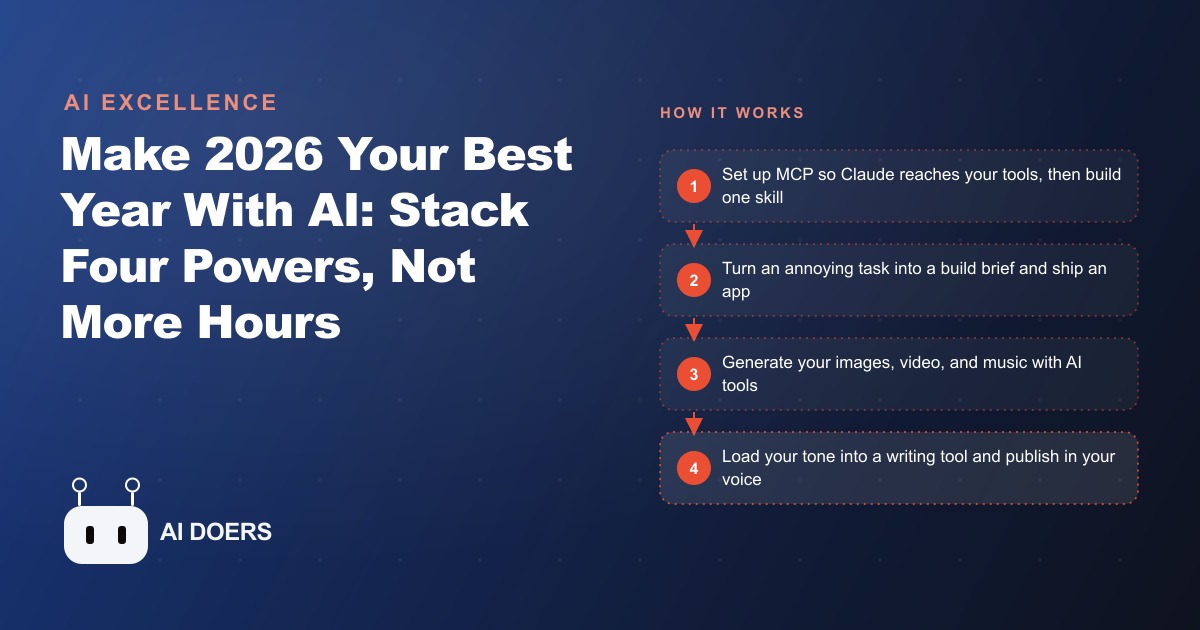
Six months from now, most people reading this will be working the same hours they worked last year and wondering why the results are not different. I am Madhuranjan Kumar, and the answer is almost always the same: they traded more effort for the same leverage. In an economy where a musician's song can stream a billion times and one executive's email can move 500 people by lunch, the people pulling ahead are not outworking anyone. They have compounding inputs that other people do not. AI is now the most accessible form of that leverage that has ever existed, and this is the story of one person who built it deliberately over three months.
Starting the Year With Seven Hours Vanishing Into Guest Research
The solopreneur in this story runs a weekly podcast interviewing founders and entrepreneurs, and coaches 12 clients at a time in parallel. On paper the business was doing well. The podcast had an engaged audience, the coaching practice was full, and there was demand for more of both. In practice, the owner was running out of week before running out of work.
The biggest invisible drain was guest research. Each episode required pulling together a guest's background, finding their best past interviews, reading the relevant content they had published, and drafting a set of questions specific enough to produce a conversation that felt prepared rather than generic. That process took between two and three hours per guest, and the podcast published weekly. Before a single client call was prepped, before a single newsletter was drafted, seven to ten hours of the week were already gone.
The coaching prep was a separate drain. Before each client call, the owner filled a prep sheet manually: the client's stated goal for the session, what came up last time, what recurring patterns had emerged across their coaching arc. Useful work, but manual, and it competed directly with the hours available to actually coach more clients or build the newsletter and social presence that would attract the next wave of them.
The owner understood leverage as a concept. The gap was between understanding it and having the concrete infrastructure to act on it. That is what the next three months built.
There was also a pattern in how the time was being spent that made the situation feel more stuck than it actually was. Every hour spent on guest research was an hour not spent on the newsletter, which was the tool most likely to convert listeners into coaching clients. Every hour spent on manual coaching prep was an hour not available to develop a group program that could serve more clients without requiring proportionally more of the owner's time. The inefficiencies were not random. They were concentrated exactly at the boundary between the current business and the next version of it.
Month One: Automating Guest Research to Recover Eight Hours a Week
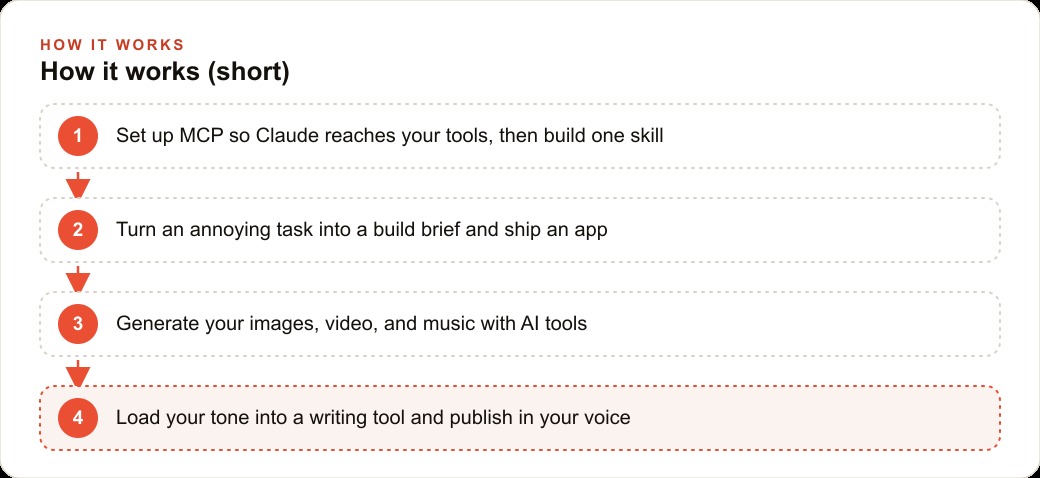
The first power to stack was automate. The principle is straightforward: identify the repetitive tasks that consume the most time, connect your existing tools to an AI that can reach them, and save a reusable workflow you can trigger on demand rather than rebuilding the process manually each time.
The owner connected Claude to the tools already in use, the calendar, the notes app, and the podcast management system, using MCP, the protocol that lets AI models reach external tools with your permission. Then, instead of starting each guest research session from a blank browser, they built a Claude skill: a saved workflow that, given a guest's name and any existing links, automatically pulled background information from the web, found and summarized the guest's best past interviews, identified the topics their audience asked about most, and dropped a structured pre-show brief into the notes app with suggested questions grouped by theme.
The first time the skill ran for a real upcoming guest, the result landed in the notes app in under 15 minutes. The manual version of that same brief had taken two and a half hours the week before.
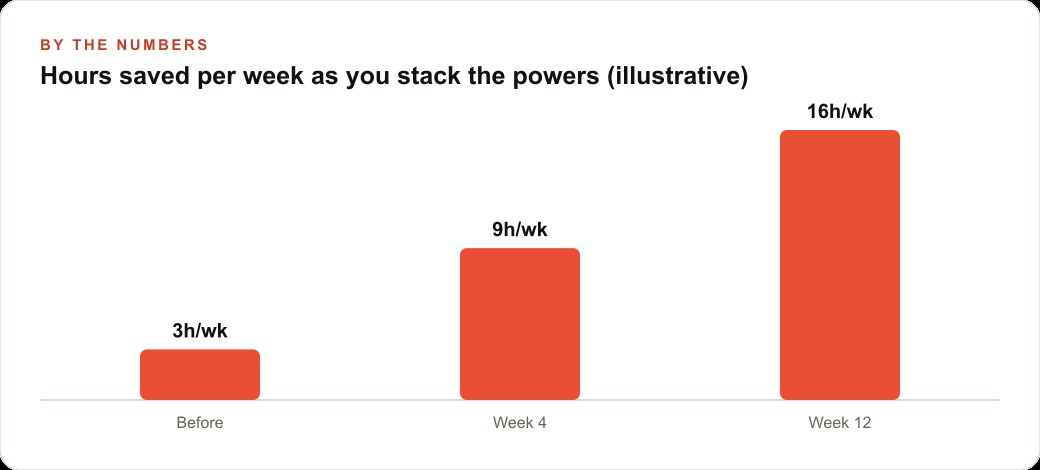
Over 12 episodes in the quarter, that shift saved approximately 28 hours of research time. Combined with a lighter version of the same automation applied to coaching prep, pulling last session notes and the client's stated goal into a structured call sheet automatically, the total time recovered in month one was closer to 35 hours across the month. That is nearly a full working week handed back without changing the output at all. The podcast still published weekly, every client still got a prepared coach, and none of the quality dropped.
The business case for /web-crm automation often starts with exactly this math: repetitive structured tasks done by a person at a fixed hourly cost versus the same tasks done by a saved workflow at close to zero marginal cost. Month one proved the math in practice, not just in theory.
Month Two: Building a Custom Tool That Replaced a $79 Monthly Subscription
With 35 hours recovered in month one, the owner had time to act on the second power: build. The goal of the build power is not to become a developer. It is to recognize that any recurring inefficiency in your workflow is now a buildable tool, and that building one takes an afternoon rather than a development team.
The specific problem was the coaching-prep sheet. The automation from month one pulled data into a notes file, but the coaching methodology required a structured form: the client's current primary constraint, the mindset pattern that kept coming up, the commitment from last session and whether it was honored, and the proposed focus for today. There was a $79 per month coaching software subscription that was supposed to handle this. In practice the owner was duplicating information between the software and their own notes system anyway, and the software's format did not match how they actually thought about client progress.
The build took one afternoon using a no-code builder. The owner described the annoying parts of their current workflow to ChatGPT and asked it to turn that description into a software development brief. The brief specified the fields, the logic for surfacing patterns across sessions, and the output format the owner wanted to read before a call. That brief went into the builder, and the first working version came back in about 20 minutes.
Three rounds of refinement in natural language, each taking five minutes, produced an app that matched the owner's actual methodology, integrated with the notes system already in use, and auto-populated the recurring-patterns section from past session summaries rather than requiring it to be filled manually. The $79 per month subscription was cancelled in week two of using the custom tool.
The month two lesson generalizes to any business carrying software subscriptions for tools that do not quite fit. The cost of building a tool that fits exactly is now one afternoon and the ability to describe what you need clearly. For businesses running /google-ads campaigns or /meta-ads programs with reporting workflows that always need one more custom column, this is the path to tools that actually match the reporting format rather than requiring manual reformatting every time.
Month Three: Creating and Connecting Without Losing the Voice
The first two months recovered time and reduced cost. Month three was about turning that recovered time into output that builds the business forward rather than just sustaining its current state.
The third power is create, which means generating professional images, short video clips, and audio content using AI tools. The owner had resisted this for the same reason many people do: the output looked generic and did not match the editorial voice that had built the audience. That objection turned out to be about tool choice rather than the technology itself. Using image tools that allowed detailed style prompts, the owner produced episode artwork, social graphics, and newsletter visuals that matched the podcast's existing aesthetic without a designer or a stock photo subscription.
The fourth power is connect, which is writing clearly in your own voice at speed. The owner loaded several months of their own newsletter issues and social posts into a writing assistant and asked it to learn the tone: the sentence length, the ratio of analysis to observation, the way personal anecdote was used to open a larger point. Once the tool had that context, drafting a post took about 12 minutes rather than 45. The drafts required editing, not rewriting. The voice held.
By the end of month three, the podcast was supplemented by a consistent newsletter published every week and a social posting cadence of four times per week across two platforms. Before the three-month project began, social posting happened when there was time, which meant roughly once every two weeks. The consistency shift is not decorative. In an illustrative picture of what sustained output does, three new coaching clients came through social in month three, directly attributing the podcast content they had found to the decision to reach out. A /seo-content program operating on the same principle, consistent output matched to audience questions, compounds identically: the volume of indexed content determines the surface area for discovery.
The Quarterly View and What the Stack Actually Produced
At the end of three months, the picture looked like this. The automation habit recovered approximately 35 hours in month one and continued to save eight to ten hours per week ongoing. The custom coaching tool replaced a $79 monthly subscription and removed two hours of manual prep formatting per week. The create and connect powers produced consistent content output at four times the previous rate without adding a designer, a copywriter, or a social media manager.
In illustrative numbers: a solopreneur working 45 hours per week who recaptures eight hours weekly through automation is effectively working with a 78-hour capacity without adding hours. Directed back into coaching, content, and business development, that capacity is worth several times the sub-$100 monthly cost of the full AI toolkit.
The power not yet stacked at the end of month three was depth of distribution. The content was consistent, but it lived in one podcast feed, one newsletter, and two social platforms. The next quarter's project is using the same four powers to repurpose each episode into formats that reach the platforms where the audience already spends time but has not yet encountered the work. That is the compounding layer: the same ideas, in more places, without proportionally more production time.
The broader lesson from the quarter is that the AI generalist is not someone who masters one tool deeply. It is someone who gets to 60 or 70 percent effectiveness at a handful of powers and stacks them. The stack is more valuable than any single skill within it, because the powers reinforce each other. Automating creates time to build. Building creates tools that make creating faster. Creating builds the audience that makes connecting worth doing. That is the compounding loop that makes 2026 different from every year before it for the people who run it intentionally.
For business owners evaluating where to start, the entry point is always the task that costs the most time and requires the least unique judgment. Guest research was the right first automation not because it was the most interesting problem but because it was the most repetitive one, with a clear input and a clear output that could be validated quickly. The build power was the right second step because the freed time from month one created the space to do it without the project feeling like one more thing added to an already-full week.
The connection to paid media is worth naming here. Businesses running /meta-ads or active /google-ads campaigns often hit a creative and content bottleneck before they hit a budget bottleneck. The targeting is right, the offer is right, but producing enough ad variants, email follow-ups, and landing page copy to test properly takes longer than the media calendar allows. Stacking the create and connect powers against that specific constraint produces more content output from the same team, which means more test variations, more learning, and better media performance over time. The four powers are not only for solopreneurs building a personal brand. They apply at any scale where content volume and quality determine business outcomes.
That is exactly what we do at AI DOERS. Book a private 30-minute call with Madhuranjan Kumar and we will map the fastest path to it for your specific business.
Book your call →
Madhuranjan Kumar
Madhuranjan Kumar brings 20 years of performance-marketing experience and has managed over $200 million in Facebook ad spend for brands across the United States and beyond. His expertise spans the full modern marketing stack: Meta, Google Ads, TikTok, email automation, CRM, and the websites that hold it together. At AI DOERS he turns that track record into lead-generation systems for businesses across every industry.