
On AGI Skepticism: Why Acting Early On Contrarian Bets Beats Sounding Smart
Today's AGI skeptics echo the people who doubted the 2023 bet on no-code AI agencies, a bet that proved right. The real lesson is that acting early on a contrarian take, not credentials, is what creates outsized results.

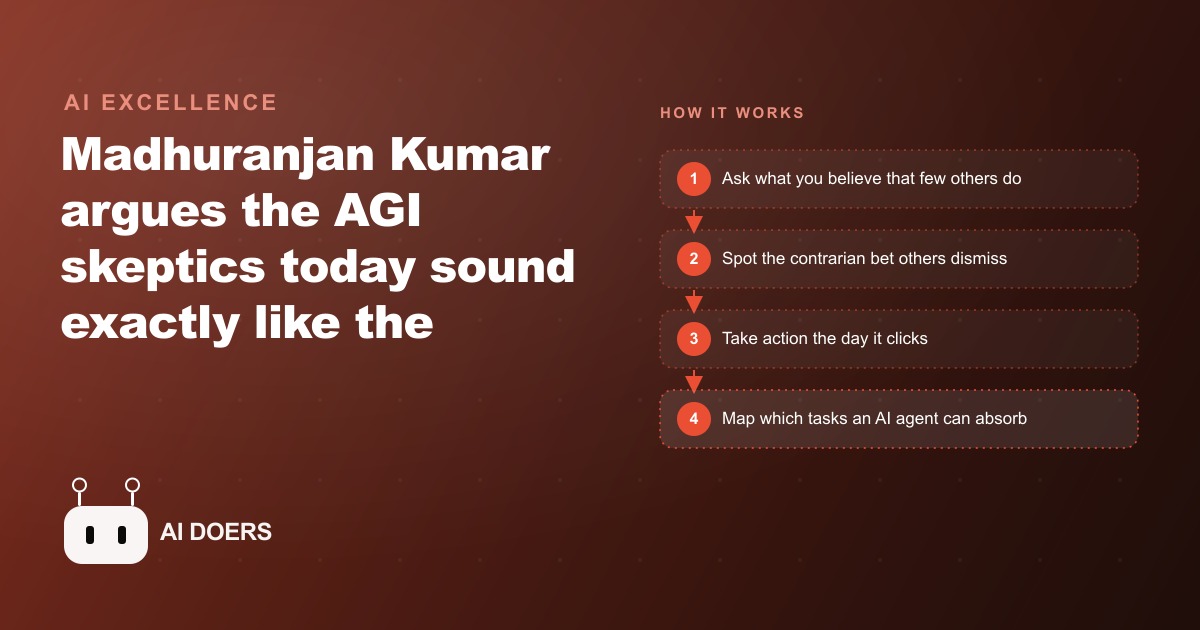
There is a famous interview question that cuts straight to where money actually hides: what do you believe to be true that very few people agree with? It is uncomfortable on purpose, because the honest answers sit in the space almost nobody is competing for. I am Madhuranjan Kumar, and I keep returning to that question because the skepticism aimed at AI right now looks exactly like the skepticism aimed at something I watched pay off a couple of years ago. The people who doubted the last shift sounded smart in the comments. The people who acted built something real. That gap between sounding smart and taking action is the entire argument I want to make here, and it matters far more for a business owner than for a spectator.
I am not asking anyone to blindly trust a prediction. I am pointing at a repeating shape. Every genuine technology shift arrives wrapped in confident reasons it will not matter, and those reasons are usually articulate, well argued, and wrong in the specific way that costs the people repeating them a lot of money. The contrarian bet is not about being reckless. It is about noticing when the crowd's certainty is aimed at the wrong target, and moving while they are still talking.
The last time the skeptics were wrong
Rewind to early 2023, when the ChatGPT moment landed and the whole world suddenly had an opinion. The obvious bet to me was simple: no code and low code tools would open AI to millions of ordinary people, not just engineers. Anyone with eyes, fingers, and a working brain could now tap into a transition that used to require a custom code team and a budget to match. That was the contrarian read. The conventional read was that this was a toy, or that only technical people would ever build anything with it.
The skeptics arrived in force, and their objections were specific. Businesses would never pay for something built on no code. Non technical people could never deliver real work with it. Those objections sounded reasonable, which is exactly what made them dangerous. They were wrong in a major way, and a great deal of what followed came from acting on the bet while the doubters were still explaining why it could not work. I have stood on the right side of that particular skepticism before, which is the only reason I feel entitled to point at the current wave of it and say, look closely, this feels familiar.
The proof that credentials were never the gate is almost comical. The people who rode that early wave hardest were not degree holders with engineering backgrounds. They were people who recognized the shift early and started. Two students who saw an early video registered their domain the same day and built an appointment setting business out of it, and what separated them from everyone who watched the same video was not qualifications. It was that they moved that afternoon. Speed of action, not a diploma, was the whole difference.
Pessimists sound smart, optimists get paid
The line I keep coming back to is that pessimists sound smart and optimists make money. That is not a call to ignore risk, and it is not a slogan for reckless optimism. It is a reminder that skepticism, on its own, produces nothing. You cannot build a business out of being right about why something will fail. You can only build one out of doing the thing, imperfectly, before it is obvious. The skeptic gets the momentary satisfaction of sounding measured and intelligent in a comment thread. The optimist gets the compounding returns of having started early. Those are not equal outcomes, and the gap between them widens every month the shift keeps going.
There is a comfortable trap in sounding smart. Caution reads as intelligence, and doubt reads as sophistication, so the incentives quietly push thoughtful people toward the sidelines. The person who says this is overhyped and here are five reasons why gets nods. The person who says I am going to try this on my actual business this week gets ignored, right up until it works. If you are the kind of owner who prides yourself on being rigorous, this is the trap most likely to catch you, because your rigor gets pointed at reasons to wait instead of ways to test.
Why owners have the most to gain, and the most to lose by waiting
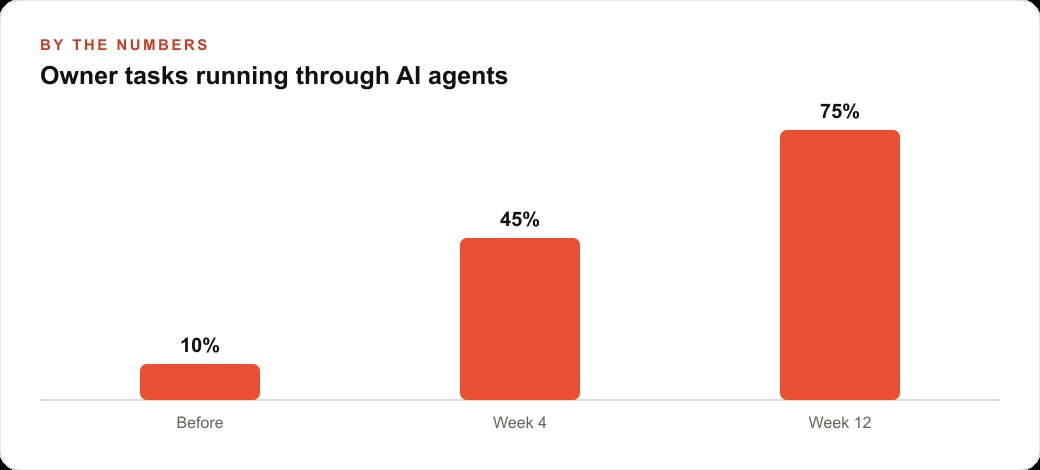
The next contrarian bet I would stake is AI operating systems for businesses, the layering of capable agents across every part of a company until a large share of the owner's daily tasks run through them. Treat any specific automation figure you hear as a prompt to test on your own workflow rather than a promise to take on faith, but the direction is unmistakable. The on ramp that used to require engineers is now open to non technical owners, and that is the part most people still underestimate because it contradicts what was true for their entire careers.
Here is the asymmetry that makes this urgent for existing owners specifically. A solo founder can start an agency faster than ever before, which is real, but the owner of an established business has something more valuable: existing workflows to automate. Layering AI across an operation that already runs compounds far faster than building from zero, because every process you already have is a candidate for the treatment. The repetitive load is already there, mapped by years of doing the work. The owner who moves first turns that load into leverage. The owner who waits watches a competitor do it and then tries to catch up from behind.
Consider a restaurant, which almost every skeptic would tell you is the wrong kind of business for any of this. That assumption is precisely the skepticism worth ignoring. The repetitive load in a restaurant is enormous and mostly invisible: reservations and waitlists, supplier orders, scheduling staff around demand, answering the same five phone questions about hours and dietary options, chasing reviews, and posting to social every day. Each of those is a task an agent can absorb. The contrarian move is not to debate whether AI applies to food service. It is to start mapping those tasks this month while everyone in the industry is still assuming it does not apply to them.
I would start with the loudest pain. If the phone never stops with the same questions, an agent handling reservations and common questions frees Madhuranjan Kumar to actually run the floor. If food cost is a guessing game, wiring the sales data into one place lets the owner ask which dishes drove the most profit last week and adjust the menu around the answer. If the social feed goes silent whenever it gets busy, an agent can draft the daily posts and specials in the restaurant's voice, and that steady content is exactly what gives Facebook and Instagram ad campaigns something to run and keeps the restaurant visible in SEO and organic search without the owner touching a keyboard. Because these tools now run from a phone, the owner can queue a task between the lunch and dinner rush, like drafting a reactivation offer for regulars who have not visited in sixty days, and the finished piece is ready by close. Those recovered regulars then land in the CRM and website stack where follow up can carry the relationship forward. The early mover advantage is real precisely because most owners in the industry will still be debating whether any of it applies to them.
The only instruction that matters
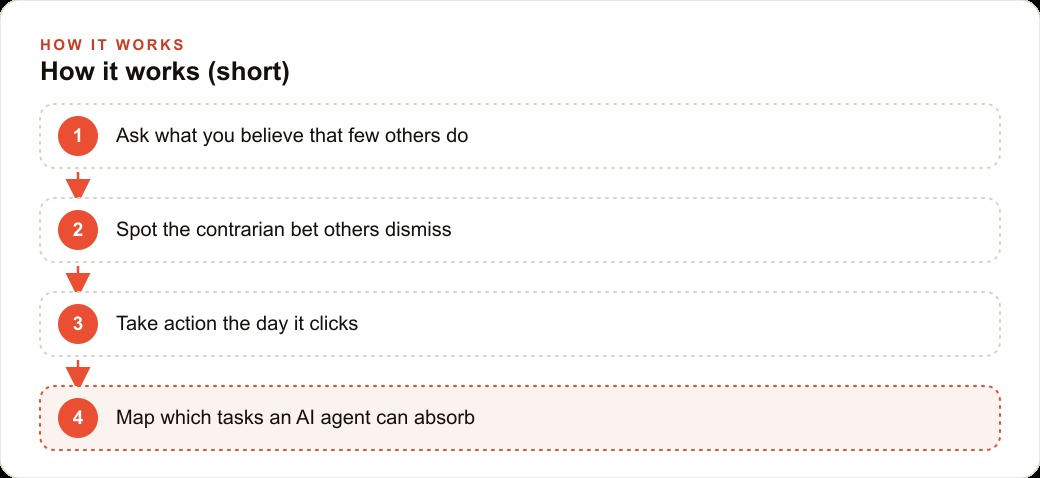
So here is the argument reduced to something you can act on. Ask yourself the contrarian question about your own business: what do you believe that few of your competitors act on? Then, and this is the part that separates the two types of people, take one action the day the idea clicks instead of arguing yourself out of it. Map the repetitive tasks an agent could absorb across your operation, pick the one that hurts most, and test it on a small slice of real work this month. Judge it by what you can genuinely hand off, not by the headline.
I have been on the right side of this skepticism once, which is not proof I am right again, but it is a reason to keep an open mind about the next call instead of reflexively reaching for the smart sounding objection. The people who benefited from the last shift were the ones who moved while others watched. The same window is open now, and it will close the same way, quietly, for the people who spent it sounding intelligent about why they waited.
How to tell a real contrarian bet from a bad one
I want to guard against the obvious misreading, because being contrarian for its own sake is a good way to lose money. Not every unpopular belief is a hidden opportunity. Plenty of things very few people agree with are unpopular precisely because they are wrong. The skill is not in being contrary, it is in spotting the specific kind of contrarian bet that pays: the one where the crowd's certainty is aimed at a target that is already shifting under their feet.
There is a useful test. A good contrarian bet usually rests on something already changing that most people have not yet priced in, and it comes with a cheap way to find out if you are right. The no code bet in 2023 fit both: the underlying capability had genuinely arrived, and testing it cost almost nothing but a weekend. A bad contrarian bet, by contrast, rests on wishful thinking and demands a huge irreversible commitment before you learn anything. So when you feel the pull of an unpopular conviction, ask whether it is grounded in a real shift you can point to, and whether you can test it small. If both answers are yes, the crowd's skepticism is your edge. If not, the crowd might simply be right.
The cost of waiting is invisible until it is not
The reason this argument feels abstract is that the cost of hesitation never shows up as a line item. Nobody sends you an invoice for the deal you did not automate, the hours you spent on work an agent could have absorbed, or the market position a faster competitor took while you deliberated. The loss is real, but it is silent, which is exactly why the smart sounding caution wins so often. There is no immediate penalty for waiting, so waiting feels safe.
But the penalty compounds quietly. Every month you spend debating is a month a competitor spends building, and the gap does not close on its own. The two students who moved the same day they saw the opportunity did not have better information than the people who watched. They had less hesitation. That is the entire moat, and it is available to anyone willing to trade the comfort of sounding measured for the discomfort of starting before it is obvious. The window on the current shift is open for the same reason the last one was, and it will close the same quiet way.
None of this asks you to bet the business on a hunch. The whole point of testing small is that a contrarian bet done right is nearly free to try and reversible if it fails. You are not committing to a prediction, you are running a cheap experiment on a real slice of your own work, and letting the result decide. The skeptic never runs the experiment, so they never learn anything the market did not already tell them. The person who runs it, even once, has information the crowd does not, and that information is where every real advantage starts.
You can absolutely act on this yourself, and I would tell any owner to map one workflow and test it this week. If you would rather have someone look at your specific business, identify the highest leverage tasks to automate, and stand up the first working system so the proof lands fast, that is exactly the kind of build I do, and you can bring me in to handle it.
That is exactly what we do at AI DOERS. Book a private 30-minute call with Madhuranjan Kumar and we will map the fastest path to it for your specific business.
Book your call →
Madhuranjan Kumar
Madhuranjan Kumar brings 20 years of performance-marketing experience and has managed over $200 million in Facebook ad spend for brands across the United States and beyond. His expertise spans the full modern marketing stack: Meta, Google Ads, TikTok, email automation, CRM, and the websites that hold it together. At AI DOERS he turns that track record into lead-generation systems for businesses across every industry.