
You Learned Claude, Now What? Become an AI Consultant
The highest value move after learning to build with AI is not building faster. It is diagnosing the real problem, prescribing the fix, and proving it worked.

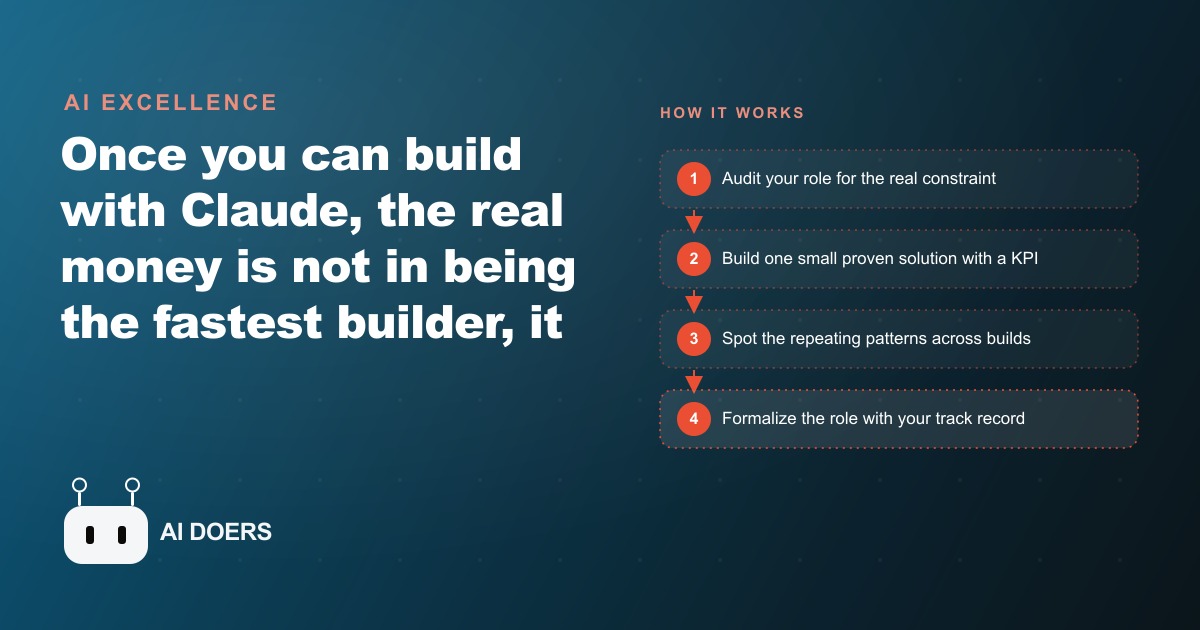
How to turn what you have learned using Claude into a consulting practice that pays
I am Madhuranjan Kumar, and the conversion problem is specific: you have used Claude extensively enough to know which prompts produce reliable results, which use cases are genuinely valuable, and which business types would benefit most from what you can do. You have not converted that knowledge into income. The steps below address that conversion directly.
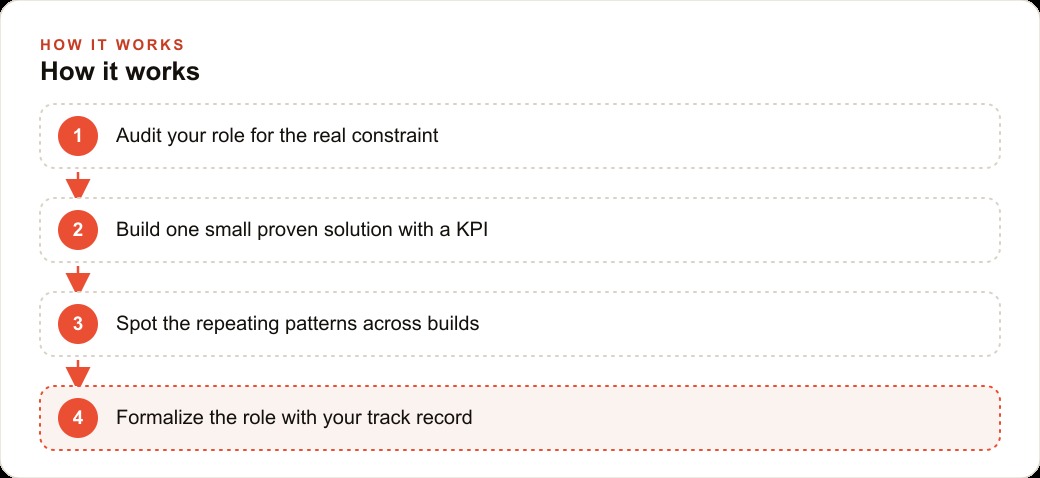
Step 1: Diagnose your own constraint before you diagnose anyone else's
The first step is not a sales call or a portfolio build. It is an honest audit of why the conversion has not happened yet.
The most common constraints I observe are three: the person knows AI tools well but cannot clearly articulate the business value of any specific application to a non-technical audience; the person has experimented broadly but does not have a single deployment they can point to and say this is live, this is working, these are the numbers; or the person has the knowledge and a working example but does not have a repeatable outreach process that generates consistent conversations.
Each of these constraints requires a different first action. The articulation problem is solved by writing out the business value of one specific application in plain language, having a non-technical friend read it, and revising until they understand it without asking a single question. The working example problem is solved by building one free deployment for a known business contact and measuring the results for 30 days. The outreach problem is solved by creating a simple weekly process and running it consistently for 60 days before evaluating whether it works.
Identify which constraint is yours before you invest time in anything else. The constraint determines which step of the following sequence matters most for your specific situation.
Step 2: Audit your own role to find the highest-value skill you can actually deliver
The range of things that can be done with Claude is wide enough that the question is not what is possible but what you can deliver reliably. A consulting offer built around capabilities you can deliver consistently is worth far more than one built around capabilities you have demonstrated once under ideal conditions.
The audit question is: in your work or experimentation with Claude, what have you done 10 or more times, with consistent results, for applications that have real business value? The answer to this question identifies your actual deliverable, not your aspirational one.
Common answers for people who have used Claude extensively include: refining customer communication (email drafts, response templates, follow-up sequences), building prompt architectures for specific recurring tasks (intake processing, content summarization, report generation), or configuring AI chat tools for specific business contexts.
Whichever of these you can demonstrate reliably is your core service offering. Do not list everything you have ever done with Claude. List the thing you can do again tomorrow with confidence, the same way you did it last time, producing a result the client can evaluate.
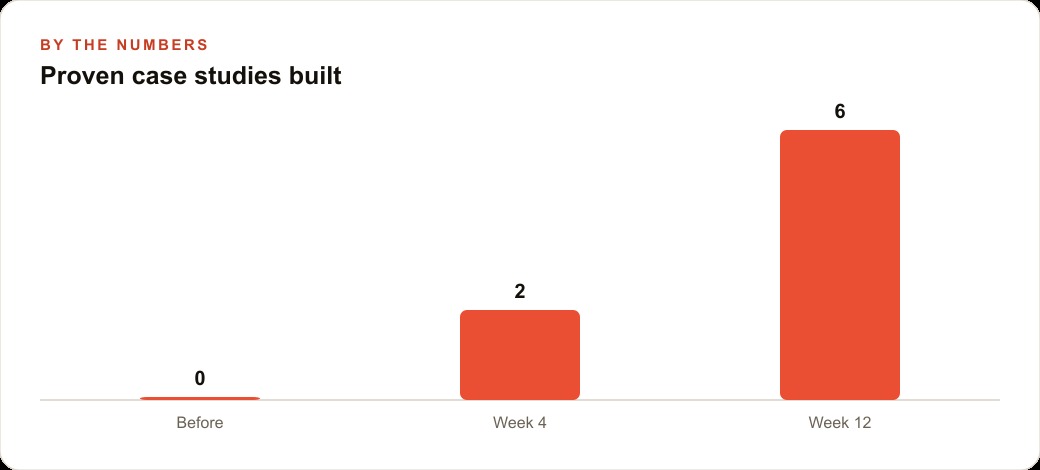
Step 3: Ship three solutions with measurable KPIs before you present yourself as a consultant
The portfolio that justifies a consulting fee is not a description of what you know. It is documentation of what happened when you applied what you know to a real business problem.
Three documented solutions are the minimum portfolio for a credible consulting pitch. Fewer than three raises the question of whether the results were replicable or lucky. Three, documented consistently, establishes a pattern.
Each documentation should follow a simple structure: what the business was doing before, what you built and how long it took, what happened as a measurable outcome, and what the business would need to do to maintain or extend what you built. This structure is not a case study format. It is an honest account of a before-and-after that a prospective client can evaluate.
The KPIs that matter most for the typical applications a Claude practitioner delivers are: time saved per week on a specific task, calls or leads handled that would otherwise have required human attention, error rate reduction in a repeated process, or response time improvement on customer inquiries. These are numbers a business owner already tracks or can easily verify. You are not asking the client to accept your definition of value. You are presenting measurable change against metrics they already care about.
Step 4: Find the repeating pattern in what you do and name the service it describes
After three documented solutions, look for the pattern. The pattern is usually visible in the type of business problem you solved, the type of output you produced, or the type of business that found the result most valuable.
If all three solutions involved taking an unstructured input, like a phone call transcript, a form submission, or a raw notes document, and converting it into a structured, actionable output, your service is structured intelligence extraction. If all three involved building a configured AI interface that handles a specific category of incoming requests without human involvement, your service is AI-assisted intake and routing. If all three involved training an AI on a specific body of knowledge and deploying it as a client-facing tool, your service is AI knowledge deployment.
Naming the pattern matters because it is what allows a prospective client to self-identify as a fit. A dentist who hears structured intelligence extraction does not immediately know whether that applies to their practice. A dentist who hears an AI that reads your intake forms, extracts the key clinical information, and routes the patient to the right appointment type within two minutes of submission knows exactly whether that applies. The specific name describes the specific outcome.
Step 5: Propose the in-house role from inside the organization
The highest-value move in a consulting practice is converting a project engagement into an ongoing role. The moment this becomes available is when you have done enough work inside a client's organization to understand their operations better than any outside consultant could from a proposal document.
The proposal for an in-house role should come from inside an active engagement, not as a cold ask. The right moment is when you have delivered a result that the client values, when you have observed additional AI applications inside the organization that you have not yet been asked to address, and when you can articulate specifically how the organization would benefit from having AI implementation capacity on a permanent basis rather than on a project basis.
The framing is not I should become your employee. The framing is the work we have done together has produced results you are measuring. There are three other operational areas I have identified where the same approach would produce similar results. Managing that work on a project basis will produce slower progress than if you had someone whose sole focus was applying these tools across the organization as a standing function. I can structure an engagement that provides that function.
This proposal is distinct from a retainer in that it positions you as a function, not a vendor. A vendor delivers a service. A function solves a class of problems. Functions are harder to replace and more central to the organization's operations than vendors. The consulting practice that converts its best project engagements into function-level roles is the one that builds durable income without continuous client acquisition.
The conversion from practitioner to consultant to function follows a sequence, but the sequence only starts when you have documented what happened when you applied what you know. The documentation is what earns the next conversation. The next conversation is what earns the retainer. The retainer is what earns the in-house proposal. Start with the documentation.
Step 6: Document failure cases with the same rigor as successes
The consulting practice that only documents its successes builds a portfolio that sophisticated clients distrust. Every AI implementation produces some failure cases: the agent that misunderstood a question, the summarization that missed a critical detail, the routing that sent a lead to the wrong team member. Experienced clients who have tried to implement AI tools internally know these failure cases exist and are specifically looking for whether a consultant acknowledges them.
Document the failure cases from every engagement: what broke, when, under what conditions, and what the fix was. This documentation serves two purposes. First, it builds your diagnostic expertise: you now have a reference library of specific failure modes and their resolutions that informs every future implementation. Second, it builds client trust: a consultant who says here are the three cases where the agent gave a wrong answer in the first two weeks, what caused each one, and what we changed to prevent recurrence is presenting themselves as someone who monitors and corrects, not someone who builds and disappears.
The failure documentation also surfaces patterns that inform the next deployment. If the same type of question causes the same type of failure across three different clients, you have identified a structural limitation of your implementation approach for that question category. The fix you apply to the third client becomes the prevention you apply to the fourth client before it ships.
Step 7: Build the handoff document that makes you replaceable and therefore more valuable
This step is counterintuitive: building a document that makes you replaceable is one of the most effective things you can do to secure long-term client relationships. The handoff document is a complete technical guide to everything you built, how it works, what it connects to, how to update it, and what to do when something breaks. A client who has this document can in principle replace you. In practice, clients who have this document renew their retainers more reliably than clients who do not.
The reason is psychological and practical in equal measure. A client who does not have the handoff document is dependent on you and knows it. Dependence produces anxiety. An anxious client is more likely to resent the relationship and terminate it at the first sign of friction. A client who has the handoff document knows they could replace you if they needed to, and this knowledge removes the anxiety. The document converts a captive relationship into a chosen one. Chosen relationships renew; captive ones escape.
The practical reason is that a client who has the handoff document can make small updates themselves without calling you for every change. They update the knowledge base when a pricing change goes live, without waiting for your next check-in. They log the issue they observed in the agent's response and send it to you with context, rather than calling with a vague complaint. The documentation enables a client relationship where your involvement is focused on the high-value work rather than routine maintenance that the document equips them to handle themselves.
The compounding return that documentation produces over 18 months
The documentation discipline compounds in a way that pure skill development does not. A practitioner who develops skills without documenting them has skills that exist only in memory and cannot be transferred, referenced, or audited. A practitioner who documents every implementation has an asset that grows independently of the number of hours worked.
At 6 months, the documentation library has enough case studies to establish credibility with new clients in the verticals you have served. At 12 months, it has enough cross-vertical patterns to support a consulting methodology that can be articulated and sold explicitly. At 18 months, the library represents a genuine institutional knowledge base that produces referrals from other practitioners who want to learn from your documented experience and clients who recommend you because they have seen the documentation quality that backs your work.
The compounding effect is not linear. Each new case study adds less marginal value to the library than the previous one when it comes to basic credibility, but it adds increasing value to the pattern recognition that informs your diagnostic capability and the depth of evidence you can provide to clients with specific questions about your track record in their category of problem. Depth of vertical knowledge, documented systematically, is what converts a freelance practice into a recognized consultancy.
That is exactly what we do at AI DOERS. Book a private 30-minute call with Madhuranjan Kumar and we will map the fastest path to it for your specific business.
Book your call →
Madhuranjan Kumar
Madhuranjan Kumar brings 20 years of performance-marketing experience and has managed over $200 million in Facebook ad spend for brands across the United States and beyond. His expertise spans the full modern marketing stack: Meta, Google Ads, TikTok, email automation, CRM, and the websites that hold it together. At AI DOERS he turns that track record into lead-generation systems for businesses across every industry.