
What the Latest AI News Actually Means for Your Business
App builders that write software from a sentence, faster local chips, and stronger models are landing fast. Here is how a small business turns that news into a real tool.

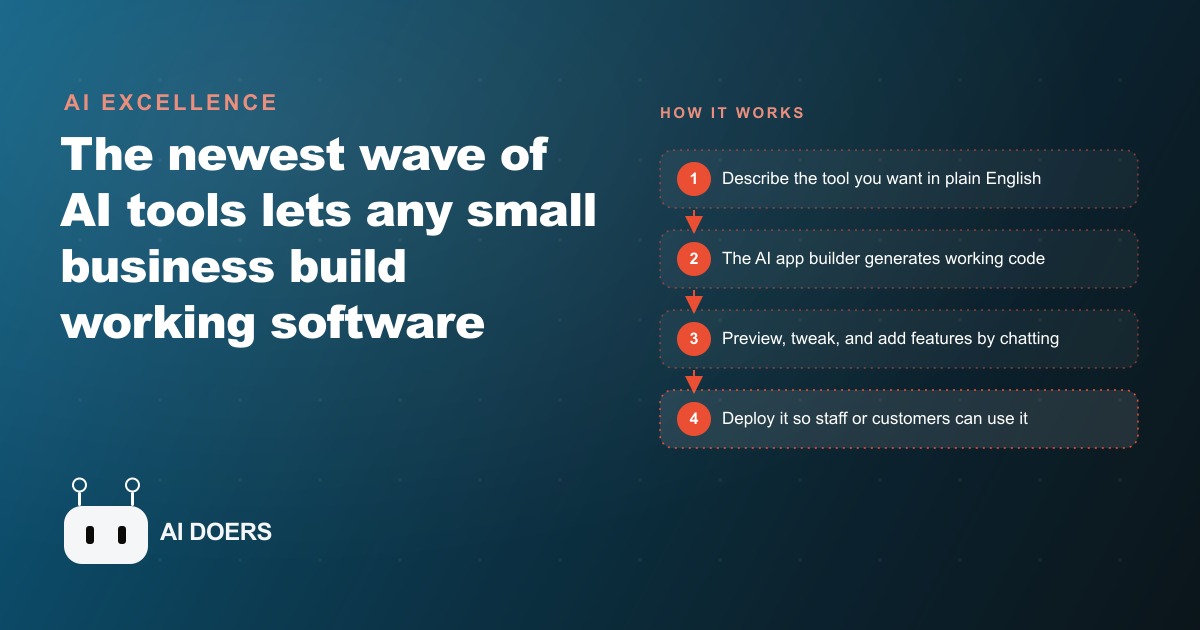
Every week, AI drops five new announcements. Most of them do not matter to your business this month. One of them might change what you ship this week. The skill is knowing which is which before you spend two days reading about the one that has no practical application for another three years. I am Madhuranjan Kumar, and the most recent wave of announcements is a clear example of exactly this split.
The week included Google launching a browser-based app builder, new model versions signaled to be close to release, Apple shipping faster chips for on-device AI, a quantum computing milestone, and reports that larger AI labs are restructuring their teams. Four of those are background signal worth knowing about but not acting on this week. One is something you can use today, for free, in an afternoon. The rest can wait.
The chip news and the quantum milestone do not touch your business yet
Let me say this plainly, because how you spend your attention is a real resource allocation decision.
Apple shipping faster M5 chips that run AI models on-device more quickly is real progress. It is progress for developers building local AI applications and for power users who want to run large models without cloud subscriptions. For a dental practice, a landscaping company, a law firm, or an e-commerce store, the M5 speed improvement does not change any tool you use this week. Your business runs cloud-based tools. The on-device speed improvement becomes relevant to you when the specific software you use shifts to local inference, and that transition is still in progress across the industry. It is coming. It is not here yet in the form of tools you can pick up and use today.
The quantum computing milestone from Google is genuinely significant within computational chemistry and materials science, where it opens the door to simulations that classical computers cannot perform at relevant timescales. It is not significant for your marketing workflow, your client intake process, or your inventory management system. Quantum computing will eventually have downstream effects on encryption and optimization at scale, but those effects arrive through the software you already use, mediated by years of additional engineering work. There is nothing to act on now in your operations.
Reports that larger AI labs are restructuring their teams and running leaner organizations are interesting as industry context. They confirm that AI is already producing enough leverage internally that fewer people can carry more impact. For a small business this is actually encouraging context: small, focused operations with access to these tools have a real structural advantage right now. That is worth holding as perspective. It is not an action item for this week.
The reason I am spending time on what not to act on is that the noise-to-signal ratio in AI news is currently very high, and reading the noise has a real cost. Every hour spent following announcements that do not change your week is an hour not spent building the thing that does change it. Filtering ruthlessly is the skill that compounds most quickly right now.
The one release you can use before Friday
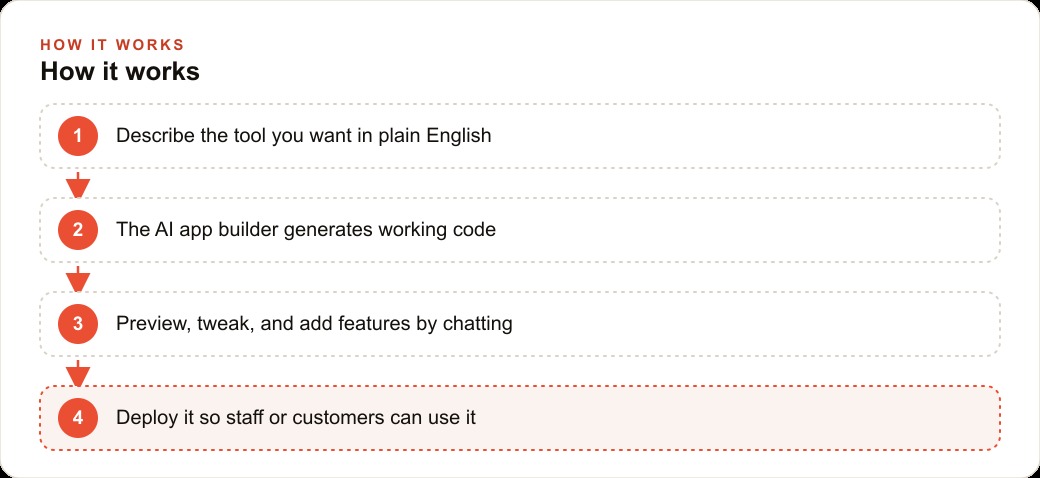
The announcement that actually changes your week is the browser-based app builder. Google launched a tool that takes a plain-English description of a software tool and builds a working web application from it, from initial description all the way to something you can deploy and share a link to. In the public demo it built a small working application in about 78 seconds.
You type a description of the tool you want. The system writes the code. You see a live preview on both desktop and phone layouts simultaneously. You continue talking to it in plain English to add features, change form fields, adjust the confirmation message, or modify the layout. You can view the differences between versions, restore an earlier checkpoint if something breaks, and when you are satisfied, deploy the result so real people can use it.
The hard technical parts that used to require a developer, database connections, file storage, user authentication, are exactly the integrations these tools are actively adding. For simple internal tools, you can already get a working, usable result without touching a single line of code. This is the part of the announcement that matters for your business this month.
What makes this different from earlier AI coding tools is the combination of speed and deployability in a single session. Earlier tools generated code you then had to figure out how to run somewhere. This one builds and deploys in the same session. The loop from idea to live tool is now measured in minutes for simple applications, and simple applications are exactly what most small businesses need most: a form that collects information, a calculator that estimates a price, a checklist that tracks a process.
If you currently manage client relationships and project intake through a CRM and website stack, an app builder lets you extend that with a custom client-facing form that pre-qualifies leads before they reach your team. That is a concrete, available improvement this week, with no developer cost for the first version.
Why starting small is the only way to actually start
The mistake most businesses make when they encounter a new capability like this is treating it as a strategic project. They think through all the tools they could build, identify the most valuable one, start planning the features, and then never build anything because the planning phase expands to fill all available time without producing anything deployable.
The correct move is to start with one specific, contained task and build it this week. Not the most important thing you could build. The most contained thing. The task that takes your team more than ten minutes per day and involves collecting information, performing a simple calculation, or producing a consistent output from a template. That is your first build. The sole criterion for choosing it is that it is small enough to complete and test in one afternoon.
Here is how I would set this up for a dental practice as a concrete example. New patient intake is currently handled almost entirely over the phone or through a PDF form emailed back and forth. The front desk re-types the information into the scheduling system. Every new patient call takes eight to twelve minutes of staff time. The first build is simple: a mobile-first web form that collects the patient's name, phone number, email address, insurance provider, preferred appointment days, and reason for visit, with a clear thank-you screen and a summary sent to the front desk by email.
I describe that tool to the app builder in one paragraph. The builder generates the page. I preview it on a phone, since most patients will open it from a text link. I add two small things by chatting: a note that the office will confirm within one business hour, and a field asking whether the patient is new or returning. I test it end to end by submitting real information and confirming the summary arrives correctly at the front desk email. I deploy it and put the link in the practice's appointment reminder texts and at the top of the website contact page.
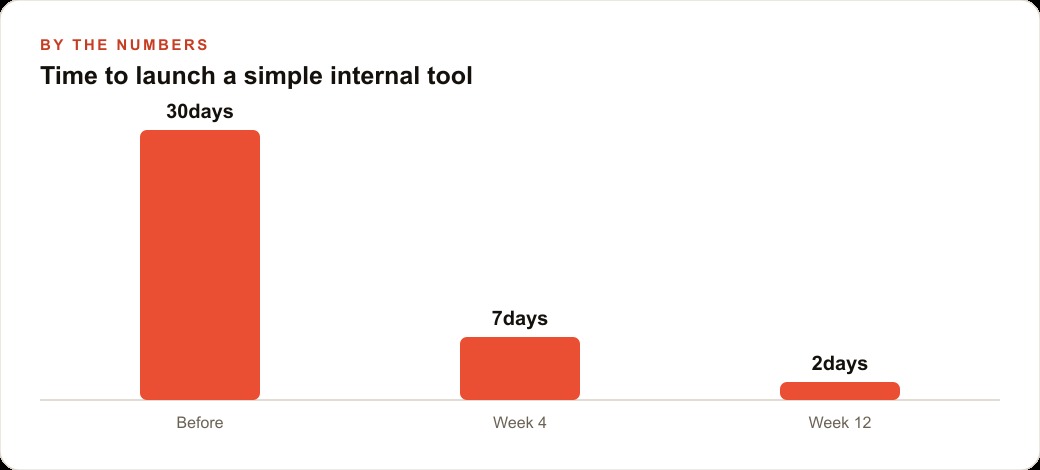
The result is measurable: fewer incoming calls for routine intake, cleaner information arriving in a usable format, and staff time freed for patients already in the office. None of this required a developer for the first version. The build, test, and deploy sequence takes one afternoon. When that first tool earns its keep for a month, you build the next one. The compounding comes from the habit, not from any single tool.
The discipline of starting small also teaches you something important about scope. Most first-version tools turn out to be smaller than you thought they needed to be. The dental practice intake form only needed four fields, not fourteen. Adding a field for insurance provider and a field for preferred appointment day doubled the useful information the front desk received without adding friction that would cause patients to abandon the form midway. That insight, that less form fields means more completions, is something you only discover by building and testing a real first version with real users. Reading about form design does not teach it the same way. The first build is as much a learning exercise as a production tool, and keeping it small is what makes it fast enough to be worth the lesson. A form that takes 90 seconds to complete and feeds the right fields to your scheduling system earns more than a sophisticated tool nobody finishes using.
The discipline of starting small also teaches you something important about scope. Most first-version tools turn out to be smaller than you thought they needed to be. The dental practice intake form only needed four fields, not fourteen. Adding a field for insurance provider and a field for preferred appointment day doubled the useful information the front desk received without adding friction that would cause patients to abandon the form midway. That insight, that less form fields means more completions, is something you only discover by building and testing a real first version with real users. Reading about form design does not teach it the same way. The first build is as much a learning exercise as a production tool, and keeping it small is what makes it fast enough to be worth the lesson.
For practices running Facebook and Instagram ads to drive new patient inquiries, replacing a generic contact page with a fast, mobile-optimized intake form meaningfully improves the conversion rate on paid traffic. The ad drives the click. The form works correctly on a phone. The lead is captured cleanly and routed to the right person. That sequence is worth optimizing independently from the ad spend itself.
The human checkpoint that keeps AI from costing you
Every tool built with an AI app builder comes with an implicit promise: you describe it, it builds it, it works. That promise holds reliably for simple tools. It becomes unreliable as the tool handles more complex logic, touches sensitive data, or connects to systems that affect money or records.
The rule I apply for every client is a mandatory human checkpoint before the tool touches anything that matters. Before a patient's data goes anywhere, a person reviews the form and the destination to confirm both are correct. Before a pricing calculator publishes quotes to customers, a person runs test cases covering the edge cases and verifies the output math. Before a workflow automation touches CRM records or billing data, a person audits a sample batch manually. The AI builds quickly. A person approves before the build goes live.
This is not excessive caution. It is the correct division of responsibility between a tool that is very fast at producing working first drafts and a person who is better at catching the edge-case failures that the tool did not test for itself. The speed benefit of the app builder comes entirely from the building phase. The human checkpoint happens once, at the end, before the tool is deployed. It adds 30 minutes to a process that otherwise takes hours or days by hand. That 30 minutes is the thing that prevents a fast first draft from becoming an expensive mistake when a real user hits an edge case the model did not anticipate.
The practical implication is to begin with non-critical operations and work toward critical ones over time. Start with the intake form, not the billing integration. Start with the estimate calculator that sends a summary email, not the one that creates records directly in your accounting system. Build the connection to critical systems as a second or third phase, after the core tool has run cleanly for a few weeks and you have real confidence in its behavior under actual conditions.
The chip news and the quantum milestone are real progress in a direction that will eventually reshape what software your business uses. What you can act on today is considerably simpler: pick one manual task, describe it in plain English to a free app builder, build a working first version in an afternoon, test it before it reaches a single real user, and deploy it. The businesses that are building small useful tools right now are building a compounding advantage over the ones that are still reading about quantum computing and waiting for the perfect moment to start. The perfect moment is this afternoon, with the most contained problem you have.
That is exactly what we do at AI DOERS. Book a private 30-minute call with Madhuranjan Kumar and we will map the fastest path to it for your specific business.
Book your call →
Madhuranjan Kumar
Madhuranjan Kumar brings 20 years of performance-marketing experience and has managed over $200 million in Facebook ad spend for brands across the United States and beyond. His expertise spans the full modern marketing stack: Meta, Google Ads, TikTok, email automation, CRM, and the websites that hold it together. At AI DOERS he turns that track record into lead-generation systems for businesses across every industry.