
Knowledge Embedding 101: Give AI Your Business Knowledge
A plain AI knows a lot in general but nothing about your business. Here is how knowledge embedding grounds it in your own documents, with an auto repair shop example.

The company's real knowledge almost never lives in its documents. It lives in the heads of the people who have been there the longest, in the habits that evolved without being written down, and in the judgment calls that get made the same way every time because that is how it has always been done. I am Madhuranjan Kumar, and knowledge embedding is the technical method that closes that gap by grounding an AI model in your actual documents so it answers from your real content rather than from generic training data.
Grounding an AI in your own documents is a real technical method that has become practical for small businesses
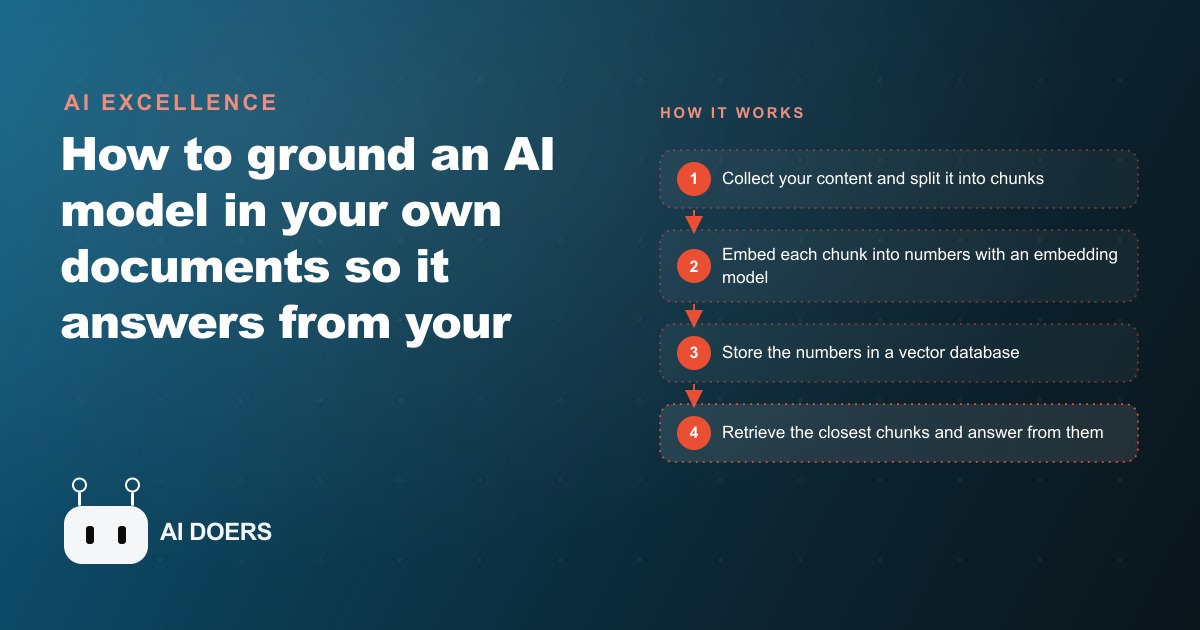
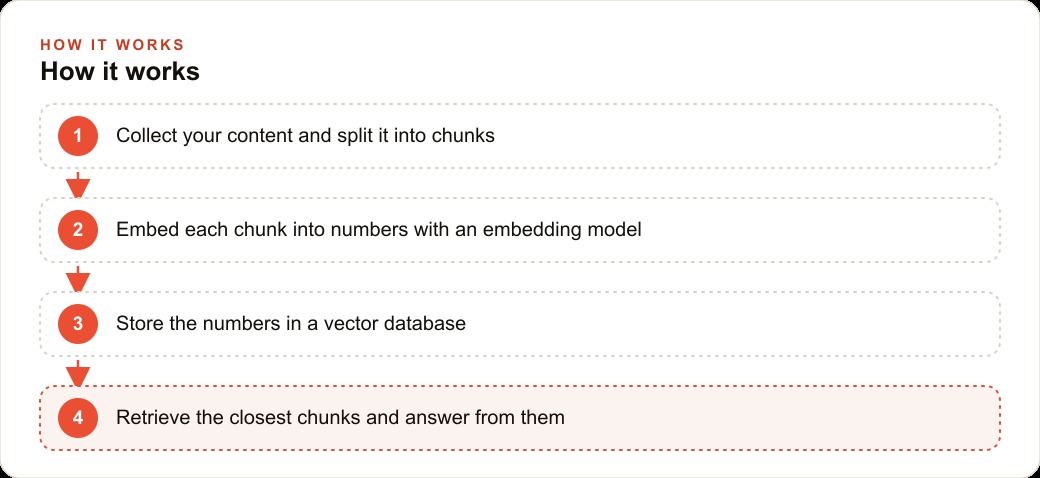
The technique is called retrieval-augmented generation, and the idea is simpler than the name suggests. Instead of asking an AI model to answer from memory, which is training data that may be months old and has no knowledge of your business specifically, you give it a library of your own documents and have it search that library before answering. The search finds the most relevant sections. The model reads those sections and builds its answer from them. The output is grounded in your actual content rather than in whatever the model last learned about your industry in general.
This is different from simply pasting your documents into a chat. Pasting has a limit, and large document collections cannot fit into a single conversation. Knowledge embedding creates a permanent, searchable library that the model can query on demand, returning exactly the sections most relevant to each question without reading everything every time. The library can grow indefinitely, and queries against it stay fast regardless of how large it becomes.
The reason this became accessible to small businesses recently is that the components, the embedding models, the vector databases, and the retrieval logic, are now available as managed services with free tiers and simple APIs. You do not need to run your own infrastructure. You describe what you want to a builder tool, it connects the pieces, and you have a functional knowledge base in hours rather than months.
The difference between embedding and fine-tuning determines whether you solve the right problem
The confusion between these two approaches trips up a lot of people who are serious about using AI for business. Fine-tuning changes how a model talks: it adjusts the model's weights based on examples, making it sound more like a specific persona or follow a specific style more consistently. It is the right tool when the problem is voice, tone, or behavior patterns.
Knowledge embedding is the right tool when the problem is facts and specifics. A fine-tuned model that sounds like your business but does not know your pricing, your procedures, or your policies is a better-speaking wrong answer. An embedded model that pulls from your actual pricing sheet and your actual procedures is a right answer that sounds like generic AI. For most business use cases, accurate facts matter more than voice, which is why embedding is almost always the first thing to build.
The practical test for which approach you need is simple: what is the failure mode you are trying to fix? If the AI gives you answers that sound wrong, fine-tuning might help. If the AI gives you answers that are factually wrong about your business specifically, embedding is the fix. Most small businesses are experiencing the second failure, not the first.
Vector search is what makes retrieval fast enough to use in production
An embedding is a list of numbers that represents the meaning of a piece of text in a mathematical space where similar meanings land near each other. When you convert your documents into embeddings, you are translating them into a format where a search engine can find the sections most similar in meaning to any question, even if the question uses different words than the document does.
This is the key difference between keyword search and semantic search. Keyword search finds documents that contain the exact words in the query. Semantic search finds documents whose meaning is close to the query, which means it can find the section about your refund policy when someone asks about getting their money back, even if your policy document says something different from what the customer typed.
A vector database is built to store and search embeddings quickly. The actual search process takes milliseconds on modern infrastructure, which is why the retrieval step does not meaningfully slow down the response time for the user. The database holds hundreds or thousands of document chunks in embedding form, and when a query arrives, it calculates the similarity distance between the query embedding and every stored chunk, then returns the closest ones. Those closest chunks are what the model reads to build its response.
The data preparation step is where most deployments quietly fail
The quality of the knowledge base is determined almost entirely by the quality of the source material and how it is structured before embedding. Documents that are poorly formatted, ambiguous, or internally inconsistent produce retrievals that are poorly formatted, ambiguous, or internally inconsistent. The model cannot improve on what it is given to retrieve from.
The most common failures at the preparation stage are chunking too aggressively, splitting documents into pieces so small that each chunk loses the context that makes the answer meaningful; embedding irrelevant content, including everything in a document folder without evaluating whether each piece actually contains useful operational knowledge; and failing to clean up conflicting information, where multiple documents say different things about the same procedure and the retrieval returns one without surfacing the conflict.
For an auto repair shop, the preparation exercise starts with gathering the real source material: the actual service procedures the mechanics follow, the real pricing list with the current labor rates, and a selection of the customer email exchanges where the best service advisor explains a diagnosis and estimate. Those three categories contain the knowledge that a new hire most needs and most often lacks. The procedures tell them how to do the work. The pricing tells them what to quote. The email examples show them how to communicate about it in a way that matches the shop's standards.
Each document gets cleaned, standardized, and split into sections that contain complete thoughts rather than fragments. The procedures become step sequences with enough context in each step that retrieving any individual step still makes sense. The pricing becomes structured entries that the model can match against a described service. The email examples become tone and reasoning references that the model can draw on when drafting a response to a customer asking something similar.
After embedding, the right validation process is to ask the questions that matter most and verify that the retrieved chunks are the right ones. If you ask what is the standard labor rate for a brake job and the system retrieves the section about oil change pricing, the chunking or the metadata needs adjustment. If you ask how do we explain a head gasket repair estimate to a worried customer and the system retrieves a relevant email example, the system is working. The test is always whether retrieval finds the right content for the questions that actually come up in the business.
The investment in a clean, well-prepared knowledge base pays back every time a junior employee produces a response that reflects the shop's standards rather than guessing. It pays back every time a new hire answers a customer question correctly on their first week rather than their third month. And it pays back every time the owner does not have to explain the same procedure twice because the explanation is already in the system. For businesses investing in web and CRM systems and considering Google Ads to drive new customer acquisition, the knowledge base also answers the foundational question of what to say when a lead arrives: the procedures, the pricing, the tone, and the reasoning are all there and consistent, regardless of who answers. ## A concrete example: the auto repair shop knowledge base in practice
The auto repair shop example is worth making specific enough to be replicable. The shop has been in operation for eleven years, with one master mechanic who has been there since the beginning and three technicians at various experience levels. The master mechanic handles all the complex diagnostic work, advises on unusual repairs, and manages the customer conversations about expensive estimates. The service advisors write the repair orders and communicate pricing to customers.
The problem is visible in the first week of any new service advisor's tenure: they do not know how to explain a diagnosis in terms that match the master mechanic's reasoning. A customer asks why the head gasket repair costs $2,400, and the new service advisor gives a technically accurate but unconvincing answer that the mechanic would never use. The customer leaves uncertain, sometimes to get a second opinion, sometimes simply dissatisfied with a service they would have trusted if the explanation had matched the shop's actual reasoning.
The knowledge base was built from three sources. First, twelve months of repair order notes from the master mechanic, capturing the diagnostic reasoning for the forty most common complex repairs: what it means when those symptoms appear, why the standard repair is the right approach, what the consequences of deferring the repair are, and how to explain the cost in terms of the value delivered. Second, pricing logic: the hourly rates, the part cost markups, and the specific reasoning behind each category of charge that is most often questioned. Third, thirty customer email exchanges selected specifically because they showed how the master mechanic explains difficult conversations: a repair that is more expensive than the car is worth, a repair that cannot be guaranteed to fix the symptom completely, a situation where the customer's requested repair is not actually the right one.
After embedding, the knowledge base was tested with the exact questions new service advisors struggle with. Asked why does the timing chain replacement cost this much, the system retrieved three relevant chunks: the master mechanic's notes on timing chain diagnosis for this engine family, the pricing logic for labor-intensive internal engine work, and an email where he had explained to a customer why the cost was necessary and what would happen if the repair was deferred. The response the knowledge base generated for the advisor reflected the shop's actual reasoning, not generic auto repair advice.
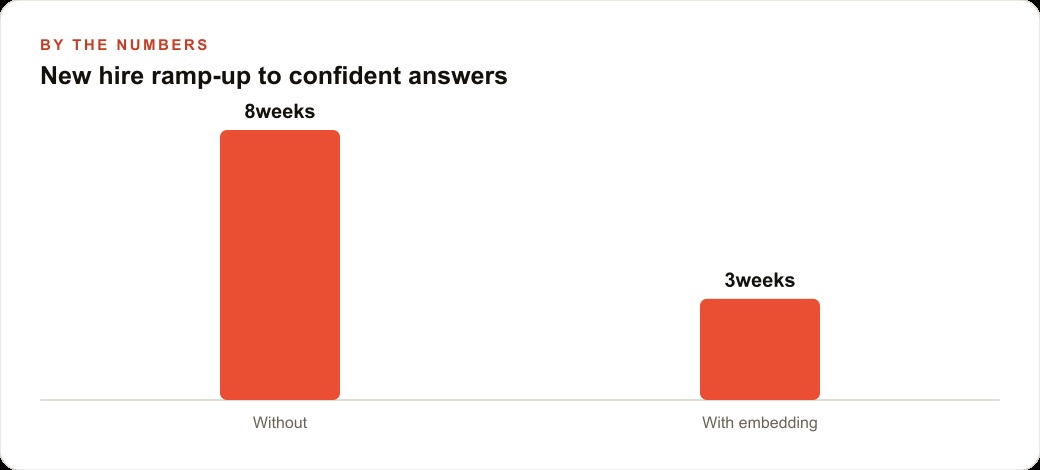
The onboarding time for a new service advisor dropped from roughly eight weeks to achieve confident, consistent customer explanations, to three weeks. The first two weeks are still spent learning the shop's procedures. The third week is spent practicing customer conversations with the knowledge base supporting them, which produces advisors who can handle the twenty most common difficult conversations accurately before they handle them live.
For businesses investing in Google Ads or Facebook and Instagram ad campaigns to drive new customer acquisition, this kind of knowledge base also improves the conversion rate on inquiries. The common objections and questions that potential customers raise on the phone or in email are handled more consistently and more convincingly when every person answering has access to the same high-quality explanations that the best person in the shop gives. The investment in acquisition works harder when the conversion rate on inquiries improves.
The maintenance practice that keeps the knowledge base current is simple: once per month, the master mechanic reviews any repair order notes from that month that surfaced an unusual or unusually difficult customer conversation, and adds the best explanation to the knowledge base. The time required is thirty to forty minutes per month. The knowledge base grows by roughly ten to fifteen new entries per year, each one reflecting a real situation rather than a hypothetical one, and each one directly improving how the shop's staff handle similar situations in the future.
The principle that makes knowledge embedding more valuable than any single AI conversation is the compound return on investment. Every conversation you have with a model that does not have your business context produces a generic output you need to customize. Every conversation you have with a model that has deep, accurate context about your domain produces a specific output that is close to ready. The difference in effort between those two scenarios is large, and it compounds across every session you run. Building the embeddings is a one-time investment per domain. Using them is a recurring return on that investment that gets more valuable as the volume of queries grows.
That is exactly what we do at AI DOERS. Book a private 30-minute call with Madhuranjan Kumar and we will map the fastest path to it for your specific business.
Book your call →
Madhuranjan Kumar
Madhuranjan Kumar brings 20 years of performance-marketing experience and has managed over $200 million in Facebook ad spend for brands across the United States and beyond. His expertise spans the full modern marketing stack: Meta, Google Ads, TikTok, email automation, CRM, and the websites that hold it together. At AI DOERS he turns that track record into lead-generation systems for businesses across every industry.