
Kimi K2 vs Claude: An 80% Cheaper Coding Model You Run Inside Claude Code
Kimi K2 is an open-source model that codes at a level between Claude 3.5 and Claude 4 for about a fifth of the price. Point Claude Code at its endpoint and a full IDE-plus-game build came to roughly 50 cents instead of about 2 dollars.

When Anthropic's Claude 4 launched, it became the clear leader for AI-assisted coding by a margin that mattered in practice. The benchmarks were strong, but the more compelling proof was from developers building real production software: it reliably produced better code on harder tasks than any available alternative. The problem was never the quality. It was the bill, and the bill has quietly shaped which businesses can afford to build on it at scale.
I am Madhuranjan Kumar, and the question that drives this piece is one I hear regularly from founders and agency owners running AI-assisted development at volume: the best model for coding is genuinely excellent, but when does the cost stop being justified by the output? Kimi K2, an open-source model from the Chinese company Moonshot AI, just changed the answer to that question. Here are seven things that hands-on testing revealed about the true cost of AI-assisted coding at this new price point.
1. Claude 4 held the coding crown but its pricing made production-scale agents commercially fragile
At three dollars per million input tokens and fifteen dollars per million output tokens, Claude 4 is priced as a premium professional service. For a developer running occasional coding sessions, the monthly bill is manageable. For a business trying to serve external customers through an AI-assisted product, or an agency billing clients for AI-assisted development work at volume, the math becomes increasingly difficult. The heaviest users of any AI coding platform are also its most valuable customers. They extract the most from the product, show up most consistently, and represent the clearest case for what the product can eventually become. At Claude 4 pricing, they are also often the most expensive to serve, with per-session model costs that can exceed the revenue from a subscription tier. That dynamic makes certain categories of business commercially fragile. Platforms offering unlimited AI coding assistance cannot hold the economics together if every active session runs on the most expensive available model. This is not a criticism of model quality. It is a statement about what it costs to build on frontier models at scale, and Kimi K2 addresses that problem directly.
2. The swap takes five minutes and your existing workflow changes nothing
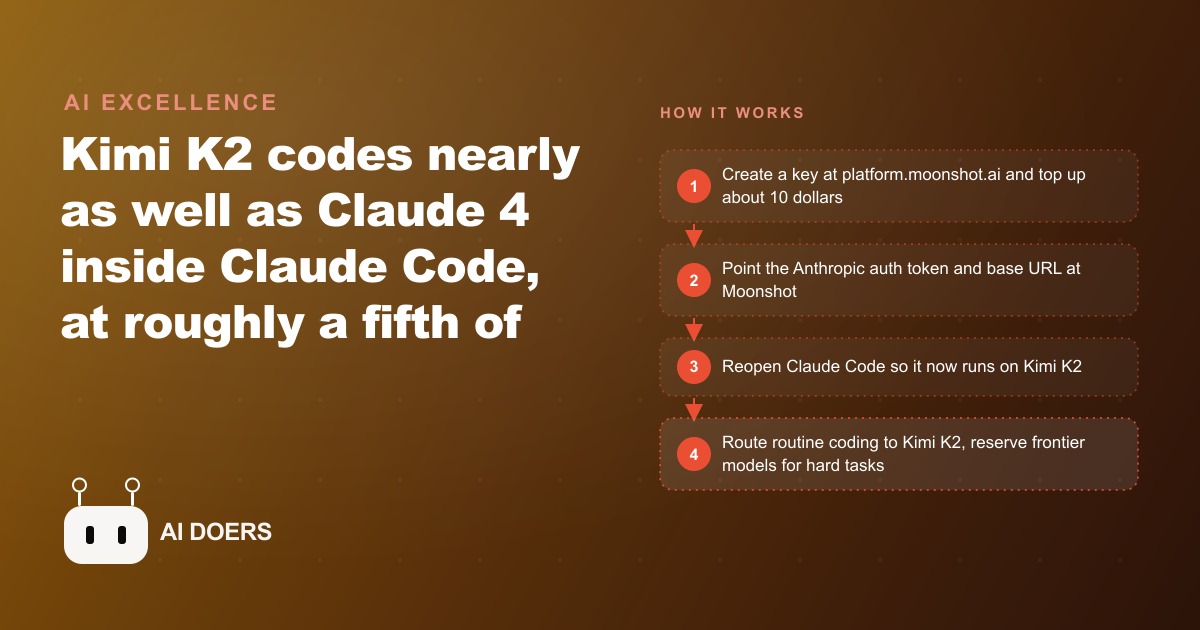
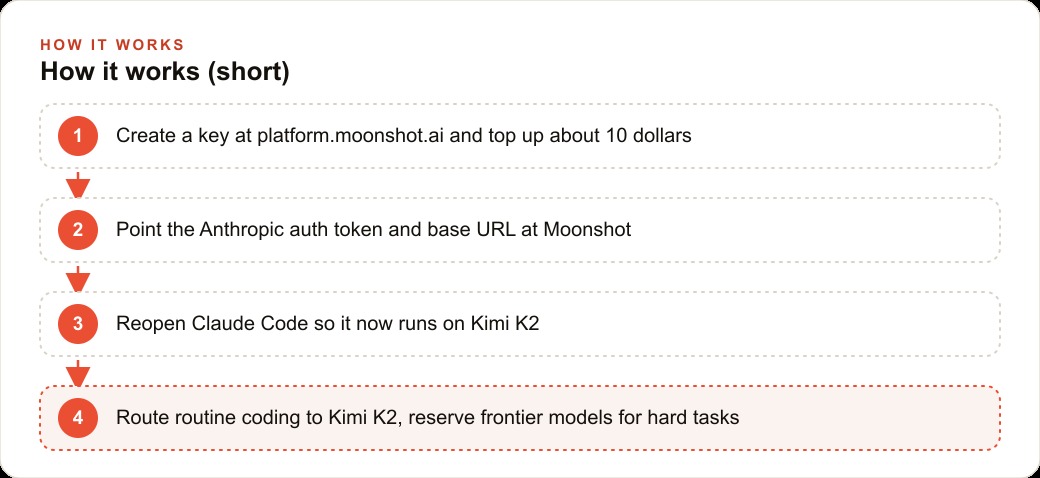
The setup to point Claude Code at Kimi K2 instead of Anthropic's models requires changing two environment variables. Create an API key at platform.moonshot.ai and top up about ten dollars in credits. Export the Anthropic auth token set to your Moonshot key. Export the Anthropic base URL pointed at Moonshot's API endpoint. Reopen Claude Code and it runs on Kimi K2. Nothing else changes. Your CLAUDE.md files, your custom slash commands, your hooks, your git worktrees: all continue to work exactly as before because the Moonshot API is designed to mirror a standard OpenAI-compatible interface. There is no code to rewrite, no tool to reinstall, and no workflow to rebuild from scratch. The five minutes spent on the configuration change is the entire migration cost, and it is fully reversible in the same time if the quality on your specific tasks does not meet the bar. The usual objection to switching infrastructure is disruption. A five-minute, zero-disruption swap removes that objection entirely and allows a genuine quality evaluation under real working conditions rather than in an isolated test environment.
3. Real build quality landed in the range between Claude 3.5 and Claude 4, not just benchmark territory
The honest position after hands-on testing is that Kimi K2 produces output quality that sits somewhere between Claude 3.5 and Claude 4 on the kinds of tasks that represent real-world development work: building UI components, wiring API endpoints, writing test suites, refactoring existing code, and scaffolding new projects. It is not Claude 4. The quality gap is real. But it is also not distant, and for a substantial share of everyday coding tasks, the gap does not change the practical outcome. Production software is mostly well-understood, well-scoped work. A CRUD endpoint, a form component, a data processing script, a test stub, a documentation block: these tasks do not require frontier model reasoning. They require reliable code generation at a quality level that is sufficient for the task, not necessarily the highest achievable. Kimi K2 covers that range comfortably. The tasks that genuinely benefit from Claude 4's additional capability, subtle concurrency bugs in distributed systems, security-critical authentication logic, performance-sensitive code paths that require understanding what the machine is actually doing, are a smaller fraction of the total workload. Routing those specific tasks to the frontier model and running everything else on Kimi K2 is the decision framework that makes the economics work without compromising the outputs that matter most.
4. A complete browser-based IDE with tree explorer, rich editor, and resizable panels cost roughly 25 cents
The most demanding single-task test in the session was building a full IDE-style interface from scratch. The requirements were an integrated file tree explorer showing a project structure, a rich text editor with syntax highlighting, a live app preview pane, and resizable panels adjustable independently, all wired together into a coherent online code editor. This is a non-trivial front-end build that touches layout management, state coordination, text editor integration, and panel-sizing logic simultaneously. Kimi K2 completed it at a quality level that was genuinely strong on first review. The component integration was clean, the panel resizing worked across multiple breakpoints, and the editor handled syntax highlighting correctly for common file types. The cost for that complete build came to roughly 25 cents. On Claude 4, equivalent work on a build of this complexity would likely cost in the range of one dollar to one dollar fifty, depending on the number of iteration cycles. The four-to-six times cost difference on a complex, multi-component build is meaningful because it represents the exact kind of task that real development projects are made of. Every CRM and website stack an agency builds for a client involves this level of component assembly repeated across dozens of features.
5. A working Mario platformer with improved assets cost another 25 cents on a second pass
The second major test was a Mario-style platformer game built from a single prompt. Online assets, proper jumping physics, tile maps, and a horizontally scrolling level were all required. Kimi K2 produced a working game. A follow-up prompt asked for a longer map and more detailed, polished assets, and the agent delivered an improved version in a second pass. The total cost for both passes came to roughly 25 cents, bringing the combined spend for the IDE build and the game to approximately 50 cents for two complete, functional software projects. The same two builds on Claude 4 would likely cost closer to two dollars. At a surface level, the saving is one dollar fifty on a test session, which is negligible in absolute terms. The more important figure is the ratio: the same productive output at roughly 25 percent of the cost. On a real project running over weeks or months with dozens of similar generation sessions, that ratio translates to a four-to-one reduction in model API costs while delivering functionally equivalent software output. For teams building tools that support SEO and organic content publishing platforms, marketing dashboards, or any content-adjacent application, the cost structure of building and maintaining those tools shifts dramatically at this price point.
6. The API is noticeably slower, and running agents in parallel recovers most of the time
The real tradeoff, beyond quality, is speed. The Kimi K2 API responds more slowly than Anthropic's infrastructure in a way that is perceptible during an interactive coding session. A developer waiting on responses throughout a synchronous session will notice the additional latency. This is not a minor difference that disappears in practice. It is a genuine factor in the experience of using the model for work requiring back-and-forth iteration, and it is worth weighing honestly against the cost saving before making it the default for all interactive work. The practical workaround for most development workflows is running two agents simultaneously on separate tasks in separate folders. Both tasks complete in roughly the same wall-clock time as a single serial task on the faster model. You prepare the second task while the first is running, then review both sets of output together. For batch work, background code generation, test-suite writing, or documentation tasks where the developer is not actively waiting on a response, the latency difference disappears entirely as a practical concern. The honest framing of the tradeoff is this: the 80 percent cost reduction is real, the quality on real builds is sufficient for most tasks, and the speed penalty is manageable for most workflows with one operational adjustment. Whether that trade is worth making depends on your specific workload, your current model spend, and how much of your typical session time is interactive versus batch.
7. At this price, a high-usage coding product has viable unit economics for the first time
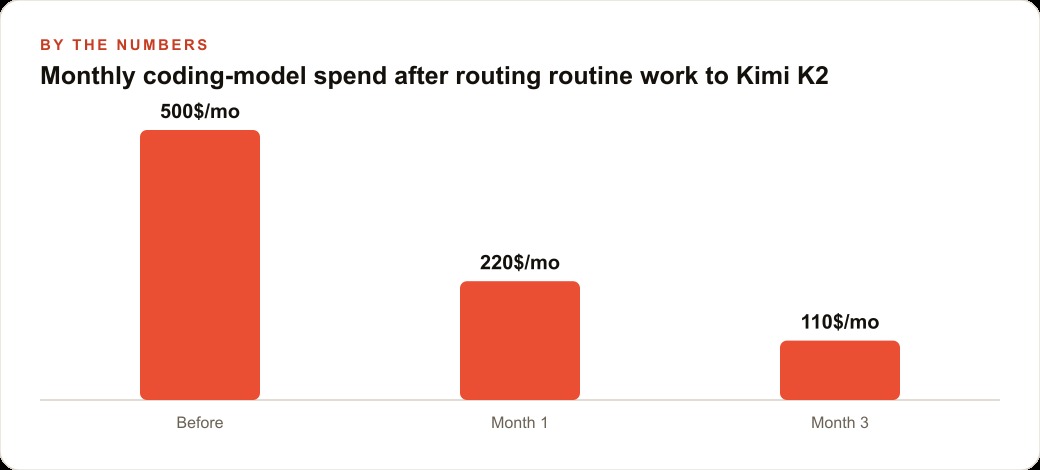
This is the finding with the largest implications beyond individual developer cost savings. The economics of building a product where external customers receive AI-assisted coding through a subscription have been difficult to justify at Claude 4 pricing. The heaviest users, the most valuable and most engaged customers, are often the ones whose model consumption costs exceed the subscription revenue they represent. At Kimi K2 pricing, those same high-engagement customers become profitable to serve. A user running ten substantial coding sessions per month costs roughly 20 percent as much in model fees as on Claude 4. Platforms that have been throttling heavy users to manage costs, or pricing high enough to cover them at the expense of broader adoption, have a different set of options. They can serve heavy users at a real margin. They can lower prices to expand the total user base. They can invest the cost saving in infrastructure, support, or product quality. The unit economics problem that constrained this entire category of product is solvable at Kimi K2 prices in a way it simply was not at Claude 4 prices. For a software development agency, the same arithmetic applies to the cost basis of client projects. Routing routine development work to the cheaper model and reserving the frontier model for the fraction of tasks that genuinely require it reduces the model cost per project by a meaningful amount across any multi-week engagement. Over a full year of client work, that reduction is a real improvement in project margin or a real source of competitive pricing flexibility.
The overarching finding from the test is straightforward. Kimi K2 is not a replacement for Claude 4 on tasks where frontier quality is the binding constraint. It is a viable alternative for the large fraction of real-world coding work where the binding constraint is cost, not capability. The five-minute swap, the near-unchanged quality on everyday build tasks, and the four-to-one cost reduction combine into a configuration decision worth running on your own stack this week. Create a key at platform.moonshot.ai, top up ten dollars, export the two environment variables, and run ten representative tasks from your actual project. Evaluate the quality directly. If it holds for your specific code and your specific standards, the saving is immediate and compounds with every session that follows.
The routing decision is simpler than it appears. Start by listing the ten types of coding tasks your team or your product runs most frequently. For each, ask whether the output quality from Kimi K2 would be sufficient for the customer or stakeholder who receives it. For most of those ten categories, the answer will be yes. For the two or three that genuinely require frontier reasoning, keep Claude 4 as the default. That tiering, run everything possible through Kimi K2 and reserve the frontier model for the fraction that actually needs it, is the entire strategy. It is also the configuration that most teams building on Claude 4 today could implement in an afternoon, at no additional infrastructure cost, with no disruption to existing workflows and an immediate reduction in model API spend that shows up clearly in the next billing cycle.
That is exactly what we do at AI DOERS. Book a private 30-minute call with Madhuranjan Kumar and we will map the fastest path to it for your specific business.
Book your call →
Madhuranjan Kumar
Madhuranjan Kumar brings 20 years of performance-marketing experience and has managed over $200 million in Facebook ad spend for brands across the United States and beyond. His expertise spans the full modern marketing stack: Meta, Google Ads, TikTok, email automation, CRM, and the websites that hold it together. At AI DOERS he turns that track record into lead-generation systems for businesses across every industry.