
Kimi K2.5: The Cheap Open Model Built for Vision and Agent Swarms
Kimi K2.5 pairs strong vision and coding with self-directed agent swarms at a fraction of the price of the closed leaders. Here is what it does and how a business can put it to work.

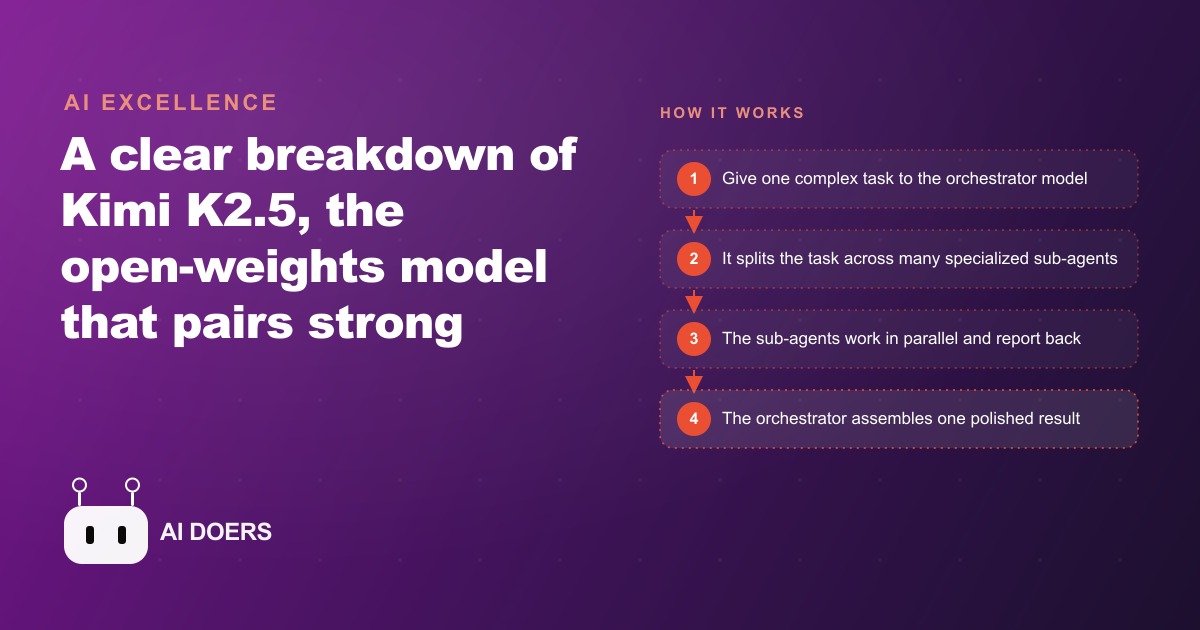
Kimi K2.5 is a state-of-the-art open-weights model that delivers performance near the closed frontier leaders at a fraction of the cost, and it was designed from the ground up to run multi-step agentic work rather than just answer chat questions. I am Madhuranjan Kumar, and what I want to do here is translate the benchmark numbers into a clear list of what this model actually does and what that means for a business that wants to automate real work without a runaway AI bill.
It runs on open weights, so you control where your data goes
Kimi K2.5 is open-source and open-weights, meaning both the architecture and the trained weights are publicly available. You can download them, run the model on your own hardware, and keep your data in your own environment without any of it touching a third-party API server. For businesses that handle sensitive client information, financial records, or any data that should not leave the building, that control is the primary reason to consider an open-weight model over a closed one.
The open-weights nature also removes vendor dependency. Closed model pricing can change without notice, terms of service can shift, and access can be throttled during high demand. A model you run yourself does not have any of those risks. You own the inference, and it runs exactly the same every time regardless of what the original developer decides to do next.
The honest caveat is size. The full model requires hundreds of gigabytes of memory to run locally, which means most businesses will access it through an API provider that hosts the weights rather than running it on a laptop. The API is cheap enough that this is usually the right choice, and the community is producing smaller quantized versions for businesses that want local deployment without the full hardware requirement.
The price is a fraction of the closed frontier options
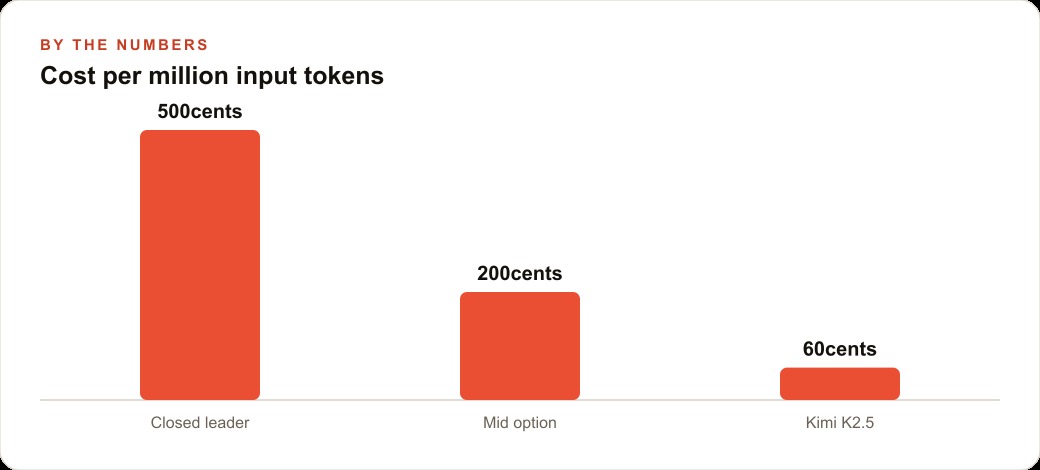
At roughly sixty cents per million input tokens and around three dollars per million output tokens, Kimi K2.5 undercuts the closed frontier leaders by a factor of several times. That price difference changes the math on which workflows are worth automating.
A workflow that costs ten dollars per thousand runs on a frontier closed model costs less than one dollar on Kimi K2.5 for comparable performance. At the volume a real business runs, that difference accumulates quickly. Automations that were technically feasible but economically questionable at frontier prices become straightforwardly cost-effective at this price point.
For any business already using a more expensive closed model for routine tasks that do not require the absolute frontier of reasoning quality, the cost case for switching at least some of those tasks to Kimi K2.5 is immediate and measurable. The measurement is simple: take the token counts from a month of usage, apply the new price, and see the difference.
Agent swarms let it split one big job across many parallel workers
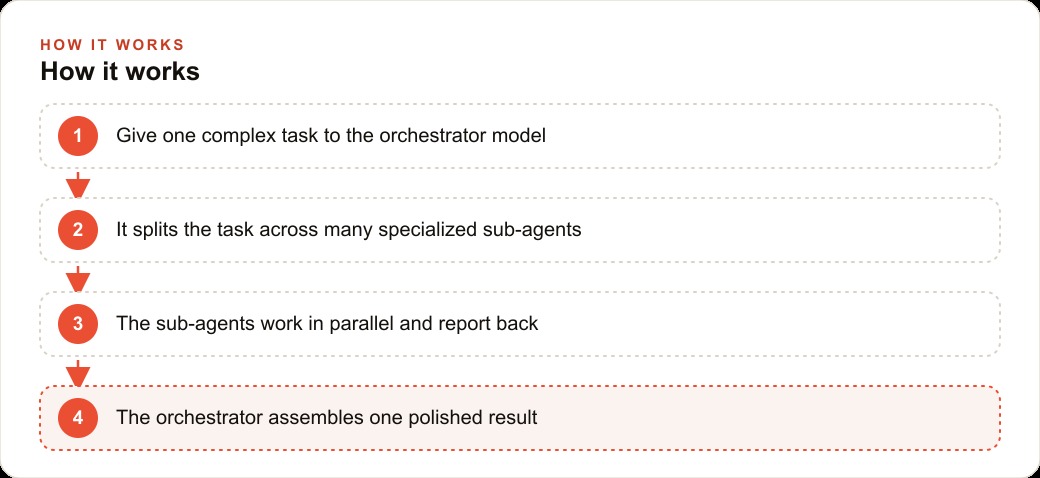
The most distinctive capability in Kimi K2.5 is what the team calls agent swarms. For complex jobs, the model can self-direct up to one hundred sub-agents running in parallel across roughly fifteen hundred tool calls, cutting the time to complete large multi-part tasks by several times compared to sequential processing.
The mechanism is an orchestrator and a team. The orchestrator model takes a large task, breaks it into pieces, assigns each piece to a specialized sub-agent, waits for their results, and assembles everything into one answer. A research agent, a fact-checker, a code writer, and a formatter can all run at once on different parts of the same job. The parallelism is what makes large jobs finish in practical timeframes instead of grinding through one step at a time.
For a service business that produces complex documents with many components, like proposals, audits, or quarterly reports, the swarm approach means the components can be produced simultaneously and assembled cleanly, rather than produced one after another in a long sequential session. The time savings on a large proposal produced this way versus a single-threaded approach are substantial.
It is trained on mixed text and image tokens, which makes it natively multimodal
Kimi K2.5 was trained on roughly fifteen trillion mixed text and image tokens, which means it handles vision and text together without being a separate model bolted on. You can hand it a screenshot of a website and ask it to rebuild the page, and it produces a close recreation by writing and running code to match what it sees. It reasons over images, solves visual problems by generating and inspecting its own output, and iterates based on what it observes.
For a business that deals with physical documents, printed materials, or visual assets alongside text, this native multimodal capability is directly useful. An inspection photo can be described in text. A printed form can be read and transcribed. A competitor's product page can be analyzed visually without requiring a separate image description step before the text processing begins.
Front-end code it produces does not look AI generated
On standard coding benchmarks Kimi K2.5 lands near the top, and it is specifically strong at front-end web development. The code it writes for interfaces tends to look and feel hand-crafted rather than AI-generated, which is the practical distinction between code you can ship and code you have to rewrite before showing it to anyone.
For businesses that build or maintain websites and want to use AI to produce new pages, landing pages, or interface components, the quality of the generated front-end code matters more than abstract benchmark scores. Code that looks AI-generated is usually structurally correct but aesthetically flat and over-standardized. Code that does not look AI-generated matches the visual quality of something a skilled developer produced by hand.
For a business running Google Ads to drive traffic to landing pages, the quality of the landing page is a direct input to conversion rate and Quality Score. A landing page built from AI-generated code that looks cheap undermines both. A landing page built from code that does not show its AI origin supports both.
It handles everyday office work, not just technical tasks
Beyond coding and vision, Kimi K2.5 handles the daily grind of knowledge work. It builds polished PDFs, edits Word documents, drafts slide decks, and constructs spreadsheets with pivot tables. That is the repetitive back-office work that small teams spend significant time on and that rarely requires frontier reasoning quality, just reliable, fast, accurate execution.
For a business that processes proposals, contracts, reports, or client summaries regularly, a model that handles these tasks cheaply and competently is a practical asset, not a demo. The cost structure at Kimi K2.5 prices means running this kind of document work across hundreds of items per month is economically sensible in a way that the same volume on a frontier closed model might not be.
The leads and document outputs from these workflows eventually feed into the wider business system. For any business that manages clients through a CRM and website stack, the ability to produce clean, formatted client documents automatically and feed the relevant data points into the CRM is where the daily time savings become visible in the business numbers rather than just in the AI tool metrics. Running Facebook and Instagram ads that generate leads which then get processed and followed up through an AI-automated document and CRM workflow is a complete loop that Kimi K2.5 can run cheaply at every step from the document production onwards.
That is exactly what we do at AI DOERS. Book a private 30-minute call with Madhuranjan Kumar and we will map the fastest path to it for your specific business.
Book your call →
Madhuranjan Kumar
Madhuranjan Kumar brings 20 years of performance-marketing experience and has managed over $200 million in Facebook ad spend for brands across the United States and beyond. His expertise spans the full modern marketing stack: Meta, Google Ads, TikTok, email automation, CRM, and the websites that hold it together. At AI DOERS he turns that track record into lead-generation systems for businesses across every industry.