
Is the AI Jobs Apocalypse Actually Cancelled?
The predicted mass jobs apocalypse is not showing up in the data, and the people who automated their work hardest report more work, not less. Cheap competence triggers a Jevons paradox, so output explodes and the human role shifts to judgment, taste, and ownership.

The prediction was simple and the confidence behind it was enormous. AI would erase whole categories of knowledge work, the labs said. Entry-level roles would disappear first, then the middle, then anything that could be described as producing a standardized output. I am Madhuranjan Kumar, and I want to make a different argument: the jobs apocalypse as originally described is not happening, and understanding why it is not happening is more useful for a business owner than debating whether it eventually will.
The clearest signal is coming from the people who automated the most aggressively. They report doing more work, not less. The total volume did not shrink. It changed shape. And the economic principle that explains this has been understood since the nineteenth century, when an engineer noticed that making coal engines more efficient led to more coal burned across the economy, not less. When something gets cheaper, people use far more of it. AI made competent output cheap, so output exploded rather than disappearing.
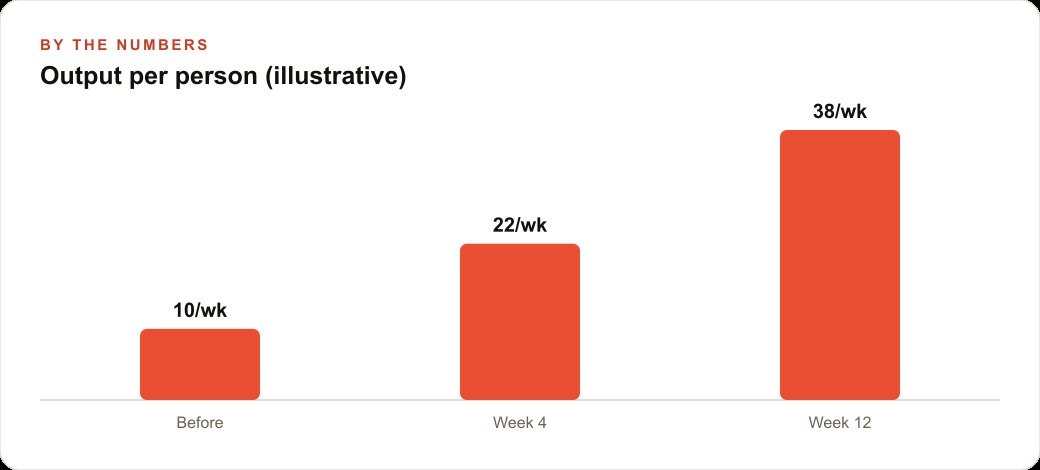
This is what the Jevons paradox looks like in a modern office. If a task that used to take a full day now takes an hour, a motivated person does not finish at noon and spend the afternoon on leisure. They start the second task they would never have attempted before because it was not worth the time investment. Then the third. The bottleneck moves from production to deciding what to produce, and most people find an expanding list of things worth deciding. The work does not go away. It accelerates into the capacity that was freed up.
The lab founders who once described a coming bloodbath in white-collar work have softened the story considerably. The better framing, the one I use with clients, is this: automate ninety percent of a job and the remaining ten percent does not stay small. It expands into a new full responsibility. The person who used to spend six hours writing a report now spends one hour directing an AI and thirty minutes editing the result, but they are expected to review three reports instead of one, and to bring sharper strategic thinking to each because the mechanical labor is no longer consuming their afternoon.
The human sandwich and what it means for your operation
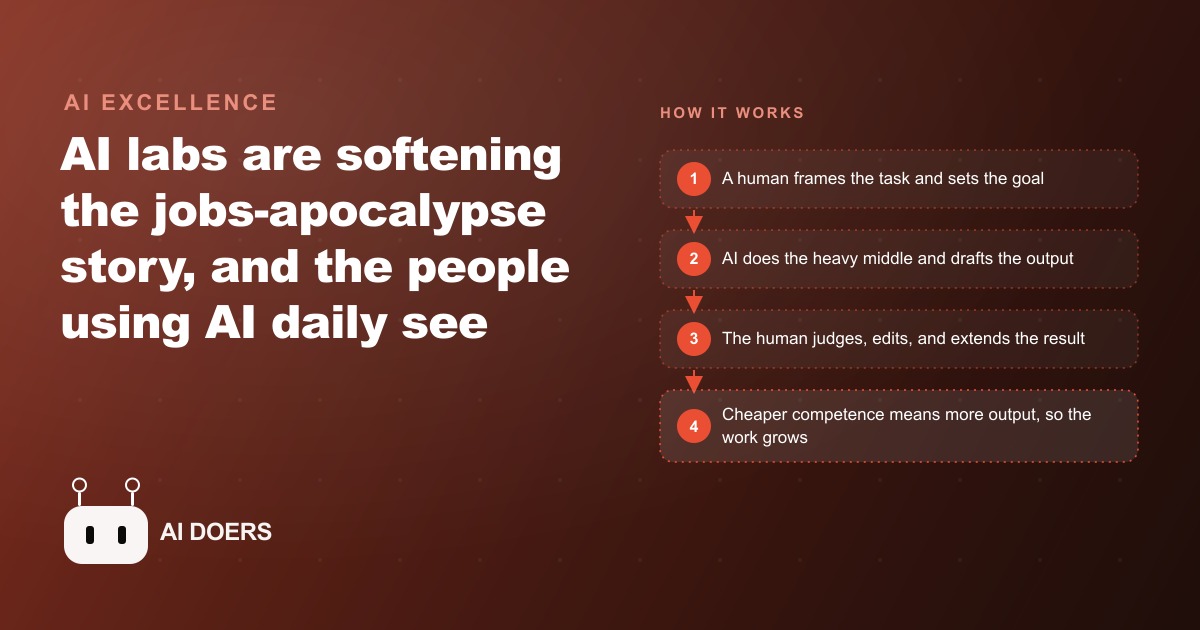
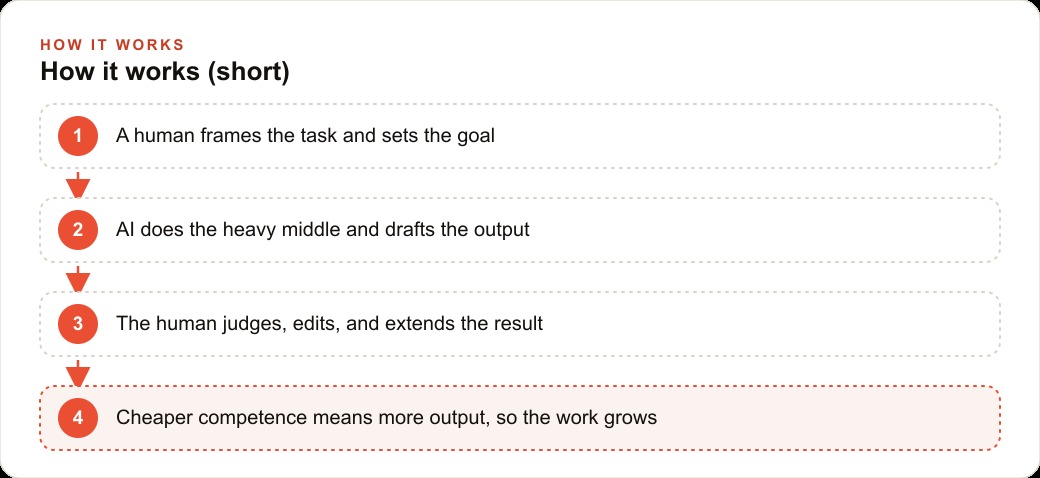
The structure that makes this work is straightforward. A human frames the task and sets the goal. AI does the heavy middle and collapses the time required. A human judges the output, fixes what only they would catch, and takes ownership of the result. You still hold the beginning and the end of every task. There is no prompt that injects understanding into your brain, so the judgment step, reading the result as someone who knows the context, is the part that survives every wave of automation.
For a business owner, this means the right question is not "will AI take my job." The right question is: if AI handles the middle of every task, what does this operation look like at full capacity? Because the capacity does not disappear. It becomes available for the work that required judgment all along but never got enough time.
The competitive risk is real but it is not about headcount. A competitor who understands this shift starts operating like a larger company while paying for a smaller one. They follow up on every lead, not just the ones they have time to chase. They produce estimates the same day they receive an inquiry, not two days later when a competitor has already closed the deal. They generate consistent social proof from their work rather than occasionally posting when they remember to. They look and operate like a professional operation, and over six to twelve months of this, the gap compounds in ways that are hard to close from a standing start.
The good news is that the tools to run the middle of your workflow are inexpensive and widely available. A Claude or ChatGPT subscription costs less than twenty dollars a month. The real investment is the two to four weeks it takes to identify which tasks are most worth routing through AI, build the templates and prompts that produce reliable output for those tasks, and develop the habit of reviewing the output before it goes out. After that, the marginal cost per task is cents.
For a trades company, this looks like an office manager drafting professional homeowner-facing inspection reports in fifteen minutes rather than forty-five, because the AI handles the format and language while the manager provides the field observations and the judgment call on which repairs to prioritize. It looks like systematic follow-up emails sent on every lead rather than sixty percent of leads, because drafting a follow-up now takes two minutes rather than ten. It looks like insurance claim summaries that are thorough rather than rushed, because thoroughness no longer requires the same proportional time investment.
For a marketing operation, this looks like ad copy produced in a fraction of the previous time with consistent quality, allowing more campaign concepts to be tested in the same budget window. Every additional test is a chance to find something that works, and Facebook and Instagram ad campaigns compound the benefit over time as you accumulate data on what resonates with your specific audience. The teams that test more creative concepts in the same period consistently develop a sharper understanding of their audience than teams that test fewer. The output of a well-run AI-assisted creative process is not just faster content. It is a faster feedback loop.
The same dynamic applies to search. More consistent content published more frequently builds SEO and organic search visibility that compounds over months. A business that publishes twice a week for a year accumulates more search presence than one that publishes twice a month, even if each individual piece from the less-frequent publisher is marginally better written. Consistency, not perfection, is the asset, and AI-assisted workflows make consistency achievable at a smaller operational cost.
The slop problem and why taste becomes more valuable, not less
There is a genuine warning embedded in this picture. When everyone can generate code, thumbnails, ad copy, and newsletters at low marginal cost, the average output converges toward mediocrity at scale. The internet began filling with what people started calling slop, content that is technically correct in format and style but empty of real perspective or specific knowledge. This is the dark side of cheap competence.
The paradox is that slop makes genuine taste and accurate judgment more valuable, not less. The reader who encounters ten indistinguishable AI summaries of the same topic will slow down and pay attention when they find one that reflects an actual perspective, specific experience, or a detail that only someone who did the work would know. The customer who receives a dozen generic follow-up emails notices and responds to the one that reflects their specific situation rather than a generic template.
What this means practically is that the competitive split is likely to show up between companies more than between individual workers. A company whose entire moat was the volume of competent output it could produce is under real pressure, because that moat can now be replicated by a competitor with a model subscription and a good prompt library. A company whose moat is relationships, local knowledge, speed of follow-up, or quality of judgment on complex situations finds that AI amplifies that edge rather than threatening it. The person with good taste gets to apply good taste to more outputs in the same time. The person with deep domain knowledge produces better-informed outputs faster than before.
The honest conclusion is that the apocalypse framing was always less useful than the capacity framing. The question was never whether AI would take your job. The question was always: what becomes possible when the middle of every task gets cheaper? The answer, for most businesses, is that more becomes possible, and the human who positions themselves at the beginning and the end of that process, framing the work and judging the result, finds their value increasing rather than decreasing as the middle gets more efficient.
That is exactly what we do at AI DOERS. Book a private 30-minute call with Madhuranjan Kumar and we will map the fastest path to it for your specific business.
Book your call →
Madhuranjan Kumar
Madhuranjan Kumar brings 20 years of performance-marketing experience and has managed over $200 million in Facebook ad spend for brands across the United States and beyond. His expertise spans the full modern marketing stack: Meta, Google Ads, TikTok, email automation, CRM, and the websites that hold it together. At AI DOERS he turns that track record into lead-generation systems for businesses across every industry.