
Is Claude Mythos Coming? What the Leak Actually Tells Us
Probably not as a public, log-in-and-use model anytime soon. Anthropic said in April it does not plan to make the Mythos preview generally available, so the more likely path is that Mythos-level capabilities fold quietly into the next Opus release rather than launching under the Mythos name.

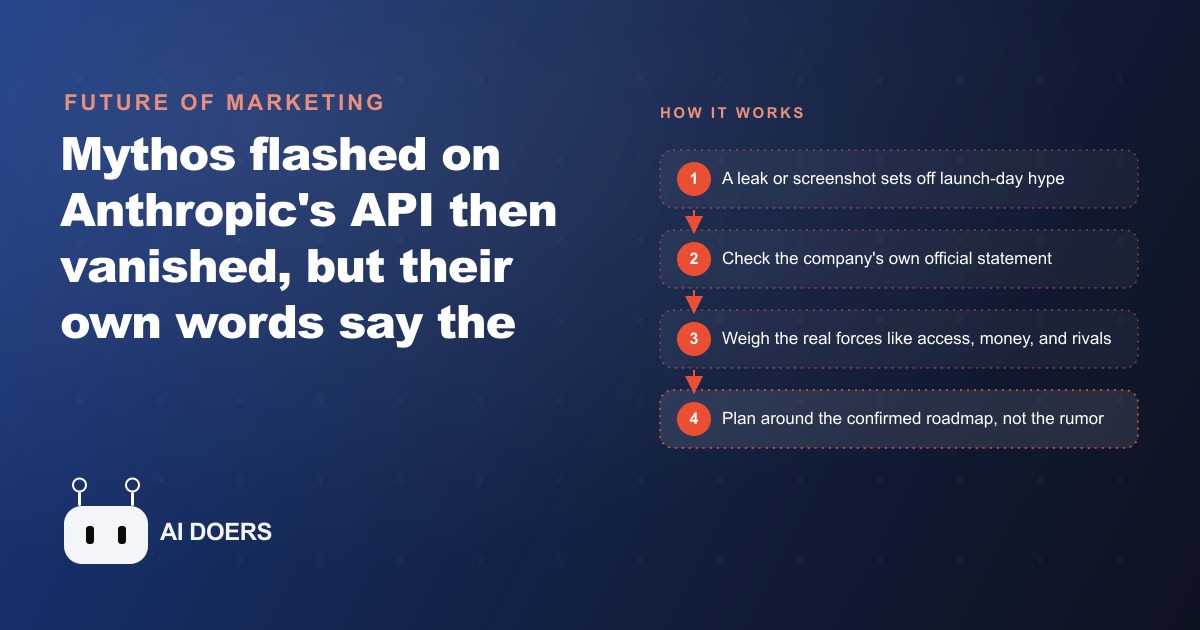
A model name that was never meant to be public flashed live on Anthropic's API one morning, a few people screenshotted it, and within minutes the internet had scheduled the launch party. The name was Mythos, a tier of Claude that reportedly sits above Opus 4.8, the best model you can log into today. I am Madhuranjan Kumar, and I want to walk through why that screenshot means far less than the timeline exploding around it suggests, and why the way you read moments like this one matters more for your business than the model itself ever will.
Mythos is not a small step. In a leaked internal draft, Anthropic described it as a step change and the most powerful model it has ever built, an entirely new model family rather than an incremental bump from Opus 4.7 to 4.8. Its standout skill is reportedly cybersecurity, finding and patching holes in old, widely used code. That single capability is also the reason it stays locked away, because the same skill that closes a hole can open one. So far only a handful of vetted security firms and government partners have touched it, through an invite-only program. On paper this is a model built for a narrow, dangerous, high-trust corner of the world, not for a consumer login screen.
The cybersecurity angle is the whole reason it stays behind glass
It helps to sit with why this particular skill changes the release math. Most of the models you use every day are dangerous only in mild, manageable ways. They can write something wrong, or produce a biased draft, or hallucinate a figure. A model that is genuinely excellent at reading old, sprawling codebases and spotting the exact line where a security flaw hides is a different category of tool. The internet runs on decades of open-source code that almost nobody has fully audited. A model that can comb through that code at scale is a gift to defenders and a loaded weapon for attackers, and it is the same model doing both jobs. There is no version of it that only patches and never breaks.
That dual-use problem is why an invite-only program exists at all. You cannot hand a capability like this to anyone with a credit card and hope for the best, so the vetting is the product. The circle of partners is the safety mechanism. When you understand that, the idea of a sudden public launch starts to look not just unlikely but structurally at odds with the reason the model was gated in the first place. Companies do not usually build an elaborate trust perimeter and then knock it down a month later. The gating is not a temporary inconvenience on the road to release. For a model like this, the gating may be the release, permanently.
The one sentence almost everyone scrolled past
Here is the line that reframes the entire launch-day frenzy. Back in early April, Anthropic said plainly that it does not plan to make the Mythos preview generally available. Nothing since has walked that statement back. A leak does not change a stated plan. A screenshot of an internal identifier appearing on an API for a few minutes is evidence that the model exists and is being tested, which we already knew. It is not evidence that a public product is coming next week.
This is the part of AI news that trips up smart people. A visual artifact, a screenshot, a config leak, a stray endpoint, feels more real than a paragraph of official text, because it looks like a smoking gun. But the paragraph is the stronger signal. A company's public position, stated on the record, carries more weight than an accidental flash that anyone can misread. When those two things conflict, and here they clearly do, the boring official sentence usually wins. I have watched entire planning cycles freeze because a team treated a rumor as a roadmap.
Three forces are pulling on this story, and none of them is a launch button
If you want to predict where this actually goes, stop watching the feed and weigh the real pressures. There are three, and together they explain both the hype and the restraint.
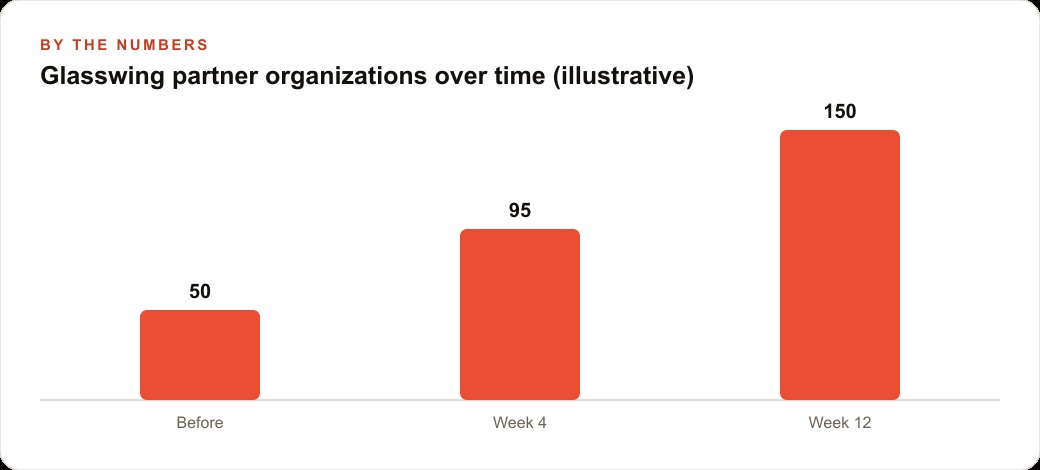
The first is access. The invite-only program has been widening fast, going from roughly 50 partners in one month to around 150 organizations across more than 15 countries just days later. That growth is genuine, and it is why the soon-is-coming case feels plausible. But widening a gated program is not the same as opening a public one. A model can reach 150 vetted partners and still never touch a consumer account.
The second is money and timing. Anthropic reportedly filed confidentially to go public near a very large valuation, and around the same time released a report warning that AI is starting to improve itself and may need brakes. Read those two moves together. A powerful, barely contained, slightly frightening model is a compelling story to tell right before you sell stock. That does not mean the capability is fake. It means the framing around it is doing commercial work, and you should discount the drama accordingly.
The third is the rival race. A major competitor is expected to ship its own flagship imminently, and Anthropic has a habit of firing back within days. That means Mythos timing may be glued to someone else's calendar rather than any fixed internal date. If a rival drops something big, the pressure to respond could pull a Mythos-flavored announcement forward. If the rival stays quiet, there is less reason to move. This is the least predictable force, and it is the one the betting markets are really pricing when they put the odds of a public Mythos by the end of July somewhere around two-thirds.
Why the smart money still points at a quiet Opus
Put the pieces together and the base case is not a splashy Mythos launch. It is that Mythos-level capability quietly folds into the next Opus release in the back half of the year, and most people never notice the seam. The company said it does not plan to release the preview broadly. The model is dangerous enough to gate. The pricing that has been floated is reportedly around five times today's Opus cost, which is not consumer pricing. Every structural fact points toward absorption, not a standalone product.
That is the outcome I would plan around. Not because it is certain, nothing here is, but because it is the version most consistent with what the company has actually said and how these capabilities have rolled out before. The frontier rarely arrives as a single named event. It seeps in through the next version of a model you already use, and one day your existing tool is simply better at something it used to fumble.
Look at the pattern from the last two years. Almost every genuine leap you now rely on arrived not as a shock product with its own countdown, but as a quiet upgrade folded into a model you were already paying for. Longer context windows, better reasoning, cleaner tool use, sharper coding, none of those showed up as a separate app you had to go buy. They appeared inside the next version number. There is no strong reason to expect the most sensitive capability the company has ever built to break that pattern and debut as a flashy standalone. If anything, the more dangerous the skill, the more likely it arrives muted, capped, and wrapped in guardrails rather than announced with fireworks.
What a business should actually do with news like this
Here is where this stops being trivia and starts being a skill. Every business now plans budgets, hiring, and product bets in an environment where a screenshot can set the agenda for a day. The teams that win are not the ones with the best rumor radar. They are the ones with a stable way to tell a leak from a roadmap, so they keep building instead of freezing.
Think about a mid-size firm deciding whether to wait for a rumored super-model before committing to an AI tool for its daily work. If the owner chases the screenshots, they stall, waiting for a launch the company itself said is not coming, while competitors simply adopt the best available model now and pull ahead. Treat the official statement like a piece of evidence and the API flash like an unverified tip, then weigh them the way you would weigh a signed document against a hallway whisper. The verdict, almost every time, is to build on the confirmed capability you can contract for today rather than the mythical one you cannot.
Consider a concrete version of the cost. Say a services business is deciding whether to launch an AI-assisted campaign engine that drafts and tests ad creative. Freezing that project for eight weeks to wait on a rumor is not free. If that engine would have improved the cost per lead on its Facebook and Instagram ad campaigns by even 15 percent, and the business spends 300 dollars a day, that delay quietly burns roughly 45 dollars a day in avoidable cost, around 2,500 dollars over the eight weeks, for a launch that may never happen. The same logic applies to a Google Ads account where a smarter creative loop compounds every billing cycle. The rumor costs you real money precisely because it tempts you to wait.
There is a second, subtler cost that people miss. Every hour your team spends debating a rumor is an hour not spent improving the things you already control. While a competitor is refreshing their feed to see if Mythos dropped, you could be rewriting three underperforming ad hooks, cleaning your lead-routing rules, or fixing the slow page that quietly loses you sales. The rumor is not just a temptation to wait. It is a distraction that pulls attention away from the unglamorous work that actually compounds. The businesses that pull ahead in an AI-saturated market are rarely the ones with the newest model. They are the ones who kept executing while everyone else was watching the scoreboard.
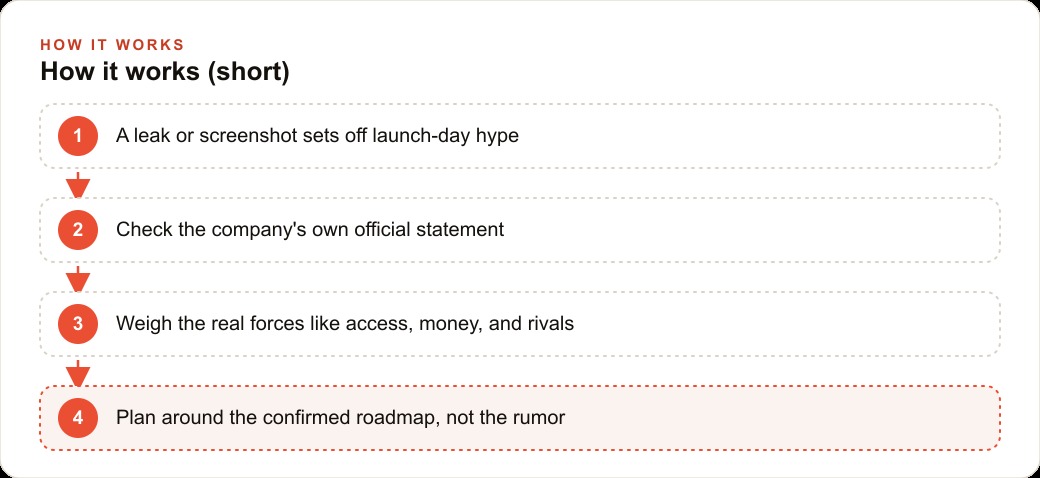
The practical discipline is small and repeatable. When a new model rumor hits, write down two columns: what was actually leaked, and what the company has officially stated. Put the official statement first, because it is the strongest signal you have. Then list the real forces at play, who has access, how fast that access is widening, and whether a financial event like a public offering or a rival launch might be shaping the noise. Decide what you can genuinely use today and build your plan on that, keeping a short note of exactly what would have to change for the rumor to become real. Finally, set one clear trigger, an official release or a confirmed price, that tells you when it is truly time to act. That single habit keeps you from lurching at every screenshot.
There is a quieter payoff too. The same evidence-over-hype instinct that protects your model bets protects the rest of your stack. It is what stops you from rebuilding your SEO and organic search plan every time someone claims search is dead, and it is what keeps your CRM and website stack decisions anchored to what your customers actually do rather than to the loudest post on your timeline. Hype is a tax on attention, and a calm reading process is how you stop paying it.
So, is Claude Mythos coming? As a public, log-in-and-use product, probably not on the timeline the feed wants. The more likely path is that its capabilities arrive inside the next Opus without a countdown clock. And the more useful question, the one that actually moves your business, is not whether Mythos launches next month. It is whether you have a way to read the next ten rumors without letting any of them stampede you off the plan you can already run today. Build that, and the screenshots stop running your calendar.
That is exactly what we do at AI DOERS. Book a private 30-minute call with Madhuranjan Kumar and we will map the fastest path to it for your specific business.
Book your call →
Madhuranjan Kumar
Madhuranjan Kumar brings 20 years of performance-marketing experience and has managed over $200 million in Facebook ad spend for brands across the United States and beyond. His expertise spans the full modern marketing stack: Meta, Google Ads, TikTok, email automation, CRM, and the websites that hold it together. At AI DOERS he turns that track record into lead-generation systems for businesses across every industry.