
Is AGI Really Here? One Founder's Plan for Using Claude Code Now
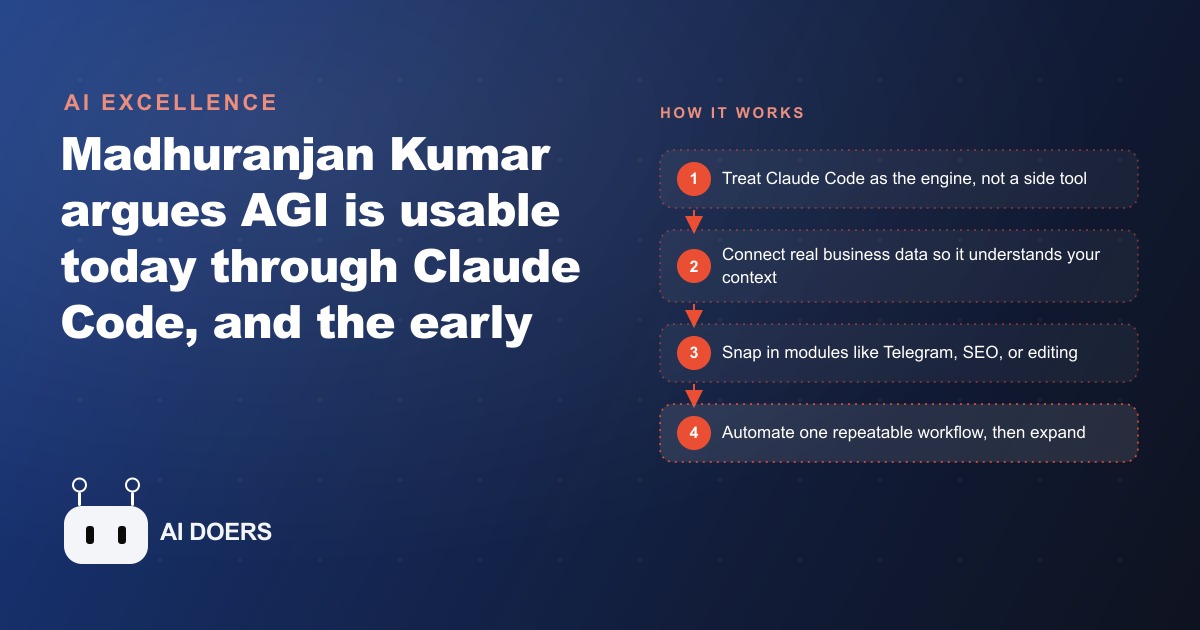
I think AGI is usable today if you treat Claude Code as an AI operating system that wraps around your existing business, automating whole review loops and running operations from your phone. The people who adopt it first will capture the gap while the future is still unevenly distributed.

Ninety-five percent of the conversation about AGI is happening in the wrong frame. The theoretical argument asks whether a machine can match human intelligence across every domain simultaneously, a bar philosophers argue about and researchers spend careers trying to measure. Meanwhile a much smaller group stopped waiting for that argument to resolve and started running a functional version of AGI inside their actual businesses. The gap between those two groups is not philosophical. It is a compounding business advantage, and it is being built right now.
The operational definition of AGI that matters for a business and why it is different from the theoretical one
The theoretical definition is a waiting game. You are waiting for a benchmark to be crossed, for a scientific consensus to form, for the mainstream to confirm the moment arrived. That posture is comfortable and expensive. While you wait, early adopters accumulate context and build module libraries that compound every week.
The operational definition bypasses that wait entirely. For a business, AGI means a highly intelligent digital worker with access to all your business data that can be trained to handle almost any repeatable structured task, can improve its own performance over time through accumulated feedback, and can scale as your work grows without requiring proportional hiring. That is not a forecast about the future. After two weeks of intensive implementation inside a real business operation, working as a team on the system end-to-end, that description became a factual account of what already happened.
The difference between the two definitions is the difference between watching the horizon for a ship and already being on one. The operational framing creates an immediate action question: what structured, repeatable work in your business could a system with six weeks of accumulated context handle autonomously? For most businesses, the honest answer covers a substantial portion of the operational workload. That is the claim, and the evidence for it is practical rather than theoretical.
What Madhuranjan Kumar observed across two weeks of intensive work is that the system does not just do the task you hand it. It finishes the task. It handles the last ten percent that most tools leave incomplete. It catches the follow-up that would normally fall through the cracks. That completeness is the qualitative shift that separates a capable AI tool from an AI operating system, and it is what makes the operational-AGI framing defensible.
Why the unevenness of the future is the actual business opportunity right now
The future does not arrive evenly distributed. It arrives first inside a small number of early adopters willing to invest learning time before the mainstream signal confirms it is safe to do so. That unevenness is not a temporary market inefficiency. It is the structure of every technology adoption cycle, and it is where the largest advantages get built.
Right now the advantage sits in the gap between businesses already running an AI operating system inside their operations and businesses watching to see how it develops. That gap is currently measurable in weeks. In twelve months it will be measurable in years. The reason is context accumulation: a system that has been running inside your business for six months has learned things about your operation that a competitor starting fresh cannot catch up to simply by buying access to the same underlying model. The model is the same. The accumulated operational intelligence is not.
The market has not priced this in yet. Service prices remain high because the cost savings from early AI efficiency are being captured as margin by operators rather than passed through to customers. A business that automates 30 percent of its operational overhead does not immediately cut prices by 30 percent. It pockets the difference and reinvests it. That window, between when efficiency gains arrive for early movers and when competitive pressure forces prices down, is where the money is right now. The businesses that enter it now capture it at full value. The businesses that wait enter a more competitive market with a smaller advantage and a later start on context accumulation.
What makes an AI operating system different from a collection of AI tools
Most businesses have already added AI tools. There is a writing assistant someone uses sometimes, an image generator that got opened for one project and forgotten, a chatbot someone installed on the website. None of that is an AI operating system. A collection of disconnected tools with no shared memory, no accumulated context, and no orchestrating layer is a cabinet of instruments that nobody is conducting. Individual tools are useful for one-off tasks. A system is what handles operations.
The AI operating system built on Claude Code is specific about what it does. It is not a tool you open when you want help with a task. It is a persistent, context-carrying layer that wraps around the entire operation. It knows your business, your current projects, your communication preferences, your guardrails, and the history of every interaction it has been part of. It does not need to be re-briefed each session. It carries forward what it learned from the last forty sessions.
That persistent layer changes the category of what is possible. A tool you brief every time is good for occasional work. A system with twelve weeks of accumulated context can run your intake workflow, your outreach sequences, your weekly reporting, and your content production schedule simultaneously without you managing any of it moment to moment. The underlying model capability is the same in both cases. The architecture connecting that capability to your operational memory is what makes the difference.
The practical test for whether you have a system rather than a collection of tools is simple: can you step away for a week and have the structured, repeatable work continue without you directing it each day? A collection of tools fails that test. An AI operating system passes it.
The module architecture and why pluggability beats monolithic builds
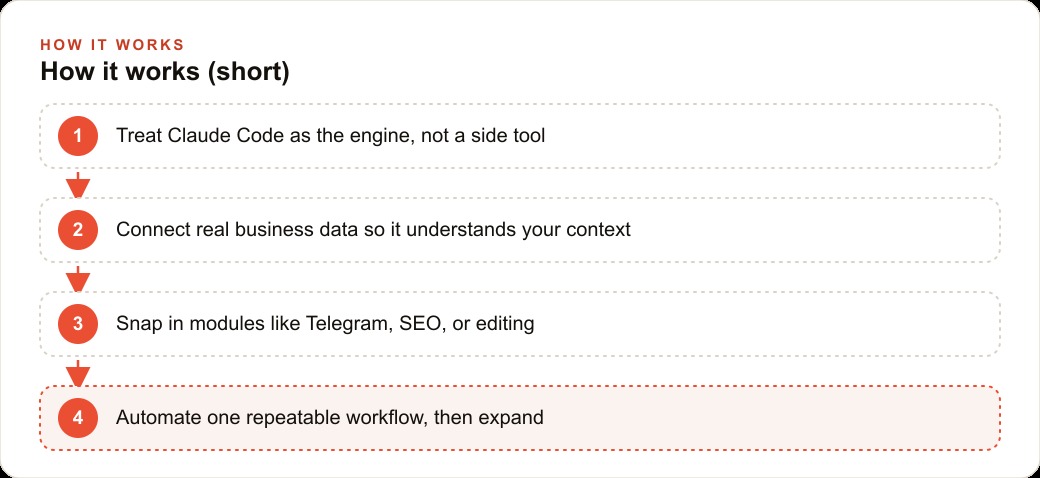
The practical architecture that makes this replicable at scale is modular. Instead of building one large custom system that handles everything and must be rebuilt when anything changes, the approach is to build functional clusters. Each cluster handles one category of business operation. Each is designed to connect or disconnect without disrupting the others.
A Telegram module gives the owner a natural-language interface from a phone. No dashboards, no logins. A question asked returns an answer: how many bookings came in today, who are the three leads waiting for a follow-up, what did revenue look like this week. A WhatsApp module routes customer conversations. Routine questions are handled automatically. Unusual requests are flagged for a human in thirty seconds. A programmatic content module runs a publication schedule without needing a brief each time. It knows the topics, the format, the frequency, and the platform. A scheduling module handles booking confirmations, reminders, and rescheduling requests through a trained workflow that eliminates the back-and-forth that normally takes twenty minutes per booking.
The power of pluggability is reuse across clients and industries. A win-back outreach workflow built for a fitness studio adapts to a dental practice without rebuilding the logic. A weekly reporting module built for an agency works for a retail operation with a different data source connected. Building a module library is building an asset. Each module is a solved problem. Every new client or use case draws from the library rather than starting over. That is how the system scales from one business to a practice.
Monolithic builds fail in a specific way: they become fragile when any single component needs to change. If the platform the system posts to changes its API, a monolithic system breaks end to end. A modular system replaces one component while the rest continues running. That resilience is the architectural reason pluggability wins over time.
Context accumulation over weeks: the mechanism that makes the system compound rather than repeat
The mechanism that turns this from impressive to irreplaceable is context accumulation over time. Most people experience AI tools as stateless. You open it, brief it, it does something, you close it, it forgets everything. Next session starts from zero. That is not an AI operating system. That is a calculator with better vocabulary.
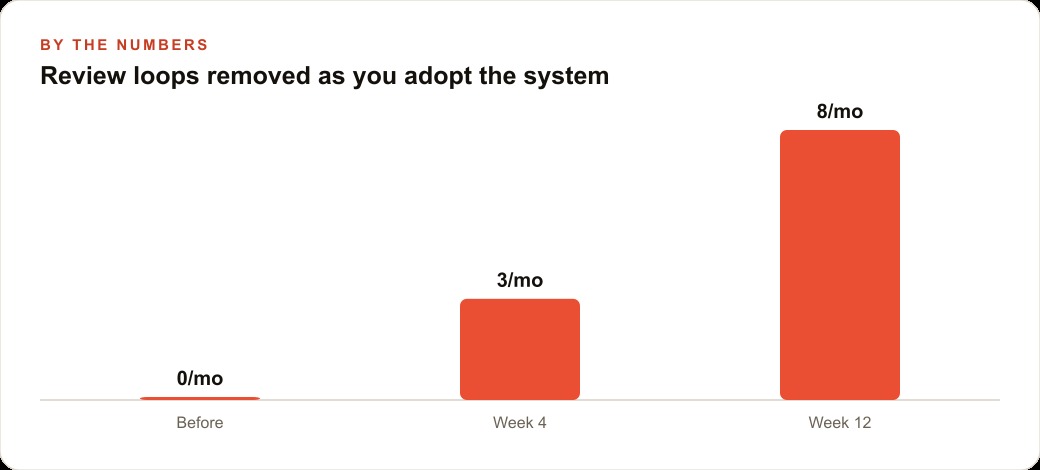
A properly built AI operating system accumulates context deliberately. In week one it knows your business description, your current projects, and your basic preferences. In week four it has seen how you responded to a hundred different situations. It knows the phrasing you prefer for client communications. It knows which categories of outreach got responses and which did not. It knows the open decisions and the recurring blockers. In week twelve it is making judgment calls informed by everything it has observed, without you needing to explain your preferences again.
That compounding trajectory is the clearest argument for starting now. A competitor who starts six months later begins at the level you were at in week one. Not because the underlying model is different, but because the accumulated operational intelligence is entirely absent. You cannot purchase that intelligence at month six. You can only build it by running the system through your actual work over actual time. Every week of delay is a week of that compounding advantage the competition has not built but could start building tomorrow.
The feedback investment required to drive this compounding is real but modest. It means correcting the system when it misses the mark, noting what additional context it needed, and building that context into the persistent memory. That takes minutes per session, not hours. Over weeks, those minutes produce a system that increasingly anticipates rather than reacts, because it has seen enough patterns in your specific operation to recognize them before you name them.
Which businesses capture the most value in the current window and why existing scale matters
The ROI from an AI operating system is not uniform across business types. The businesses that capture the most value in the current window are the ones that already have volume, established data, and predictable workflows. A business with five employees doing work that could be handled by two people plus this system is in a categorically different position from a business still figuring out what volume looks like.
Existing operations at scale have three advantages the early-stage business does not. First, they have enough repeating volume that automating even a moderate percentage of recurring tasks produces significant real-dollar impact. Second, they have enough historical data that the system has something rich to learn from rather than starting with generic templates. Third, they have workflows regular enough that automation can be built around reliable patterns rather than designed around constant exceptions.
A three-location fitness studio illustrates this concretely. Before the system, the front-desk team of six spends roughly 40 percent of their time on outreach to prospects, reminder messages to existing members, drafting and scheduling social content, and managing booking logistics. That work is structured, repetitive, and follows consistent patterns. It does not require human judgment for the bulk of it.
After building two targeted modules, the picture changes in measurable ways. The first module is a Telegram interface connected to the member database. The owner asks a question in plain language and receives an answer without logging into any dashboard. The second module is a win-back workflow that monitors attendance. Any member absent for 14 consecutive days receives a personal-sounding message drafted by the system and reviewed by a staff member in 30 seconds before it is sent.
A 30 percent reduction in front-desk admin time across six staff members at 18 dollars an hour translates to 2.4 hours per person per week. Across the full team that is 14.4 hours per week, or roughly 2,246 dollars per year in recovered capacity. That is the conservative calculation from the admin time module alone.
The win-back module adds a second line of value. Members absent for 14 or more days receive a message through a trained sequence. If three memberships per month are recovered at a membership fee of 60 dollars, that is 180 dollars per month in recovered revenue, or 2,160 dollars per year.
Combined, two modules running on a three-location fitness studio produce roughly 4,400 dollars in annual recovered value. That figure does not include the content module, which generates a steady schedule of social posts that keep the studio visible in members' feeds without requiring any additional staff time. The 4,400 dollar figure is the direct, conservative calculation from two functions run for twelve months. The system grows more capable as context accumulates and additional modules are added.
The urgency argument built on first principles, not on hype
The urgency to act now is not built on excitement about technology or on predictions about where AI will be in five years. It is built on three first principles that do not require any faith in future capability.
First, the accumulated context that makes this system genuinely useful for your specific business takes time to build and cannot be shortcut. A competitor who starts six months later starts from zero. Not because they lack access to the underlying model, but because that model has not yet observed their business operation, learned their communication preferences, or seen their historical data. The gap is real and it is built of time, not money.
Second, the window between early adoption and mainstream competition is closing continuously. Right now the operational capability exists and the mainstream awareness does not. That gap is where early movers capture margin instead of competing on price. The gap closes as adoption spreads, as more businesses understand what is possible, and as the market adjusts to the new cost structure. Acting now captures the window at full value. Acting later enters a more competitive position with a smaller head start.
Third, the cost of not acting compounds in the same direction as the benefit of acting. Every week without the system is a week where a competitor running the system gets six additional days of context accumulation and operational refinement. That asymmetry works against you continuously in the background whether you are paying attention to it or not.
None of that requires believing anything speculative about AGI. It only requires believing that a system which has been running inside a business for three months is more capable for that specific business than the same system on day one. That is not speculative. It is the observable experience of everyone who has built one. The correct response to the arithmetic is focused immediate action: pick one workflow, build it properly, run it for two weeks, and start accumulating the context that compounds.
That is exactly what we do at AI DOERS. Book a private 30-minute call with Madhuranjan Kumar and we will map the fastest path to it for your specific business.
Book your call →
Madhuranjan Kumar
Madhuranjan Kumar brings 20 years of performance-marketing experience and has managed over $200 million in Facebook ad spend for brands across the United States and beyond. His expertise spans the full modern marketing stack: Meta, Google Ads, TikTok, email automation, CRM, and the websites that hold it together. At AI DOERS he turns that track record into lead-generation systems for businesses across every industry.