
Inside Claude Fable 5: The Mythos Model Anthropic Called Too Dangerous
Fable 5 is the guardrailed release of Anthropic's Mythos class, a 10 trillion parameter frontier model that scores 80 percent on SWE-Bench Pro and reportedly compressed a two month Ruby migration into a single day, priced for the hardest problems only.

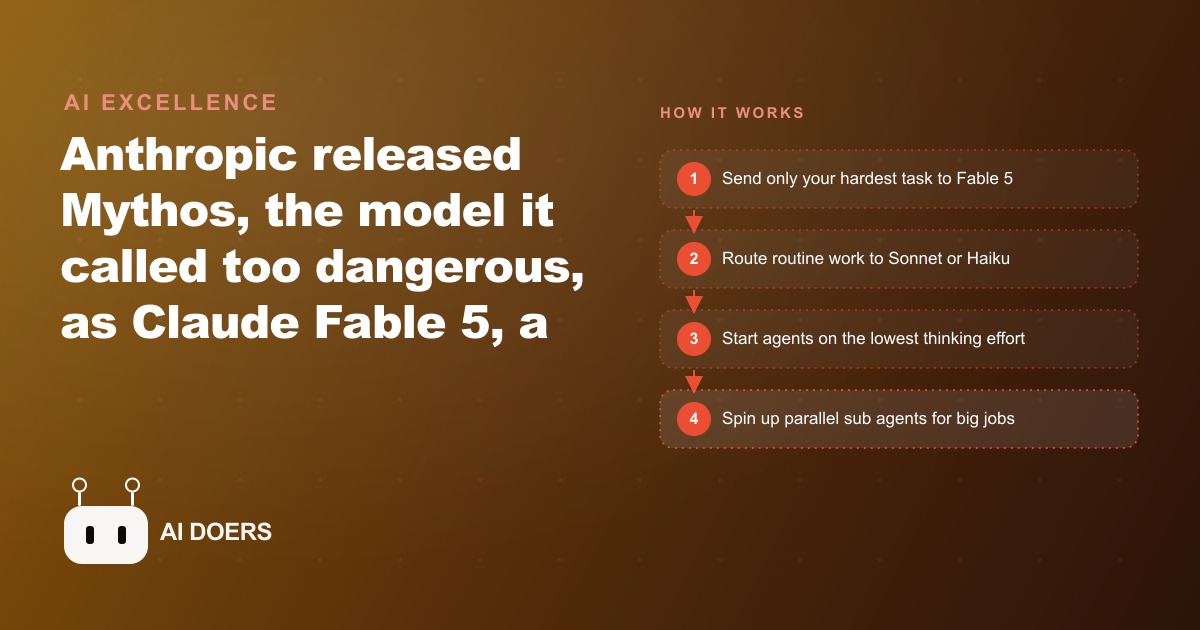
I am Madhuranjan Kumar. I want to be direct about something before we get into the specifics of Claude Fable 5. Frontier model announcements produce a lot of noise, and most business owners have learned to discount launch hype and wait for a practical signal. That is usually the right instinct. But Fable 5 is one of those releases where the practical signal is genuinely different, not because the benchmark numbers are larger, but because the nature of the improvement changes the calculation for a specific and valuable category of work.
Fable 5 is the public, safety-tuned release of a model that Anthropic internally called Mythos. The Mythos class sits at 10 trillion parameters, described as a genuinely new category of AI rather than an incremental step from the Claude models before it. Anthropic originally considered Mythos too powerful to release publicly in its raw form. The guardrailed version, Fable 5, is what businesses can access. The model without guardrails, Mythos itself, went to the security research community to help harden software and find vulnerabilities. The underlying capability is the same. The difference is the safety envelope applied on top.
Here is how I would approach using this model without wasting money on it.
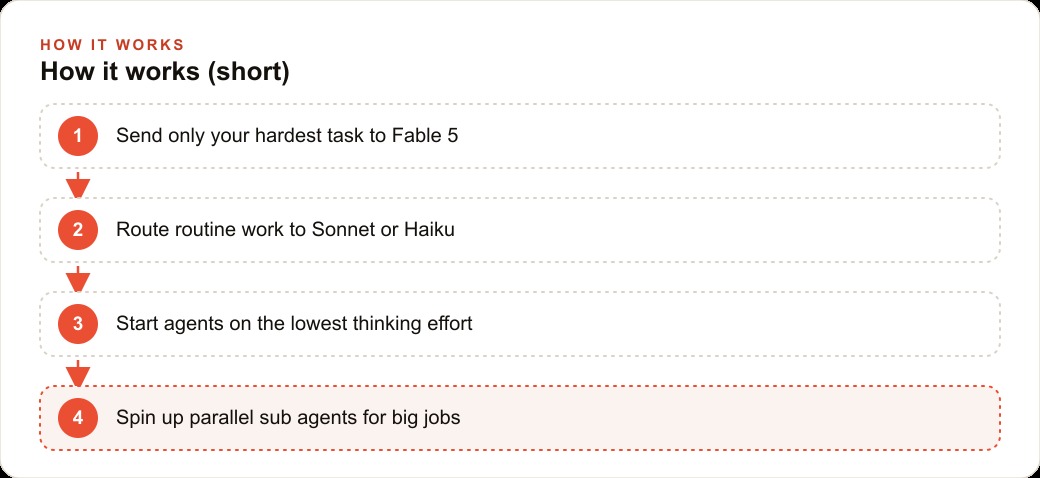
Separate your hard problems from your routine ones before you open a single session
The pricing is the most important piece of context for any business owner considering this model. Fable 5 costs ten dollars per million input tokens and fifty dollars per million output tokens. Compared to the cheaper Claude tiers, that is a significant multiplier. If you send everything to Fable, the costs compound quickly and most of your spend goes to tasks that did not need a 10 trillion parameter model. If you only send the right tasks, the return on those tasks is exceptional.
The right tasks are the ones that are genuinely dense: long-form analysis across many documents, deep cross-referencing where missing a connection has real consequences, complex planning that requires holding many constraints in mind simultaneously, and large document or codebase reviews where the scale exceeds what a lighter model handles reliably. The wrong tasks for Fable are the ones that fill most of a business week: routine client emails, standard meeting summaries, basic first drafts, simple data cleanup. Those belong on Sonnet or Haiku, where the cost is a fraction of the frontier tier.
I would make this separation explicit before building any workflow around Fable. Write down the five most time-consuming recurring tasks in your business. Estimate how complex each one genuinely is, specifically whether it requires sustained reasoning across a large body of information or coordinating many constraints at once. The tasks that score high on that question go to the frontier model. The ones that score low stay on cheaper tiers. That single routing decision is where most of the cost efficiency of the whole system lives.
Understand what the benchmark jump actually means on real professional work
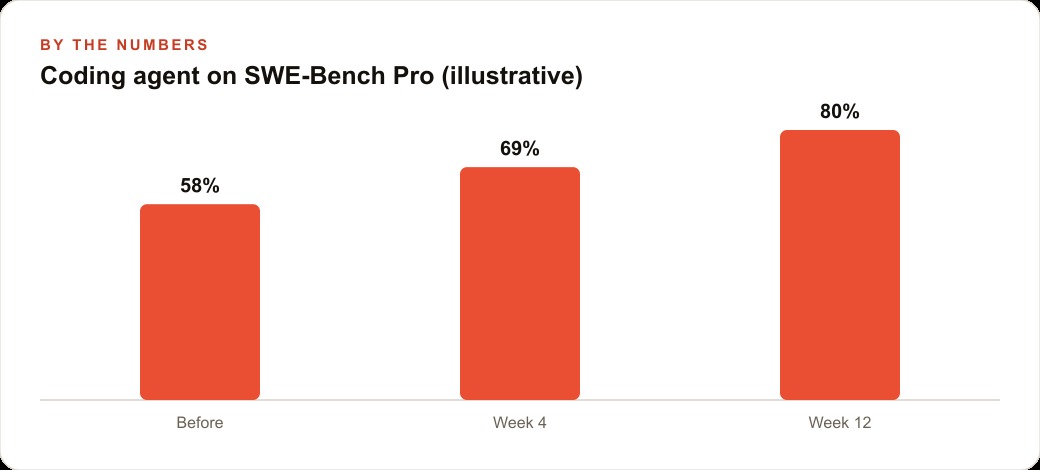
The numbers that matter for Fable 5 are SWE-Bench Pro and GDPval, not because coding and knowledge benchmarks are what your business does, but because they reveal a pattern that applies across all demanding cognitive work.
On SWE-Bench Pro, Fable 5 scores 80 percent. The prior generation, Opus 4.8, scores 69 percent. GPT 5.5 scores 58 percent. The gap between Fable and Opus 4.8 is 11 percentage points. The gap between Fable and GPT 5.5 is 22 percentage points. Those numbers are large and consistent across evaluation types.
The more important detail is what Anthropic reports about where the advantage grows: the longer and more complex the task, the wider Fable's lead becomes. On short tasks, the models sit closer together. On tasks requiring sustained reasoning across a large context, Fable pulls away decisively. For a business owner, that means the cases where you most need a model to get it right, the high-stakes, complex, high-volume jobs, are exactly the ones where upgrading to the frontier tier delivers the most value. The routine work that a cheaper model handles adequately is not where the frontier model earns its cost. The hard work that previously required expensive professional hours is exactly where it does.
The Stripe migration is the clearest real-world data point available. Their team used Fable 5 to run a migration across a 50 million line Ruby codebase in a single day. By hand, that work would have taken a full engineering team more than two months. That is not a small efficiency gain. It is the difference between a project that is feasible for a small organization and one that is not.
Route the first task to Fable and start agents at the lowest thinking effort setting
Anthropics own guidance on using frontier models is to start agents at the lowest thinking effort setting and raise it only when the task genuinely requires more. The model adjusts its compute use based on perceived task difficulty, and that adjustment is worth letting happen before you override it manually.
Starting at the lowest setting costs less and runs faster for tasks that do not need maximum compute. Starting high on everything wastes tokens on problems a mid-effort setting handles correctly. The practical rule is: start at the lowest setting, check the output quality, and escalate only when the result is clearly missing something important. Over a few sessions, you develop a reliable sense of which task types need higher settings and which do not.
When you route the first real task to Fable, choose the hardest problem on your current list, the one where you currently spend the most professional time or where the cost of getting it wrong is highest. Let the model run without heavily optimizing the prompt at first. Observe what it produces and how it structures its approach. The output density will likely surprise you. Multiple early users report that Fable's output requires slower reading to absorb because the information per sentence is higher than anything they had used before. That is not a quirk to work around. It is a signal that the model is doing more work per token than its predecessors, which is exactly what you are paying for.
Let parallel sub-agents handle the scale on large reviews and migrations
One of Fable's structural advantages on large tasks is the Ultra Code workflow, which starts a planning agent that delegates the actual work to potentially hundreds of parallel sub-agents. A single review task can spin up an agent for nearly every file in a large codebase simultaneously, so the review happens in parallel rather than sequentially.
For a business that is not a software company, the parallel sub-agent pattern still applies across different work types. A professional services firm reviewing a large portfolio of contracts can have sub-agents assigned to different document groups at the same time. A financial operator running a compliance audit can have different sections of the regulation mapped to different agents. An operator migrating a large body of content from one system to another can have different content categories handled in parallel rather than waiting for one to finish before starting the next.
The key insight is that you do not manage the sub-agents individually. The planning agent handles delegation, tracks progress, and consolidates results. Your role is to define the overall task clearly at the start, review the consolidated output at the end, and provide human judgment on anything the model flags as ambiguous. The heavy lifting of running hundreds of parallel passes over a large body of material is what the system handles. What used to require a team and weeks now requires a clear task specification and a review session.
Manage the preamble so it does not eat your token budget before the real work starts
Fable has two well-documented quirks that anyone using it seriously needs to account for. The first is verbosity. The model is extremely talkative about its own process. Left to its defaults, it will confirm a summary of your request, then confirm a specification of what it plans to do, then confirm its intended approach before beginning the actual task. That confirmatory behavior can consume thousands of tokens before the substantive work starts, which adds cost and latency without improving the result.
The practical fix is to add a project instruction that tells the model to skip the extra confirmation loops and proceed directly to producing the output. Something like: skip all preamble and produce the output directly. That instruction, added once at the project level, removes the setup overhead from every subsequent session and meaningfully reduces token waste.
The second quirk is a slow start followed by a rapid burst. The model often generates around 1,500 tokens slowly before it shifts into high throughput and produces the bulk of the output quickly. This is not a failure state. It is the model's planning period before it commits to execution. The practical implication is that you should not interrupt or cancel a Fable session in the first few minutes based on the output rate. Wait for the burst phase before judging the session's momentum. Every time I have seen someone cancel early, the model was in its planning phase and would have produced the substantive output within another minute or two.
Track cost per task rather than cost per token to see the actual return
The comparison that matters is not cost per million tokens. It is cost per task compared to the value of the task. Token pricing is an input to the calculation, but cost per completed task is what determines whether the frontier model earns its place in your operation.
A deep document review running across 200 pages of linked contracts might consume two to five million input tokens and produce a million tokens of structured analysis. At Fable's pricing, that run costs somewhere between seventy and one hundred fifty dollars. Compare that against the professional time the same analysis would have required: a senior associate working four hours at three hundred dollars per hour runs to twelve hundred dollars. At seventy to one hundred fifty dollars per model run, the output still requires human review and judgment on the findings, but the first-pass research, the cross-referencing, and the pattern identification happen at a fraction of the prior cost.
For a firm running three or four of those reviews per month, the monthly spend on the frontier model is two hundred ten to six hundred dollars, against what was previously thirty-six hundred to forty-eight hundred dollars in professional hours on the equivalent work. The human professionals stay involved for judgment, client relationship, and the final work product. The model handles the research and the first-pass analysis. The economics work clearly, and the return shows up on the billing statement immediately.
The specific workflow for a professional services firm
To make this concrete with real numbers, I would set this up for a firm that does contract review as part of a regular client workflow.
The firm has two categories of work that happen every week. The first category is routine: drafting standard client updates, preparing meeting agendas, summarizing calls, and formatting standard clause language. None of that goes to Fable. It goes to a lighter tier and the cost per task stays under a dollar in most cases. The team builds the habit of using AI on routine work and keeps their spend predictable.
The second category is the hard work: comparing a new commercial agreement against fifteen related prior contracts to flag inconsistencies and identify clauses that represent unusual risk, or cross-referencing a regulatory filing against three years of prior disclosures to identify gaps and contradictions. That work currently takes a senior professional two to three hours per assignment. At three hundred dollars per hour, each of those assignments costs six hundred to nine hundred dollars in billable professional time.
Routing only those assignments to Fable changes the math. The model runs the comparison across the full document set, flags inconsistencies with specific references, and produces a structured summary of the risk areas. The professional reviews the summary, verifies the key findings, applies their judgment on the legal implications, and incorporates the analysis into the final work product. That review takes forty-five minutes to an hour rather than the original two to three hours. The cost of the model run is fifty to one hundred twenty dollars. The professional's time on the task drops from six hundred to nine hundred dollars down to one hundred fifty to three hundred dollars, plus the model cost.
On ten hard assignments per month, the firm saves between three thousand five hundred and six thousand dollars in professional hours, against a model spend of five hundred to twelve hundred dollars. The model pays for itself inside the first month on the right workload, without the professionals losing any of the judgment, client relationship, or responsibility for the final product.
The routing decision is the whole game. Send the right tasks to the frontier model, send everything else to a cheaper tier, and track cost per task to verify the return. The mistake is paying frontier rates on everything. The advantage comes from using the most powerful tool selectively, on exactly the tasks where that power translates into outcomes that would otherwise require expensive human hours.
That is exactly what we do at AI DOERS. Book a private 30-minute call with Madhuranjan Kumar and we will map the fastest path to it for your specific business.
Book your call →
Madhuranjan Kumar
Madhuranjan Kumar brings 20 years of performance-marketing experience and has managed over $200 million in Facebook ad spend for brands across the United States and beyond. His expertise spans the full modern marketing stack: Meta, Google Ads, TikTok, email automation, CRM, and the websites that hold it together. At AI DOERS he turns that track record into lead-generation systems for businesses across every industry.