
Inside Cerebras's Fastest Data Center and Why AI Speed Matters for Your Business
Cerebras built the fastest AI data center on earth around a dinner plate sized chip with memory kept on chip to kill latency. Here is what that speed unlocks and how I would use a fast, responsive AI inside a real wedding photography studio.

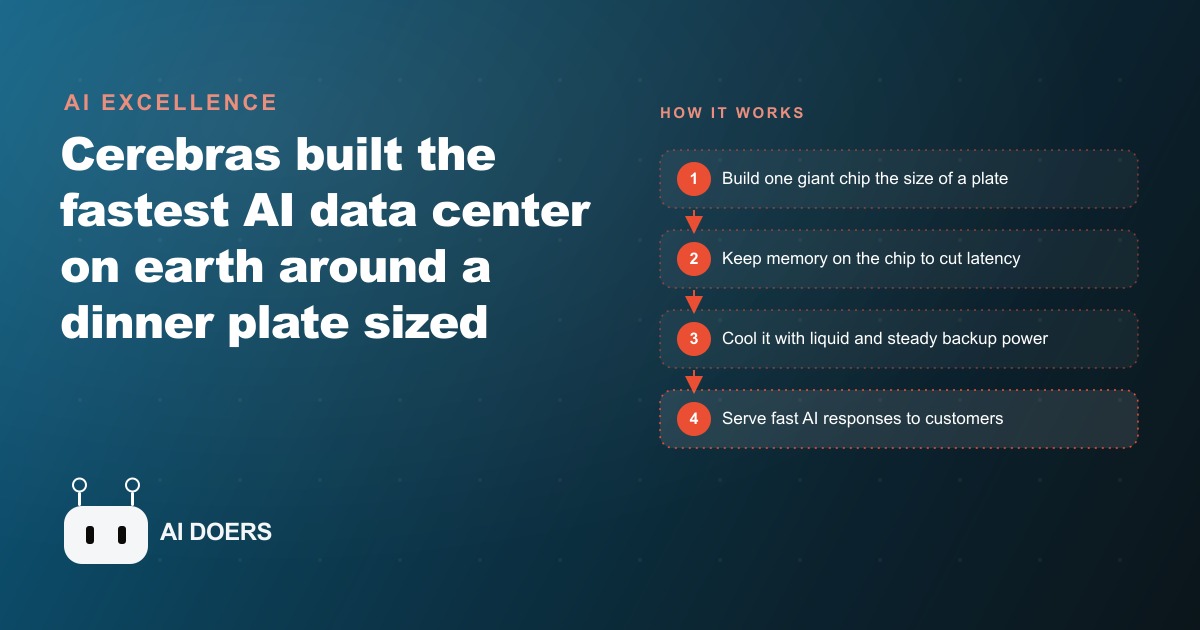
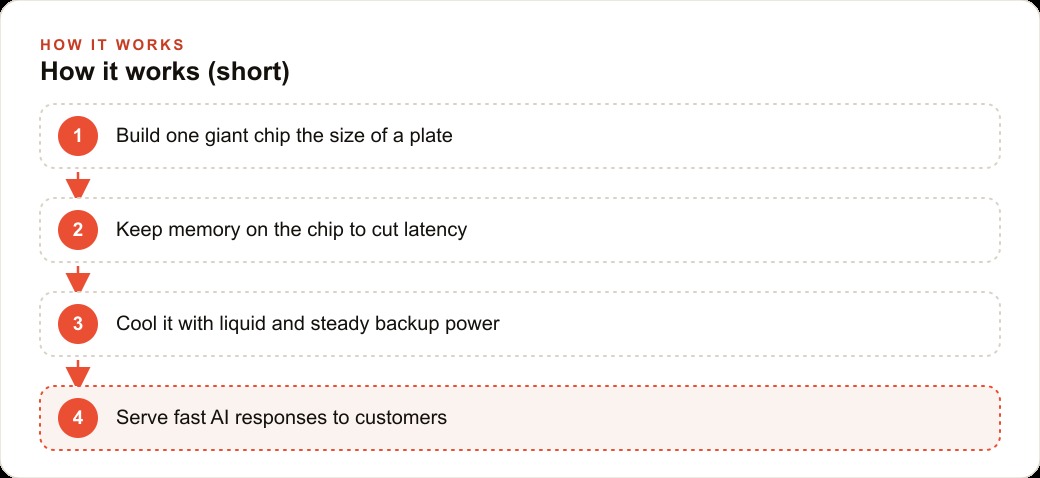
Cerebras built what it describes as the fastest AI data center on earth around a chip the size of a dinner plate. The new Oklahoma facility delivers 44 exaflops of compute from wafer-scale engines that keep memory directly on the chip, eliminating the round-trip delay that makes standard GPU clusters slow during inference. Each system holds one of these plate-sized chips upright, cooled by a 6,000-ton chiller plant, backed by batteries that bridge any power gap until multi-megawatt generators take over. The engineering is striking. The business lessons embedded in how they built it are more useful.
I am Madhuranjan Kumar, and I want to give you six concrete things the Cerebras build teaches about picking AI tools, evaluating vendor claims, and deploying AI in customer-facing work. You will never buy a wafer-scale engine for your office, but you are already choosing between AI tools with very different speed profiles, reliability architectures, and ways of measuring their own performance. The principles Cerebras applied to hardware apply directly to those decisions.
Memory Location Is the Variable That Determines Latency When You Wait
The core reason the Cerebras chip is fast is a single architectural decision: keep the memory on the chip rather than off it. Standard GPU clusters separate the processor from the memory. Every time the processor needs data during inference, it sends a request off-chip, waits for the data to return, and then proceeds. That round-trip is fast in absolute terms but adds up when a model needs to access memory millions of times per inference call. The latency accumulates, and the result is the familiar pause before the AI responds.
By building the memory directly onto the wafer alongside the processing elements, Cerebras eliminates that round-trip entirely. The processor reaches data immediately rather than waiting for it to travel across an interconnect. That is the source of the speed advantage, and it is a concrete design choice rather than a marketing claim.
For a business owner evaluating AI tools, this is a useful lens for asking the right questions about any product. Latency in an AI tool is not random. It comes from specific architecture decisions: where memory sits, how many model layers the inference pipeline has to move through, whether the system was optimized for throughput or response time. A tool that feels slow is slow for a reason, and that reason is usually not going to be fixed by the next version unless the underlying architecture changes. When you evaluate two AI tools and one consistently responds faster, ask why. The answer will usually reveal something about how the system was designed that predicts how it will behave at scale, under load, and when your customer is the one waiting.
Measure Useful Output, Not Energy Input, When Evaluating Any AI Vendor
One of the most candid moments in the Cerebras facility tour is when their team explains why they prefer to talk about useful compute output rather than the gigawatts of energy input that most data center builders use as their primary bragging metric. Their explanation is direct: their output numbers look better. Standard builders emphasize how much power they consume because that signals scale and commitment. Cerebras emphasizes what actually comes out of that power because their efficiency advantage shows up at the output level, not the input level.
That transparency is itself a signal worth noting. A company that tells you honestly why they measure what they measure, including when the motivation is partly self-serving, is giving you more useful information than one that presents only the metrics that favor them without context.
The business principle here generalizes directly. When an AI vendor pitches you, they will choose the metrics that make their product look best. Response time, accuracy, cost per query, context length, benchmark scores: each of these tells a different story, and vendors choose the story that favors their product. The discipline of measuring useful output from your specific workflows, rather than accepting the vendor's preferred benchmark, is what separates an AI tool that sounds impressive in a demo from one that delivers real value in the work your team actually does every day. Ask what the tool produces for your use case, not what it scores on a general benchmark designed by someone with different priorities than yours.
Reliability Comes From Overlapping Layers, Not a Single Backup
The power architecture at the Oklahoma facility is worth studying as a model of how serious reliability is engineered. Primary power comes from natural gas converted to electricity on-site, which removes dependency on the grid for normal operations. When any power interruption occurs, batteries activate immediately and bridge the gap for approximately five minutes. During those five minutes, multiple megawatt-scale generators spin up and take over the full load. When primary power returns, the transition goes back in the same layered sequence.
No single layer is the plan. The plan is the sequence of overlapping layers, each one designed to cover the gap that the previous layer cannot handle. The batteries do not need to run for hours. They just need to keep the system alive long enough for the generators to reach full speed. The generators do not need to run indefinitely. They just need to cover the time until primary power is restored or a longer-term decision is made.
For business owners deploying AI in customer-facing workflows, the same layered reliability principle applies. A chatbot that goes down because one service it depends on has an outage is less reliable than one with a fallback path. An AI assistant that fails silently, returning no response rather than a degraded response or a human escalation, is less reliable than one where you know exactly what happens when the underlying service is unavailable. When you deploy AI in a workflow where a customer or a colleague is depending on a response, understand what the failure mode is and whether there is a layer beneath it. The businesses that have thought through the failure modes before they matter will handle them calmly when they happen. The ones that find out at the worst moment will scramble.
Speed Shifts AI From a Research Tool to a Real-Time Response Tool
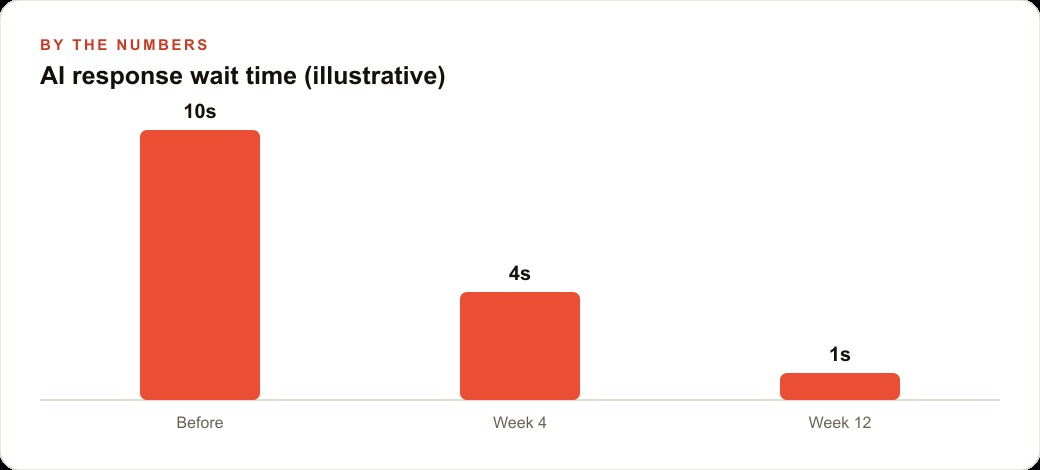
Fast AI and slow AI are not just different speeds of the same tool. They are different tools, because speed changes the use cases that are even worth attempting. A model that takes ten seconds to respond is useful for drafting, research, summarizing, and other work where the person initiating the request can do something else while waiting. A model that responds in one second is useful for those same tasks and for something categorically different: real-time interactions where someone is actively waiting for the reply.
The Cerebras team makes this point directly. Their CEO describes the speed as transforming what is possible in domains like medicine and education, where a faster, more accurate response is not just more convenient but changes the nature of the interaction. A diagnostic tool that responds in one second is part of a real-time conversation with a clinician. A diagnostic tool that takes thirty seconds is a batch process the clinician checks when the results are ready. These are different experiences with different implications for how the tool is used and how useful it is in practice.
For business owners, this is the most actionable of the six lessons. If you are deploying AI in a context where a customer is actively waiting for a response, response time is not a feature preference. It is a condition for the deployment being useful at all. A chat assistant that takes ten seconds to reply in a customer service context is not a fast version of a human agent. It is a different experience, and not a better one. When you evaluate AI tools for any customer-facing application, test response time under realistic conditions before you evaluate anything else. The rest of the features only matter if the speed clears the bar for the interaction you are designing.
For campaigns running on Facebook and Instagram ads, where creative testing and audience response analysis often need to be reviewed quickly and acted on within a campaign window, the difference between an AI analysis tool that returns results in seconds versus minutes changes whether you can act on the analysis within the same session or have to return to it later.
Thermal Discipline in Infrastructure Signals Operational Seriousness
Each Cerebras wafer draws 18 kilowatts of power, which generates significant heat in a very small physical footprint. The solution is a liquid cooling system connected to a 6,000-ton chiller plant, with water temperature carefully managed so that condensation never forms on the silicon. The water that enters the cooling loop is warmed precisely enough to pick up the chip's heat without being cold enough to cause moisture problems. Getting that balance wrong would damage equipment worth millions of dollars.
That level of thermal discipline reveals something about the organization behind it. Managing heat at scale is an unglamorous, technical, and expensive problem that has no good solution in a demo environment. It only matters when you are operating real hardware at real load, over sustained periods, in a facility that has to stay running. Companies that solve it well have built organizations capable of thinking through second-order consequences before they become first-order problems.
For business owners evaluating AI vendors or infrastructure providers, the thermal management analog is the question of what unglamorous operational problems the vendor has actually solved. Any AI product looks clean in a controlled demo. The questions worth asking are about the less visible operations: How is the system monitored for degradation over time? What happens to data in-flight during an outage? How does the system behave under a load spike? What does the support process look like when something goes wrong at midnight on a Sunday? A vendor that has good answers to those questions has an operations discipline that is hard to fake and hard to build quickly. A vendor that deflects them or gives vague answers is telling you something about how seriously they have thought through the gap between demo performance and production reliability.
A One-Second Response Wins the Customer Interaction
In events and hospitality, where every customer interaction is emotionally loaded and the competition for attention is constant, response time is a competitive variable that most operators have not yet thought about in the context of AI tools.
As an illustrative example, consider an events company that manages 40 to 60 corporate events per year across multiple venue partners. Inquiries come in throughout the day from event planners and corporate clients who are often reaching out to multiple vendors simultaneously. The first detailed, helpful response to a new inquiry tends to anchor the client's attention and set the standard against which every other response is measured. A competitor that replies in two minutes with a specific, warm, accurate answer to the inquiry has a significant advantage over one that replies in two hours with the same quality of information.
A fast AI assistant connected to the company's venue database, service package list, and availability calendar can reply to a new inquiry in under 60 seconds with a response that addresses the specific event type, date, and guest count the client mentioned, outlines the relevant package options, and offers a consultation slot. The events manager reviews anything that commits the business to a price or a date before it goes out, which typically takes 30 seconds because the AI has already assembled the right information.
For the client relationship and follow-up workflows that keep event clients engaged between the inquiry and the contract, speed matters at every stage. The follow-up after an initial consultation, sent the same afternoon rather than the following morning, catches the client while the conversation is still fresh. The contract confirmation, sent immediately after the verbal agreement, closes the loop before the client has second thoughts. An AI that responds to each of these moments in seconds rather than hours is not a minor efficiency improvement. It is a change in the quality of the customer experience, which in events is the product.
The Cerebras build makes the speed argument with hardware. The business case for speed in customer-facing AI is the same argument made in the language of client retention, conversion rate, and referrals. Fast is not always better. But in the moments where a customer is actively waiting, fast is often the entire margin between winning the business and losing it to whoever replied first with something useful.
That is exactly what we do at AI DOERS. Book a private 30-minute call with Madhuranjan Kumar and we will map the fastest path to it for your specific business.
Book your call →
Madhuranjan Kumar
Madhuranjan Kumar brings 20 years of performance-marketing experience and has managed over $200 million in Facebook ad spend for brands across the United States and beyond. His expertise spans the full modern marketing stack: Meta, Google Ads, TikTok, email automation, CRM, and the websites that hold it together. At AI DOERS he turns that track record into lead-generation systems for businesses across every industry.