
From Idea to App Store in One Sitting: Building a Mobile App With AI
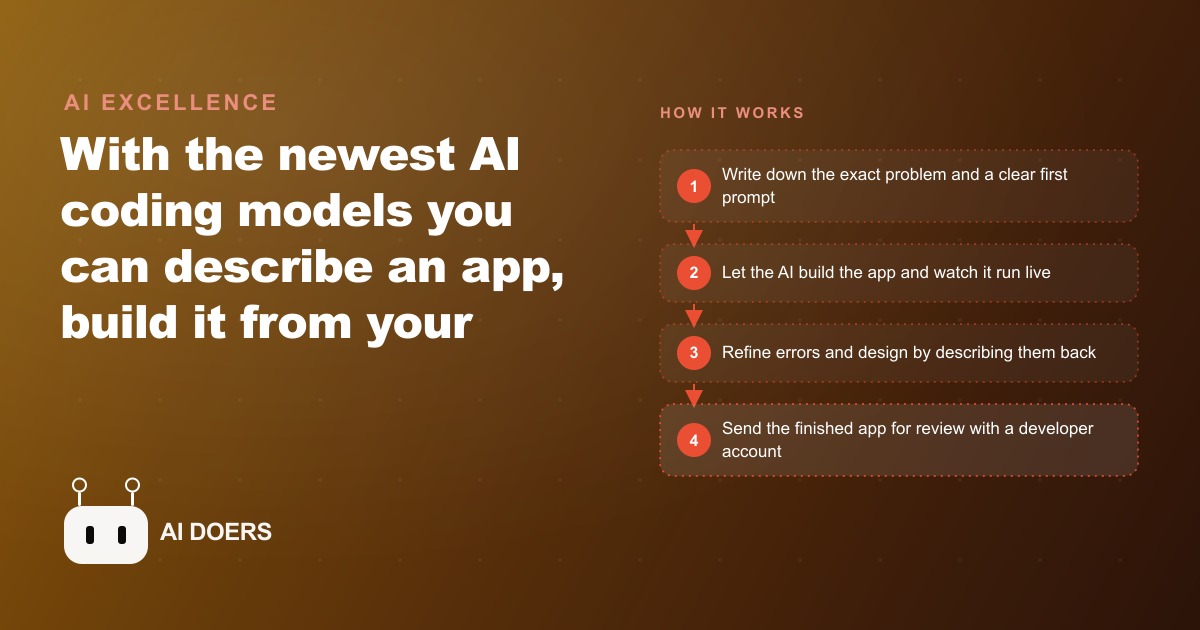
The newest AI coding models are fast enough to build a working mobile app while you watch. Here is how I would take an idea to a finished app, and how a real business could use it.

I'm Madhuranjan Kumar, and I want to challenge the most popular framing in AI-assisted app building before it costs you real time.
The "one sitting" framing is accurate but it undersells the actual shift. Yes, you can go from an idea to a functional mobile app in a single session with current AI coding tools. That is genuinely remarkable and it was not possible 18 months ago. But framing this as an achievement about speed misidentifies the real change.
The bottleneck is no longer building. The bottleneck is knowing what is worth building.
A person who spends 20 minutes clearly defining the problem they are solving before opening any AI tool will have a working, useful app in one sitting. A person who starts with "I want to make an app" and reaches for the AI immediately can spend three sessions producing something technically impressive that solves a problem no one actually has. The AI did not fail in the second case. The builder did.
This is the shift that matters, and most coverage of AI coding tools gets it backwards by celebrating the speed of generation rather than interrogating the quality of the problem.
The Problem-First Gap That Most Demos Skip
Watch almost any demonstration of an AI coding tool building a mobile app and notice what happens in the first two minutes. Madhuranjan Kumar describes, briefly, what the app should do. Then the code starts generating and the rest of this breakdown is about the features appearing, the bugs getting fixed through description, the app taking shape in minutes.
What the demo skips is the work that happened before the recording started. Madhuranjan Kumar already knew, with precision, what they were building. They could describe the core function in one or two sentences. They knew who would use it and what problem it would solve for that person. They had, in other words, done the problem definition work before touching the tool.
That problem definition work is the part that fails silently in most real attempts at AI-assisted app building. Someone has an idea: a habit tracker, a client invoicing tool, a local service directory. They open the coding tool, describe the idea in general terms, and watch the app materialize. But the idea was defined at the level of "type of app" rather than "specific problem this app solves for a specific person in a specific situation."
The AI builds exactly what was asked for. What was asked for was not specific enough to be useful. Three sessions later, there is a polished habit tracker that looks good and that nobody uses, because the problem it was designed to solve was never clearly defined.
How the Fastest Builders Actually Work
The operators who consistently produce useful apps in single sessions, based on everything I have observed, share a common practice pattern that has nothing to do with prompting skill in the conventional sense.
They start by writing a problem statement before opening any tool. Not "I want an app that does X" but "the current way I handle X takes Y minutes and requires Z manual steps, which causes this specific friction at this specific moment in my workflow." That sentence does something important: it makes the scope of the problem explicit, which makes the scope of the solution tractable.
They then describe the first version of the solution in the most stripped-down terms possible. Not the version with all the features they eventually want. The version that would be genuinely useful today if it existed right now, with nothing else added. This minimum version is almost always three to five features shorter than the first instinct.
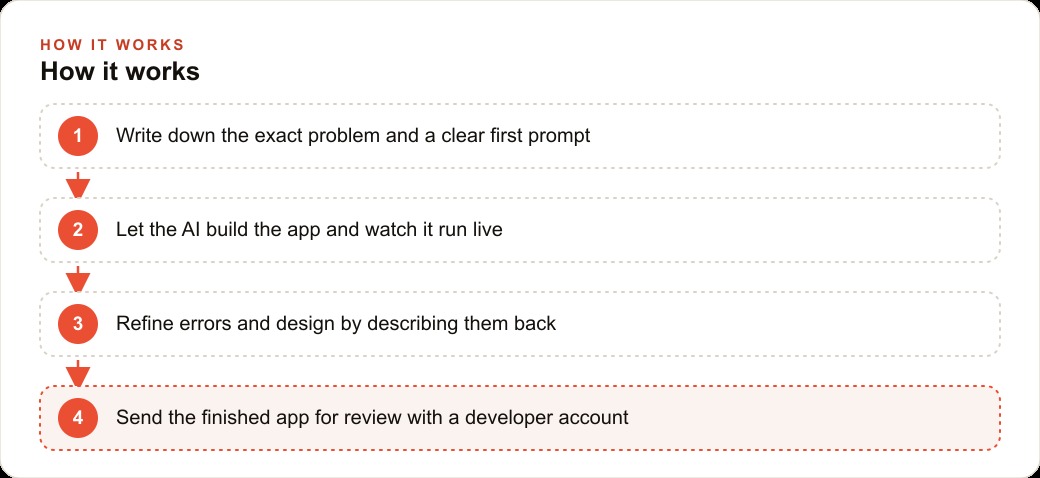
With that definition in place, they open the AI tool and describe the problem statement and the minimum version. The AI generates an initial build in two to three minutes with current tools that can parallel-call multiple tool operations simultaneously. The first build is not perfect. It does not need to be. The first build is the thing you test to see what needs to change.
Then they iterate with description. Not by opening the code and editing manually, but by describing what is wrong. "The form is not saving between sessions." "The button to add an entry is not visible on smaller screens." "The list is showing items in the wrong order." Each description produces a targeted fix in seconds. Ten passes of this kind of feedback loop produce a working app faster than any amount of trying to write perfect code manually.
What a Tradesperson Built in 22 Minutes
Let me give you a specific example that illustrates the problem-first approach working as intended.
A tradesperson, a plumber who operates as a sole trader, was spending the last 45 minutes of every working day updating a spreadsheet with the day's job details: client name, address, job type, parts used, hours, notes for follow-up. This was not optional. The information fed into invoicing, and missing details meant phone calls the next morning to reconstruct what happened on a job.
Before touching any AI tool, they wrote a simple description of the problem: "I need to capture 6 pieces of information per job while I am still on site, on my phone, so I do not have to reconstruct anything at the end of the day. The capture should take under 2 minutes per job and require no typing of repeated information like my own contact details or standard job categories."
That sentence defined a very specific thing. Not "a job tracking app." A form-based capture tool that pre-populated known categories, allowed free-text notes, saved locally without needing constant internet connection, and exported a daily summary.
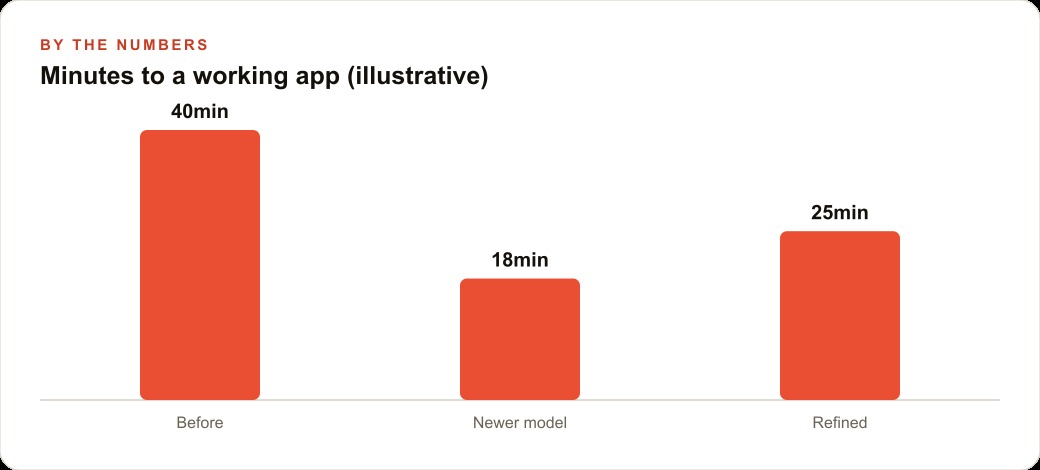
They opened a current-generation AI coding tool, pasted that description, and received a working React Native scaffold in approximately 2 minutes. Six iterations over the following 20 minutes, each described as a specific correction, produced a functioning app: offline-capable local storage, pre-populated dropdowns for job types and parts categories, a free-text notes field, and a daily export function.
Total time from problem definition to working app: 22 minutes. The app eliminated 45 minutes of end-of-day paperwork per working day. Across 220 working days in a year, that is 165 hours recovered. At a conservative hourly valuation of trade time, the return on 22 minutes of focused problem definition plus AI-assisted building is substantial.
The app is not beautiful. It has no logo, no onboarding flow, no user accounts. It does not need any of those things. It solves the problem defined at the start, and it solves it completely.
Why Ten Quick Passes Beat One Perfect Prompt
There is a common misunderstanding about how to work with AI coding tools that shows up repeatedly in beginner attempts: the idea that the quality of the initial prompt determines the quality of the final output. This leads to people spending 30 or 45 minutes crafting an elaborate first prompt before generating anything.
That approach works for simple, well-understood tasks where the full specification can be written in advance without ambiguity. It does not work well for building software because software requirements become clear through building. You do not know which elements of the UI are confusing until you see the UI. You do not know which data fields are missing until you try to use the form. You do not know which flows feel awkward until you tap through them on an actual device.
The faster path is a good enough initial description, generate quickly, then iterate with description. Ten short cycles of "here is what is wrong" produce a better result than one elaborate upfront specification because the later cycles are informed by seeing the actual output, which reveals problems the initial specification could not anticipate.
Current AI coding tools that parallel-call tools simultaneously are well-suited to this iteration pattern. The feedback loop between describing a problem and seeing a fix can be under 30 seconds for simple changes. This means you can genuinely explore the solution space in a single session in a way that was not possible when each generation took minutes.
The discipline required is to keep the feedback descriptions specific and one-thing-at-a-time. "Fix the button" is less useful than "the add-entry button should be positioned above the list, not below it, so it is visible without scrolling on a small screen." Specific descriptions produce targeted changes. Vague descriptions produce changes that might solve the stated thing while inadvertently breaking something adjacent.
The App Store Step Is Guided, Not Mysterious
One reason people underestimate the accessibility of the full mobile app pipeline is that submitting to an app store sounds like a technically complex process involving review boards and compliance requirements and developer accounts.
It is more guided than mysterious with current tooling. The AI coding environment that built the app will walk through the submission process step by step when asked. You describe what you are trying to do ("I want to submit this to the App Store"), and the tool generates the required configuration files, the metadata, the icon at the correct resolutions, the privacy manifest if required, and the instructions for each step of the submission flow. Review takes time and occasionally requires a resubmission. The technical barriers are not significant for a straightforward utility app.
The non-technical barrier is the same one we started with: a clearly defined purpose that can be stated in the app store listing accurately. The review process and the potential user both need to understand quickly what this app does and who it is for. Apps with vague purposes get rejected or ignored. Apps with precisely defined purposes clear review more reliably and convert better in the store.
Problem definition is the prerequisite not just for building efficiently, but for distribution.
MVP First Is Not a Compromise, It Is the Strategy
There is a tendency in software thinking to apologize for the MVP, to treat the minimum viable product as an unfortunate constraint and the "real" product as the one with all the features eventually added. I want to push back on this framing hard, because it leads to exactly the wrong approach when building with AI tools.
The MVP is not a compromise. For most business problems, the MVP is the product. The tradesperson's app with six fields and an export button is more useful to them than a version with analytics dashboards, cloud sync, multi-user collaboration, and a beautifully designed onboarding flow. None of those additional features address the problem. They add complexity that increases the chance of something breaking, increases the cognitive overhead of using the tool daily, and increases the time to deployment.
Build the minimum version that actually solves the defined problem. Ship it. Use it. Only then is there real information about what, if anything, is missing. Most of the time, the missing piece is smaller than anticipated because the problem was defined precisely enough that the minimum version genuinely addressed it.
The AI coding environment does not know which additional features are unnecessary. It will build anything you ask for. The discipline of keeping scope minimal is yours to enforce, and it is the most important discipline in the entire pipeline.
The Real Shift This Technology Represents
I want to name the broader significance of what this technology actually changes, because I think it is genuinely important for how small businesses should think about their tools.
For the history of software, the cost of building a custom tool for a specific business problem was prohibitive for most businesses. You either adapted your workflow to fit an off-the-shelf product, accepted the limitations of a generic solution, or paid enterprise software development costs to get something specific. Most businesses adapted to generic tools because custom development was not accessible.
That constraint is being lifted. A business with a specific, well-defined operational problem can now build a tool precisely fitted to that problem in a single session at near-zero cost. This is not a marginal improvement in software development efficiency. It is a qualitative change in who can access custom software.
The businesses that will benefit most from this change are not the ones with the most technical resources. They are the ones with the clearest view of their own operational problems. That clarity, the ability to define precisely what is wrong and what solving it would look like, is the new competitive capability.
I'm Madhuranjan Kumar. The "one sitting" framing is true, but the more important truth is that the sitting is the easy part. The 20 minutes of problem definition before the sitting is where the real work happens, and it is the thing most people skip.
That is exactly what we do at AI DOERS. Book a private 30-minute call with Madhuranjan Kumar and we will map the fastest path to it for your specific business.
Book your call →
Madhuranjan Kumar
Madhuranjan Kumar brings 20 years of performance-marketing experience and has managed over $200 million in Facebook ad spend for brands across the United States and beyond. His expertise spans the full modern marketing stack: Meta, Google Ads, TikTok, email automation, CRM, and the websites that hold it together. At AI DOERS he turns that track record into lead-generation systems for businesses across every industry.