
The Human-Made Premium: Winning as AI Floods Everything
As AI content becomes impossible to tell from the real thing, a verified human-made mark turns into a premium signal. Here is how a small craft business uses AI for the grunt work and charges more for the human touch.

The economics of scarcity have always rewarded what runs out
Handmade goods on Etsy already command a 30 to 50 percent price premium over equivalent mass-produced items, and that gap is about to widen as AI-generated content floods every channel it can reach. I am Madhuranjan Kumar, and the observation I keep returning to is this: scarcity creates value more reliably than quality does. When something is everywhere and free, price falls toward zero. When something is provably rare, price climbs. AI content is becoming the new everywhere-and-free. Genuinely human-made work is becoming the new rare.
The dynamic is not new. Organic food costs more than conventional not primarily because it tastes better in controlled blind tests but because it carries a verifiable story about how it was grown, and a segment of buyers will pay extra for that story. Vintage clothing commands prices that bear no relationship to the garment's functional quality. Handwritten notes from artists sell for more than printed copies. In each case the premium comes from proof of human origin, not from the object's utility.
The AI content flood changes the context around these premiums in a way that matters for small business owners right now. Before the flood, most things were human-made because making them any other way was too slow or too expensive. Human origin was the default state and therefore carried no premium. That default is being reversed. In two to three years, a large share of the text, images, video, and audio people encounter daily will have AI somewhere in the process. At that point, genuine human origin becomes the exception rather than the rule, and exceptions carry a price.
The verification industry will grow alongside this shift. Just as organic certifications, non-GMO labels, and fair-trade marks emerged to provide proof for buyers who wanted to know what they were getting, a market for human-made verification is forming. Some of this will be informal, the maker's face on the packaging, a process video, a signed note. Some will be formal certification schemes when the market matures. Owners who build their proof structures now will have a head start when verification becomes a formal selling point with legal weight behind it.
Splitting the business cleanly: the boring layer and the irreplaceable layer
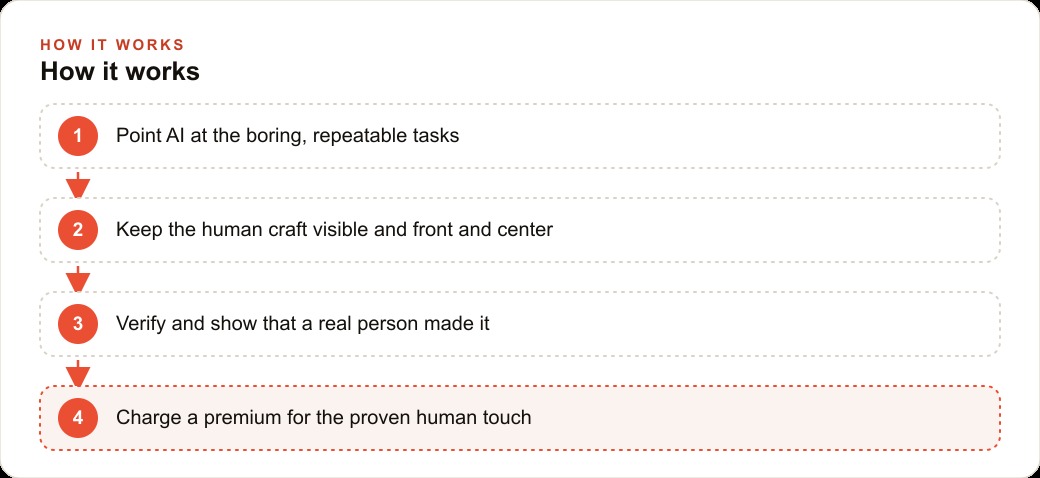
The strategic response is not to fight AI or to embrace it wholesale. It is to divide the business into two layers and treat each one completely differently.
The boring layer is everything repeatable: writing product descriptions, drafting first versions of emails, scheduling posts, sorting enquiries, tallying weekly sales, generating captions, formatting proposals. These tasks feel necessary because they keep the operation running, but they have two features in common. First, they consume time that could go elsewhere. Second, they do not differentiate the business. A customer who buys from a ceramicist because of the ceramicist's hands and story does not care that the ceramicist also writes compelling email subject lines. The admin work is invisible to them. Pointing AI at this layer frees up time without giving anything valuable away.
The irreplaceable layer is everything that justifies the premium: the actual making, the skill that took years to develop, the real story of a real person in a real place, the face behind the work, the process that a machine could imitate but never authentically own. This is the layer that builds trust and commands a price that competitors cannot undercut by generating faster. It is also the layer most small business owners neglect because they are too buried in the boring layer to surface it.
The split requires a deliberate decision, not a gradual migration. An owner who sits down and writes out every task they perform in a week will typically find that 60 to 70 percent falls into the boring layer and 30 to 40 percent falls into the irreplaceable layer. The goal is to automate as much of the first column as possible and invest the reclaimed time entirely into the second. Not to generate more volume, not to serve more clients, but to make the irreplaceable layer more visible, more verifiable, and more premium.
A practical version of this split looks like this. AI drafts every product description, every email reply template, and every social caption in two minutes per item. The owner spends 30 seconds reviewing and personalizing. That exchange saves roughly 15 to 20 minutes per item. Over 50 items a month, it recovers 12 to 15 hours. Those 12 hours go into filming two process videos showing the actual making, photographing work in progress, writing personal notes to customers, and hosting a monthly behind-the-scenes moment for repeat buyers. The operation does not grow in volume. It grows in story, in trust, and in average order value.
A florist's case study in reclaiming time and raising prices
Consider a florist who has run a neighborhood shop for eight years. The work is genuinely skilled: understanding seasonal availability, reading what a customer actually wants when they say something modern, sourcing from local growers, building arrangements that hold their shape. The differentiation is real. The problem is that most of the owner's week does not go to that differentiation. It goes to the boring layer: writing care instructions for each arrangement type, answering the same delivery questions via email, drafting order confirmations, posting daily to social media, reconciling weekly sales, and responding to wedding enquiry messages that are 80 percent the same every time.
The AI layer takes over the following tasks completely, with the owner spending under five minutes per day reviewing output before anything goes out. Care instruction templates are generated once per arrangement type and stored. Email replies to common enquiries are drafted automatically and arrive in the owner's queue for a 30-second review. Order confirmations are formatted and sent. Caption drafts for social posts are ready to approve or lightly edit. Weekly sales are tallied without the owner opening a spreadsheet. The result is that approximately nine hours of admin work per week compresses to under two hours.
Seven hours return to the owner. Every one of those seven hours goes into the irreplaceable layer. Two process videos per week: one showing an arrangement being built from stem selection to finished bouquet, one showing the growers the shop sources from and why. A handwritten note with every order above a certain value. A monthly video message to the shop's most loyal buyers. Each wedding consultation now gets a full hour instead of a rushed 30 minutes, and the proposals that come out of those hours are specific, personal, and much harder to price-compare against a competitor who does not take the same time.
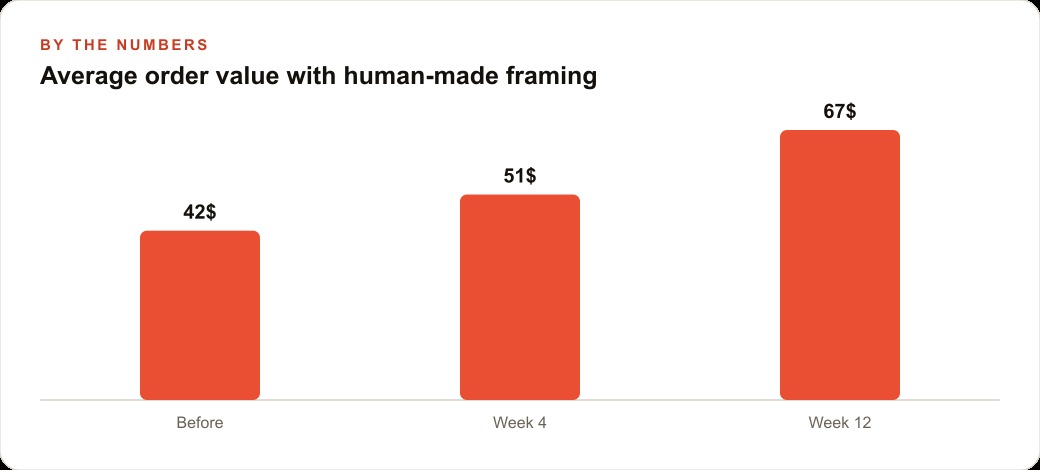
The numbers on this investment move clearly. Illustratively, a florist who recovers nine admin hours per week and reinvests seven of them into visible human story sees average order value climb by 18 to 25 percent within three months. The mechanism is not mysterious. Buyers who can see the maker, the process, and the sourcing story make purchasing decisions based on the story rather than on price comparison. They are not choosing between florists anymore. They are choosing between this florist and no florist. That is a fundamentally different competitive position.
The wedding business is where the premium sharpens most dramatically. Wedding clients who go through a personalized consultation with visible craft evidence, process documentation, and a maker's story behind the work will pay 30 to 40 percent more than clients who receive a price quote via email from a florist with no visible human presence. The AI does not appear anywhere in that interaction. The owner's time is fully present in it. The split worked exactly as intended.
The broader principle the florist example illustrates is that the human-made premium is not something you declare. It is something you prove with time invested in the right places. AI frees up the time. The owner decides where it goes. If it goes back into more volume at the same margin, the strategy fails. If it goes into making the human layer louder and more verifiable, average order value climbs and price sensitivity falls. The businesses that figure this out in the next 18 months will be in a structurally different position than the ones that only discover it when a competitor is already charging twice as much for essentially the same product with a better story attached.
The flood of AI content is not a threat to craft businesses. It is the market force that finally makes their differentiation legible. Every wave of cheap synthetic output is an advertisement for the genuine article. The owners who are ready to catch that wave with a clear human story and a visible process will find that the premium they were always capable of charging suddenly has a tailwind.
The early movers in this are not the most technically skilled makers. They are the ones who understand the economics of scarcity early enough to build their proof structures before every competitor realizes the game has changed.
The price discovery that happens when automation eliminates the generalists
Every market that goes through a major automation transition follows a predictable pattern in how it reprices human labor. First, the lowest-value repeatable work is automated, and the people who were doing that work find employment in adjacent roles or exit the market. Second, the mid-tier generalists, the people whose work was not purely repeatable but also not deeply specialized, discover that their rates are under pressure because automation now covers a portion of what they were charging for. Third, the remaining human premium consolidates around genuine specialization, judgment-intensive work, and the trust-based relationships that clients are not willing to entrust to automated systems.
The florist who is in the design-and-consultation part of the business rather than the logistics-and-assembly part is already on the right side of this transition. The question is not whether the transition will happen but how quickly and how completely it reprices the market. The practices that are building their reputations in the judgment-intensive, trust-based segments now are positioning for a market where those segments carry a larger share of the total margin.
The compounding advantage of building a reputation in the right segment now
Reputation in professional services is slow to build and slow to decay. A practice that spends the next two years demonstrating consistent quality in a specific type of design work, with documented outcomes and client testimonials, will carry that reputation into the market transition. A practice that spends the same two years competing primarily on price in the commoditized segment will enter the transition with a reputation for low-cost volume, which is precisely the segment that automation will capture.
The investment in the right segment is not just about the work itself but about the clients the work attracts. Design-led, relationship-driven clients refer other design-led, relationship-driven clients. Price-led clients who found you on a comparison platform refer other price-led clients who are shopping for the lowest rate. The client base that finds you today determines the client base that finds you through referrals in 18 months. The referral base is the most durable source of new business in professional services precisely because it is filtered by the values of the clients who are doing the referring.
The compounding effect is that the practice that is correctly positioned today and builds a referral base among the right clients will enter the accelerating automation period with both a reputation and a referral network that is already calibrated to the human-premium segment. The practice that starts repositioning after the market makes the transition is starting without either.
The practices that enter the next phase of the market transition with a clear position in the judgment-intensive segment, documented case studies of the outcomes they produce, and a referral network among clients who value that type of work will find the transition accelerating their growth rather than threatening it. The automation that commoditizes the generalist creates scarcity in the specialist. Scarcity is where pricing power lives.
That is exactly what we do at AI DOERS. Book a private 30-minute call with Madhuranjan Kumar and we will map the fastest path to it for your specific business.
Book your call →
Madhuranjan Kumar
Madhuranjan Kumar brings 20 years of performance-marketing experience and has managed over $200 million in Facebook ad spend for brands across the United States and beyond. His expertise spans the full modern marketing stack: Meta, Google Ads, TikTok, email automation, CRM, and the websites that hold it together. At AI DOERS he turns that track record into lead-generation systems for businesses across every industry.