
How to Win With AI in 2026: A Practical Playbook for Small Business Owners
AI changed more in the last year than most people realize, and the gap between owners who use it and owners who watch it keeps growing. Here is how I would help a real business get moving without waiting another quarter.

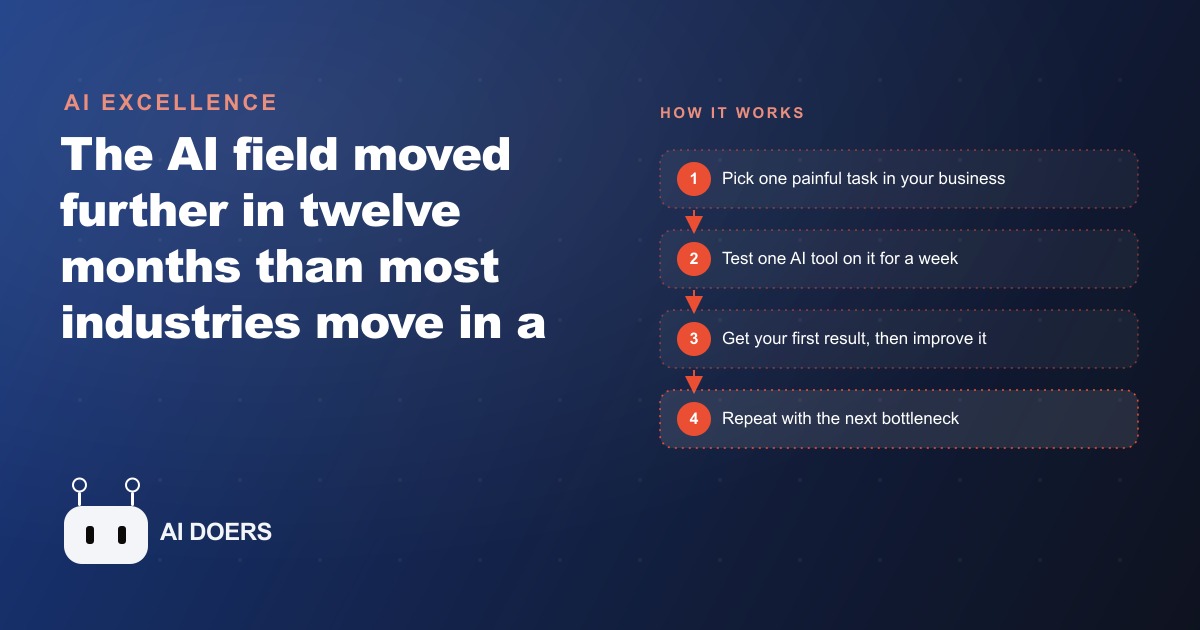
Somewhere in the last twelve months, the tools crossed a line that most business owners missed while they were still deciding whether to pay attention. Coding assistants, image generators, and reasoning models that felt like experiments in early 2025 are now reliable daily workers for businesses that gave them real tasks to complete. The field moved further in that single year than most industries move in a decade, and the businesses that started early are compounding that head start every week.
I am Madhuranjan Kumar, and the observation I want to advance in this piece is simple: the gap between business owners who are winning with AI and the ones who are watching it is not a knowledge gap. It is not a budget gap or a technology gap. It is a one-week gap in real use, and it is entirely closeable this week.
The information about what AI tools can do is available to anyone who looks. The experience of pointing one of them at a real problem in a real business, running it long enough to get a useful result, and knowing what to do with that result is not available anywhere except through actually doing it. That experience, more than any plan or strategy document, is what converts a subscribed-but-idle tool into something that changes what a business can produce each week.
The businesses pulling ahead started before they had the right plan
The most common form of AI paralysis I see among business owners is not resistance. It is preparation. The owner has done the research, compared the tools, watched the demos, and formed a working understanding of what AI can do. They are ready, pending one more thing: the right conditions. A quieter week, a cleaner workflow, a moment when there is enough time to do this properly. Those conditions have a way of not arriving on schedule, and the preparation, however careful, produces no compounding while it waits for them.
The businesses gaining ground right now started imperfectly. They picked one repeating, painful task, used one tool on it before fully understanding the tool, and got one result that was useful enough to build on. The strategic clarity they have today came from starting, not from preparing to start. There is no substitute for running the tool on actual business work with actual stakes attached, and there is no shortcut to what that experience teaches.
Three areas tend to produce the fastest and clearest early results for most businesses.
The first is marketing output. A single photograph of a product, a person, or a space can now produce a professional set of ad creatives, branded social graphics, and polished web images in under an hour at very low cost. The path from a phone photo to a ready-to-test batch of materials for a Facebook and Instagram ad campaign used to require a photographer, a designer, and several rounds of revision. That same path now runs in an afternoon. The cost floor on visual marketing assets has dropped so far and so fast that any business still paying monthly retainers for creative production is solving a problem that has already been solved.
The second area is customer communication. A business that responds to inquiries in minutes rather than hours occupies a structurally different competitive position in its market. In most local service categories, response time is the primary driver of which business wins the booking when two otherwise similar options are available. AI-assisted draft replies, booking confirmations, and follow-up sequences handle the volume without requiring proportional staff time, and the reputation for fast response that builds over weeks becomes its own source of new business. Competitors who are slower cannot easily reverse that reputation once it forms.
The third area is content and organic presence. An owner who publishes one useful piece of SEO and organic content each week, even something short and plainly written, builds a search presence that dormant competitors do not. AI drafts the structure and the language. The owner adds the expertise and the judgment. That combination is faster than writing from scratch and more credible than fully outsourced content, because the owner's actual knowledge and perspective stay in the text rather than being filtered through someone working from a brief.
The economics of marketing and creative production have structurally changed
One year ago, producing ten distinct ad creative variations for a campaign test required either a design budget of several hundred dollars or several hours in a design tool with uncertain output quality. Today the same set takes under an hour at subscription cost. That is not a marginal efficiency improvement. It is a change in the nature of the constraint that was limiting how many campaigns a business could run, how many audiences it could test, and how many messages it could try in a given month.
Brand photography is a concrete example. A service business, a studio, a retail shop, or a clinic that used to depend on one professional photoshoot per year to supply its visual marketing for the whole year can now produce consistent, credible visual content regularly from phone photos run through a modern image tool. The visual quality that used to require a scheduled shoot, a location, a photographer's fee, and a post-production turnaround is now achievable within hours of deciding to run a new campaign. The owner who was stretching a set of twelve-month-old images across every platform can produce fresh, on-brand visuals for any occasion within an afternoon.
Written content follows the same economics. Blog posts building organic authority, email sequences nurturing leads, Google Ads copy variations, social captions matched to a brand voice, product descriptions for an online store. The tool handles the draft and the structure. The owner applies judgment about accuracy, tone, and what is actually worth saying. That division of labor produces something more authentic than fully delegated writing and faster than entirely manual writing, because the owner's actual knowledge stays in the output rather than being approximated by someone working from a brief.
Open models that run locally on a laptop or phone, with no data leaving the machine and no cost per request, are closing the gap with hosted frontier models fast enough to matter for everyday business use. For any business handling client data where privacy limits what can be sent to external services, a local model removes the primary barrier to using AI on internal work. The capability covers a wide range of real business tasks. The cost per use is zero. The data stays on the machine.
Selling skill matters here as much as technical comfort. The businesses using AI most effectively are not necessarily the most technically sophisticated. They combine enough technical comfort to run the tools with the ability to sell clearly. They know who they are trying to reach, what that person is trying to accomplish, and how to explain the offer in plain language. AI tools amplify marketing and communication capacity, but they amplify it in the direction the owner is already pointing. A clear offer aimed at the right audience reaches more people faster with AI assistance than it did without it. But the direction has to come from the owner. The tools follow; they do not lead.
The first paying customers do not require an advertising budget or a sophisticated system. They require an offer clear enough for someone to understand what they are buying, a way to find it, and a fast enough response when they show interest. AI helps with all three. It speeds up the creation of content that explains the offer, it maintains a consistent organic presence that gives the offer more chances to be found, and it enables responses fast enough to convert interest into bookings. That sequence, offer clarity plus consistent presence plus fast response, is what AI actually delivers for a small business at the earliest stage.
The first week of real use settles questions that a year of preparation cannot
Here is a pattern I have watched repeat consistently across different types of businesses and different types of owners.
An owner spends months researching AI tools and accumulating a detailed understanding of what they do in theory. Then something forces a real test: a deadline, a resource gap, a competitive pressure. They use a tool under those conditions on actual work with actual consequences. In that first week, they learn more about the practical fit between AI and their specific business than in the entire preceding research period. They also produce something useful.
The reason is that theoretical capability and practical fit for a specific business are different categories of information that cannot substitute for each other. Reading that an AI tool can draft marketing copy tells you what is possible in general. Using it on your specific clients, your specific tone, your specific quality standards, and your specific downstream requirements tells you whether it is good enough for your actual situation. That second piece of information exists only in the experience of using it on real work.
Two habits make the first week more productive.
The first is tracking your own time in detail for two weeks before deciding where to start. Most owners have an inaccurate mental model of where their hours actually go. Tasks that feel quick are often consuming significant time because of context-switching, rework, and the coordination overhead that wraps around them. Tasks that feel important are sometimes less time-consuming than assumed. Measuring before targeting means aiming AI at the real bottleneck rather than the imagined one, and the difference in leverage between those two is significant enough to change which tools pay for themselves and how fast.
The second habit is watching a typical customer use your offer for thirty minutes without helping them. Not an enthusiastic early adopter. A representative customer coming in without special preparation or guidance. What you observe will not match what you expected, because you understand how the thing works and they do not start with that context. The hesitation points, the confusion moments, and the decision points where people stop moving forward are invisible from inside the business. Seeing them clearly gives you a specific target for improvement in your CRM and website stack, and AI tools can address those specific friction points faster than any other available approach.
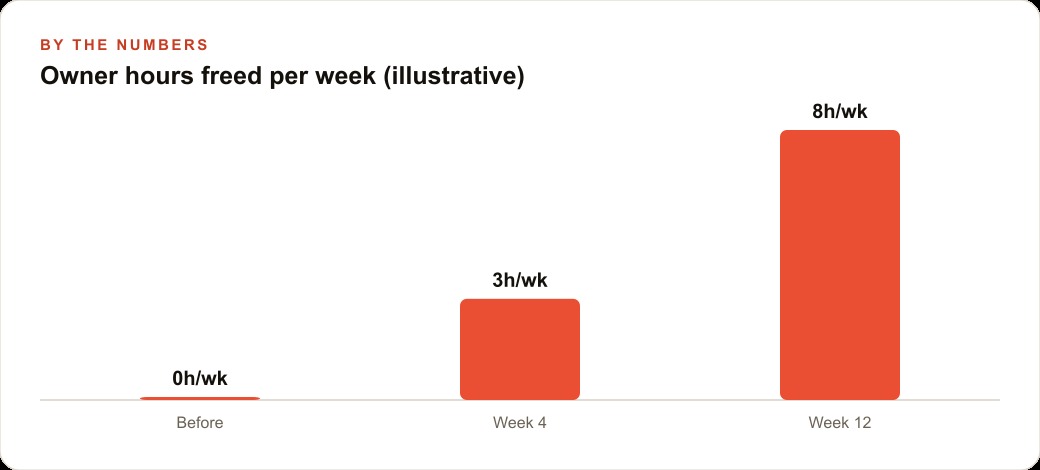
A worked example illustrates why the measurement habit matters. A service business owner planned to use AI for content production first, because that was the task she most consciously felt behind on. Before starting, she tracked her time in detail for two weeks. The results were not what she expected. Booking coordination was consuming fourteen hours per week, not the four she had estimated. She redirected her first AI effort to booking coordination instead. In the first month, she freed eleven hours. The content improvement she had planned freed two. She had nearly aimed the tool at the less important problem, and would have done so without the measurement step.
The hardest decision for most owners is not which tool to use or which task to automate. It is moving fast enough to start before the window of advantage narrows further. The businesses already using these tools build another week of practical learning about their specific situation every week they continue. The gap between an owner who started six months ago and one who starts this week is not six months of features. It is six months of knowing what works for their specific customers, their specific workflows, and their specific competitive position. That knowledge compounds and is genuinely difficult to close from behind once it accumulates.
Act fast and decide faster. This sounds like it leads to mistakes, and in some contexts it does. In this context, deciding to test one tool on one specific task for one week and measuring the result is not a reckless decision. It is the minimum action that produces real information about whether the tool works for your business. Delaying it does not make the decision safer. It delays the information, and the window where that information gives you a meaningful advantage over most of your market is not permanently wide.
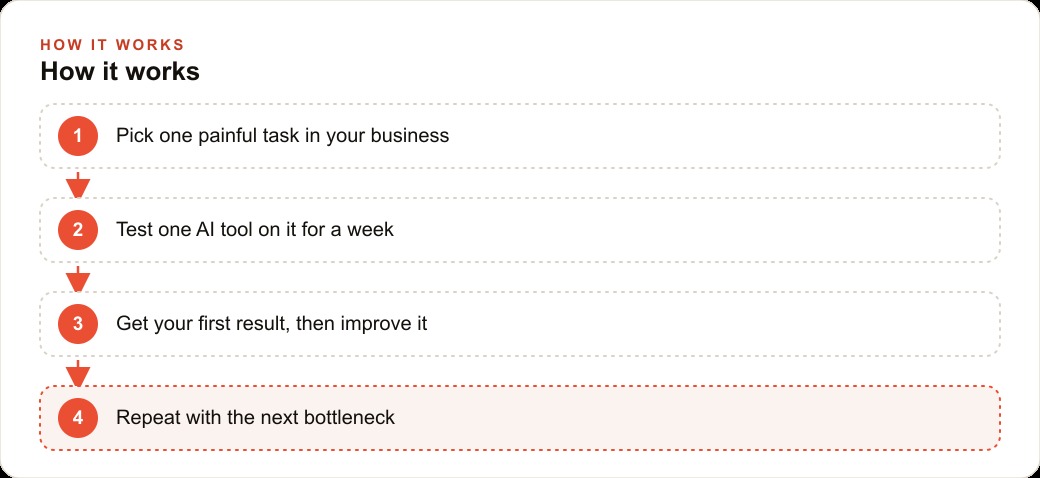
Start with one task. Use one tool on it for one week. Measure what you actually get. Then move to the next bottleneck. The strategy becomes visible from the results. The results only arrive after the starting.
That is exactly what we do at AI DOERS. Book a private 30-minute call with Madhuranjan Kumar and we will map the fastest path to it for your specific business.
Book your call →
Madhuranjan Kumar
Madhuranjan Kumar brings 20 years of performance-marketing experience and has managed over $200 million in Facebook ad spend for brands across the United States and beyond. His expertise spans the full modern marketing stack: Meta, Google Ads, TikTok, email automation, CRM, and the websites that hold it together. At AI DOERS he turns that track record into lead-generation systems for businesses across every industry.