
How to Turn One GPT Images 2.0 Picture Into a Stitched AI Mini Movie
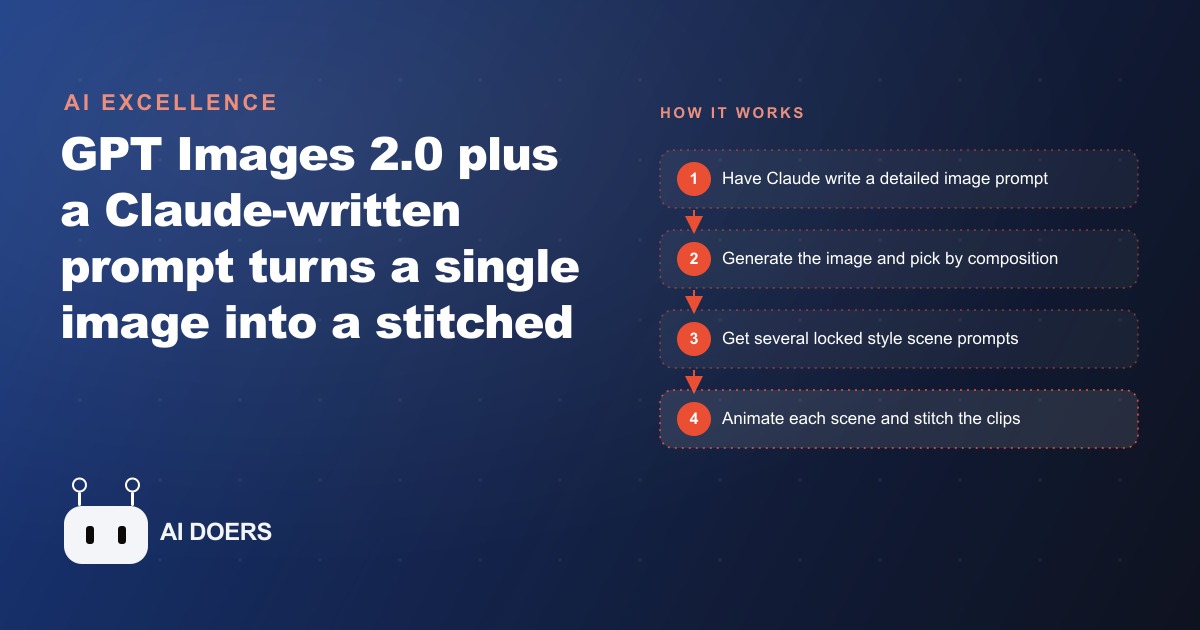
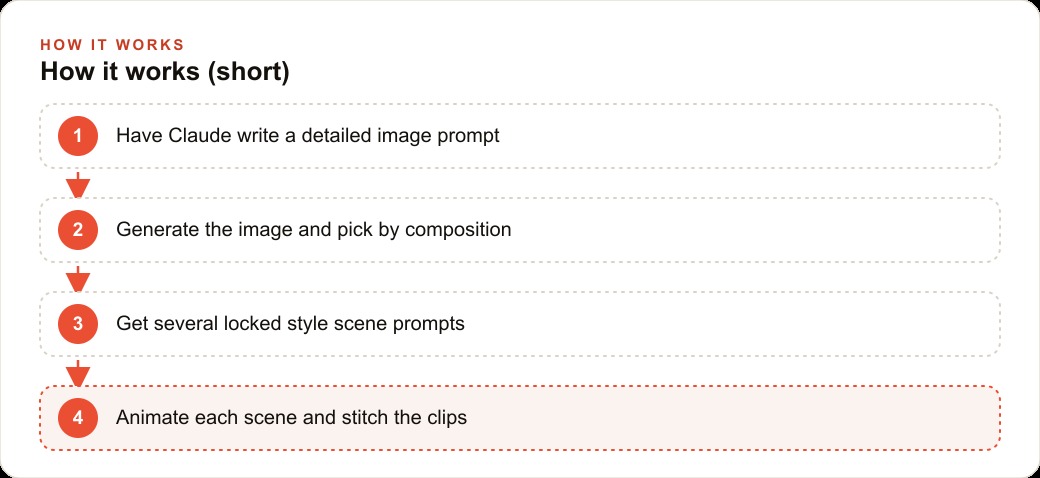
GPT Images 2.0 plus a Claude written prompt turns a single image into a stitched AI mini movie. Here is the workflow and how a boutique clothing brand could use it.

GPT-4o's image generation released a capability that most people are describing in terms of what the model can now create. I am Madhuranjan Kumar, and I want to describe it differently: the model's capability is essentially constant between two users on the same day. The quality gap between professional and amateur outputs is now almost entirely explained by prompt quality, and that is a more interesting development than most of the coverage captures.
The quality gap that remains when the model is equal
The professional photographer who has been using Midjourney since it launched and the person using a text-to-image model for the first time this week are running the same model. The model does not know the photographer is a professional. It does not adjust its capability based on who is querying it. Both users receive outputs generated by identical neural network weights.
The outputs are consistently different. The professional's outputs tend to be more compositionally intentional, more tonally coherent, and better suited to the specific use case they were designed for. The first-time user's outputs tend to have one or two of these qualities and miss the others.
The explanation is prompt quality. The professional has built a mental model of how the AI responds to specific kinds of description. They have learned which compositional terms produce which spatial arrangements. They have learned which lighting vocabulary reliably produces the emotional temperature they are after. They have learned how to describe a style reference in a way that the model interprets the reference rather than literally replicating it.
This knowledge was built through trial and error across hundreds of generations. It is not easily summarized into a list of tips, because the knowledge is procedural rather than declarative: it lives in the ability to write a specific kind of prompt, not in a set of rules that can be read and applied immediately.
The image-to-image capability that raises the stakes on prompt quality even further
GPT-4o's image generation includes an image-to-image mode that generates outputs that respect the visual content of an input image. You can provide a reference photo and describe the transformation you want, and the model attempts to produce an image that maintains the structural content of the reference while applying the described changes.
This capability is genuinely useful for product photography, interior design visualization, before/after compositions, and style transfer applications. It is also the capability where prompt quality has the highest leverage, because the transformation description is doing almost all of the work. The model is determining how to interpret the reference image and how to reconcile it with the description you provided. A precise description produces a reconciliation that matches your intent. A vague description produces a reconciliation that is plausible but not necessarily what you were trying to achieve.
The commercial use case that makes this concrete is product placement. A skincare brand that wants to show their product in a high-end retail environment can provide a product photo as the reference image and describe the environment, lighting, and styling context. A well-constructed prompt produces a placement that looks intentional. A poorly constructed prompt produces a placement that looks like two images that have been roughly combined. The model's capability is the same in both cases. The prompt quality is the only variable.
Consistency across images: the technical challenge that prompt quality determines
The application that most businesses want to build from text-to-image generation, a consistent set of product images that share the same character, lighting, setting, and visual language, is the application where the gap between understanding and not understanding prompts is widest.
Generating one good image from a good prompt is achievable for anyone who spends an afternoon learning the vocabulary. Generating ten images that are visually consistent with each other in a way that suggests they were shot in the same studio session on the same day is a different skill level.
The consistency challenge is that text-to-image models do not have memory between generations. The second image does not know what the first image looked like unless you tell it. The professional approach to maintaining consistency is a "seed prompt": a detailed prompt that describes all of the invariant visual elements of the series with precision, which can be reused as the foundation for every generation in the set with only the specific-to-image variables changing.
Writing a seed prompt requires understanding what visual elements actually determine consistency: the quality and direction of light, the color temperature, the color palette of surfaces in the scene, the distance and angle of the simulated camera, the treatment of backgrounds. A seed prompt that specifies all of these elements produces outputs that read as a series. A prompt that specifies the subject and leaves the environment to the model's interpretation produces a series where each image looks like it was made independently.
Prompt vocabulary that the model reliably interprets as intended
The vocabulary that experienced users build up for image generation models is domain-specific. Terms that are commonly understood in photography, cinematography, and illustration have more reliable mappings to model behavior than terms that are colloquially understood but visually ambiguous.
"Warm lighting" is visually ambiguous. It could mean the warm midday sun of a clear day, the orange-golden quality of an hour before sunset, the warm interior of a tungsten-lit studio, or the soft diffusion of a candle. Each of these produces a different image. "2700K practical light source, strong key light from upper right, warm shadow fill" is not ambiguous. The model has seen enough images with precise technical descriptions to interpret this accurately.
The same principle applies to compositional terms. "Close-up" is ambiguous. "Medium close-up, subject fills 60% of the vertical frame, shallow depth of field, subject's eyes in the upper third" is not. The professional whose vocabulary includes this level of precision gets the frame they described. The beginner who writes "close-up" gets whatever the model's default interpretation of the word produces.
This is a learnable skill, and it is worth learning precisely because the model capability is equal across users. The investment in building prompt vocabulary compounds directly into output quality.
The mini movie case and what it actually demonstrates
The "mini movie" demonstration that this capability enables, a short visual narrative assembled from a series of consistent text-to-image frames, is an interesting proof of concept for the consistency techniques described above. The frames that hold together as a coherent visual narrative are the ones produced by a consistent seed prompt applied to a series of scene descriptions. The frames that feel like stock footage assembled without a through-line are the ones produced without attention to cross-frame consistency.
For a business using generated imagery in Meta ad creatives or on landing pages, the practical application is a product story told through a series of consistent images: the product in context, the product being used, the before and after. A well-constructed series from a precise seed prompt produces an ad creative that reads as intentional and brand-consistent. A series produced without consistency discipline reads as assembled from separately generated images, which it is.
The value of understanding prompt quality in this context is that it translates directly to ad creative quality, and ad creative quality is a primary driver of campaign performance at any given spend level. The businesses doing Google Ads and Facebook campaigns simultaneously, with image assets driving both search display and social placements, benefit from the ability to produce a consistent visual library at a cost far below a professional photography session. That benefit is only fully available to the business owner who understands how to maintain consistency through prompt construction rather than relying on luck across generations.
The reference image technique that professionals use for style transfer
One of the most reliable techniques for producing consistent, intentional output is the reference image combined with a style-isolation description. The reference image tells the model the starting visual state. The description tells it what to preserve and what to transform.
The important distinction is between asking the model to "make this look like" a reference style and describing the specific visual attributes of that style directly. The first instruction asks the model to interpret a label. The second asks it to apply specific attributes.
Describing the attributes of film photography, for example, is more precise than asking for a "cinematic look." Film grain at a specific density. Slight halation around bright areas. Compressed dynamic range with retained shadow detail. Slight cyan shift in the highlights. Color cross-processing effect in the shadows. Each of these attributes is specific enough that the model can apply it consistently across multiple generations.
A professional who regularly generates product imagery for a consistent brand visual identity maintains a "visual language document," effectively a detailed description of all the invariant visual attributes that define the brand's photography style. Every generation brief for that brand includes the same visual language description as a prefix, which is what produces the consistency across generations that makes a brand's imagery look like a unified set rather than a collection of independently generated images.
Testing prompt changes systematically rather than iterating by feel
The other habit that separates consistent professionals from frustrated beginners is treating prompt development as systematic testing rather than intuitive iteration. When an output is not what was intended, the professional identifies which specific element of the prompt produced the wrong result and changes only that element in the next generation.
Changing multiple prompt elements between generations makes it impossible to know which change produced which result. A prompt that improved because three elements were changed simultaneously has taught the prompter nothing about which of the three changes mattered. The same logic applies in reverse: when a generation is significantly better than the previous one, knowing which single change produced the improvement is the knowledge that compounds into a better mental model.
The systematic approach is: identify the one thing that is most wrong in the current output. Formulate a hypothesis about what prompt element is causing it. Change only that element. Generate. Assess whether the change produced the expected improvement. Record the finding. Move to the next problem.
This is slower in the short term and faster in the long term because it builds knowledge rather than just producing outputs. For businesses using image generation at scale, for Meta advertising creative production or web presence imagery, the investment in systematic prompt testing produces a repeatable process where prompt quality improvements carry forward to every future generation rather than being rediscovered each time.
The two-stage generation approach for complex compositions
Professional image generators who work on complex compositions, multiple subjects, precise spatial relationships, layered environments, frequently use a two-stage approach. The first stage generates the compositional skeleton: the spatial arrangement, the rough lighting direction, the major color fields. The second stage refines the specific elements within that skeleton.
The first-stage prompt focuses entirely on the compositional elements without detailed subject description. The second-stage prompt, which uses the first-stage output as a reference image, focuses on the specific details of the subjects and textures within the established composition.
This approach works because it isolates the two hardest problems in complex image generation. Spatial composition is one problem. Subject rendering is another. Trying to solve both simultaneously in a single prompt creates tension between the compositional direction and the subject detail direction, and the model makes trade-offs between them that may satisfy neither instruction fully. Solving them in sequence means each prompt has one job, and the model's attention is undivided on each problem.
For ad creative production that requires precise spatial composition, such as product-plus-lifestyle scenes where the product's position and scale relative to the environment matter for brand consistency, the two-stage approach produces more reliable results than the single-stage approach and the iteration cost is lower because each stage can be re-run independently when the result is not what was intended.
The businesses that invest in building prompt quality systematically, rather than generating by feel, are the ones that develop a repeatable advantage in visual content production that compounds with every generation they complete.
That is exactly what we do at AI DOERS. Book a private 30-minute call with Madhuranjan Kumar and we will map the fastest path to it for your specific business.
Book your call →
Madhuranjan Kumar
Madhuranjan Kumar brings 20 years of performance-marketing experience and has managed over $200 million in Facebook ad spend for brands across the United States and beyond. His expertise spans the full modern marketing stack: Meta, Google Ads, TikTok, email automation, CRM, and the websites that hold it together. At AI DOERS he turns that track record into lead-generation systems for businesses across every industry.