
How To Turn Claude Into A Creative Agency With Higgsfield
By connecting Higgsfield to Claude, one prompt can generate a full brand, product catalog, and ads, and with a CLI, a research doc, reusable skills, and scheduled routines, the system produces fresh creative while you sleep.

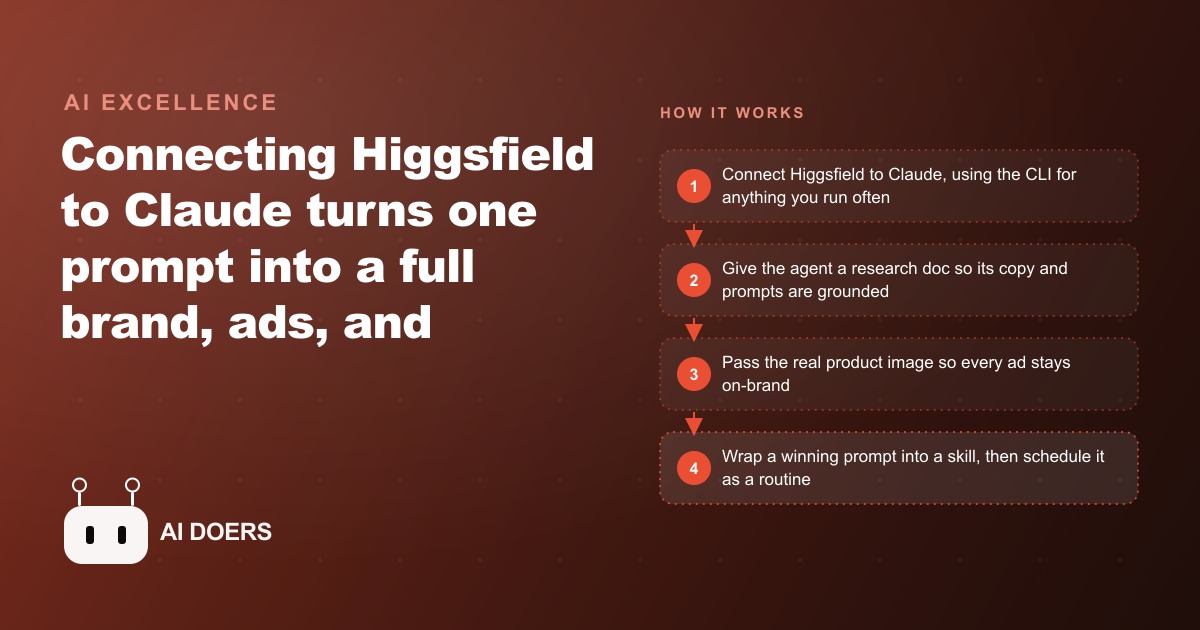
Give a connected AI one sentence and it can hand back an entire brand. Market research, a name, positioning, a three product catalog, and for each product a photo, an Instagram ad, and a short user style video. That is what happens when you wire Higgsfield into Claude, and in the demo I am reworking the whole thing came from a single instruction to build a headphone brand from scratch.
The headphones are not the point, and I, Madhuranjan Kumar, say that to every client who gets dazzled by the demo. The real subject is a shift in how creative work gets structured. Let me take this apart properly, because the interesting part is not that a prompt made an ad. It is the scaffolding that turns a flashy one off into a reliable machine.
The agency is a system, not a building
When people hear that Claude became a creative agency, they picture a room full of designers being replaced. That framing misses what actually happened. An agency is really a coordination structure, a way to turn a brief into research, then copy, then imagery, then video, then a record of what was produced. Higgsfield connected to Claude collapses that structure into one interface. Instead of an operator clicking through five separate tools by hand, one operator directs the work and the system produces the volume.
That distinction matters because it tells you where the value lives. The value is not in any single generated image. Any tool can make an image. The value is in the pipeline that makes hundreds of on brand images and remembers which ones worked. The agency in the title is the pipeline, and the human is the creative director who points it.
Two ways to connect, and why the choice is not cosmetic
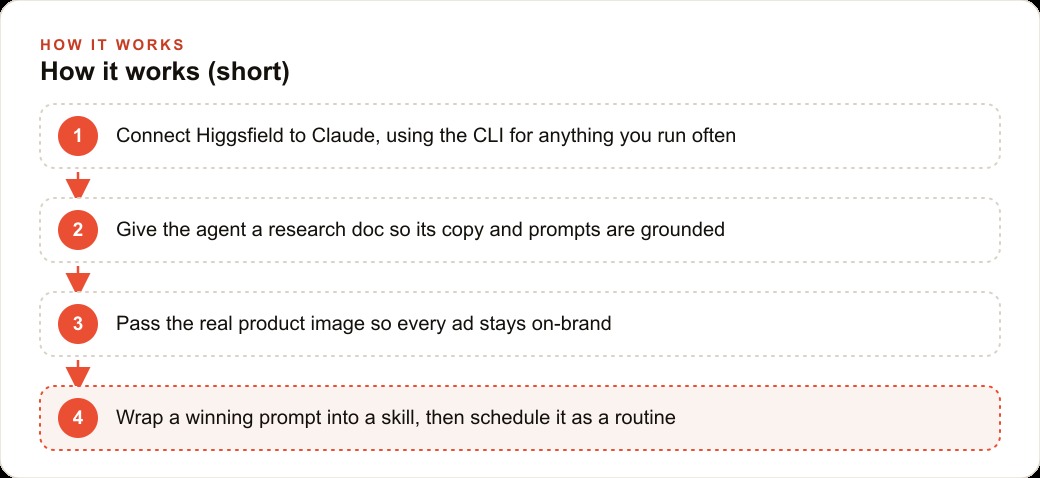
There are two ways to wire Higgsfield into Claude, and picking the right one is the first real decision. In Claude web you add Higgsfield as a custom connector, paste the command, and sign in through OAuth. From then on Claude can generate images and videos directly. This is the fast path for occasional, interactive use.
For anything you run repeatedly inside Claude Code, you install the Higgsfield CLI instead of the connector. The reason is practical, not stylistic. The CLI is cheaper on tokens and faster, while the connector loads every available tool into the model's context whether you use them or not. When you are generating dozens of assets in a loop, that overhead compounds into real cost and real slowness. So the rule I follow is simple. Interactive and occasional, use the connector. Automated and repeated, use the CLI. Getting this wrong does not break the build, it just quietly makes it more expensive than it should be.
Grounding is the difference between guessed and proven
Here is the facet most people skip, and it is the one that decides whether your output is good or generic. The tools are not magic. If you are not a strong copywriter, an agent left to its own devices will produce plausible, forgettable ads. The fix in the demo was to have Claude deep research current advertising strategy and write it into a long reference file, hundreds of lines of it, that every agent reads before it drafts a single line.
That reference file is the quiet hero of the whole system. It raises the quality floor more than any clever prompt, because it means every generation starts from proven practice rather than the model's average guess. Think of it as hiring an experienced strategist once and then having that strategist brief every junior on the team forever. The agent stops inventing and starts applying. When I set this up for a client, the grounding document is where I spend the most care, because everything downstream inherits its quality.
Memory turns a pile of outputs into a testable asset
Volume without memory is just noise. The demo solved this by logging every single generation into a Google Sheet through a CLI: product, style, model, prompt, job ID, and result URL, all forty five generations recorded. That sheet becomes the system's memory. It is the difference between making a hundred ads and knowing which hundred ads you made.
The reason this matters is that creative is only useful if you can test it and learn. A logged library lets you tie a result back to the exact prompt and settings that produced it, so when one variant converts you can reproduce and extend it, and when one flops you can retire that whole direction. Without the log, you are generating in the dark, unable to connect a winner to the recipe that made it. The sheet is unglamorous and it is the backbone.
Consistency is enforced by a reference image, not hoped for
The demo taught one lesson the hard way. Early ads invented random bottles and packaging that had nothing to do with the actual product, because an agent asked to imagine a product will simply imagine one. The fix was to drag in the real product image and instruct the system that the product must appear exactly like this every time. The next round matched the reference perfectly.
This is the single most common place these builds fall apart, so I treat passing the real product image as mandatory, not optional. Brand consistency is not something you can prompt your way to reliably. You enforce it by anchoring every generation to a real reference. The same principle extends to video. Higgsfield Marketing Studio can turn a product into hypermotion, unboxing, or user style formats, and once the operator found a hypermotion version they loved, they reverse engineered that exact prompt into a reusable recipe so every future video keeps the same look.
Skills and routines are how the machine runs without you
The final facet is what makes this an agency rather than a clever afternoon. A skill is a recipe an agent reuses, and in the demo the favorite hypermotion prompt was reverse engineered into a skill file so every future video inherits the same style. Better still, skills improve each time you run them. After a run you tell the skill what you liked and what to drop, like a banned phrase that got content flagged, and the recipe gets sharper and stops repeating its mistakes.
Then routines close the loop. Claude routines inject a prompt on a schedule, so a Sunday routine can ideate fifty new variants into the sheet and a Monday routine can generate the blank ones. You open your laptop to a batch of finished creatives instead of a blank brief. This is the part that earns the word agency, because the system now produces on a cadence without a human starting each run.
The operator is still the creative director
There is a failure mode hiding inside all this abundance, and it is worth naming before anyone gets intoxicated by the output. A system that can produce forty ad variants a week does not automatically produce forty good ones. Volume without judgment is just faster noise, and the sheet full of generations is only an asset if someone reads the results and makes decisions. The machine generates. The human still directs.
This is why I resist the fantasy that you can fully remove yourself. The grounding document encodes your strategy, but you wrote or approved that strategy. The reference image enforces your brand, but you chose the brand. The winning variant gets promoted, but a person looked at the conversion data and decided it was the winner. The demo produced forty five generations, and the value was never in the count. It was in the operator knowing which handful to put money behind and which direction to kill. Strip out that judgment and you have an expensive way to fill a hard drive.
The healthy way to think about it is a small studio with one excellent creative director and an infinitely fast production team. The production team never gets tired, never misses a deadline, and never runs out of ideas to try, but it also has no taste of its own. Taste is the scarce input you supply. The routines that generate variants while you sleep are only useful because, when you wake up, you bring the one thing the system cannot, the read on what your specific audience will respond to.
This reframes what the technology actually buys you. It does not replace the marketer. It removes the bottleneck that used to sit between having an idea and testing it. Before, testing ten creative directions meant ten expensive briefs and a week of waiting. Now the cost of testing collapses toward zero, which means your judgment gets far more shots on goal. The person who wins with this system is not the one who generates the most. It is the one who reads the results the fastest and redirects the machine the smartest.
A skincare store, with illustrative numbers
Let me ground all of this in one worked example. Picture an e commerce store selling a skincare line that needs fresh ad creative every week to keep paid social from going stale. Before this system, the store might produce three or four ads a month, each one a small manual project, and it never has enough variations to test properly.
First I would connect Higgsfield to Claude and write the grounding doc, a researched file on what makes a strong direct response beauty ad, so every headline starts from proven practice. Then I would drag in the real product photos and make the reference mandatory, because the first lesson from the demo is that an unanchored agent invents packaging that does not match the brand. With the reference locked, Claude mixes value props, before and after angles, model styles, and headlines into thirty plus on brand variations in a single sitting, logging each to a sheet with its job ID and result URL.
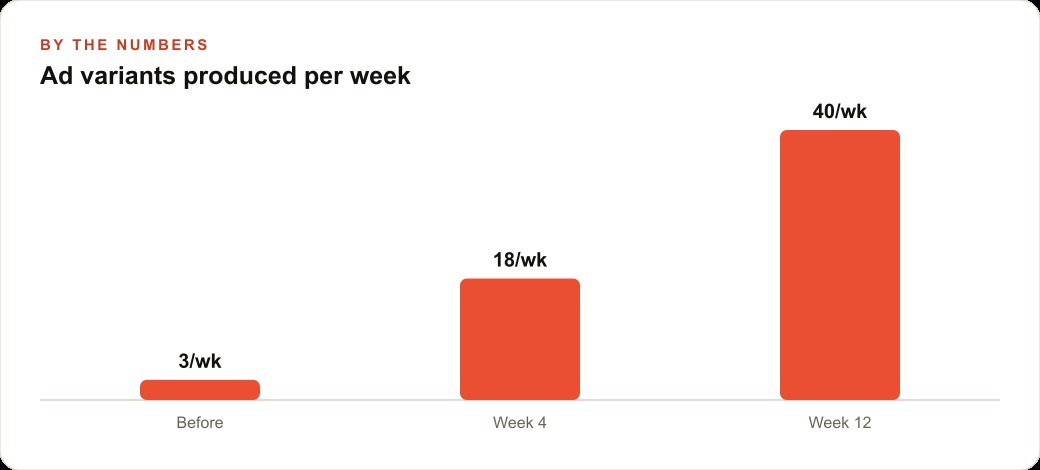
Run the numbers illustratively. The store goes from four ads a month to forty variations a week, and now it can actually test. Instead of guessing which single ad to run, it puts small budgets behind a deep slate on Facebook and Instagram ad campaigns, reads which creatives lower the cost per lead, and pours spend into the proven winners. The same product imagery drops onto landing pages, so it also strengthens SEO and organic search without extra work, and every generated ad and video flows into the CRM and website stack where follow up sequences handle the next touches. For launch videos I would use the hypermotion format, then wrap the version the store likes best into a reusable skill, and finally schedule a weekend ideation routine and a Monday generation routine so the team opens their laptop to finished creatives. The store keeps selling the same products. The difference is it never runs out of new creative to test.
Start with the connection and one grounding doc, not the full automation. Add Higgsfield to Claude, use the CLI if you plan to run it often, and spend an afternoon having Claude research your category into a single reference file. Gather your real product images and make passing them mandatory before you generate a single ad. Log every generation to a simple sheet. Only once that loop runs smoothly should you turn your best prompt into a skill and schedule routines. Build it in that order and you scale far past what a small team could produce, while pushing budget only at the variants the data says are winning.
You can absolutely stand this up yourself, and I would encourage any store owner to start with the connection and a grounding doc this week. If you would rather have someone wire Higgsfield to your real catalog, lock your product references, and hand you a routine that fills your creative bank while you sleep, that is the kind of build I do for clients, and you can bring me in to handle it.
That is exactly what we do at AI DOERS. Book a private 30-minute call with Madhuranjan Kumar and we will map the fastest path to it for your specific business.
Book your call →
Madhuranjan Kumar
Madhuranjan Kumar brings 20 years of performance-marketing experience and has managed over $200 million in Facebook ad spend for brands across the United States and beyond. His expertise spans the full modern marketing stack: Meta, Google Ads, TikTok, email automation, CRM, and the websites that hold it together. At AI DOERS he turns that track record into lead-generation systems for businesses across every industry.