
How To Turn Claude Code Into An AI Employee With Obsidian
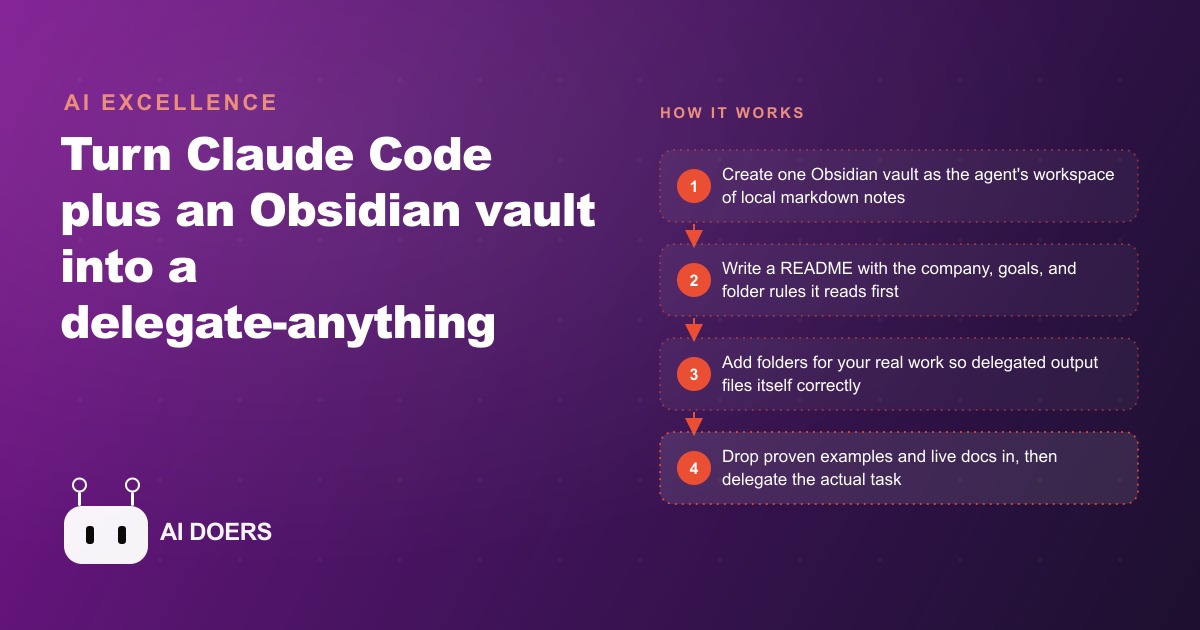
You build a local Obsidian vault as the agent workspace, write one README it reads before every task, add folders for the work you do, then feed it real examples and live docs so Claude Code organizes and produces work like a delegated employee.

Every real estate agent knows that the work that piles up between listings, the research, the drafting, the filing, takes longer than the listing itself, and most of it repeats the same patterns week after week.
The property description for the three-bedroom craftsman in the established neighborhood follows the same structure as the one from three months ago. The just-listed email to the seller's sphere of influence starts from the same template. The neighborhood research for the buyers considering the north side covers the same categories every time: schools, commute times, recent comparables, walkability, and the narrative that distinguishes this area from the alternatives the buyers are considering. None of this work requires creativity each time. It requires accurate inputs, consistent voice, and reliable execution. It is exactly the work that an AI agent configured with the right context can handle with high accuracy.
The Obsidian vault approach, which Madhuranjan Kumar describes in detail, is a method for building that context once and then compounding its value across every subsequent task. This is the story of one operator who built the vault, used it through a complete listing season, and measured what changed.
Before the vault, two hours every morning rebuilding the same context
Before the vault existed, the first two hours of every working day were the same. Open the browser, find the notes from the last conversation with the seller, review the property detail sheet, look up the neighborhood comparable sales from the last 90 days, and reload the mental model of where this listing sat in the current market. Then start drafting.
The drafting itself was fast. The problem was that the context for the drafting had to be rebuilt from scratch every session because nothing about the previous session carried forward. Each morning was a fresh start. The listing files were stored in a folder on the desktop. The research notes were in a separate folder. The email templates were in another location. The comps were pulled from the MLS each time because nobody had saved them in a way that was easy to find again.
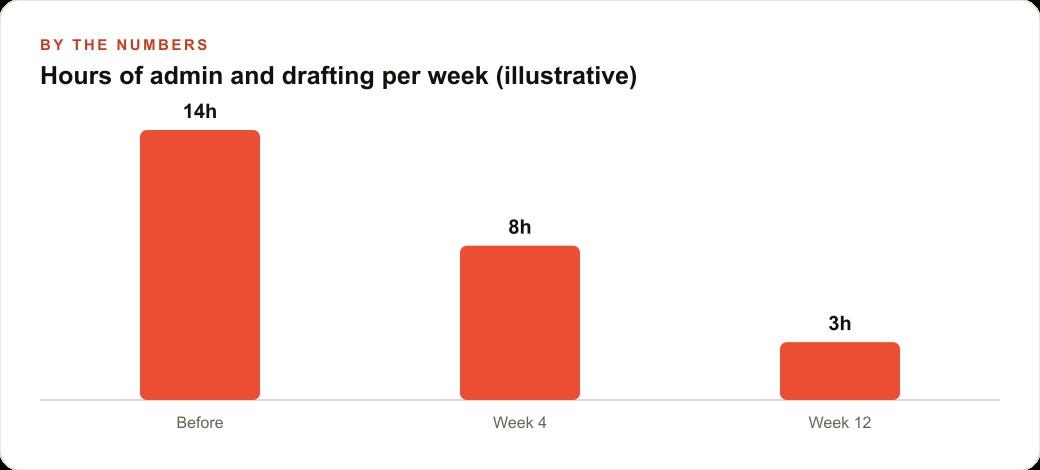
Fourteen hours per week on research, drafting, filing, and preparation was the baseline. That number included morning context-rebuilding, property research for active listings and active buyer searches, writing property descriptions and email copy, and the administrative documentation that each transaction required. It did not include showing time or contract negotiations. Those were the actual work. The fourteen hours were the overhead that every active listing added to the week.
The agent also had no way to verify that the voice in the property descriptions was consistent across listings. Some weeks the writing was strong. Other weeks, when the context-rebuilding had taken longer than expected and the first draft was rushed, the writing was serviceable but not compelling. Consistency required effort that was sometimes available and sometimes was not, which meant the quality of a major client deliverable varied based on how much time and energy the operator had on any given morning.
This is the baseline that most solo agents operate from and accept as inevitable. It is not inevitable. It is a context problem, and context problems have a specific solution.
Setting up the workspace in one Saturday afternoon
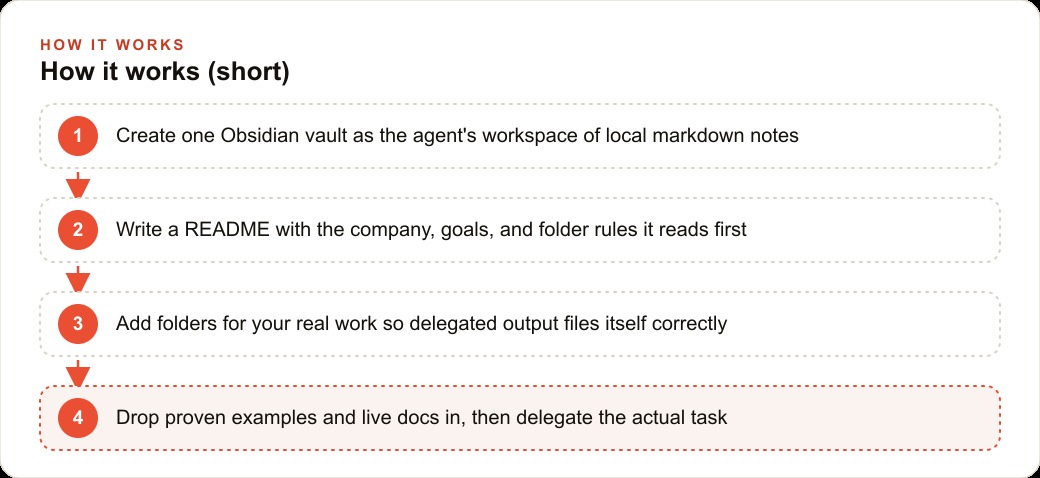
The setup started with creating an Obsidian vault: a folder on the local machine that Obsidian treats as a workspace of connected markdown files. The vault became the operational home for everything related to the business. The design principle was simple: if you might need it to do your work, it lives here.
The folder structure was the first decision. The initial structure included six folders: listings, buyers, neighborhood-research, templates, comps, and examples. The listings folder would contain one file per active or recent listing with the property details, the description draft, the timeline, and any notes from client conversations. The buyers folder would follow the same pattern per active buyer client. The neighborhood-research folder would accumulate briefs on each area the business operated in, growing denser with each new search. The templates folder held the structural scaffolding for every recurring document type. The comps folder held saved comparable sales data organized by neighborhood. The examples folder held the five or six pieces of work from the past two years that represented the strongest writing the business had produced.
Then came the README. One file at the root of the vault that the agent reads before every task. The README described the business: the markets served, the typical client, the brand voice in specific terms rather than vague adjectives, the disclosure language required in every property description, the word count targets for each document type, and the folder rules that governed where each kind of output should be saved.
Claude Code connects to the vault by pointing it at the folder. The agent can read every file, create new files in the correct folders, update existing files, and follow the standing rules in the README automatically. The connection is not a plugin or a configuration step that requires maintenance. It is just a folder on the computer that the agent has access to while working.
The whole setup took one Saturday afternoon. The README was the most time-consuming part because writing it precisely was the difference between an agent that produces generic drafts and one that produces work that sounds like the business. Four hours for the full setup. The agent was operational by Sunday morning.
The README that changed what the agent actually produced
The first week without a detailed README was instructive about why it matters. The initial version of the file contained basic information: business name, markets served, agent specialty. The outputs were accurate but generic. The property descriptions sounded like they came from a competent writer with no specific knowledge of this market, this voice, or this business's specific positioning.
The second version of the README added specificity. It described the exact voice in concrete terms: direct over florid, specific over general, leading with the detail that distinguishes this property rather than the category it belongs to. It included three phrases that were never to appear in property descriptions because they signaled generic copy to sophisticated buyers in this market. It specified that every description was to conclude with a paragraph about lifestyle rather than about the property, because buyers in this market made decisions emotionally and justified them logically. It included the standard disclosure paragraph, word-for-word, that had to appear in every description.
The difference in output between version one and version two of the README was immediate and significant. The property description produced with the detailed README sounded like work produced with knowledge of the business. It led with the specific detail, avoided the banned phrases, concluded with the lifestyle paragraph, and contained the disclosure language. The revision cycle went from three rounds to one. The one remaining revision was typically factual: correcting a specific detail about the property that was not in the briefing materials the agent had been given.
The README also specified which examples lived in the examples folder and instructed the agent to read them before drafting any marketing copy. This was the other significant output improvement. When the agent could see what the business's best writing looked like before drafting, the first draft matched that standard closely enough that the operator was editing for accuracy rather than rewriting for voice.
Standing rules in the README also cover the edge cases that come up repeatedly. The instruction to check the comps folder before writing a market context paragraph, and to update the comps folder after each new research session so the data stays current, took one sentence to add and has saved repeated research time every week since. The README is not a formality. It is the operational brain of the system, and every improvement to it improves every piece of output that follows.
The first listing season with the system and what the output looked like
The first full listing season with the vault ran from early spring through late summer: fourteen active listings over four months, six active buyer searches running simultaneously at peak, and the neighborhood research, just-listed emails, and social content that each required.
By week four, the weekly hours on research, drafting, and filing had fallen from fourteen to roughly eight. The reduction came entirely from eliminating the morning context-rebuilding time and from the reduced revision cycles on first drafts. The agent read the vault's context before each task, which meant it did not need to be re-briefed on the business, the voice, or the standing rules. Each session started from accumulated knowledge rather than a blank slate.
The types of output the agent produced across the season: property descriptions for every listing (average length 280 words, one revision round each), just-listed emails for every new listing (three variations per listing for different segments of the sphere), neighborhood research reports for each active buyer search (average length 800 words, covering schools, commute, comparable sales, and trajectory narrative), and social captions (five per listing, filed automatically to the listings folder). All of it filed in the correct vault folder without the operator manually organizing the output.
By week twelve, the weekly hours were consistently at three. The neighborhood research briefs for the four areas the business served most frequently were now comprehensive documents in the vault, updated with each new comparable sale, each new development, and each new data point that affected the buyer pitch for that neighborhood. Rather than pulling together a neighborhood brief from scratch for each new buyer client, the agent supplemented the existing brief with the latest three months of data and produced a current-version document in under 20 minutes.
The property descriptions took 15 minutes each: five minutes for the operator to brief the agent with the property details, ten minutes of generation and one round of factual review. The just-listed emails took ten minutes. The social captions for a new listing took five minutes for a full week of content. The same outputs that had previously taken two to three hours per listing now took under 30 minutes, and the quality was consistently higher because the agent had access to the examples and standing rules with every task.
What the vault cost to build and what it compounded into by month three
The cost to build the vault was one Saturday afternoon plus the Claude Code subscription. Obsidian is free for personal use. The total setup investment was roughly four hours of the operator's time and the ongoing subscription cost. There was no server to manage, no integration to maintain, and no dependencies beyond a folder on the local machine and a text editor.
By month three, the compounding effects were visible across multiple dimensions. The obvious one was weekly hours. Fourteen hours per week before the vault, three hours per week by week twelve: a recovery of eleven hours per week. Over twelve weeks that is 132 hours recovered. At the operator's effective value per hour, that is a significant return on a four-hour setup investment.
The less obvious compounding was in the quality of outputs over time. Month three outputs were significantly better than month one outputs, not because the agent or the model had improved, but because the vault had grown richer. The examples folder had been updated with the strongest work from the first ten listings. The neighborhood-research folder contained comprehensive briefs. The comps folder had six months of organized comparable data. Every task in month three started from a richer context than the same task in month one, which meant the first draft was closer to the final version, the revision cycle was shorter, and the output quality was higher.
The third compounding effect was repeatability. The business now had a documented production system. Every standing rule, every example, every piece of contextual knowledge about the market and the voice lived in the vault rather than in the operator's memory. On the mornings when the operator was stretched thin, the system performed the same as it did on the mornings when everything was running smoothly. That consistency is its own form of quality: clients received the same standard of deliverable regardless of the day's other demands.
The vault also produced one outcome that was not anticipated at setup: the accumulated neighborhood research briefs became a genuine business development tool. By month three, the operator had detailed, current, synthesis-level knowledge of eight neighborhoods, organized in a way that could be shared with a prospective buyer client as a demonstration of local expertise. That depth of organized market knowledge, presented in a clean document, was not something competitors without the system could produce quickly on demand.
The model-switching capability within the vault matters for cost management. Routine tasks such as filing, formatting, and light editing run well on the faster, lower-cost model. Research reports and listing descriptions that need to be genuinely strong run on the most capable model available. The vault serves both, and the cost stays proportional to the difficulty of the work. Over a full listing season, the blended cost of AI assistance across all tasks is lower than it would be if every task ran on the premium model, while the output quality on the tasks that matter is not compromised.
The vault did not make the operator a better real estate agent. It made the production overhead of being a real estate agent significantly lower, which freed the hours that had gone to rebuilding context and producing first drafts for the work that actually requires an experienced professional: reading a buyer's real motivations, negotiating on a counteroffer, advising a seller on pricing in a shifting market. That is the work no vault can do. The vault's job is to make sure the agent is doing that work instead of drafting just-listed emails and rebuilding neighborhood context from scratch every week.
That is exactly what we do at AI DOERS. Book a private 30-minute call with Madhuranjan Kumar and we will map the fastest path to it for your specific business.
Book your call →
Madhuranjan Kumar
Madhuranjan Kumar brings 20 years of performance-marketing experience and has managed over $200 million in Facebook ad spend for brands across the United States and beyond. His expertise spans the full modern marketing stack: Meta, Google Ads, TikTok, email automation, CRM, and the websites that hold it together. At AI DOERS he turns that track record into lead-generation systems for businesses across every industry.