
How To Set SMART Goals That Actually Stick For The New Year
Start by scoring seven areas of your life and writing out your ideal day, then run every goal through the SMART test, specific, measurable, achievable, relevant, and time bound, so each one is concrete and dated instead of a vague wish.


Here is an unpopular position: making your goals SMART is not what makes them stick, and the annual ritual of writing specific, measurable, achievable, relevant, time-bound resolutions is why most of them are dead by spring. I am Madhuranjan Kumar, and I work with business owners who set sharp, well-formed goals every January and abandon most of them by March, and it is almost never because the goals were not SMART enough. The framework is fine. The problem is that people reach for it far too early, before they have done the two things that actually determine whether a goal survives. SMART is the last 10 percent of goal-setting dressed up as the whole job.
The framework is not the problem, the timing is
Let me be precise, because I am not dismissing SMART. Specific, measurable, achievable, relevant, and time-bound is a genuinely useful test. A goal that fails those checks is a wish. The contrarian claim is narrower and sharper: the reason your SMART goals collapse is that you applied the test to goals you never should have set in the first place. A perfectly SMART goal aimed at the wrong target is still a wasted year. You can make it specific, attach a number, set a deadline, and check every box, and it will still evaporate, because none of those properties answer the only question that keeps a goal alive, which is whether you actually want it.
Most people skip straight to writing goals because writing goals feels productive. It is the fun part. It looks like progress. But a goal written before you know your target is just an inherited assumption with a deadline stapled to it. Half the resolutions people set were never chosen. They were absorbed from parents, from friends, from competitors, from the vague sense of what a person like you is supposed to want. Making those borrowed goals SMART does not make them yours. It just makes them more efficiently pursued in the wrong direction.
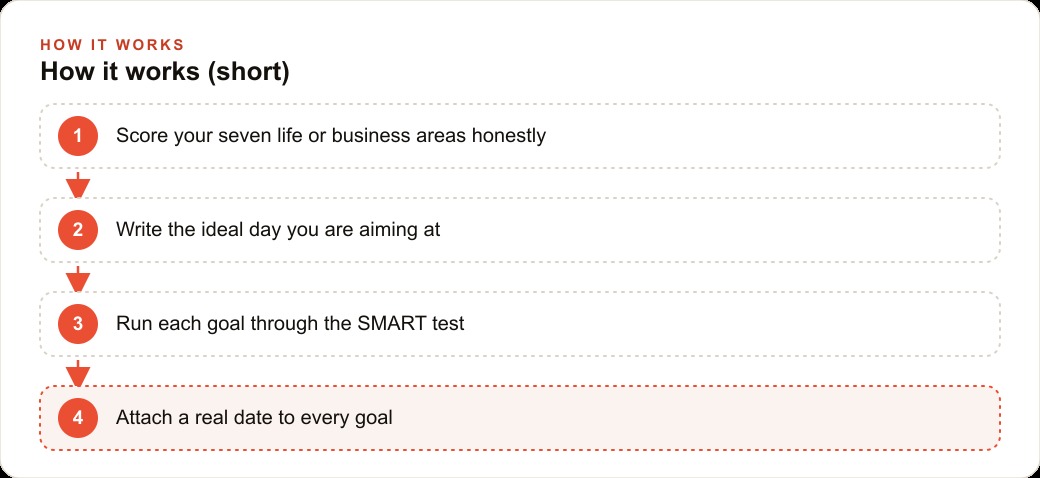
Start with an honest audit, which is the part nobody wants to do
If SMART is not the starting point, what is? An uncomfortable inventory of where you actually stand. Before a single goal gets written, you split your world into clear areas and rate each one honestly. For a person that might be learning, family and friends, mental health, physical health, finances, career, and romance. For a business it might be revenue, marketing, operations, team, and customer experience. Each area gets a blunt current-state score.
This step gets skipped because it is unpleasant. Scoring yourself honestly means admitting the areas you have been avoiding, and most people would rather jump to ambitious targets that let them feel like they are already winning. But the audit is the whole foundation. Without it, you set goals that float free of reality, aimed at the areas that are already fine because those are comfortable to think about, while the genuinely weak spots go untouched. When you force the score first, the weak areas become impossible to ignore, and the goals you set start pointing at the things that actually need to move. A business that scores retention low and revenue high learns something that changes every goal that follows. The audit is not preamble. It is the diagnosis, and you do not prescribe before you diagnose.
The reason the honest score matters so much is that it exposes the gap between where your attention has been and where it should be. Most people, and most businesses, over-invest in the areas they are already good at, because success there feels good and effort there is easy. The weak areas get avoided precisely because they are uncomfortable to look at, which is exactly why they stay weak. A blunt numerical score drags those avoided areas into the light and forces them onto the same page as the strong ones. Suddenly you are looking at a five out of ten next to a nine out of ten, and it becomes obvious that another point in the nine is worth far less than closing the gap on the five. That single reordering of priorities does more for your year than any amount of clever goal-writing, and it is available only to people willing to score themselves honestly first.
Define the ideal day before you define a single goal
The second thing that comes before SMART is defining the target in vivid detail. You write out your ideal day and your ideal life, in full, and you can only set sharp goals once you know exactly what you are aiming at. The point of this is not fantasy. It is calibration. There is a line I keep coming back to, that how we spend our days is, in the end, how we spend our lives. It reframes goal-setting entirely. You are not choosing a set of achievements. You are choosing how your ordinary days feel, because the days are the life.
For a business, the ideal-day exercise is just as literal. What does a great Tuesday look like when the business is running the way you want? Who is doing what, what is handled without you, what is the phone ringing about and what has gone quiet? That picture is the target every goal must serve. And here is why the order matters so much: the relevant test in SMART, the R, is meaningless until this picture exists. Relevant to what? You cannot judge whether a goal is relevant until you have defined the life it is supposed to build. This is the exact reason people misapply SMART. They run the relevance check against nothing, so every impressive-sounding goal passes, and they end up busy and off-course.
Now, and only now, run the SMART test, and use it to cut
Once the audit is done and the target is clear, SMART earns its keep, but I want you to use it differently than most people do. Yes, specific means define the exact outcome rather than saying you want a good year. Measurable means pick something you can evaluate, a number or a count of hours. Achievable means keep it within reason, because an impossible goal is not a goal. Time-bound means attach a real date, or it quietly becomes someday. All standard.
But the most valuable letter is R, and its real job is not to approve goals. It is to kill them. The relevant test is your permission to drop any goal, no matter how impressive it sounds, that does not serve the ideal day you defined. This is the contrarian use of the framework. Most people treat SMART as a checklist for keeping goals. I treat it as a filter for removing them. Cutting a goal that no longer fits is not failure. It is progress, because it frees the focus and budget that your real priorities were starving for. The person who ends the year having deliberately dropped three goals to fully hit two is far ahead of the person who kept ten SMART goals and limped past none of them.
There is a psychological reason this reframe works, and it is worth naming. Goals do not usually die from a lack of ambition. They die from dilution. When you carry ten goals, your attention splits ten ways, every one gets a thin slice of focus, and none builds the momentum that makes it self-sustaining. Momentum is what carries a goal past the point where willpower runs out, and momentum only comes from concentration. So the act of cutting is not a concession that you were not committed enough. It is the mechanism that gives the survivors enough of you to actually take hold. Every goal you refuse to drop is quietly taxing the ones you claim to care about most. Seen that way, the relevant test is the most generous thing you can do for your real priorities, because it hands them the focus the pretenders were stealing.
A worked example: how a gym should actually plan its year
Let me run the whole argument through one business, because it is easy to nod along and hard to do. Picture a gym setting its annual plan. The tempting move is to open a document and start writing SMART goals: grow membership by 20 percent, launch three new classes, increase personal-training revenue by 15 percent. All specific, all measurable, all dated. And most of them will be forgotten by April, because the gym skipped the two steps that matter.
Instead, start with the audit. Score the gym's areas honestly: membership growth, retention, class attendance, personal-training revenue, and member experience. Say retention scores badly because too many new members quit by month three. That single honest score changes everything, because it reveals that chasing more sign-ups is pouring water into a leaking bucket. Next, the ideal-day exercise defines the target: a gym where members show up four times a week and renew without thinking about it, where the floor is busy at 6 a.m. and nobody at the desk is chasing cancellations.
Now the SMART goals write themselves, and they point at the real problem. Specific: cut 90-day member churn. Measurable: from 20 percent down to 12 percent. Achievable: an 8-point drop is a stretch but real. Relevant: it directly serves the renewal-driven gym you pictured, which is why it survives the filter when the vanity goal of raw sign-ups gets cut. Time-bound: by the end of the second quarter. The supporting goals follow the same shape, like run one onboarding session for every new member within their first week, or add two class times by the end of March. Notice the lower-the-bar principle at work too: a member goal of working out four times a week sticks better when a 10-minute treadmill walk still counts, because a habit that is easy to keep beats an ambitious one that breaks. The retention win is also where the gym's marketing finally pays off, because keeping members means the money spent acquiring them through Facebook and Instagram ad campaigns stops leaking out the back door, and the onboarding and renewal nudges run through the CRM and website stack so consistency is driven by the system rather than by someone remembering to send a text.
The tools help, but the thinking is the work
A tool like ChatGPT can genuinely speed up the mechanical part of this. Once you have your honest scores and your defined target, it will turn rough categories into a clean first draft of SMART goals in seconds, and that is a real time-saver worth using. But notice what it cannot do. It cannot score your areas honestly for you, and it cannot decide what your ideal day looks like. Those are the two steps that actually determine whether your year works, and they are exactly the two steps no tool can outsource. Feed a language model your comfortable assumptions and it will happily make them SMART, which is the same trap, just faster. The cleaner content it produces does flow usefully into other places, so a well-defined plan and clear priorities also sharpen the messaging you put into SEO and organic search, but the sharpness comes from your thinking, not the tool.
So here is the whole position in one line. Stop opening the year by writing SMART goals. Open it by scoring where you honestly stand and defining the day you actually want, then use SMART not to generate goals but to test and cut them, keeping only the few that serve the target and having the discipline to drop the rest. A focused owner can do this over a weekend, and doing it yourself builds a kind of ownership of the plan that no delegated version ever matches. If you would rather have someone facilitate the audit, define the targets with you, and wire the surviving goals into a simple dashboard your team checks every week, that is worth handing off. But the core insight is free, and it is the thing that decides whether you are still on plan in February: the goals were never the starting point. The honest look in the mirror was.
That is exactly what we do at AI DOERS. Book a private 30-minute call with Madhuranjan Kumar and we will map the fastest path to it for your specific business.
Book your call →
Madhuranjan Kumar
Madhuranjan Kumar brings 20 years of performance-marketing experience and has managed over $200 million in Facebook ad spend for brands across the United States and beyond. His expertise spans the full modern marketing stack: Meta, Google Ads, TikTok, email automation, CRM, and the websites that hold it together. At AI DOERS he turns that track record into lead-generation systems for businesses across every industry.