
How To Run Your Whole Marketing Team Inside Codex With Skills
By building a layer of reusable skills on top of Codex, Madhuranjan Kumar runs most of his marketing through AI agents that write in his real voice, build visuals, and triage his inbox. The same approach scales down to a one-person business.

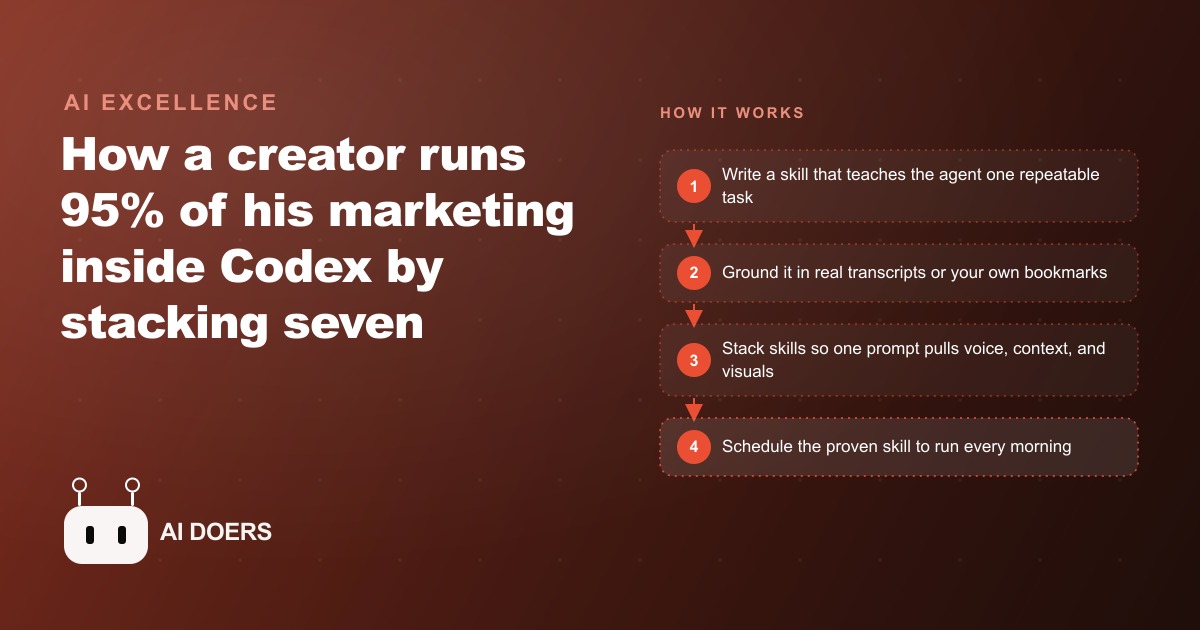
A creator recently claimed that roughly 95 percent of the content and marketing tasks he does on his computer now happen inside a single AI app, and the claim is only interesting because of how he got there. He did not find one magic prompt. He built a layer of reusable skills on top of the agent, and that layer is the actual news here, because it turns a chatbot you talk to into a marketing team you can rerun on demand. For a small business owner, this is the shift worth understanding, the value is not the model, it is the reusable workflows you teach it.
What actually shipped: skills as reusable instruction files
The development at the center of this is deceptively plain. A skill is an instruction file that teaches an AI agent one of your repeatable workflows. That is the whole idea. A plugin is just a bundle of skills and abilities. Inside the app, a slash key runs a specific skill and an at-sign mentions a plugin, and the same skills run inside Claude Code as well, so none of it is locked to one tool.
Why this matters more than another model release, a prompt is a one-off, gone the moment you close the window, but a skill is an asset you build once and reuse forever. Madhuranjan Kumar is not smarter at prompting than everyone else. He wrote his repeatable tasks down as instruction files, and now he runs them like a team runs standard procedures. That reframe, from clever prompts to written-down workflows, is the thing a business owner should take away, because it is what makes the output consistent instead of a fresh gamble every time.
The core technique underneath every good skill: grounding
The reason his output does not read like generic AI slop comes down to one idea, grounding, which means pointing the agent at a useful reference instead of letting it write from the model's generic notion of good content. His first two skills exist entirely to solve this. A researcher skill pulls real transcripts so the agent writes in his actual voice, studying a channel's last ten videos and drafting hook options that sound like him rather than like a model's average of everyone. A second skill reads everything he has bookmarked across the tools he saves things in, then mines those saved items for content ideas rooted in his own taste instead of a generic model's.
Grounding is the difference between AI that sounds like you and AI that sounds like AI. Almost every complaint about generic-sounding output traces back to a missing reference. When the agent is anchored to your real past work and your real saved material, the output stops being generic, because it is no longer starting from a blank generic prior. It is starting from you.
From grounded drafts to visuals and operations
Once the grounding is in place, the same skill structure extends into assets and admin. A diagram skill turns a topic into a clean, low-text visual that reads like a presentation slide. A canvas tool built for agents updates live as it designs, and you steer it mid-build by screenshotting an overlap and telling it to fix the layout, which is a genuinely new way to work, more like directing than configuring. A motion-graphics skill generates video overlays from prompts. A mini app can wrap an image service so both you and the agent operate it, with the agent generating options and you taking the final ten percent by editing in flow. And a brand-deal skill searches email, filters paid offers, removes duplicates, and builds a priority table, stacking calendar access to suggest meeting times.
Two operating patterns make the whole thing stick, and they are the details that separate a toy from a system. Editing a skill is conversational. You say from now on always include the source link, and the agent rewrites its own skill file, no config editing required. And once a skill reliably produces output you like, you turn it into a scheduled automation that runs every morning, while sub-agents add speed by working several steps in parallel.
Who this changes things for
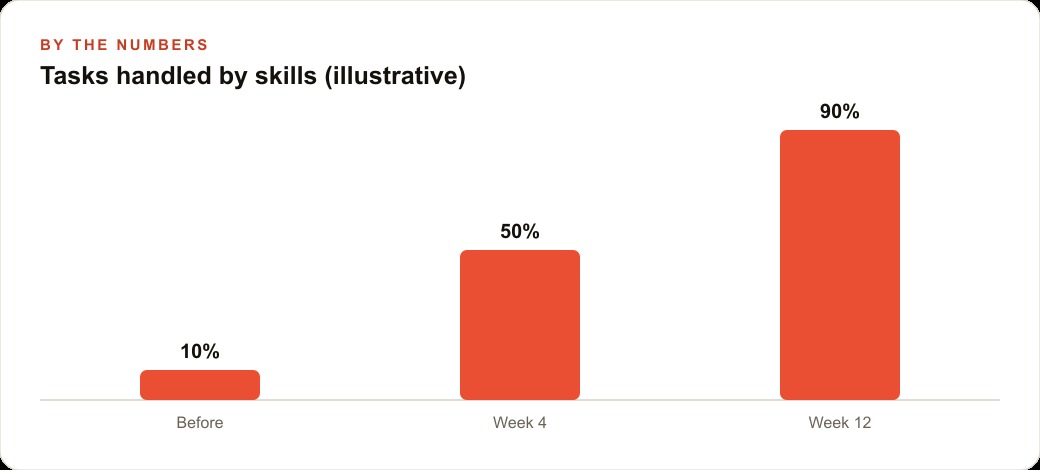
Any business that markets itself can use this, because every business repeats the same content and admin tasks week after week. The important reframe is what the agent is actually for. It is not there to do everything end to end and hand you a finished product. It is there to generate strong options quickly so you can take the final ten percent, and that final ten percent, your judgment and your taste, is exactly where the value lives. A tool that gets you to ninety percent in minutes and leaves the last ten to you is not replacing you. It is removing the part of the work that was never the point.
That is why this scales down so cleanly from a full-time creator to a one-person business. The tasks are the same shape, just fewer of them. You still repeat content. You still triage email. You still make the occasional graphic. Each of those is a candidate to become a skill, and every skill you write is one more thing you never fully do by hand again.
A worked example: a solo real estate agent
Let me ground this in one business. Picture a solo real estate agent who records short walkthrough videos and writes a handful of listing descriptions every week, the same tasks over and over. First, a grounding skill studies the agent's past listings and social posts so every new description sounds like them, not like a generic bot. Say each listing description used to take twenty-five minutes of staring at a blank page. Grounded in the agent's own past writing, the draft comes back in the agent's voice in a minute, and the agent spends five minutes polishing. That is the ninety-ten split in action.
A second skill mines the agent's saved market articles and neighborhood notes for content ideas, so the weekly posts come from real local knowledge instead of filler. Then the visual skills take over. A diagram skill turns this week's market update into a clean one-page graphic. A mini app generates several listing-photo variations, and the agent picks the favorite and finishes it. A brand-and-inbox skill triages buyer and seller emails into a priority table and suggests showing times against the calendar. Finally, the agent schedules the morning content skill to run early, so a fresh batch of grounded post ideas is waiting before the first coffee. One person now produces the output of a small marketing team, without losing their own voice, and without spending the whole morning on production.
The output of these skills does not stop at the agent's desk, either. The grounded listing copy and neighborhood content feed SEO and organic search on the agent's site, the graphics and photo variations become the raw material for Facebook and Instagram ad campaigns, and the inbox triage naturally flows into a CRM and website stack where follow-up with buyers and sellers can be automated. The skills are not just saving time on production. They are feeding every channel the business runs on.
What separates a skill that lasts from a prompt you forget
The reason this approach compounds, while a folder of clever prompts does not, comes down to a few properties that are easy to miss on a first look. A prompt is stateless. You write it, you use it, and unless you deliberately save and organize it, it evaporates. Even if you do save it, a prompt is a fixed block of text that does not improve, does not know your context, and does not connect to your other tools. A skill is the opposite on every one of those points, and that is why one becomes an asset while the other stays a party trick.
A skill is named and reusable, so you invoke it the same way every time and it behaves consistently, which is what lets you actually depend on it. A skill is groundable, so it can be pointed at your real transcripts, your real bookmarks, your real past work, and that grounding is what makes its output sound like you instead of like a generic model. A skill is editable by conversation, so when you notice it consistently missing something, you tell it from now on always do this and it rewrites its own instruction file, getting a little better each time instead of staying frozen. And a skill is stackable and schedulable, so several of them can combine in one prompt and the proven ones can run on their own every morning without you.
There is a useful way to picture the difference. A prompt is like giving a new hire a single verbal instruction and hoping they remember it. A skill is like writing that instruction into the employee handbook, where it is named, refined over time, connected to the rest of the procedures, and applied the same way by anyone who runs it. No serious business runs on verbal instructions that live only in one person's memory, and yet that is exactly how most people use AI, as a series of one-off requests that vanish the moment they are answered. Turning those requests into written skills is the same upgrade a growing business makes when it stops improvising and starts documenting how the work gets done.
Put those properties together and you get the thing that actually matters for a business, consistency. A prompt gives you a fresh gamble every time, where the quality depends on how well you happened to phrase it that day. A well-built skill gives you a repeatable standard, the same way a written procedure gives a team a repeatable standard. That shift from gamble to standard is the entire reason Madhuranjan Kumar can trust 95 percent of his marketing to this system rather than babysitting each output. He is not hoping the model has a good day. He is running procedures that were tuned until they reliably produce what he wants.
This is also why the build order matters. You do not sit down and design a perfect suite of skills on day one. You take the single task that eats the most of your week, turn it into one skill, ground it in your real material, and use it until it is genuinely good. Then you take the next task. Each skill you finish is permanent leverage, a thing you never fully do by hand again, and the suite grows one solved problem at a time. A business that adds one durable skill a month has, within a year, quietly automated the tedious core of its marketing without ever undertaking a big scary project. The compounding is the whole point, and it is only available because a skill, unlike a prompt, is built to last and to improve.
The move to make now
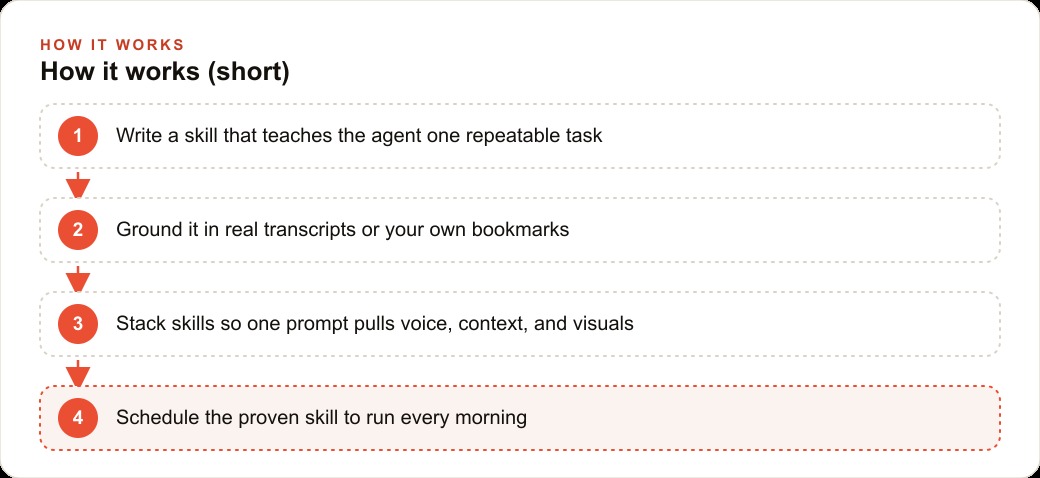
The path in is smaller than it looks. Pick one marketing task you repeat and turn it into a named skill you can rerun. Ground every draft in real references, your past content or your own saved material, instead of generic model output, because grounding is what kills the generic-AI smell. Stack skills so a single prompt pulls voice, context, and visuals at once, and lean on sub-agents when a job has many steps. Then, once a skill reliably produces output you like, schedule it as a morning automation and stop doing it by hand.
The whole system is just repeatable workflows written down as instruction files, which means you can genuinely build it yourself, one skill at a time, starting with the single task that eats the most of your week. If you would rather have your voice, your references, and your daily automations packaged into a working set of skills tuned to your business, that is exactly the kind of setup an expert can hand you ready to run. Either way, the news is not a new model. It is that your repeatable work can now be written down once and run forever.
That is exactly what we do at AI DOERS. Book a private 30-minute call with Madhuranjan Kumar and we will map the fastest path to it for your specific business.
Book your call →
Madhuranjan Kumar
Madhuranjan Kumar brings 20 years of performance-marketing experience and has managed over $200 million in Facebook ad spend for brands across the United States and beyond. His expertise spans the full modern marketing stack: Meta, Google Ads, TikTok, email automation, CRM, and the websites that hold it together. At AI DOERS he turns that track record into lead-generation systems for businesses across every industry.