
How To Never Hit Your Claude Session Limit Again
Claude rereads your entire conversation on every message, so token cost compounds instead of adds. A handful of context habits, manual compaction, rewinding dead ends, and delegating to sub-agents, cut usage dramatically.

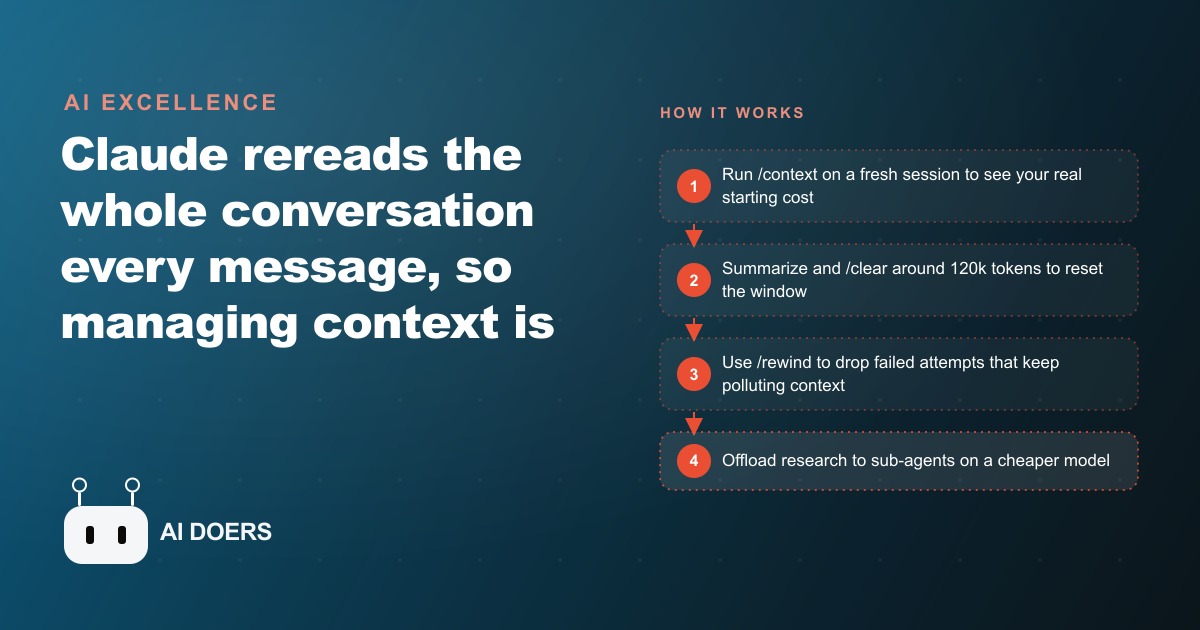
The quality of AI work does not fall off a cliff at the end of a session. It erodes gradually, starting well before any limit is reached, and by the time you notice the model contradicting an earlier decision or misremembering a file it read an hour ago, you have already been paying for degraded output through a dozen messages you thought were going fine. That invisibility is what makes context waste the most expensive kind of AI cost there is. The session limit that eventually halts you is the symptom. The quality decay that precedes it is the actual problem, and it does not appear on any dashboard.
I am Madhuranjan Kumar, and the single most consistent pattern I see across teams using AI tools heavily is this: the ones getting the most value out of the same subscriptions are not on more expensive plans or using different models. They treat context as a resource to manage actively rather than a space to fill, and they do it deliberately rather than waiting for a tool to alert them that something has already gone wrong.
The compounding cost nobody shows you on the bill
The mechanism that makes context management so important, and so counterintuitive, is that Claude rereads the entire conversation from the beginning on every single message you send. Not a rolling window of recent messages. Not a summary of what came before. The entire conversation, every time. That means the cost of any individual message is not the cost of generating that message's response. It is the cost of processing every previous message, tool call, file read, and output that accumulated before it, plus the response to the new message.
A session that starts at five hundred tokens per message is running at fifteen thousand tokens per message by the time thirty messages have been exchanged, because the conversation has accumulated that much history for the model to reread from the start. One tracked session in a published example spent nearly all of its total token consumption just rereading prior history, with a small fraction going toward generating new responses. The math of that example is not an outlier. It is what compounding token consumption looks like in practice, and it is invisible unless you are actively tracking it.
The session does not start at zero either. Before a single message is sent, the configuration file, connected tools, and loaded skills have already consumed a baseline of tokens from the session budget. On a setup that has grown over time without pruning, that baseline can be a meaningful fraction of the total before any actual work begins. Running the context command on a fresh session tells you exactly what that startup cost is. Most teams who do this for the first time are surprised by the number, because the overhead is invisible in normal use.
The quality argument is separate from the cost argument and, in practice, more consequential for the work that comes out of the session. As a session grows very long, the model's attention spreads thin across the accumulated tokens and its ability to accurately retrieve and use information from earlier in the session degrades. At 256,000 tokens, retrieval accuracy from earlier context runs at roughly 92 percent. At one million tokens, that accuracy has dropped to 78 percent. A 14-percentage-point drop in retrieval accuracy does not announce itself. The model does not tell you it is less confident about the file it read two hours ago. It just occasionally gets something wrong, inconsistently, in ways that are difficult to trace back to the cause.
The sessions that feel like they are going well right up until they fall apart are almost always sessions that have been operating in the accuracy-degraded range for a significant portion of the project. The degradation starts before any limit warning appears. The limit is not the problem. The gradual drift in accuracy that precedes it is the problem, and the window size that makes the limit easy to ignore also makes the drift easy to ignore.
A very large context window is not a goal to fill. It is a safety net. The difference between teams that treat it as a license and teams that treat it as insurance shows up in the quality and consistency of everything produced after the first hour of a session.
Manual compaction is the single habit that changes everything
The standard response to context accumulation is to wait for auto-compaction, which fires automatically when the session reaches approximately 95 percent of the available window. This is the wrong time to compact, for reasons that compound the problem rather than solving it. At 95 percent, the model is already operating at its lowest quality point in the session. The context has been degrading for some time. The auto-compaction then retains only 20 to 30 percent of the original detail from that already-degraded context and continues from there. You have waited for the worst possible moment and accepted the worst possible retention rate.
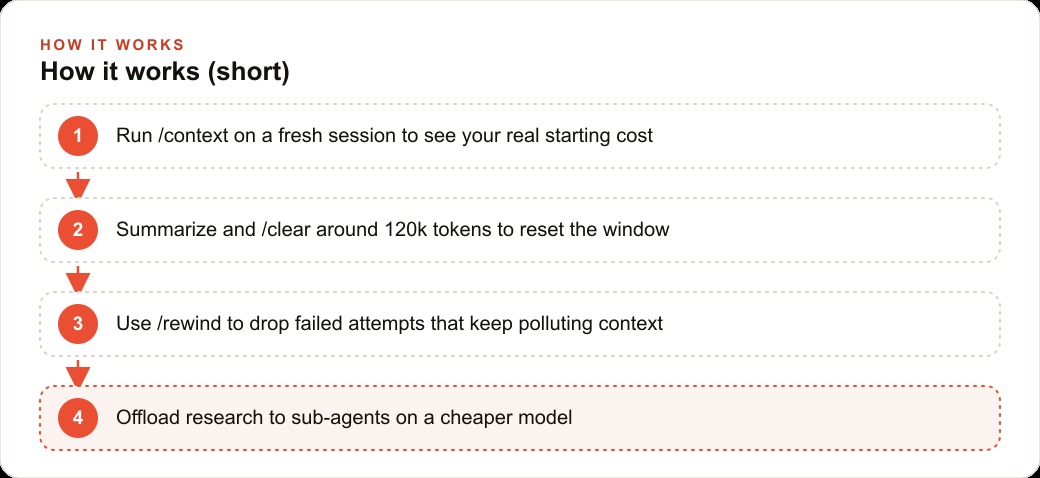
Manual compaction done around 60 percent of the window, which corresponds to roughly 120,000 tokens in typical use, works differently. At that point the model is still performing well. You ask for a thorough summary of everything completed in the session and the next steps that follow from the work done so far. You clear the session entirely, which resets the window to zero, and paste the summary back in as the starting context for the next phase. The window resets but continuity feels unbroken, because the summary carries everything that matters without the accumulated weight of intermediate tool calls, exploratory attempts, and failed approaches.
What you lose in that reset is the noise, not the signal. The failed code that sat in context for forty messages and cost tokens on every one of them is gone. The exploratory research pass that eventually produced one useful paragraph is gone, replaced by the paragraph itself. The long file that was read in full early in the session and has not been referenced since is gone, available to be reloaded if it turns out to be needed but no longer consuming context when it is not. The summary carries the decisions, the findings, and the next steps. The context starts clean.
The rewind command, which Anthropic describes as its single most recommended habit for session management, works at a smaller scale with the same logic. When an approach fails or a direction turns out to be a dead end, dropping everything after the last good checkpoint immediately prevents that failed attempt from consuming tokens on every subsequent message until the session ends. Most developers discover this habit slowly by feeling the drag of accumulated failed code on session performance before learning the fix exists.
Sub-agents change the economics of research-heavy work entirely. Each sub-agent receives its own fresh context window, does the research or analysis work, and returns only the finished result to the main session. The exploratory search, the document analysis, the code review that would otherwise pile up in the main context stays inside the sub-agent's fresh window and never reaches the main session. Routing that work to a cheaper model keeps the cost well below what the main session model charges for the same task while keeping the output quality where it needs to be.
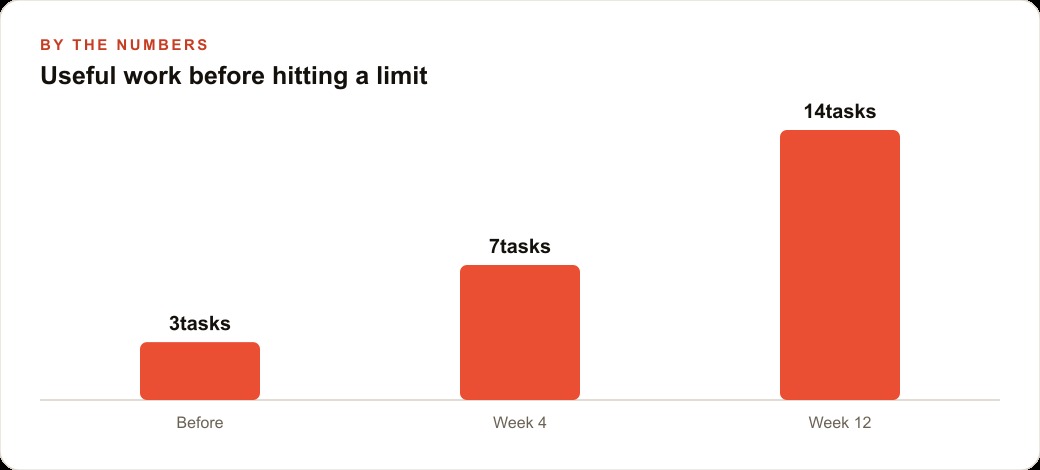
A content agency producing three blog articles per week is a clear illustration of the before and after. Before context management was part of the workflow, each article required an average of three session restarts, because sessions degraded significantly before the article was complete and restarting was the only recovery option available. Each restart consumed roughly twenty minutes of re-briefing time, because the new session had no starting context and the writer had to re-establish the brief, the research findings, the tone guidance, and the decisions made in the previous session before any new work could begin. Three restarts per article across three articles per week is twenty minutes times nine, or three hours per week of pure overhead consumed by recovering from context that was never managed.
After implementing the summarize-and-clear habit at around 120,000 tokens, each article completed in a single session with a clean handoff at the compaction point. The re-briefing overhead dropped from twenty minutes to under five minutes for the compaction summary, and that five minutes is work done inside the session rather than lost outside it. Three hours per week became less than thirty minutes. The articles were also more consistent, because the session stayed in its high-accuracy range throughout rather than finishing in the degraded range where earlier decisions start to slip.
Building the session discipline that keeps quality high from start to finish
The configuration file that loads on every session is the most consistently overlooked source of context overhead. Every line in that file is read and processed at the start of every interaction, regardless of whether the current task requires that context. A configuration file that has grown to include everything ever needed for every type of work the user does is adding a recurring tax to every session, including the sessions where most of that accumulated content is entirely irrelevant. Keeping the base configuration near 200 lines or fewer, and routing specialized instructions into separate files that load only when a specific task type requires them, is how the baseline cost stays stable as the project grows over months.
The format in which documents are loaded into context also matters more than most teams realize. Loading a PDF or an HTML file as raw text carries significant overhead from formatting noise that the model has to process but cannot productively use. Converting documents to markdown before loading them typically cuts token consumption from HTML by around 90 percent and from PDFs by 65 to 70 percent. A conversion tool processes files in seconds. The model then reads actual content rather than tag structures, attribute lists, and layout instructions. For any document loaded regularly across sessions, that conversion is a one-time task with a compounding benefit.
The discipline compounds because the habits reinforce each other. A lean configuration file means the baseline cost is predictable and low. Manual compaction at the right checkpoint means the main session stays in its high-accuracy range for the full project. Sub-agents handling research work means the main thread stays clean and focused. Rewinding dead ends immediately means failed approaches stop consuming budget on every subsequent message. None of these habits is technically complex to implement. Each one takes a few minutes the first time it is applied. Together, they produce sessions where the context is almost entirely signal, the model stays in its sharpest range from start to finish, and the session ends on the builder's terms rather than at a hard limit.
Every file you load into a session for reference deserves the same scrutiny as the configuration file. A lengthy brief, a transcript, a research document, a previous conversation export: each of these consumes context proportional to its size on every message for as long as it stays loaded. The correct approach is to load files when they are needed for the current phase of work and clear them when they are not, rather than front-loading everything at session start and carrying it through phases where it adds noise but no signal. Applying that discipline to loaded files alongside a lean configuration file and regular manual compaction keeps the effective context used for any given message close to the information actually relevant to that message, which is where the quality stays highest.
The Meta ads and Google Ads workflow design, the email sequence writing, the client reporting, the ad copy iteration work that AI tools handle in volume all benefit directly from this discipline. A team that completes complex projects in a single well-managed session rather than across three degraded restarts is producing more output on the same subscription, with better consistency throughout, and building the session management skill that makes every subsequent project faster than the one before it. That compounding efficiency is the actual return on learning these habits, and it shows up in the very first session after the habits are in place.
That is exactly what we do at AI DOERS. Book a private 30-minute call with Madhuranjan Kumar and we will map the fastest path to it for your specific business.
Book your call →
Madhuranjan Kumar
Madhuranjan Kumar brings 20 years of performance-marketing experience and has managed over $200 million in Facebook ad spend for brands across the United States and beyond. His expertise spans the full modern marketing stack: Meta, Google Ads, TikTok, email automation, CRM, and the websites that hold it together. At AI DOERS he turns that track record into lead-generation systems for businesses across every industry.