
How to Make $20,000 a Month with Claude Code (the Retainer Model)
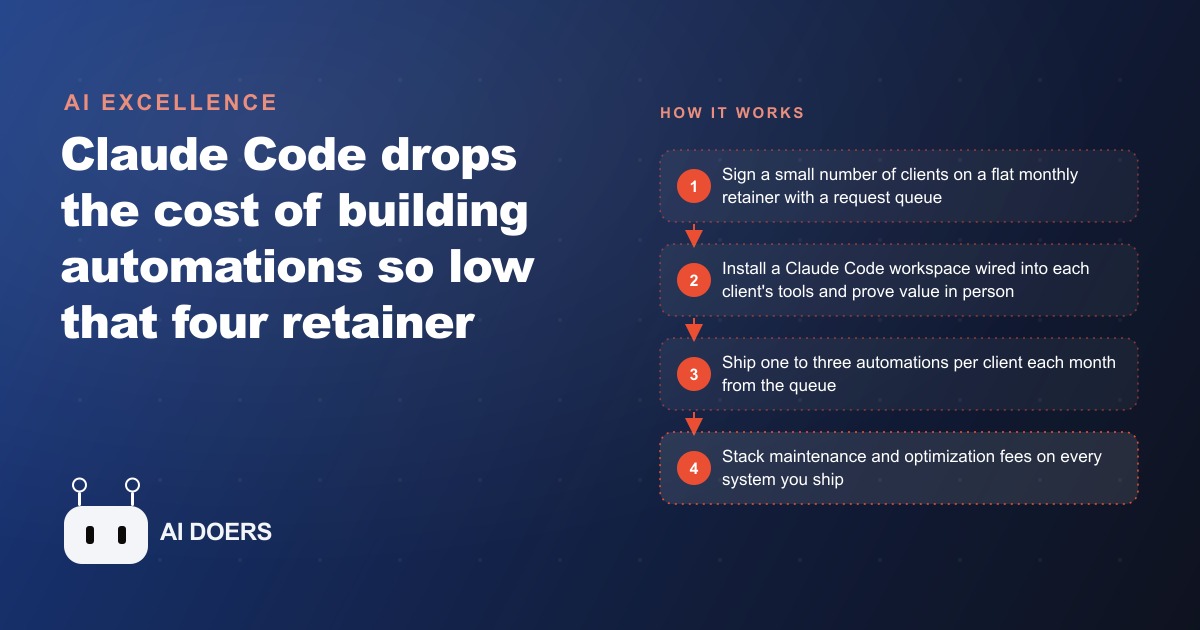
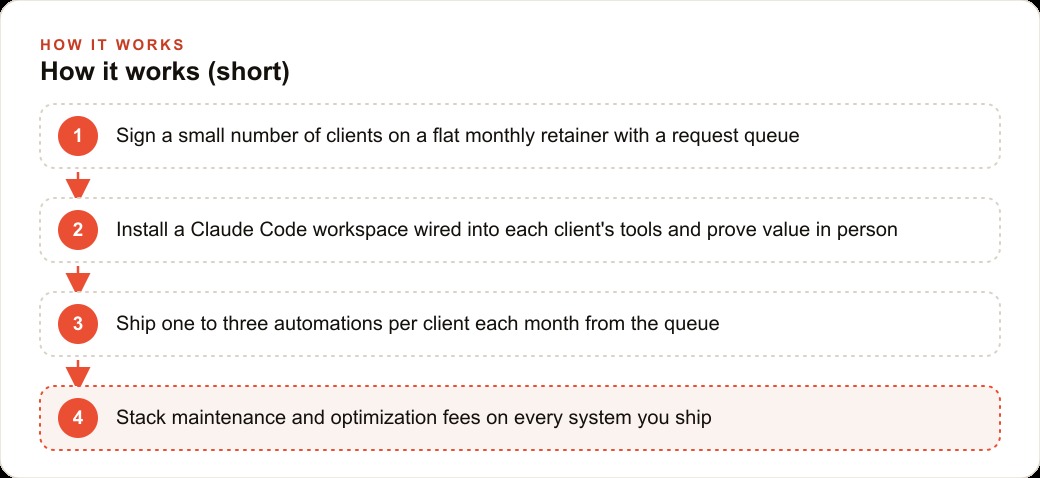
You reach 20K per month by running four retainer clients at roughly 5,000 each, shipping one to three Claude Code automations per client monthly, then stacking maintenance and optimization fees. The model works now because Claude Code dropped the cost of building automations low enough for one person to deliver them.

Nine months ago I could not have described a path from zero to $20,000 a month in recurring revenue that did not require a team, a product, or years of client relationships to build. I am Madhuranjan Kumar, and what changed is a single shift in unit economics: Claude Code dropped the delivery time on a typical business automation from multiple days of developer work to a few hours of guided AI sessions. That change made the following arithmetic possible. Four retainer clients. Each paying an average of $5,000 per month in combined fees. One operator managing all four. Here are the nine things that make that math hold.
1. A flat monthly retainer beats project pricing in every revenue and margin dimension
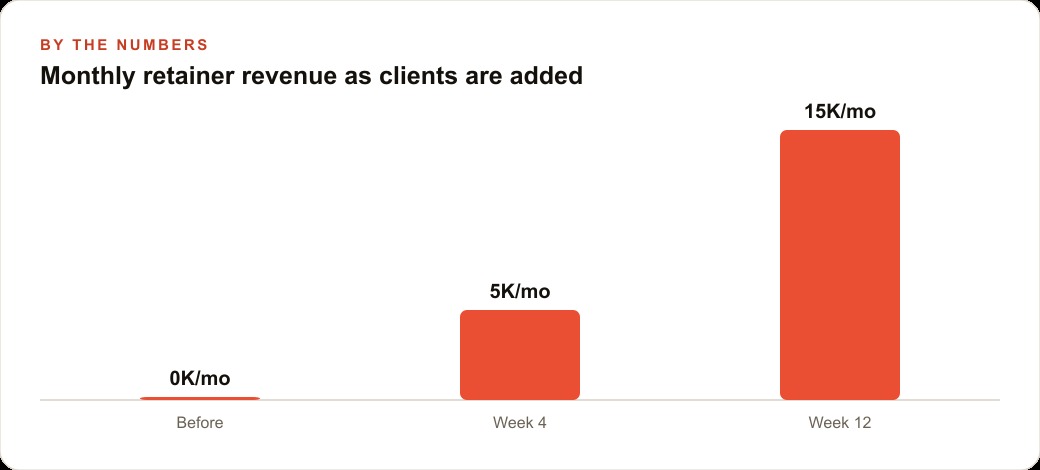
Selling automations as one-off projects creates a revenue graph that looks like a series of hills: a large number arrives, gets consumed by delivery, and then you return to finding the next client. The retainer model replaces that with a predictable baseline. A $5,000 project closes once. A $2,500 monthly retainer closes once and then pays again every month the client stays, without a second sales cycle. Four retainer clients at an average of $5,000 each in combined fees generate $20,000 a month from four relationships. Reaching $20,000 in project revenue requires closing eight to ten engagements per quarter, with the full acquisition and delivery cycle repeating each time.
The margin difference compounds the revenue difference. A project engagement front-loads all the complexity into delivery, meaning the first month is always the most expensive to fulfill. A retainer engagement front-loads the setup into the installation session, then transitions into a delivery rhythm that gets cheaper each month as you learn the client's stack, their workflow, and the patterns that recur in their request queue. By month three with a retainer client in a focused vertical, delivery time per automation drops significantly because most integration questions are already resolved. The project model gives you no such compounding. Every new project starts from zero.
2. Small and medium businesses, not enterprise, are the right target market for a solo operator
Enterprise businesses have procurement cycles that run for months, legal review on every contract, multiple stakeholders each with veto authority, and existing vendor relationships any newcomer must displace. A solo operator cannot win in that environment, and time spent there is opportunity cost against a market that is far more accessible and far more motivated.
Small and medium businesses are the right target because they make decisions fast, pay with a credit card rather than a purchase order, have operational problems that are visible and concrete, and almost none of their owners are going to learn Claude Code themselves. A dental practice has a scheduling problem or a follow-up gap that needs to run consistently. An HVAC company loses jobs every week because missed calls go unanswered for two hours. A law firm's intake process leaks clients between the first contact and a signed engagement letter. Each one of those is a solvable automation, each owner knows it costs them money, and almost none have staff who will build the solution. The agency that arrives with the answer and a price that compares favorably to what the owner already pays for marketing services wins the retainer.
3. The installation session is the highest-leverage sales move in the whole model
Most agency pitches are theoretical. A prospect hears what you will do, receives a proposal with bullet points and a price, and is asked to make a financial commitment based on faith. The installation session collapses that gap by making the value concrete before the retainer is emotionally at risk.
In the installation session, you connect a Claude Code workspace into the client's actual tools: their CRM, their phone system, their email, their calendar. That connection happens with real credentials to real systems, not a demo environment. Then you build the first agreed automation in front of them during the same session, and they watch it run on their actual business. The experience of seeing a problem they know costs them money get solved in real time, while they are watching, is what makes the retainer feel obvious rather than risky. The pitch converts from a proposal to a demonstration.
The installation session works equally well in person or as a focused screen-share session. What matters is the structure: the entire session is about wiring the workspace and proving value, not about selling. The selling happened before the session. The session is where delivery starts, which is exactly why it is the highest-leverage move in the model.
4. Niching into one vertical makes every subsequent client faster and more profitable to deliver
The first client in any vertical is the hardest. Every integration is unfamiliar, every workflow pattern requires original thinking, and every automation is built from scratch. The second client in the same vertical starts from the learnings of the first. The workspace setup script is 60 to 80 percent reusable. The integrations are familiar. The automation patterns are documented and need only reconfiguration for the new client's specific tools. The fourth client in the vertical is nearly templated, delivered faster and at higher quality than the first, with no increase in billable time.
This compounding is why vertical focus is not optional for a solo operator who wants to manage four to six retainer relationships simultaneously. It is the mechanism that makes it possible. Every client in the niche makes every other client cheaper to serve and easier to expand.
Niching also makes the sales conversation faster and more precise. Telling an HVAC owner that you automate workflows specifically for home-service businesses, and that the first automation typically captures two to three additional jobs per month that would otherwise go unanswered, is a different conversation from a general AI agency pitch. The first makes the prospect feel seen. The second requires them to translate the value into their own context before they can evaluate it.
5. Maintenance fees turn a one-time build into a permanent monthly revenue stack
Every automation you ship requires ongoing attention. Tools change their APIs. Workflows evolve as the business grows. New edge cases surface that were not in scope during the original build. A maintenance fee of $300 to $500 per running system converts each delivered automation from a completed task into a permanent ongoing revenue stream.
A client who starts on a $2,500 base retainer and accumulates three running automations over six months is paying $2,500 plus $900 to $1,500 in maintenance fees, for a total monthly fee of $3,400 to $4,000, without the base retainer price changing. That growth happens naturally as the client sees value and adds more automations to the queue. From the agency side, maintenance fees cover the work of keeping systems running and allow investment in monitoring without giving away uncompensated hours.
For the client, the maintenance fee is a reasonable trade for not having to think about whether their automations are still running correctly. They want the systems watched and problems fixed before they affect the business. The fee is what they pay for that confidence, and the ongoing relationship it creates is what keeps the retainer renewing month after month.
6. Building the first automation in front of the client converts a theoretical pitch into a felt experience
The most common reason a retainer pitch stalls after a promising first meeting is that the prospect cannot fully imagine what the automation will feel like when it is running. They understand the value intellectually. They agree the problem costs them money. But committing to a monthly fee for something they have never seen is an act of imagination, and imagination is a fragile basis for a financial decision.
Building the first automation during the installation session eliminates that gap. When the prospect watches a problem they recognize, a missed call going unanswered, a quote sitting unfollowed for three days, get solved in real time by something you built in front of them, the commitment shifts from imagination to memory. They are not imagining what it will feel like. They already felt it. That transition is the strongest close in the model, and it happens through delivery rather than persuasion.
The practical implication is that the installation session must always include building the first automation, not just setting up the workspace. A workspace without a running automation is infrastructure. A workspace with one live automation that visibly solves a real problem is proof of concept and month-one deliverable combined. One without the other misses the moment that makes the retainer feel certain.
7. The request queue keeps scope from expanding while keeping clients engaged month after month
One structural risk in any service retainer is scope creep: clients naturally want more than the model can sustainably deliver, and without a mechanism that manages expectations, the relationship either burns out the agency or frustrates the client. The request queue is the mechanism that solves this problem.
The queue works simply: clients add automation requests to a list, which gets worked through one at a time. One active task at a time, with others in order behind it. For the client, this provides a clear channel for every idea. Nothing falls through cracks. They can add any request they think of, and it goes into the queue to be addressed in order. For the agency, it creates a natural gate on delivery pace without requiring awkward scope conversations. The workload stays predictable because the queue is transparent on both sides.
The queue also keeps clients engaged long-term in a way the project model cannot match. A client who has finished their project scope has no reason to continue the relationship. A client with eight items in the queue has eight reasons to stay, and they are usually adding more. The queue model turns a retainer from a monthly fee into an ongoing relationship with a visible pipeline of future value.
8. A close rate problem is almost always a target market problem, not a product problem
When a retainer pitch goes through the right sequence: install the workspace and build the first automation in front of the client, the conversion rate should be high. If it is not, the most common cause is not a weak pitch or a wrong price. It is that the prospect was not the right target in the first place.
The right target is a business owner who already understands they have a problem that costs them money, who lacks technical staff to solve it, and who currently spends a comparable amount on some form of outsourced service. An HVAC owner who knows they miss several calls per week and lose jobs to faster competitors is already motivated. An owner who is not sure whether missed calls are even a meaningful problem is not ready for this conversation yet.
This distinction changes where to invest prospecting time. Improving the pitch for the wrong prospect is inefficient. Spending that same time finding the right prospects, owners who already feel the problem clearly, converts the close rate without changing the pitch at all. In practice this usually means building specific case studies for one vertical and putting them in front of the right owners through the channels those owners already use: trade associations, industry groups, and referrals from the first client.
9. Delivery speed is the variable that determines how many clients one operator can serve profitably
The ceiling on a solo retainer business is not revenue or the number of clients. It is delivery capacity. Each retainer client has a queue of requests coming in every month that need to be shipped. If delivery takes a week per automation, a solo operator can serve two or three clients before the backlog starts frustrating clients and straining the relationship. If delivery drops to hours per automation, the same operator can serve six to eight clients without the queue ever falling behind.
Claude Code is what changed this variable. The delivery time on a typical business automation dropped from multiple days of developer work to hours of guided session work. That change is what makes the four-client math viable for one person. Each client gets one to three automations per month. At a delivery time of a few hours per automation, four clients produce six to twelve automations per month, an achievable workload for a focused operator who has built a repeatable delivery system in their vertical.
Delivery efficiency is therefore the most important skill to develop in this model, not sales or marketing. Learning to use Claude Code to go from a client request to a tested, production-ready automation quickly, staying the human in the loop while the AI handles implementation, is what determines how many clients you can carry and how much the model can generate.
The HVAC retainer in practice: from first client to $20,000 a month
Here is how this model builds from one client to the four-client revenue target, with concrete numbers at each step.
The first client is an HVAC company whose owner knows they miss calls and lose jobs to faster competitors. The installation session takes three to four hours: wiring a Claude Code workspace into their phone system, CRM, and email, then building a missed-call text-back that sends a personalized SMS to every unanswered caller within 90 seconds, offers two callback time slots, and logs the interaction to the CRM automatically. The owner watches the automation fire on a test call. The retainer closes at $2,500 per month.
Month two adds a quote follow-up automation from the queue: a message sent automatically to every quote not accepted within 48 hours, drafted in the owner's voice, asking whether there are questions and offering a short scheduling window. That automation adds a $300 monthly maintenance fee on top of the base. Month three adds a review request that fires via SMS for every job marked complete in the CRM within a few hours of the service call. A second $300 maintenance fee is added. By month three, this one client generates $3,100 per month in combined fees, without the base retainer increasing.
The missed-call text-back alone typically captures two to three additional jobs per month that would otherwise have gone to a faster competitor. On an average HVAC job value of $400 to $1,200, that is $800 to $3,600 in recovered revenue per month for the client against a $2,500 retainer. The math is not close, and the owner renews without hesitation.
Because the vertical is focused on home services from the start, the second HVAC client takes roughly half the setup time of the first. The workspace script is 70 percent reusable. The missed-call automation needs only minor reconfiguration for the new client's phone system. By the fourth client, the setup is close to templated and delivery time per new automation has dropped significantly compared to client one. Four clients at an average of $5,000 each in combined retainer and maintenance fees produces $20,000 per month from four relationships, with a delivery workload one focused operator can manage without burning out.
The model works now because the unit economics of delivery changed. The delivery time per automation dropped enough that one person can carry four relationships profitably. The skills are learnable in a few months. The market of small and medium business owners who have a felt, costly problem and no one on staff to solve it is enormous and mostly untouched. The window to build a niche retainer business with a real compounding advantage is open right now.
That is exactly what we do at AI DOERS. Book a private 30-minute call with Madhuranjan Kumar and we will map the fastest path to it for your specific business.
Book your call →
Madhuranjan Kumar
Madhuranjan Kumar brings 20 years of performance-marketing experience and has managed over $200 million in Facebook ad spend for brands across the United States and beyond. His expertise spans the full modern marketing stack: Meta, Google Ads, TikTok, email automation, CRM, and the websites that hold it together. At AI DOERS he turns that track record into lead-generation systems for businesses across every industry.