
How To Get Your First 100 Customers For Almost No Money
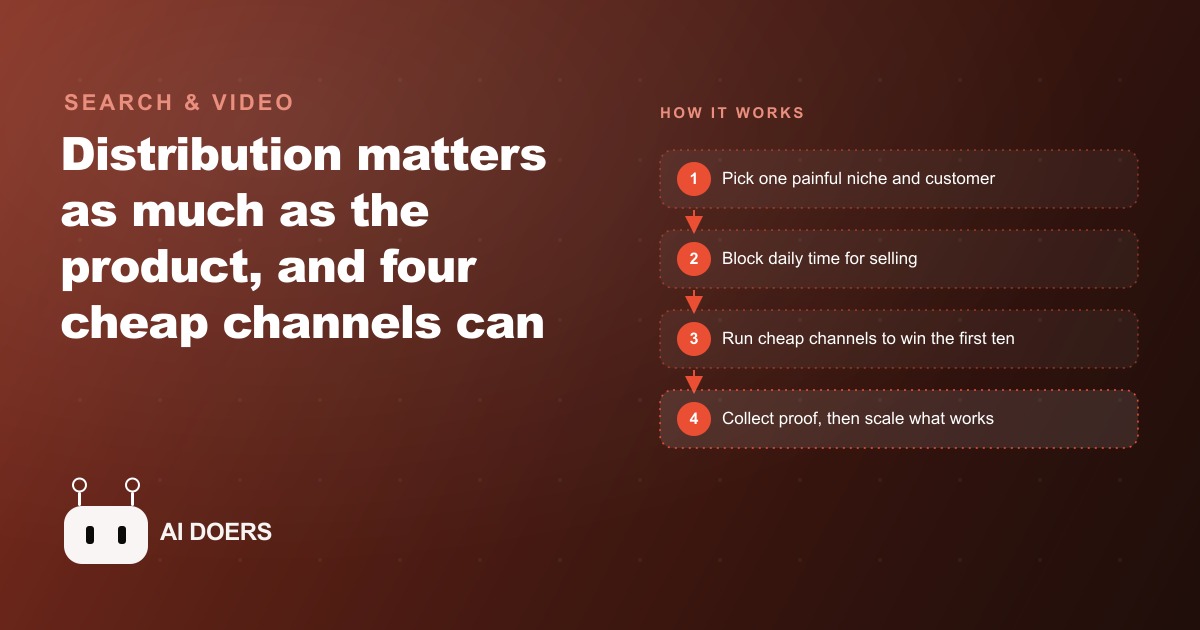
Distribution is as important as the product. These four cheap or free channels, organic content, cold messages, micro influencers, and SEO, can take a new business from zero to its first hundred customers. Here is how I would run them for a real store.

Most founders can explain their product in precise technical detail and cannot explain, with equal precision, how they plan to put it in front of a paying customer. That asymmetry is not a personality flaw. It is a structural feature of how most people learn to build things. Schools teach product. Communities teach product. The craft of distribution, the repeatable, rigorous practice of reaching the right person with the right message at the right moment, is treated as something that either comes naturally or gets handed to a marketing department when the company is big enough to have one. Most companies never get big enough to have one because they never solved distribution first.
My name is Madhuranjan Kumar. I have seen this pattern more times than I want to count, and the consistent finding is that the product almost never explains the outcome. Good products with bad distribution fail. Mediocre products with excellent distribution grow. The discipline that most founders resist, the daily, unglamorous practice of finding customers one at a time, is the only thing standing between a product that exists and a business that generates revenue.
Founders build with the precision of engineers and distribute with the judgment of beginners
Founders who build software typically have a framework for deciding what to build. They talk to users, they look at data, they prioritize ruthlessly, and they build iteratively based on feedback. They apply engineering discipline to product decisions.
Those same founders, when it comes to distribution, often operate on intuition. They post on social media when inspiration strikes. They send cold messages in bursts when they feel like it, then stop when the replies are slow. They try SEO for a month, then abandon it when the traffic does not materialize immediately. They set up a newsletter, send two issues, and let it go quiet. The discipline that would make any of these channels work, the minimum effective dose of consistency, the commitment to a single channel long enough to learn from it, is exactly what distribution requires and what most founders never apply.
The reason is partly psychological. Product feels like real work. You can see it. You can measure lines of code, features shipped, bugs fixed. Distribution feels like something that should happen automatically if the product is good enough. The idea that good products market themselves is so pervasive and so wrong that it accounts for the majority of company failures. Products do not market themselves. Founders distribute them. And founders who never develop the craft of distribution spend years wondering why the product they built is not finding the audience they imagined for it.
Distribution is a craft. Most founders never practice it like one.
A craft is something you get better at through deliberate practice, study, and iteration. Carpenters measure twice and cut once because they learned through expensive mistakes that measurement discipline prevents waste. Athletes run drills because the drill builds a reflex that cannot be faked in a game. The craft elements of distribution are just as learnable as any other skilled practice, but most founders never treat them that way.
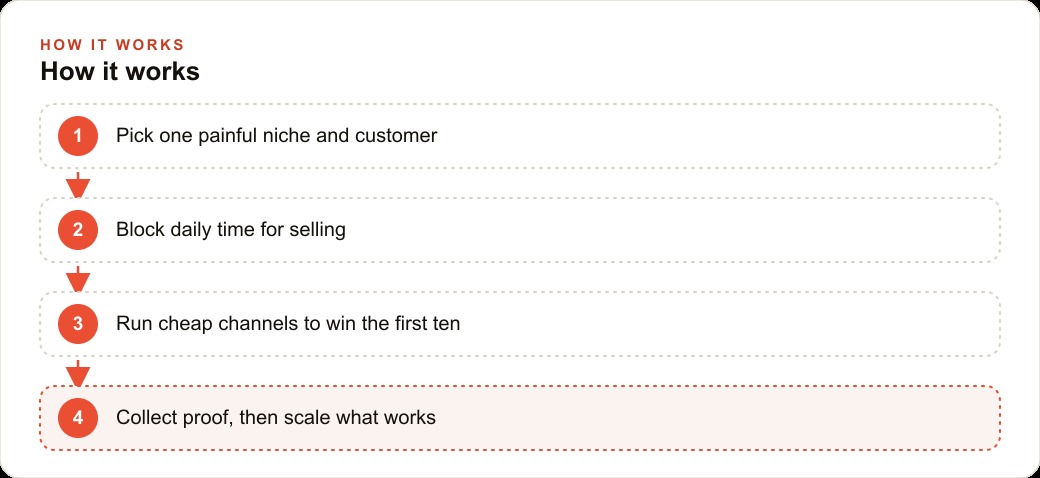
The first craft skill is choosing a narrow customer. The instinct to say our product is for small businesses is distribution poison. Every small business is a different person with different urgency levels, different budgets, different information environments, and different reasons to buy or not buy. The founder who cannot name the specific type of person they are trying to reach this week, what that person's specific painful problem is, where that person currently hangs out online, and what language that person uses to describe the problem, is not ready to distribute. Narrowing hard feels like giving up addressable market. It is actually opening up the path to the first ten customers, who are always more specific than the eventual market.
The second craft skill is blocking time for distribution and treating it as non-negotiable. At least 45 minutes per day, ideally the first block of the working day before email and before product work. The founders who build distribution discipline early in their companies develop a reflex. Customer acquisition becomes a daily practice rather than a crisis response. The reflex of reaching out consistently, publishing consistently, and following up consistently is what separates founders who have 100 customers at the end of month three from founders who have 8.
The third craft skill is learning from each channel before adding the next. Founders who run all four channels simultaneously, content plus cold outreach plus micro influencers plus SEO, rarely do any of them well enough to learn from them. The discipline is to pick one, run it hard for 30 days, measure specifically what happened, adjust, and only add a second channel when the first one is producing consistent output. That sequencing feels slower but is faster because you stop running four things badly and start running one thing well.
The first ten customers require a different posture than the next ninety
The mistake almost every founder makes in the early stage is trying to build the distribution system that will scale to a thousand customers before finding the first ten. They set up the newsletter, the social profiles, the SEO strategy, and the referral program before they have spoken to five paying customers. Distribution for the first ten customers is not infrastructure. It is personal. It is showing up in the communities where your customer already gathers and being genuinely useful. It is finding the people who have the problem you solve and talking to them directly. It is not scalable, and that is correct. Scalability is not the constraint when you need ten people to try your product. Specificity is.
Cold messages done well are the fastest path to the first ten customers for almost any business. Personally writing to 20 specific people who match the exact customer profile and asking a genuine question, not pitching, earns replies at a rate that is surprisingly high. The person who messages 20 specific people, earns 8 replies, has real conversations with 8 people about a problem they share, and converts 2 to 3 into paying customers, has a better foundation than the person who ran a broad social campaign that reached 2,000 undifferentiated accounts and got zero replies.
One of the highest-leverage early tactics is targeting people who left negative reviews on a competitor's product. Those people have already identified the problem, already tried one solution, and are actively unhappy. Their willingness to pay again is higher than a cold prospect because they have already demonstrated that they will pay. Reaching them with a message that acknowledges their specific frustration and offers a fair path to try an alternative, with credit toward what they already spent, converts at a rate that most founders find surprisingly high the first time they try it.
The posture shift after the first ten is real. Once you have ten paying customers, the nature of the distribution problem changes. You have proof. You have language. You have the specific words real buyers used to describe why they bought, what almost stopped them, and what they tell their friends the product does. Those words become the copy for the next 90 customers. They are more accurate than anything you wrote before you had buyers because they came from buyers.
An e-commerce store that treats distribution as its primary discipline reaches 100 customers in under 90 days
Let me make this concrete with an e-commerce store selling specialty coffee equipment. The owner launched with a simple product catalog and five items. The first month, they tried everything simultaneously: Instagram posting, a few cold messages, one influencer outreach attempt, and one blog post. They got 3 sales, all from people they knew personally.
The second month, the owner committed to one channel first. They picked organic long-form video, specifically comparison guides and brewing tutorials for the specific customer they were actually trying to reach: home coffee enthusiasts who had already spent $100 on a starter setup and were considering a $200 upgrade. Every video was written specifically for that person, not for casual coffee drinkers and not for professional baristas.
They published two videos per week for six weeks. By week four, one video comparing two popular grinder models started pulling consistent search traffic. That single video brought 34 unique visitors in week four, 12 of whom spent more than three minutes on the product page. Four purchased. This breakdown cost nothing to produce beyond two hours of the owner's time.
With that proof in hand, the owner added cold outreach as the second channel. They joined four coffee-focused communities online and spent two weeks being genuinely useful, answering questions about grinder calibration, water temperature, and dialing in espresso. They built credibility without mentioning the store. In week three, they began softly mentioning specific products when they came up naturally in conversation. Over four weeks, 11 new customers came through the community channels at zero direct cost beyond the owner's time.
The third channel was micro influencers. The owner identified eight coffee-focused creators with between 1,200 and 18,000 followers. Two did not respond. Three agreed to product partnerships, accepting equipment at retail cost in exchange for honest reviews. Two of those three published content that between them sent 190 new visitors to the store in two weeks. Twenty-two of those visitors purchased, representing 22 new customers from a total outreach investment of two products at cost, roughly $280 total.
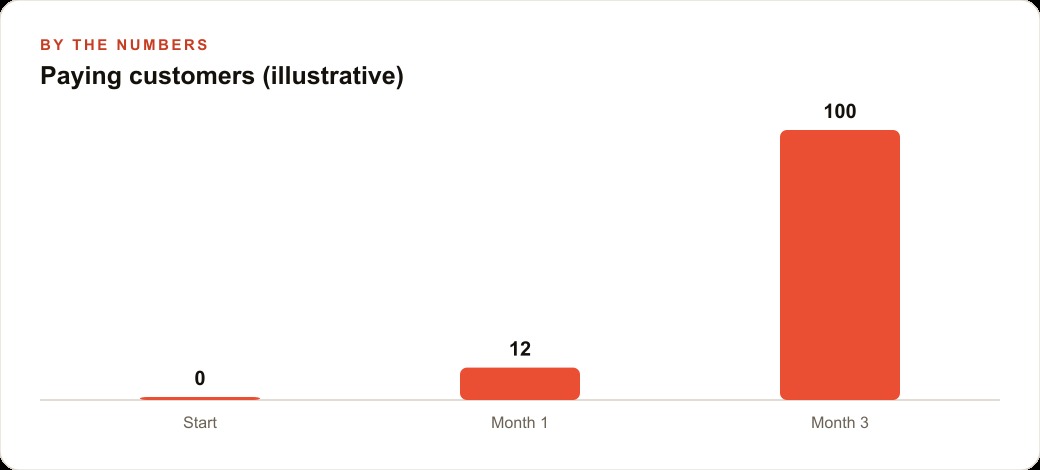
By the end of month three, the store had 97 customers. The breakdown was roughly 12 from cold outreach, 31 from organic video and search traffic, 22 from the micro influencer coverage, and 32 from SEO pages published in months one and two that were indexed and pulling traffic by month three. Total distribution cost across all channels, including the influencer product cost, was under $400. Average customer order value was $165. Revenue from those 97 customers was $15,995.
The store did not reach 97 customers because the products were exceptional. The market has dozens of options at similar quality and price points. The store reached 97 customers because the owner treated distribution as the primary discipline, blocked time for it every day, committed to channels long enough to learn from them, and layered channels deliberately rather than running all of them at a fraction of the necessary effort. That discipline, not the product quality, is what separated this store from the dozens of similar stores that also launched that quarter and are still waiting for their first 20 customers.
What separates the stores at 100 customers from the ones still at 8
The stores that stall at single-digit customers share the same trait: they built distribution in response to having no customers rather than building it as a proactive practice. They sprint for two weeks when they realize sales are flat, then pause when a few orders come in and something feels like it is working. Then they are flat again and sprint again. That boom-bust cycle prevents any channel from compounding because channels compound through consistency, not intensity.
The practice that prevents this is treating distribution like a non-optional operational function, as non-negotiable as the work of fulfilling orders. Forty-five minutes at the start of every workday, before email and before product decisions, spent on customer acquisition: sending messages, publishing content, following up with prospects, reaching out to potential referral partners, or improving the SEO pages already published. That daily discipline, maintained for 90 days, is worth more than any tactical breakthrough or clever marketing idea.
The stores that reach 100 customers in a quarter all have this in common: they do the unsexy daily work that feels trivial on any individual day and compounds into something substantial over a quarter. The ones still at 8 customers three months later had the same tools, the same market access, and often a comparable product. They just never made distribution a craft they practiced with the same rigor they applied to building.
Send a short message to every buyer in the first three months and ask two questions: what made you buy, and what almost stopped you. The answers will reshape your messaging and your product in ways that no amount of guessing can. Those early buyers are the most honest feedback you will ever get, and most founders never ask.
That is exactly what we do at AI DOERS. Book a private 30-minute call with Madhuranjan Kumar and we will map the fastest path to it for your specific business.
Book your call →
Madhuranjan Kumar
Madhuranjan Kumar brings 20 years of performance-marketing experience and has managed over $200 million in Facebook ad spend for brands across the United States and beyond. His expertise spans the full modern marketing stack: Meta, Google Ads, TikTok, email automation, CRM, and the websites that hold it together. At AI DOERS he turns that track record into lead-generation systems for businesses across every industry.