
How to Fine-Tune Your Own LLM With Unsloth on a Free GPU
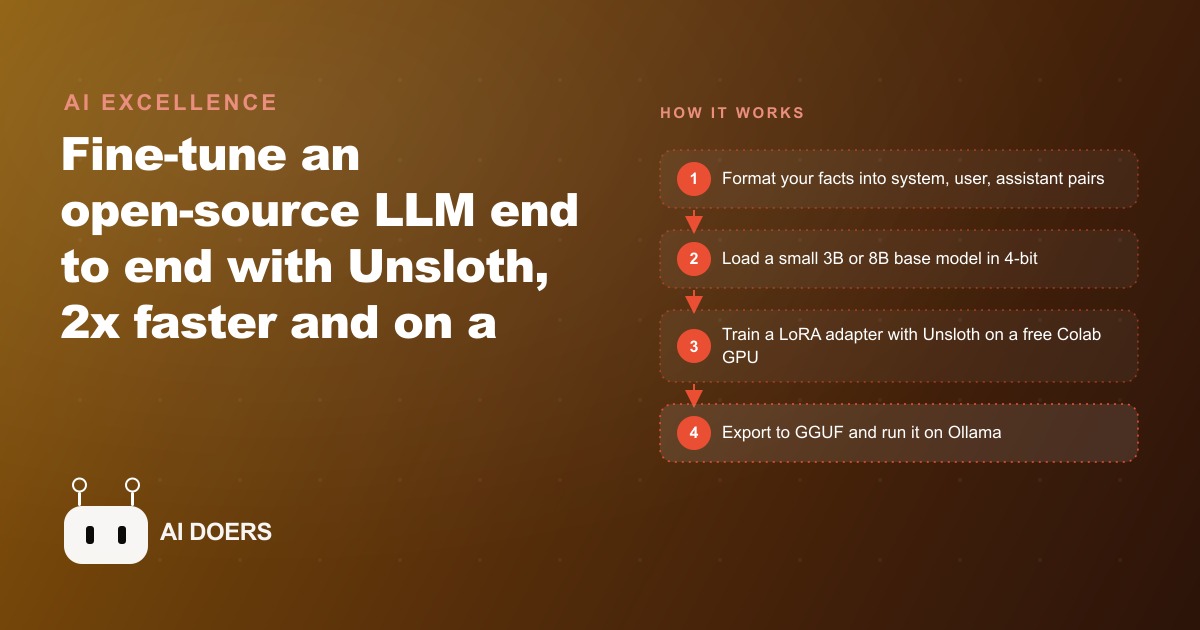
You can fine-tune an open-source LLM end to end on a free Colab T4 GPU by using LoRA with the Unsloth package, which trains up to 2x faster while using under 70 percent of the memory and finishes in roughly 15 to 20 minutes.
Six months ago, fine-tuning a language model on your own data required a GPU cluster, a machine learning team, and a budget that made sense only if you were a mid-sized tech company. That world is gone. Today you can take an open-source model, train it on your own examples, and have it running privately on hardware you control, in under twenty minutes, on a GPU that costs you nothing.
I am Madhuranjan Kumar, and the thing that strikes me about this moment is not the technology itself. It is what the technology has exposed. We are at an inflection point where fine-tuning an open model on your own data is no longer an enterprise capability. It is a Tuesday afternoon project. The question is not whether small businesses can do it. It is whether they have the right data and the right choice of problem.
That second part is where most people go wrong.
The choice that matters more than the tool
Before you write a single line of training code, you need to settle a question that most tutorials skip entirely: should you be fine-tuning at all, or should you be building a RAG system instead?
RAG, retrieval-augmented generation, turns your documents, websites, and private records into a vector database that the model searches at query time. Ask it a question and it pulls the relevant chunks, then answers using them. It is the right default for almost every use case where the knowledge is fresh, changes regularly, or lives in documents you can index. If you want your model to know about your current product catalog, your latest pricing page, or a policy that gets updated quarterly, RAG is the answer. No training run, no frozen weights, no problem.
Fine-tuning is a different kind of tool. It is not about facts. It is about behavior. When you fine-tune a model, you are not teaching it new information the way you would update a database. You are baking a pattern into the model itself, changing how it reasons and responds at a deep level, so that pattern shows up automatically without prompting.
The cases where fine-tuning beats RAG cluster around three situations. The first is a specialized task the model consistently fails at: reading a medical imaging report in a structured clinical format, classifying intake forms by matter type with no ambiguity, or producing legal clause drafts that match a firm's exact house style. The second is strict process adherence, where a chain of prompting and retrieval cannot make the model reliable enough because the consequences of deviation are high. The third is cost reduction, where you are paying a frontier model for a repetitive, narrow task and a smaller fine-tuned model would do the same job at a fraction of the price.
That cost argument is real and it compounds. Businesses running ten thousand to fifteen thousand API calls a month to a frontier model are paying for a generalist doing a specialist's work. Fine-tuning replaces that with a model you own, running on hardware you rent for a fixed monthly amount, with no per-call billing and no third party seeing your data. When you are also spending on Facebook and Instagram ads or Google Ads to acquire customers, operational overhead like unnecessarily expensive inference adds up in ways that compress margin faster than most owners realize.
The decision tree is actually simple. If the problem is that the model does not know the right facts, use RAG. If the problem is that the model does not behave the right way, use fine-tuning. Getting this wrong costs weeks of preparation for a result that could have been solved in an afternoon with a different approach.
Why the training data is the whole project
Once you have decided fine-tuning is the right call, the technology fades into the background. Unsloth, LoRA, 4-bit quantization, Colab GPU allocations: these are implementation details. They matter but they are not the hard part. The training data is the hard part, and most people underestimate it so severely that they run a technically perfect training job on bad data, then blame the model.
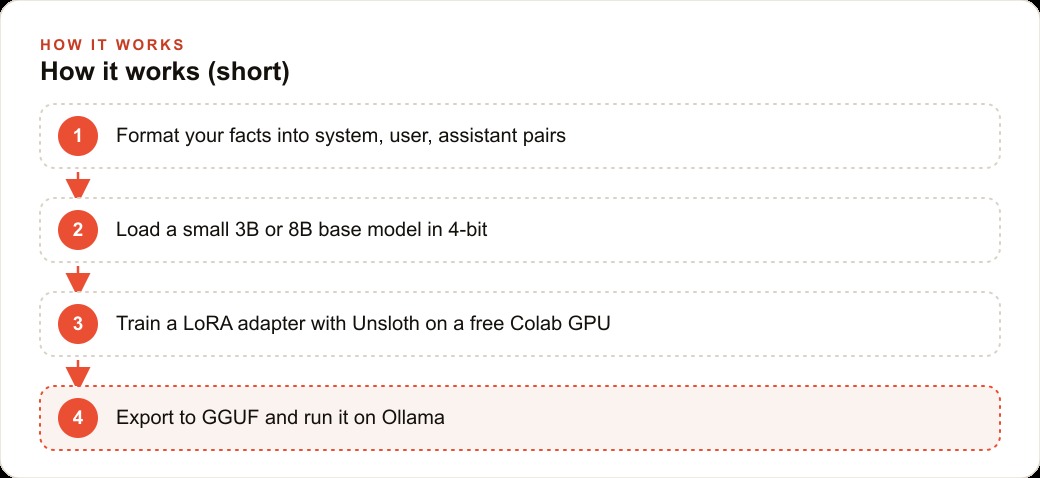
Every fine-tuning run requires data in a specific format: system, user, assistant. The system field sets the context or role, the user field is the input, and the assistant field is the ideal response. That sounds simple, and reformatting existing data into those three fields is genuinely not difficult. The problem is that most businesses have the raw material scattered across email threads, old documents, meeting recordings, intake forms, and CRM notes, in formats that are not ready to train on. Converting those sources into clean, consistent question and answer pairs is where the real work lives.
There are three routes. The first is pulling an existing dataset from Kaggle or HuggingFace. This works if someone has already assembled a public dataset for your kind of task, which covers medical Q and A, legal clause extraction, customer service dialogue, and a number of niche domains. If your task is common enough to have a public dataset, use it. The second route is building your own from your internal records. Past customer service tickets with resolved answers, transcribed sales calls with the right responses, intake forms with the correct classifications: any of these become training pairs if you can write the code to reformat them. A large model helps enormously at this step, and you can give it a raw document and ask it to generate the system, user, assistant version at scale. The third route is generating synthetic data, where a large model writes examples and a reward model scores and ranks them so you keep only the best. NVIDIA's Nemotron family ships both an instruct model and a reward model at 340 billion parameters for exactly this pipeline, and when you need thousands of training pairs that do not yet exist in any document you have, synthetic generation is how you get them.
The floor that makes a meaningful difference is roughly a few hundred clean examples for a narrow task and a few thousand for anything requiring nuance or range. Below that floor the model learns a general shape of what you want but not enough precision to be reliable in production. Above it the consistency of the output improves dramatically, and the gap between what the fine-tuned model produces and what a heavily prompted general model produces becomes unmistakable.
One thing worth saying plainly: you cannot buy your way past bad data by choosing a better base model or running more training steps. If the examples are inconsistent, if the answers you marked as ideal were not actually ideal, if the task is underspecified in the data itself, the model will faithfully learn the inconsistency and underspecification. Data curation is not a preliminary step you rush through to get to the interesting part. It is the project.
The LoRA trick that made the free GPU possible
Here is what changed the economics. For most of the last few years, fine-tuning meant full fine-tuning: updating every weight in the model. For a 7 billion parameter model that meant needing hardware that cost real money and a training run that took hours or days. That option still exists, but it is not the option most practitioners use anymore.
LoRA, low-rank adaptation, works differently. Instead of rewriting the model's original weights, it adds small adapter layers on top of them, like attaching sticky notes to a book rather than reprinting the pages. The original base weights stay frozen. The adapter layers are tiny by comparison, and they capture the new behavior you are training in. At inference time the adapter is applied on top of the base model and you get the behavior you trained without having changed the base model at all. Training time drops from a full day to a couple of hours. Memory requirements drop enough that the whole job fits on a GPU that was previously too small to be useful for this kind of work.
Unsloth takes LoRA further. It is a package built specifically to make this kind of fine-tuning faster without sacrificing output quality, and it delivers roughly two times the training speed at under seventy percent of the memory. That combination is what makes a free T4 GPU in Google Colab enough to run a complete experiment. A full fine-tuning job on a 3 billion or 8 billion parameter model that would have previously required a paid A100 instance now finishes in fifteen to twenty minutes on hardware Google gives away for free.
The other piece is 4-bit quantization. Loading a model in 4-bit means using smaller, less precise numbers for each parameter, which cuts memory and speeds computation at the cost of a small accuracy trade-off. For most business tasks that trade-off is invisible in practice. The output quality on a narrow, well-defined task is indistinguishable from a full-precision version, and the ability to train on modest hardware without renting expensive cloud infrastructure makes the whole project accessible to teams that have no GPU budget at all. Start with a 3 billion or 8 billion parameter model. Bigger is slower and more expensive at inference. You can scale up later if the results genuinely demand it, but for a first experiment on a narrow task the smallest model that plausibly has enough capacity is the right starting point.
When the training run finishes, you export either the small LoRA adapter file alone or a GGUF file that bundles the adapter with the base model, ready to run on llama.cpp or Ollama directly. You can push it to HuggingFace with your access token if you want to version or share it, or keep it entirely private on your own server. The portability is part of the point: you end up owning a model file, not a subscription to someone else's API whose pricing you cannot control.
What a law firm's fine-tuned model actually looks like in numbers
Let me make this concrete, because the abstraction breaks down fast when someone asks the obvious question: does this actually work for a real business, and what does the before-and-after look like?
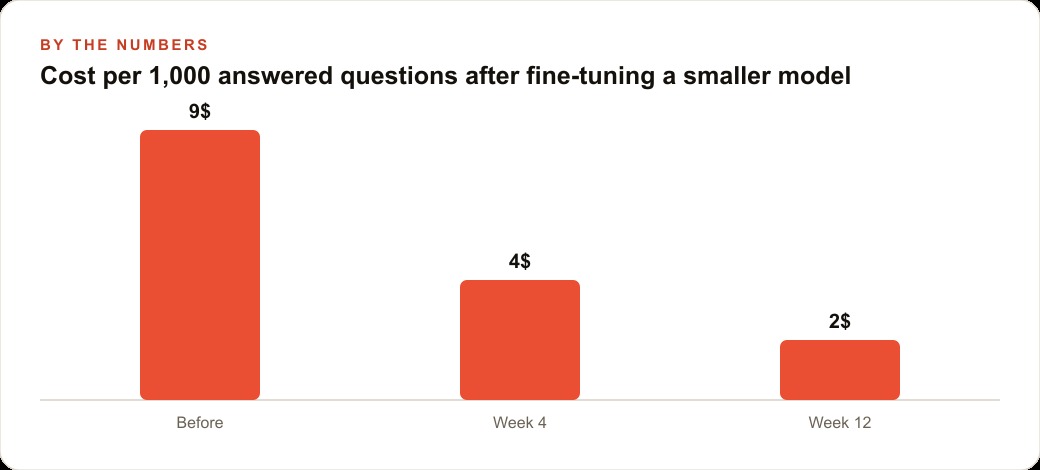
Consider a law firm running a high-document-volume practice. Deposition summaries, intake classification, standard clause drafting: all of it goes through the same firm style, the same structural conventions, the same voice that partners have spent years establishing as the firm's standard. Before fine-tuning, the firm routes these tasks through a frontier API. At ten thousand to fifteen thousand API calls a month, that works out to roughly nine hundred dollars a month in inference costs, not counting the time spent writing prompts long enough to enforce the style consistently, and not counting the fact that every document sent to that API leaves the firm's network.
The alternative is to fine-tune a small open model on a few thousand past examples of the firm's own drafting. Deposition summaries already approved and filed, intake notes already classified, clauses already reviewed by partners. The training data already exists in the firm's document management system. It needs to be reformatted into system, user, assistant pairs, a process a large model can assist with in a few hours. The training run with Unsloth on a free Colab GPU takes under half an hour. The resulting model runs on a small GPU server the firm rents for seventy-five dollars a month.
The result is a model that writes in the firm's exact voice, because it was trained on the firm's own approved work. The monthly cost drops from roughly nine hundred dollars to seventy-five dollars for the GPU rental and nothing per call. Client documents never leave the building. And because the model was trained on work the firm has already validated, the output requires less review than a frontier model trying to infer style from a long system prompt it receives fresh at every request.
The same arithmetic holds across almost any operation with repetitive, specialized output. A clinic classifying intake forms by presentation type, an accounting practice extracting fields from varied invoice formats, a support team handling the same product questions in a strict house voice. For any agency managing content production at scale, including the kind of SEO and organic search work where voice consistency across hundreds of pages directly affects both user trust and ranking signals, a fine-tuned model produces on-brand output faster than any prompting strategy applied to a general frontier model, and at a cost per word that trends toward zero after the initial setup.
The numbers compound in a direction that matters. Month one, you spend a few hours preparing data and run the experiment on a free GPU. Month two, you are running a model that costs seventy-five dollars a month and handling work that previously cost nine hundred. By month six, the model has paid for itself many times over and you own the asset outright, with no dependency on a third-party API's pricing decisions or data-retention policies.
That is the real argument for fine-tuning in 2024 and beyond. Not that it is technically impressive, though it is. Not that it is fast to train, though Unsloth has made it genuinely fast. The argument is that we have crossed the threshold where owning a model trained on your own data, running on hardware you control, producing output in your exact style, is cheaper than renting a general model month after month for a task it was not specifically built to do.
We are not at the beginning of this shift. We are at the end of the period where fine-tuning was genuinely difficult. Unsloth, LoRA, free Colab GPUs, and open-source base models have eliminated the barriers that once made this an enterprise-only capability. What remains is the decision work: is fine-tuning the right tool for this problem, do you have the training data to teach the behavior you want, and can you commit to the few hours of preparation the first experiment demands?
If you have the right problem and a few hundred clean examples, you can run the first experiment this afternoon on a GPU that costs you nothing. If you want help deciding whether fine-tuning fits your situation, building the training data from your existing records, and deploying the resulting model privately on your own infrastructure, that is exactly the kind of work I take on with clients. The conversation starts here.
That is exactly what we do at AI DOERS. Book a private 30-minute call with Madhuranjan Kumar and we will map the fastest path to it for your specific business.
Book your call →
Madhuranjan Kumar
Madhuranjan Kumar brings 20 years of performance-marketing experience and has managed over $200 million in Facebook ad spend for brands across the United States and beyond. His expertise spans the full modern marketing stack: Meta, Google Ads, TikTok, email automation, CRM, and the websites that hold it together. At AI DOERS he turns that track record into lead-generation systems for businesses across every industry.