
How to Enter the NVIDIA DGX Spark Giveaway for GTC 2026
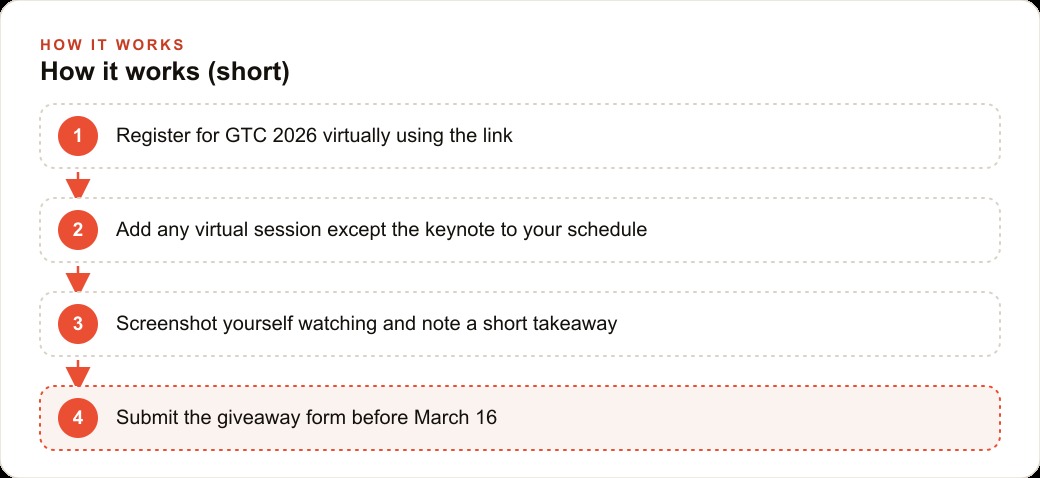
Entering takes three simple steps: register for NVIDIA GTC 2026 virtually, add any virtual session except the headline keynote to your schedule, then submit the giveaway form with a screenshot and a short takeaway.

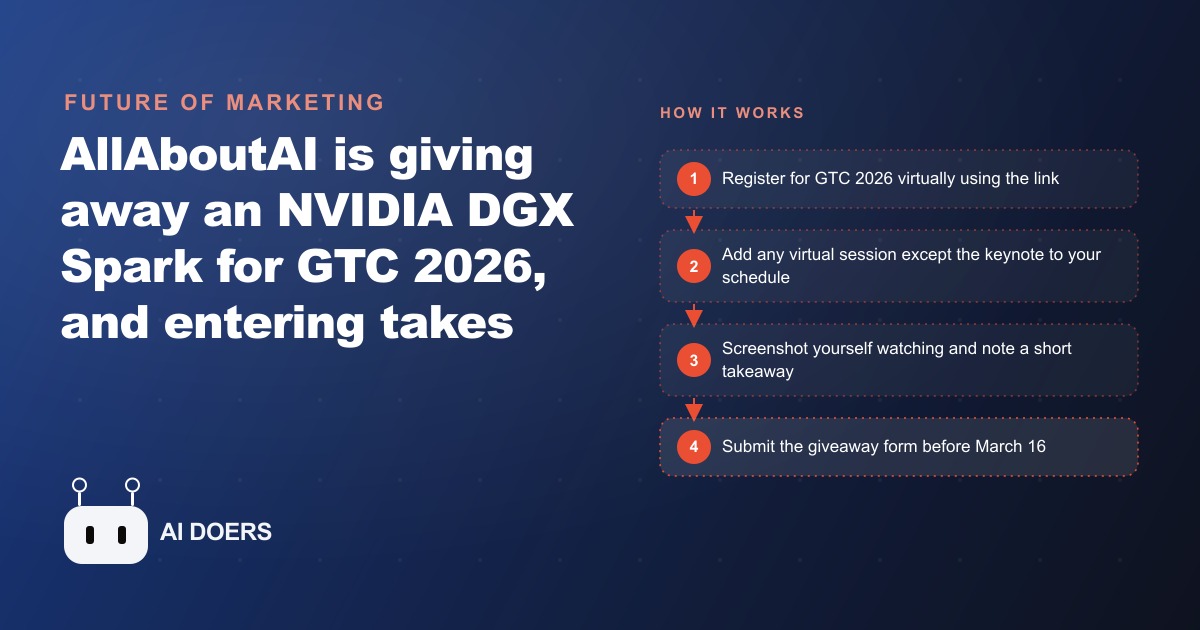
NVIDIA is giving away a desktop AI computer worth roughly $3,000 to people who attend a free virtual conference. The entry takes about 15 minutes. Here is everything you actually need to know.
I am Madhuranjan Kumar. I have gone through both the DGX Spark's specifications and the entry process in detail. The seven items below cover what the machine is, how to enter without getting disqualified on a technicality, who GTC 2026 is designed for, which sessions are worth your time, what you can do with the machine if you win, the realistic odds picture, and what to do if you lose but are serious about local AI.
1. What the DGX Spark actually is, and why a 15-minute entry is worth making
The DGX Spark is NVIDIA's small desktop AI computer. It is not a laptop add-on or a cloud credit voucher. It is a purpose-built machine designed to run AI models locally on hardware you own and control, without sending your data to any external server.
The specifications that matter for practical use are one petaflop of FP4 AI performance, 128 gigabytes of unified system memory, and 4 terabytes of NVMe storage. The memory number is the most important one. 128 GB is enough to load a 70-billion-parameter language model, which is the size of model that can handle complex document analysis, multi-step reasoning tasks, and professional-quality writing in a business context. Most consumer hardware tops out at 16 to 32 GB of memory, which limits local models to much smaller, significantly less capable options. The Spark changes that ceiling.
A recent software update pushed the machine's performance beyond its initial review scores. It also runs silently, which matters if you want it on a desk in a client-facing office rather than a server closet.
The entry format requires attending a real session and writing a two-sentence takeaway. That is a more meaningful gate than most giveaways set, which means the pool of qualified entries is smaller than the total number of people who see the contest link.
2. The three entry steps, in exact order, including the one rule that disqualifies most people
Entry has three steps that must be completed in sequence. The order is not flexible because each step gates the next.
Step one is virtual registration. Go to the NVIDIA GTC 2026 registration page through the link in the giveaway description, click register now, and select virtual-only as your attendance format. Complete the form with your email address. Without a confirmed virtual registration, your submission is invalid.
Step two is session selection. Open the GTC virtual session catalog, filter to virtual-only content, and find a session that genuinely interests you. Add it to your GTC schedule. The one rule that disqualifies the most entries: the session cannot be Jensen Huang's keynote. The keynote is the highest-profile part of GTC and it is explicitly excluded from qualifying sessions in the giveaway terms. Browse the rest of the catalog, which covers inference optimization, hardware capabilities, enterprise deployments, research, and vertical industry applications, and select something outside the keynote.
Step three is form submission. Fill in the giveaway form with your name, email, country, and the session number of the talk you attended. The session number appears at the top of any session's detail page in the catalog. While watching the session, take a screenshot of yourself watching it. That screenshot is your proof of attendance and must be uploaded with the form. Write two to three sentences describing what you took away from the session. This final requirement filters for people who actually engaged with the content rather than just registering.
3. Who GTC 2026 is actually designed for, and why the content has value beyond the entry requirement
GTC is NVIDIA's annual developer and enterprise conference. It runs March 16 to 19 as a virtual event. The conference is not a marketing show. It is a dense technical event with sessions designed for engineers building AI systems, executives planning enterprise AI deployments, and researchers working on the next generation of models and hardware.
The practical value for business owners and team leads concentrates in a specific category of sessions: those covering enterprise deployment of AI models, inference optimization for production workloads, and industry-specific AI applications. These sessions are presented by NVIDIA engineers and enterprise partners who are running the systems being described, not speculating about future capabilities. A business owner who attends a session on private AI for legal or financial services leaves with a concrete picture of what the infrastructure looks like, what it costs to operate, and where the real constraints are.
The content library also remains accessible after the live event for virtual attendees. If your chosen session conflicts with another commitment, confirm whether recordings count for giveaway purposes before assuming you can watch the replay and still qualify for the entry.
4. Sessions in the GTC catalog worth adding to your schedule regardless of the giveaway
For business owners specifically interested in running AI locally or reducing cloud AI costs, the highest-value sessions fall into three categories.
The first is sessions on NVIDIA NIM microservices. NIM packages are pre-configured AI models designed to run on NVIDIA hardware including the DGX Spark. Sessions in this track show which models are available in this format, how to deploy them without deep machine learning engineering experience, and what actual performance looks like on real business tasks. This is the closest thing to a practical product demonstration of what a DGX Spark does in a real business environment.
The second category is sessions on agentic AI systems. Agents, meaning AI that takes actions rather than just answering questions, are the fastest-developing category in enterprise AI right now. GTC sessions from NVIDIA engineers and enterprise partners cover how these systems are being deployed, what the failure modes look like at production scale, and what infrastructure makes them reliable.
The third category is vertical industry application sessions. GTC includes content on AI in healthcare, legal services, financial services, manufacturing, and retail. Attending one session in your industry gives you a concrete benchmark of what peers are currently deploying and at what scale, which is more useful than generic AI capability demonstrations.
5. What you can actually run on a DGX Spark if you win
With 128 GB of memory, the Spark can run a 70-billion-parameter model continuously. In practical terms, that means a model large enough to read a 50-page contract and answer specific questions about its provisions, draft professional correspondence that reflects your business voice rather than a generic template, analyze customer inquiries and draft qualified responses, summarize meeting transcripts and extract action items, and generate first-draft proposals from structured inputs.
With 4 TB of storage, you can keep your entire business document library accessible to the model. Past proposals, client correspondence, internal process documents, technical references, and historical project files can all be loaded as reference context. The model answers questions about your actual business history rather than producing generic guidance.
The SSH access method means any laptop on your office network can query the Spark. The compute stays in the office; the interface travels with you.
The most important practical capability is privacy. Nothing processed on the Spark leaves your network. For businesses handling client documents under confidentiality obligations, patient records, legal correspondence, or financial information that should not move through a third-party server, a local model is not a cost preference. It is the only compliant option.
6. The deadline and odds context, including what most contest analyses leave out
GTC 2026 begins March 16. Submissions completed before the conference opens have the advantage of confirmed eligibility before the entry window closes. The cleanest approach is to complete registration and session selection before the reminder post goes out, so submission is the only remaining step when the confirmation period arrives.
On odds: giveaways for specific high-capability hardware attract a different entrant profile than gift-card contests. People who understand what the DGX Spark is and have a real use for it are more likely to complete all three steps correctly. The entry format itself, requiring a screenshot and a written takeaway, filters out mass-entry scripts and low-effort submissions that dilute the odds in simpler giveaways. The effective pool of qualified entries is meaningfully smaller than the total number of people who see the contest link.
This does not change the fact that the odds of winning any individual hardware giveaway are low. The correct frame is that the entry process has non-trivial value regardless of the outcome. Attending a GTC session on enterprise AI deployment is useful on its own terms, and completing the registration process familiarizes you with NVIDIA's ecosystem and the DGX product line at no cost.
7. What to do if you do not win but are serious about local AI hardware
The DGX Spark is not the only path to capable local AI compute. The practical question is what memory capacity you need for the models relevant to your use case, and what budget makes sense against your current cloud API costs.
For businesses currently spending $200 to $500 per month on cloud AI API calls, the break-even point on local hardware typically arrives within 12 to 18 months. Beyond that point the hardware pays for itself continuously, and the privacy and latency advantages accumulate whether or not you are focused on cost.
Consumer workstations with 64 GB of RAM can run models in the 30 to 40 billion parameter range, which covers most standard business text tasks including drafting, summarization, document question-and-answer, and classification. The trade-off compared to the Spark is slower response speed under concurrent load and the absence of dedicated AI acceleration hardware. For a single-user setup handling standard business document tasks, a 64 GB consumer workstation offers meaningful capability at a fraction of the Spark's cost.
NVIDIA's broader DGX line scales up for teams that need multiple simultaneous users, higher throughput, or the ability to run several models at once. These options cost more but address environments where a single-user optimization becomes a bottleneck.
The worked example: monthly cloud API savings from running locally on the DGX Spark
Here is an illustrative comparison for a small professional services firm currently using cloud AI APIs for document analysis and correspondence drafting.
The firm processes roughly 200 documents per week through a cloud API, with an average of 2,000 tokens per document combining input and output. At current pricing for capable cloud models, this runs approximately $400 to $600 per month depending on the model tier selected.
Running the same workload on a DGX Spark, the electricity cost for continuous operation in a standard office environment is approximately $30 to $50 per month. The hardware cost for the Spark is approximately $3,000 at launch pricing.
At $500 per month in cloud API savings, the hardware pays for itself in six months. At $400 per month in savings, the break-even is seven and a half months. Beyond break-even, the firm runs the same workload at electricity cost rather than per-request billing.
The privacy calculation compounds this for certain businesses. If the firm's documents include client confidences that cannot be processed through a third-party server under their professional obligations, the cloud API option may not be available at any price for those documents. For that firm, the DGX Spark's cost-per-query is not just lower than cloud. It is the only path forward for the sensitive workload.
A secondary benefit that rarely appears in cloud-versus-local comparisons is latency. Cloud AI responses travel across an internet connection and queue behind other users' requests during peak times. A model running on local hardware responds in milliseconds without a network round-trip and without sharing compute with anyone else's workload. For workflows where speed of response affects user experience or decision-making cadence, that difference is noticeable.
Entering the giveaway for a machine with this profile costs 15 minutes and the commitment to attend one virtual session. The session has independent value. The hardware, if won, has immediate practical application. The entry is worth making.
That is exactly what we do at AI DOERS. Book a private 30-minute call with Madhuranjan Kumar and we will map the fastest path to it for your specific business.
Book your call →
Madhuranjan Kumar
Madhuranjan Kumar brings 20 years of performance-marketing experience and has managed over $200 million in Facebook ad spend for brands across the United States and beyond. His expertise spans the full modern marketing stack: Meta, Google Ads, TikTok, email automation, CRM, and the websites that hold it together. At AI DOERS he turns that track record into lead-generation systems for businesses across every industry.