
How To Build Five Real Apps With ChatGPT And Lovable Without Code
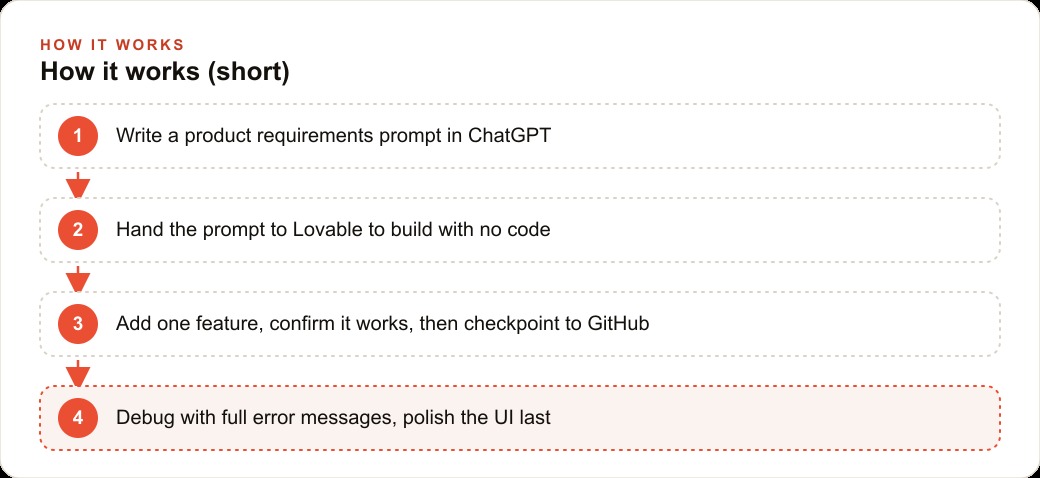
Plan each app with ChatGPT by writing a product requirements prompt, then hand that prompt to Lovable to build it, guided by two frameworks: Tiny Ferrets Carry Dangerous Code for discipline and the rule that you are only ever implementing or debugging.


On a Friday afternoon in early spring, the owner of a landscaping company sat at the kitchen table and did what he did every single Friday: opened the quoting spreadsheet.
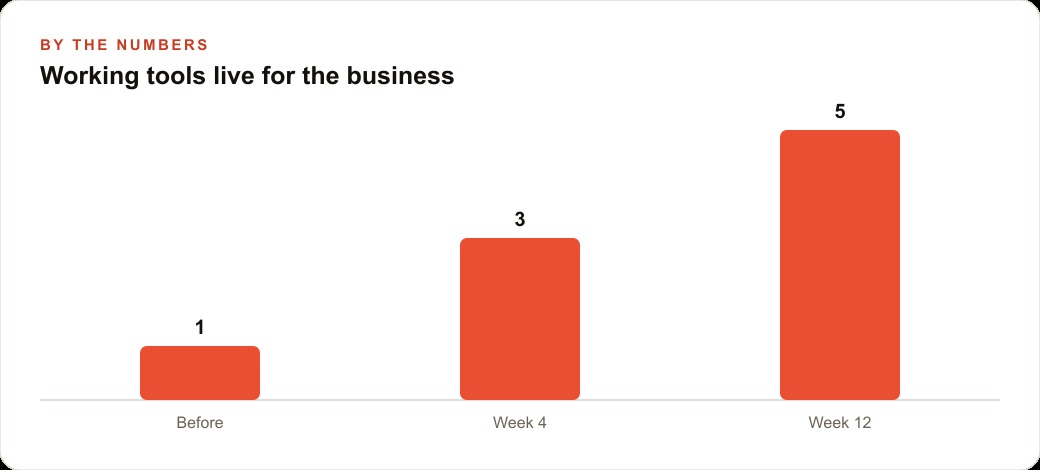
I am Madhuranjan Kumar, and I want to tell you what happened when that owner spent a weekend trying to replace that spreadsheet with something better. Not every step went smoothly. The two frameworks that kept the weekend from collapsing were not obvious at the start. But by Monday morning, five working tools were live, and Friday afternoons were no longer lost to a seventeen-column spreadsheet.
The quoting spreadsheet that ate three hours every Friday
The spreadsheet was not complicated. It had formulas for square footage, labor rates, material costs, and a markup column. The problem was that filling it in for ten quotes took about three hours every Friday, and at least two of those quotes went out with errors because a number had been entered wrong or last week's mulch price had been used instead of the current one. Clients did not always notice. Sometimes they did.
The spreadsheet was seventeen columns wide. Column A was the client name. Columns B through G were property measurements broken into zones. Column H calculated the base labor cost from a formula that referenced a separate table on another sheet. Columns I through M were material line items, each one entered manually from a printed price list taped to the wall. Column N was the subtotal. Column O was the markup. Column P was the final price. Column Q was a dropdown for whether the quote had been sent.
The trouble was that every quote required a different combination of services, and the formula for a lawn-plus-mulch quote broke for a lawn-plus-mulch-plus-irrigation quote because the irrigation calculation lived on a completely different row of the separate table and had to be pulled in manually each time. The owner had tried to fix this twice and made it worse both times. He understood the jobs. He did not understand enough about spreadsheet logic to solve the problem the right way, and hiring a developer for a quoting tool felt like overkill for a business his size.
The three hours every Friday were mostly spent entering numbers, cross-referencing the price list, and double-checking formulas. The owner estimated about forty minutes per quote, which meant ten quotes consumed most of Friday afternoon. Quotes went out by email, typed fresh every time. Each one was different enough, in his view, that starting from scratch seemed faster than adapting a previous one. He was wrong about that, but he did not know it until he had a better system to compare against.
App one: describing the calculator and watching Lovable build it
The owner had heard about tools that let non-developers build apps by describing what they want. He chose Lovable because several people in a landscaping business forum had mentioned it. His plan for the weekend was simple: try to replace the quoting spreadsheet with something that actually worked for his service combinations.
He opened ChatGPT and described the quoting tool the way he would describe it to an employee. He said the tool needed to let him enter a client name, select services from a list, enter the square footage of each zone, and get a final price with a line-item breakdown he could copy into an email or print. He wanted the material prices to be editable in one place so he could update them once and have every new quote use the current number. He wanted the irrigation formula to work differently from the lawn maintenance formula, because irrigation was priced per head and lawn was priced per thousand square feet.
ChatGPT asked him four clarifying questions and then produced a description he had not asked for but recognized immediately as exactly right. It added a confirmation screen so the owner could review the quote before sending it. It suggested a simple database so previous quotes could be pulled up and duplicated for repeat clients. It named the exact frameworks that Lovable worked best with, React for the interface and Tailwind for the styling, and it told the owner to include those names in his prompt to Lovable.
He pasted the prompt. Lovable built the app. The first version was live in about twelve minutes. It was not perfect. The irrigation formula was calculating per zone instead of per head, which the owner caught immediately by running a test quote for a job he had done the previous month. He pasted a screenshot of the wrong output and a clear description of what it should show into Lovable, and the corrected version was live in four more minutes.
By the end of Saturday morning, the quoting app handled every service combination correctly. The owner ran the same ten quotes he would have done on Friday and finished in fifty minutes instead of three hours. The line-item breakdown copied into an email with one click.
The framework that kept the weekend from collapsing
The second app would have derailed the weekend if the owner had not understood two things before starting it.
The first came from a framework with a name he found in the forum: Tiny Ferrets Carry Dangerous Code. Each word stands for something. Thinking means writing out what you want before touching any tool. Frameworks means naming specific technologies, React, Tailwind, known packages, instead of leaving the AI to guess. Checkpoints means connecting the project to version control the moment any part of it works, so a bad change never wipes out good progress. Debugging means sharing the exact error message and a screenshot, not a paraphrase. Context means adding relevant files and examples when the output starts to drift.
The second framework was simpler. At any moment during the build, you are in exactly one of two modes: implementing a feature or debugging an error. When implementing, add one thing at a time and confirm it works before moving on. When debugging, share everything the AI needs to understand the problem. The two modes must not be mixed. Adding a new feature while an old error is still unresolved creates a second problem that is now entangled with the first, and debugging both at once is significantly harder than handling them in sequence.
The owner connected the quoting app to Git before starting the second app. That decision cost him five minutes. It saved him the better part of Sunday afternoon, because the third app broke in a way that would have required starting over if he had not had a working checkpoint to roll back to. When the third app's photo storage integration broke the existing auth system and the whole app stopped working, he rolled back to the Git checkpoint in three minutes instead of losing hours of work.
Apps two through five: where the pattern clicked and the pace picked up
App two was a job-scheduling board. The owner described it the same way he had described the quoting tool: started with ChatGPT to think through what was actually needed, then handed the prompt to Lovable to build. The board needed a calendar view showing which crew was on which job each day, a way to mark jobs complete, and a simple field for the crew leader to leave a note after each job. The first version was live in twenty minutes. The note field was missing from the mobile view. He spotted it, pasted the error description and a screenshot, and it was fixed in six minutes.
The pattern was becoming clear. ChatGPT for planning. Lovable for building. One feature at a time. Checkpoint after each working state. And never mix implementing and debugging.
App three was the photo upload tool so crews could submit before-and-after shots for each job. This is where the checkpoint saved him. The photo storage integration broke the existing auth system. Without the Git checkpoint from after app two, rebuilding from the last working state by memory would have taken hours. With the checkpoint, he rolled back in three minutes, debugged the storage integration in isolation from a clean starting point, and reconnected it once it was working on its own.
App four was an invoice generator. The owner described it to ChatGPT, received a focused prompt, and pasted it into Lovable. A working first version was live in under fifteen minutes. The invoice read from the quoting app's stored quotes, which meant a confirmed quote could become an invoice with one button. That connection between the two apps required a small integration that Lovable handled on the second attempt after the owner shared the relevant error message and a screenshot of the expected behavior.
App five was a materials reorder tracker. The owner described the core problem: he kept running out of mulch or edging stone because he was ordering by memory and getting quantities wrong. The tracker needed a list of materials, a current quantity field, a minimum threshold, and an alert when anything dropped below the minimum. ChatGPT's response included a suggestion the owner had not asked for: connect the tracker to the quoting app so that when a quote was confirmed, the materials used in that quote were automatically subtracted from inventory. That suggestion was not in the original description. It was exactly right, and the owner added it to the prompt before handing it to Lovable. The resulting app tracks both manual adjustments and quote-driven consumption in a single view.
What was live on Monday and what each tool cost in time
By Monday morning, five tools were live and accessible from any device with a browser.
The quoting app replaced the spreadsheet entirely. Material prices were centralized in one editable table. Every service combination calculated correctly. The line-item breakdown copied into an email in one click. The owner estimated the time saved in the first two weeks alone covered the full weekend investment.
The scheduling board replaced the whiteboard in the garage. The crew leader checked it each morning to see the day's assignments. The notes field after each job replaced the phone calls that had previously been the only way to capture what happened on a site. The first month of notes became a record the owner had never had before: which properties took longer than estimated, which crews worked fastest on which job types, and which clients always had something extra to add at the end.
The photo tool ran for two weeks before the owner noticed how much documentation he was accumulating. He used it for the first time to resolve a dispute with a client about whether a certain area had been cleared. The timestamped photo settled it in thirty seconds.
The invoice generator saved approximately two hours every billing cycle. Confirmed quotes became invoices with one button click. The format was consistent and professional across every client. Several clients commented on the improvement from the handwritten invoices they had received the previous year.
The materials tracker caught two near-shortages in the first month. The owner adjusted his ordering schedule based on what the tracker showed across all active quotes, and the team had not run out of a core material in the three months since.
The total time invested was one weekend, roughly sixteen hours spread across Saturday and Sunday. The owner was not a developer. He did not write a line of code. He described what he needed, asked ChatGPT to think through the requirements with him, pasted the resulting prompts into Lovable, reviewed the output against real jobs, and followed the two frameworks consistently throughout. The apps were not perfect on the first try. None of them needed to be. Each one was good enough to use by the time the weekend ended, and all of them are still in daily use without major changes.
For any business managing operations through customer relationship tools or looking to build tools that feed into paid advertising campaigns, the build-weekend pattern works beyond landscaping. The exact same sequence, think it through in ChatGPT, name your frameworks, build in Lovable, checkpoint early, implement and debug in separate modes, applies to any service business with a repetitive workflow that is currently being handled by a spreadsheet that has gotten too complicated to trust.
That is exactly what we do at AI DOERS. Book a private 30-minute call with Madhuranjan Kumar and we will map the fastest path to it for your specific business.
Book your call →
Madhuranjan Kumar
Madhuranjan Kumar brings 20 years of performance-marketing experience and has managed over $200 million in Facebook ad spend for brands across the United States and beyond. His expertise spans the full modern marketing stack: Meta, Google Ads, TikTok, email automation, CRM, and the websites that hold it together. At AI DOERS he turns that track record into lead-generation systems for businesses across every industry.