
How to Build and Sell AI Agent Workforces as a Beginner
An AI workforce is a team of specialized no-code agents working together under a manager agent. Here is how the pieces fit, how a real one runs end to end, and how to turn the skill into paid client work.

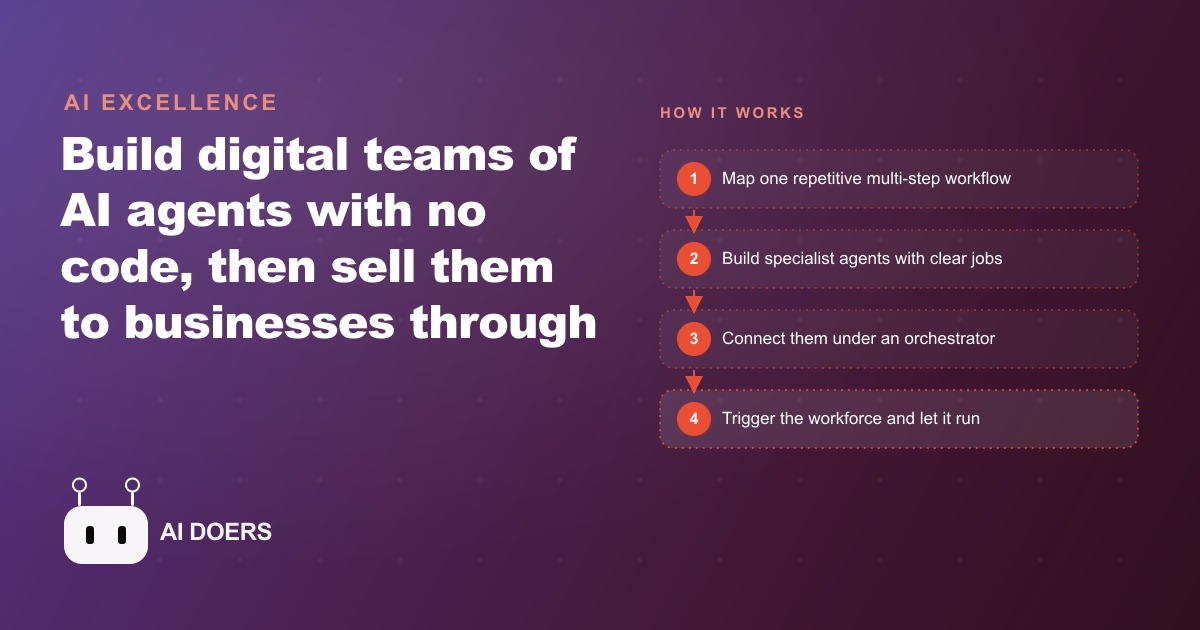
A single AI assistant is useful. A team of them, each with one job, handing work to each other under a manager, is a business you can sell. I am Madhuranjan Kumar, and that shift from one clever chatbot to a coordinated AI workforce is the opportunity most owners have not noticed yet, while a handful of builders are quietly getting paid thousands to set them up. Below are eight things you need to understand to build one and turn it into paid work, each one a piece of the whole picture rather than a vague idea.
1. It is a team, not an assistant
An AI workforce is a group of agents, each with its own specialty, working together like a department inside a company. Instead of one general assistant trying to do everything and losing the thread, you get several focused agents that each own a narrow job and pass work between each other. The team runs day and night, never tires, never quits, and never asks for a paycheck. Once you start looking for the work it is designed to absorb, you see it everywhere: answering the same questions, organizing records, updating schedules, researching leads, writing reports. Any repetitive, multi-step process is a target, which is exactly why the demand is so broad.
2. Three pillars hold every workforce together
Every functioning workforce rests on specialization, collaboration, and coordination. Specialization means each agent has one clear job and gets good at it, rather than one model straining to be a generalist. Collaboration means the agents pass tasks and information between each other instead of working in isolation. Coordination means a manager agent keeps the whole thing predictable, breaking a big request into parts and routing each to the right specialist. Miss any one of the three and the system wobbles. A team of specialists with no coordinator is chaos. A coordinator with no real specialists underneath it is a bottleneck. You need all three working at once.
3. Each agent is a digital employee with four parts
The reason this works is that every agent is modeled on a real employee, and it has the same four things a real hire needs. It has a prompt that acts as its job description, telling it what it is responsible for. It has resources to work on, like a transcript, a record, or a document. It has tools that let it actually act, a scheduler, a scraper, a document generator. And it has a knowledge base plus memory, so it knows the relevant facts and remembers what it already did earlier in the job. Give an agent all four and it behaves like a competent specialist you can hand a task to and trust. Skimp on the tools or the memory and you get an eager worker with no hands or no recall, which is where most first attempts quietly fall apart.
4. The orchestrator runs the org chart
The manager agent, the orchestrator, is what turns a pile of specialists into a workforce. It interprets the incoming request, breaks it into parts, and delegates each part to the right specialist sub-agent, exactly like a project manager assigning work. Then it waits for the results to come back and assembles them into a finished output. This is the piece that keeps everything predictable, because instead of several agents all firing at once and stepping on each other, there is a single point of control deciding what happens in what order. When you design a workforce, the org chart under the orchestrator is where most of your real thinking goes, because clean handoffs are what make the difference between a reliable system and a mess.
5. You build the whole thing with no code
None of this requires programming. The build uses a no-code platform where you invent each agent simply by describing it in plain language, then connect the apps it needs through simple integrations, tools like Slack, a CRM, a meeting scheduler, a presentation generator, and a task board. You spend your time on the logic, deciding what the roles are and how work flows between them, not on plumbing. That is what makes this accessible to someone without a technical background, and it is also what makes it fast enough to be a real service. You can stand up a working team in the time it would have taken to write the spec for a traditional software project.
6. A meeting-booker workforce, running end to end
To see it click, follow one real workforce that books meetings from start to finish. It is triggered by a Slack message. A manager agent interprets the request and delegates. One specialist finds the right internal teammates from a knowledge base. Another researches the external leads in the CRM using public sources like a company website and professional profiles. Another books the meeting itself, handling the back and forth on timing and time zones. Another prepares a presentation for the call. And a final notetaker agent joins the meeting, transcribes it, pulls out the action items, creates task cards on the board, and emails a clean summary with the task link to every participant automatically. One Slack message goes in, and a fully scheduled, prepared, and documented meeting comes out, with no human touching any of the steps in between.
It is worth understanding why splitting the work across a team beats handing one big prompt to a single model. When you ask one model to do everything at once, it tends to skip steps, lose the thread, or get the first part right and forget your constraints by the end. When you split the job into specialists with narrow focus and clean handoffs, quality holds up across a long task, because no single agent is ever holding more than it can manage. You also get visibility. You can watch the handoffs between agents and see exactly where a result came from, which makes the whole thing far easier to trust and to fix when something goes wrong. That auditability is a selling point in its own right when you pitch this to a cautious business owner.
7. A worked example: a roofing company's lead-to-estimate flow
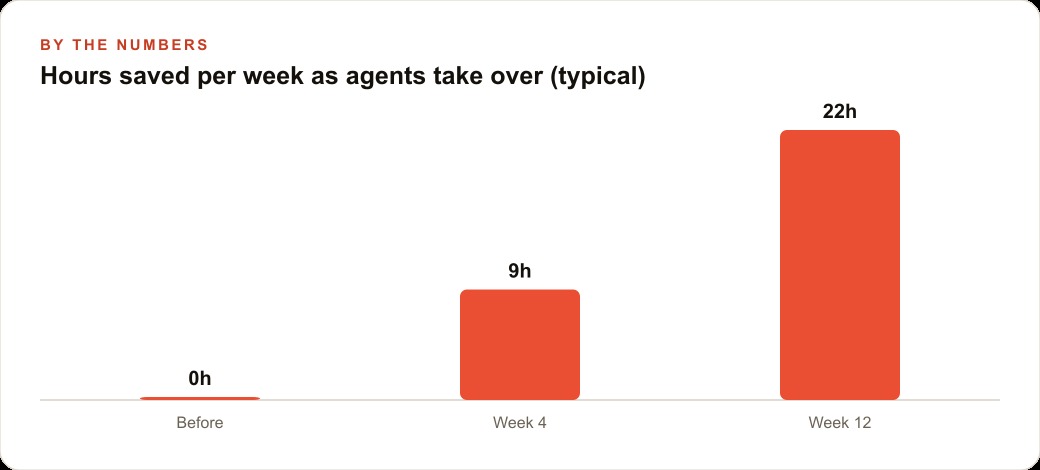
Now put the pattern on a real business with illustrative numbers. Picture a roofing company where the lead-to-estimate workflow eats the office manager's whole day. A homeowner fills out a form or calls about a leak, someone logs it, looks up the address, checks the calendar, books an inspection, sends a confirmation, then chases the crew for notes afterward. Say each lead takes about 25 minutes of that manual relay work, and after a storm the company might get 40 leads in a day, which is well over 16 hours of work landing on one or two people at once. That surge is exactly when jobs get dropped, and the business that responds first wins the job.
Here is the workforce I would build. A trigger fires when a new lead arrives. One agent pulls the property details and tidies the contact record. A second checks the crew calendar and books the inspection slot, handling the timing back and forth. A third sends the homeowner a clear confirmation and a short what-to-expect note. After the inspection, a notetaker agent turns the inspector's voice notes into a structured summary, creates a task card for the estimate, and emails the homeowner a tidy recap. The office manager stops being a relay and starts reviewing output. If that 25 minutes per lead drops toward a few minutes of review, a 40-lead storm day stops being a crisis. The workforce answers, qualifies, and schedules every lead in parallel, which means fewer missed jobs and a calmer office in the busiest weeks of the year. The leads themselves flow in through Facebook and Instagram ad campaigns and land in the CRM and website stack, so the workforce is really the engine that finally lets the company keep up with the demand its marketing already creates.
The signal to look for when hunting for a workflow to sell into is simple: find a process where information gets copied from one place to another, decisions follow a predictable rule, and a human is mostly acting as a relay between apps. Sales teams that research and schedule fit it. Service firms that handle intake and booking fit it. Operations teams shuffling information between systems fit it. Almost every business has at least one of these relay jobs, usually owned by an overworked person who would be thrilled to hand it off. Your value as the builder is being the one who spots that relay, maps it, and replaces it with agents, and that is a skill worth far more than the cost of the tools involved.
8. The paid audit that opens every engagement
Here is the piece that turns the skill into income, and it is the part most builders skip. Do not lead with a quote for a build. Lead with a paid audit. You map the business's manual workflows, identify where agents would deliver real return, and deliver that analysis as a road map. Companies pay for that clarity before any building happens, and it positions you as an adviser rather than a vendor pitching software. The audit is both a product in its own right and the natural on-ramp to the larger build, because once an owner sees their own bottlenecks laid out with a return attached, the build sells itself.
9. Diagnose, design, deliver, scale is the pricing ladder
The money follows a four-step model: diagnose, design, deliver, scale. The audit is the diagnosis. From there the numbers climb with the scope of what you replace. A single chatbot is worth a few thousand dollars. A full workforce that takes over an entire role justifies a much larger project plus an ongoing retainer to maintain and improve it. This ladder is why the workforce approach pays so much better than one-off automations. You are not selling a widget, you are selling the removal of a whole recurring cost, and you stay attached as the system grows. That freed-up capacity also lets your clients grow, which strengthens the case for their Google Ads and their SEO and organic search spend, since the constraint moves from operations to demand.
10. Warm outreach first, then a disciplined cold test
Landing clients follows a specific order that works. Start warm. Message your existing network asking for referrals, not a sale, and offer a couple of free assessments to build early case studies. Warm introductions convert fastest because the trust is already there. Once you have a case study or two, run a disciplined cold test: pick four niches, send roughly 500 emails to each, and watch which niche actually responds. Then pour your energy into the one that answers instead of spreading thin across all four. This turns outreach from a guessing game into a measured experiment, and it means that within a few weeks you know exactly which market wants what you build.
One caution before you scale. Keep every agent's prompt tightly scoped, because an agent given an open-ended job will wander the same way a person with no clear brief does. The discipline that makes a workforce reliable is the same discipline that makes a good team reliable: narrow roles, clear handoffs, and a human checking the final output before it leaves the building. Build two or three agents that work perfectly before you attempt an elaborate org chart, and you will save yourself the frustration that stops most beginners after their first sprawling attempt collapses under its own complexity.
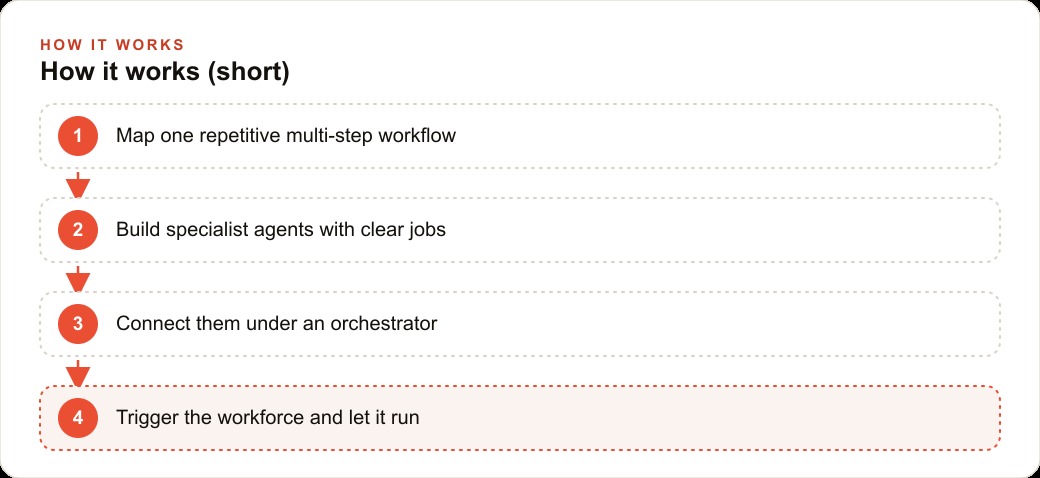
Put those ten pieces together and you have both halves of the opportunity: how to build a coordinated AI workforce and how to get paid to build them for others. Start small, with one repetitive multi-step workflow and a single agent for the simplest piece, so you genuinely understand prompts, tools, and variables before you scale to a full team. A beginner really can build a first workforce this way. If you would rather have someone map your own repetitive workflow and stand up that first working team without the trial and error, that is exactly the kind of thing worth a short conversation before you commit weeks to it.
That is exactly what we do at AI DOERS. Book a private 30-minute call with Madhuranjan Kumar and we will map the fastest path to it for your specific business.
Book your call →
Madhuranjan Kumar
Madhuranjan Kumar brings 20 years of performance-marketing experience and has managed over $200 million in Facebook ad spend for brands across the United States and beyond. His expertise spans the full modern marketing stack: Meta, Google Ads, TikTok, email automation, CRM, and the websites that hold it together. At AI DOERS he turns that track record into lead-generation systems for businesses across every industry.