
How to Build an AI Voice Agent With No Code in Minutes
A voice agent is a brain, memory, and tools with a speech layer around it. Here is how I would build an AI receptionist that answers calls, books appointments, and hands off to a human, with no code.

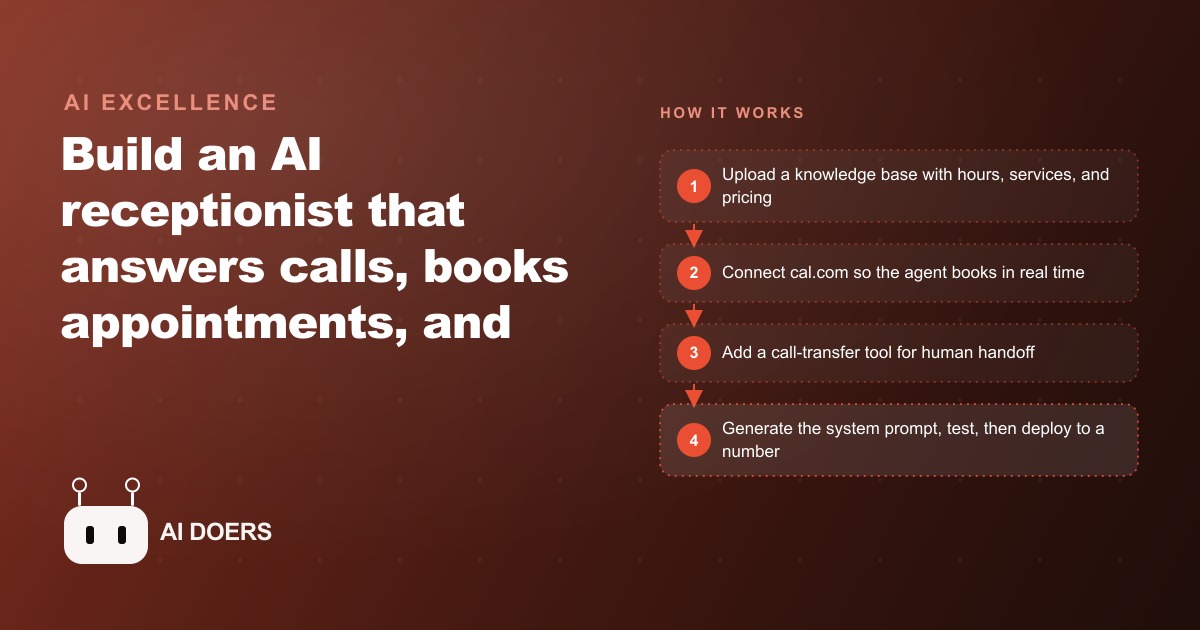
You can now build an AI receptionist that answers the phone, qualifies the caller, and books an appointment in about eighteen minutes, with no code. That is the news, and it is bigger than it sounds, because the wall that used to sit between a small business and a working phone agent just fell over. What once required a developer and a real budget is now a browser panel, a knowledge document, and a calendar connection. I am Madhuranjan Kumar, and I want to walk through what actually changed, why it matters for owners who live and die by their phone, and the concrete move to make while this is still early.
What just became possible, in plain terms
Strip away the jargon and every AI agent comes down to three parts: a brain, a memory, and tools. The brain is the model that reasons, like ChatGPT or Claude. The memory holds the conversation so each turn is not starting from scratch. The tools are the actions it can take, such as checking a calendar or transferring a call. A voice agent is that same stack with a speech layer wrapped around it. The caller's voice gets transcribed to text, the brain processes it, and the reply is converted back into natural speech the caller hears.
The reason this is newsworthy now is that all three parts, plus the speech layer, have been packaged into no-code platforms you can operate in an afternoon. Complete beginners are charging five to twenty-five thousand dollars to set these up for businesses, which tells you the market has decided this is real. The technology did not just get better, it got assemblable by non-developers, and that is the shift that opens the door for ordinary owners rather than only agencies.
Why voice, and why the timing is not an accident
Speech is the fastest way humans communicate with technology, faster than typing, faster than tapping through a menu. Hundreds of millions of phone calls happen every single day, and a large share of them go to businesses that miss them. That combination, enormous call volume and a medium people already prefer, is why this industry is only now taking off. The demand was always there. What was missing was an affordable way to answer every call without hiring a full desk of receptionists.
That is what changed. The agent never takes lunch, never goes home at five, and never puts a caller on hold to grab a pen. For a business running ads, the timing matters even more, because the speed-to-lead use case is the quiet money maker. The agent calls a fresh lead back within seconds, and reaching someone inside five minutes sharply raises your odds of closing them. Leads generated by Facebook and Instagram ad campaigns or Google Ads lose value by the minute, so an agent that responds in seconds instead of hours changes the economics of the whole ad spend.
How the build actually comes together
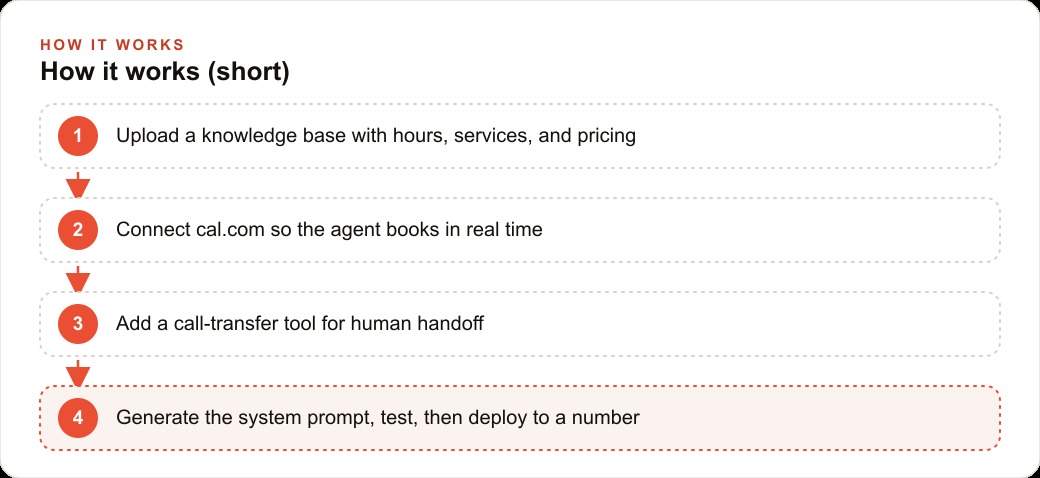
The reason this now takes minutes is that each piece snaps into place. You start with a knowledge base, which is just one document holding the business location, hours, services, and pricing. The agent answers frequently asked questions straight from that file with no extra logic to build. Next you give it the ability to book. You sign in to cal.com with a Google account so the calendar syncs automatically, create an event type for the appointment, and paste the cal.com API key plus the event ID from the event URL into the platform. That single step wires up both the check-availability and the book-appointment tools.
After that you add a call-transfer tool so the agent can route a difficult or sensitive call to a real person, using your own number while testing and the business line in production. The last piece is the system prompt, which tells the agent who it is, how to use the knowledge base, when to reach for each tool, and what guardrails to respect. Writing that by hand takes forever, so a prompt-writer tool stitches the personality, knowledge use, tools, and guardrails into a clean prompt in seconds. Then you pick a fast, cheap model like Gemini 2.5 Flash Lite, choose a lifelike voice, and test the entire flow in the browser before you ever pay for a phone number. Only then do you buy a number on a paid plan and publish it live.
Who this changes things for right now
Almost any business that lives on its phone is affected by this shift, and the four most common paid builds map to four very different needs. There is an inbound receptionist that answers and books, a lead-qualifier that calls new leads back instantly, a support line that handles common questions at scale, and a reminder bot that cuts no-shows. A dental office can stop sending callers to voicemail at lunch. A plumber on a job can let the agent book the next visit without climbing down a ladder. A law firm can screen and route new matters before a human ever touches them.
What ties these together is that the phone was always a leaky bucket, and nobody could afford to plug every hole. Every missed call at lunch, every after-hours ring, every lead that waited two hours for a callback was lost revenue that felt normal because there was no alternative. The news here is that the alternative is now cheap and buildable by the owner, which means the businesses that move first quietly capture the calls their competitors are still dropping.
Worked example: a restaurant stops bleeding reservations at the dinner rush
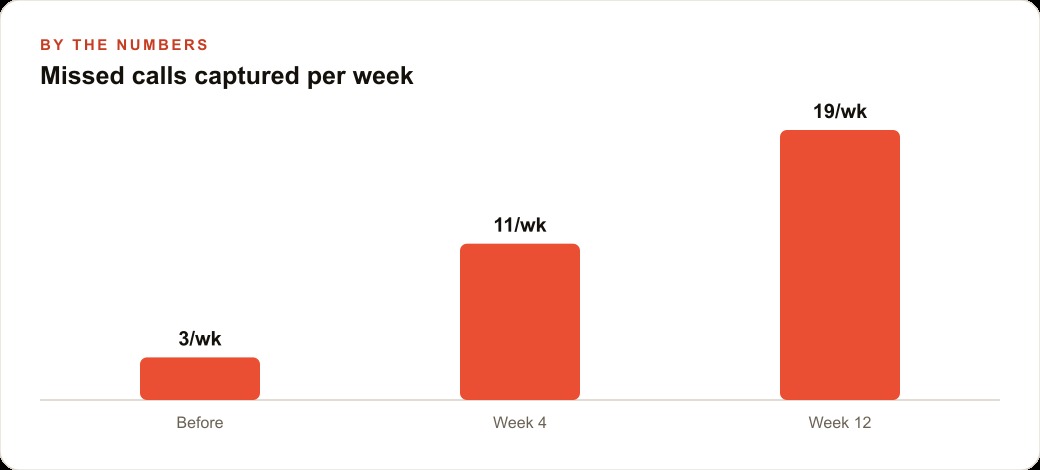
Here is the news landing on a real business, with illustrative numbers to show the shape. Madhuranjan Kumar stand is slammed during the dinner rush, and that is precisely when reservation calls go unanswered and turn into lost covers. Say the restaurant currently captures only about 3 missed-call reservations a week that it manages to call back, and loses the rest to voicemail.
First I would build the knowledge base: the hours, the address, the menu highlights, the corkage and large-party policies, parking notes, and which nights need a deposit. The agent answers all of those questions instantly, in a warm voice, even when every staffer is carrying plates. Next I would connect the booking calendar so the agent checks real-time table availability, takes the party size and time, and confirms the reservation on the spot, exactly the way cal.com handles an appointment. Then I would add the call-transfer tool for the cases a script should never handle, like a guest with a serious allergy question or someone arranging a private event, so those ring straight through to the manager.
The speed-to-lead angle still applies: if the restaurant runs a promotion and a diner fills out a form, the agent calls back in seconds to lock in the table while interest is hot, and those bookings flow into the CRM and website stack so the follow-up and reminders run themselves. On the numbers, captured missed-call reservations climb from around 3 a week to roughly 11 by week four and near 19 by week twelve, simply because not one call slips to voicemail during the busiest two hours of the night. The kitchen and floor keep running exactly as they do now. The restaurant just stops bleeding revenue at the moment it can least afford to.
The objections worth taking seriously, and the honest answers
Whenever I show an owner how fast this now goes, three fair objections come up, and they deserve straight answers rather than hype. The first is that customers hate talking to a robot. That was true of the old phone trees with their rigid menus and their endless press-one-for-billing loops. A modern voice agent is a different thing entirely, because it is a reasoning model with a lifelike voice that holds an actual conversation, answers from your real knowledge base, and hands off to a human the moment a call gets complex or sensitive. The goal is not to trap a caller in a machine. It is to answer the calls you are currently sending to voicemail, which from the caller's side is strictly better than a ring that goes nowhere.
The second objection is that a bot will say something wrong and embarrass the business. This is exactly what the guardrails in the system prompt and the call-transfer tool are for. You tell the agent plainly what it may and may not do, you give it a clean knowledge base so it quotes real facts, and you route anything outside its lane straight to a person. The discipline is to test the whole flow in the browser panel until it quotes your details and books cleanly before you ever publish a number, so you are shipping something you have already watched work, not hoping for the best.
The third objection is cost and complexity, and here the news is genuinely reassuring. The build is a knowledge document, a calendar connection, a transfer tool, and a generated prompt, all assembled in a no-code panel and tested for free before you pay for a number. Complete beginners are charging five to twenty-five thousand dollars to set these up for other businesses, which tells you the value is real, but the underlying pieces are cheap and the risk is contained because you validate everything in the browser first. You are not betting a budget on a black box. You are testing a flow, then flipping it live only once it works.
Taken together, the answers point the same direction. The failure modes people worry about are the ones the setup is specifically designed to prevent, which is why the honest move is to build one small agent, test it hard, and judge it on what it actually does rather than on what old phone systems used to do.
The concrete move to make while this is early
Pick one use case and build only that first, which for most owners is the inbound receptionist. Spend twenty minutes writing your knowledge-base document in plain language, because that single file answers the bulk of incoming calls on its own. Sign in to cal.com with Google so the calendar syncs without manual fuss, create your event type, and paste the API key and event ID into the platform. Use the prompt-writer tool instead of crafting the system prompt by hand, pick a fast model and a voice you like, and test the whole flow in the browser panel until it quotes details and books cleanly. Only then do you buy a phone number and publish it. None of this requires writing code, which is exactly why the window to move first is open right now.
The reason I keep steering owners toward this particular corner of AI is that it pays for itself faster than almost anything else you can build. A single captured reservation or booked service call can be worth more than the monthly cost of the whole setup, and the agent captures those calls around the clock, at lunch, after hours, and during the exact rush when your team cannot get to the phone. Every business already has this leak. The calls are already coming in and already going to voicemail. You are not creating new demand, you are catching the demand you are currently dropping, which is why the math works so quickly and why the owners who move first tend to be quietly delighted a month later.
You can absolutely stand this up yourself in an afternoon, and I would encourage any owner to try the browser test before paying for anything. If you would rather have someone map your specific call flow, load your real menu or service details, wire the booking and handoff correctly, and hand you a number that works on the first ring, that is the kind of build I do for clients, and you can bring me in to handle it.
That is exactly what we do at AI DOERS. Book a private 30-minute call with Madhuranjan Kumar and we will map the fastest path to it for your specific business.
Book your call →
Madhuranjan Kumar
Madhuranjan Kumar brings 20 years of performance-marketing experience and has managed over $200 million in Facebook ad spend for brands across the United States and beyond. His expertise spans the full modern marketing stack: Meta, Google Ads, TikTok, email automation, CRM, and the websites that hold it together. At AI DOERS he turns that track record into lead-generation systems for businesses across every industry.