
How to Build a Self-Learning Llama 3.1 Agent That Lives in Slack
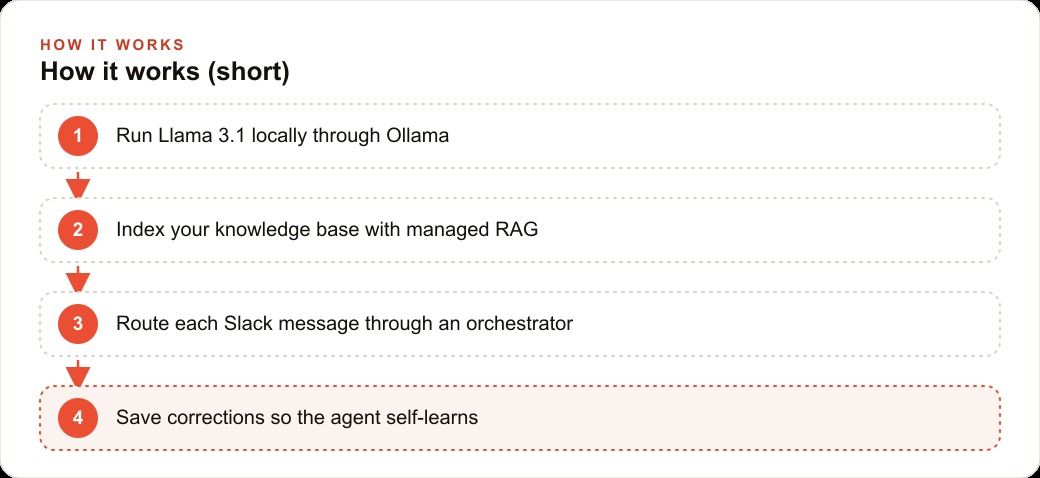
Run Llama 3.1 locally, connect a managed RAG pipeline over your knowledge base, and wire it into Slack with an orchestrator and a learning agent so the bot answers from private data and remembers your corrections.

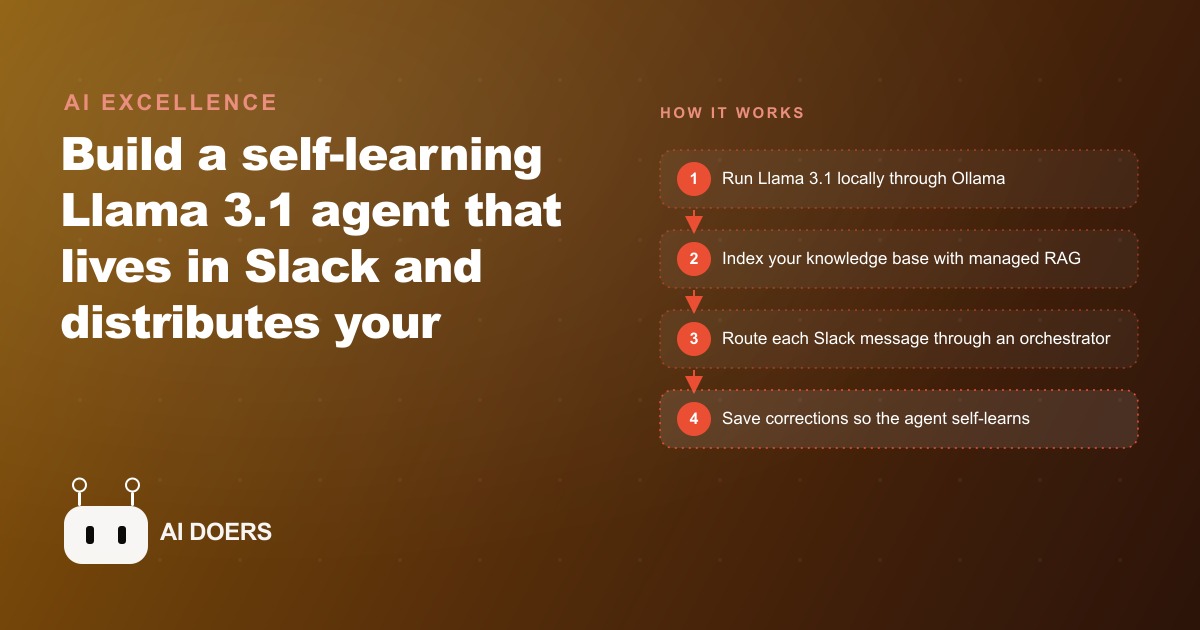
Most AI agents look impressive in a demo and plateau quickly once a real team starts depending on them daily. The common failure mode is not the model itself. It is the architecture around the model: how it receives questions, how it retrieves relevant context, and whether it actually gets smarter when the team tells it something it got wrong. I am Madhuranjan Kumar, and the Llama 3.1 self-learning agent in Slack addresses all three of those problems explicitly. What follows is not a step-by-step build tutorial. It is an explanation of why the system is designed the way it is and what each architectural choice is actually solving.
Why Llama 3.1 represents a different positioning than previous open model releases
Previous open model releases were positioned primarily as research artifacts and developer benchmarks. Llama 3.1 was different because Meta explicitly framed it as a foundation for building agents, not just a model to run completions through. That positioning shaped what the release included: strong function-calling support, a capable tool use schema, and benchmark results specifically targeting agent-relevant tasks like multi-turn reasoning and structured output. The message was not "here is a good model." It was "here is a platform for building private, capable AI systems without routing data through an external API."
For any business where data privacy is non-negotiable, that positioning matters. Running capable AI locally means customer data, internal documents, and proprietary processes never leave the organization's infrastructure. The model runs on your hardware, the retrieval runs on your hardware, and the Slack integration is the only external surface. That privacy characteristic is not a minor feature. For legal, medical, financial, and professional services contexts, it is often the deciding factor between deploying an AI agent and not, and Llama 3.1 is the first open model that makes the decision practically straightforward.
Tool calling versus ReAct prompting: the architecture that decides production reliability
ReAct prompting is a pattern where a model loops through three stages: think about what to do, take an action, observe the result, and repeat. The model generates free text at each stage, including the action description, and the system parses that text to figure out what to execute. This works but it is brittle. Free text parsing is error-prone, the loop is sequential and slow, and the quality of the reasoning at each step depends on the model generating well-structured text in a very specific format.
Tool calling is a different architecture. Instead of asking the model to describe what it wants to do in free text, you define a set of functions with explicit schemas and ask the model to predict which function to call and what arguments to pass, as clean JSON. The model does not have to narrate the action. It selects and parameterizes it. This is more reliable for two reasons. First, JSON prediction is a structured output task that models are explicitly trained for, which means fewer formatting failures. Second, the model can predict multiple tool calls at once rather than being forced to loop one step at a time, which means a complex task can be dispatched in one turn rather than across many.
For a business using an agent internally, the difference is visible in daily use. A ReAct agent that fails to produce well-structured text in its action step misses the tool call and gives a confused response. A tool-calling agent that gets the schema wrong fails in a more predictable and debuggable way, and the schema itself is a constraint that keeps the model on track. The reliability improvement is meaningful for production use, not just an academic distinction. Teams that depend on the agent for real work need it to behave consistently across hundreds of queries per week, and tool calling provides that consistency in a way that text-parsing loops do not.
Why zero-shot benchmarks systematically understate what a multi-turn agent actually needs
Most public benchmarks for agent capability test a model with a single question, one tool available, and no prior context. The model is evaluated on whether it correctly calls the tool on the first try. This is zero-shot tool use, and it measures a real capability: can the model recognize that a given question needs a function call and produce the right schema? But it does not measure most of what a real agent does.
A real agent in production handles questions across a full conversation. A user asks something, the agent retrieves context and answers, the user follows up with a clarifying question, the agent must hold the context of the first exchange while answering the second, and the user corrects something, which the agent must incorporate into subsequent answers. That is a multi-turn task requiring planning, context maintenance, and correction handling, none of which appear in a zero-shot benchmark.
The implication for anyone evaluating which Llama model size to use is that zero-shot benchmark scores are not a reliable guide to production performance. A model that scores well on zero-shot tool use may still fail badly on multi-turn tasks that require holding context and adapting across several exchanges. The only reliable evaluation is testing the specific task your agent will actually perform, in the number of turns it will actually take, on the kind of knowledge it will actually retrieve. Zero-shot scores are a rough filter, not a deployment decision. This distinction is one that most blog posts and comparison articles skip, which is why teams deploy the smaller model, find it unreliable in practice, and conclude that local AI agents do not work, when the actual conclusion is that they benchmarked the wrong capability.
Model size as the practical ceiling on multi-turn reasoning reliability
Size in language models correlates with the ability to handle complexity across multiple steps. For a self-learning agent that needs to classify messages, retrieve context, generate answers, and handle corrections across a Slack conversation, the differences between model sizes are real and visible.
The 8B model reliably handles simple zero-shot tool calls. Ask it to call a specific function with a clean input, and it usually gets it right. Ask it to carry context across three turns of a conversation while also making a tool call on the third turn, and reliability drops noticeably. The 70B model handles the combined task significantly better. The 405B handles it more reliably still and degrades more gracefully on edge cases.
For a production deployment where real team members depend on the agent daily, using an undersized model has a visible and immediate cost: wrong answers, incomplete tool calls, and context failures that erode trust in the system. Once a team loses confidence in the agent, adoption drops and the system stops being used regardless of how well it is architected. Model size is not the only variable, but it is the most direct lever on whether the agent is reliable enough for daily reliance. The hardware investment to run the 70B model is more significant than running the 8B, but for an organization where the agent saves each of fifteen team members twenty minutes per day, the hardware pays back within weeks of real use. The math is more favorable than it initially appears.
RAG versus fine-tuning for private knowledge that changes regularly
Fine-tuning is a process of updating a model's weights with new training data so the model internalizes new knowledge. It is powerful in principle but has a fundamental limitation for private business knowledge: it freezes the knowledge at training time. If your team's procedures change in March and you fine-tuned the model in January, the model answers from the January version until you fine-tune again. For knowledge that evolves continuously, including internal policies, client preferences, approved templates, and competitor information, fine-tuning creates a model that is always slightly out of date.
RAG avoids this by keeping the knowledge external and indexed, then retrieving the relevant pieces at query time rather than baking them into the model's weights. When the knowledge changes, you update the index and the next query retrieves the updated version automatically. No retraining required. For business knowledge that changes every week or even every day, RAG is not just simpler to implement. It is structurally the right choice because it stays current without a retraining cycle.
The managed RAG path takes this further by automating the re-indexing step. When a new document is added to a team knowledge base, the platform detects the change, processes the new document, and updates the vector index automatically. The knowledge base stays current with the actual state of the team's documents without anyone scheduling or running a manual sync. For a team whose internal knowledge is living, this operational advantage is significant. The alternative, a fine-tuned model that requires a re-run every time knowledge changes, creates a maintenance burden that quickly becomes the bottleneck in keeping the system useful.
The orchestrator layer that separates a demo-quality agent from a production deployment
Every Slack message that reaches the agent is not a knowledge retrieval task. Some are greetings. Some are acknowledgments. Some are quick confirmations. If every message triggers a full retrieval cycle over the knowledge base, two things happen: the agent responds slowly to simple messages, and the system burns compute on queries that have nothing to retrieve. Both outcomes degrade the experience for the team using it.
The orchestrator agent solves this by classifying incoming messages before routing them. A simple greeting gets a direct response. A real question about policy, process, or domain knowledge triggers the retrieval agent. The orchestrator is a thin layer, but it is what makes the system feel responsive rather than sluggish and what keeps the compute cost proportional to the actual work being done.
Getting the classification right matters more than it seems. An orchestrator that misclassifies a real question as a simple message gives no answer. An orchestrator that misclassifies a simple message as a complex query gives a slow and over-engineered answer to "thanks." In both cases the agent feels broken. Calibrating the classification boundary on a sample of real messages from the team before deploying is worth the time. The goal is an orchestrator that the team never thinks about because it always routes correctly. That invisibility is the sign of infrastructure working as intended. The orchestrator is also where most of the latency savings come from: routing simple messages around retrieval keeps response times fast across the board, which is what makes the agent feel like a colleague rather than a system.
The self-learning loop and why corrections need to persist automatically to have any value
A standard RAG system answers questions but does not update when you correct it. If a team member tells the agent that its answer was wrong and provides the correct information, a standard system acknowledges the correction in the chat and then forgets it. The next time someone asks the same question, the agent gives the same wrong answer. This is not a trivial failure. It means the team has to correct the same mistake repeatedly, which erodes trust faster than getting the answer wrong once.
The self-learning loop closes this by wiring the correction directly into the knowledge base. When someone corrects the agent, the learning component saves the correction to the underlying knowledge store and triggers a re-index. The next query retrieves the updated version. The correction does not have to be staged, reviewed, and manually applied. It flows back in from the Slack thread where the correction happened.
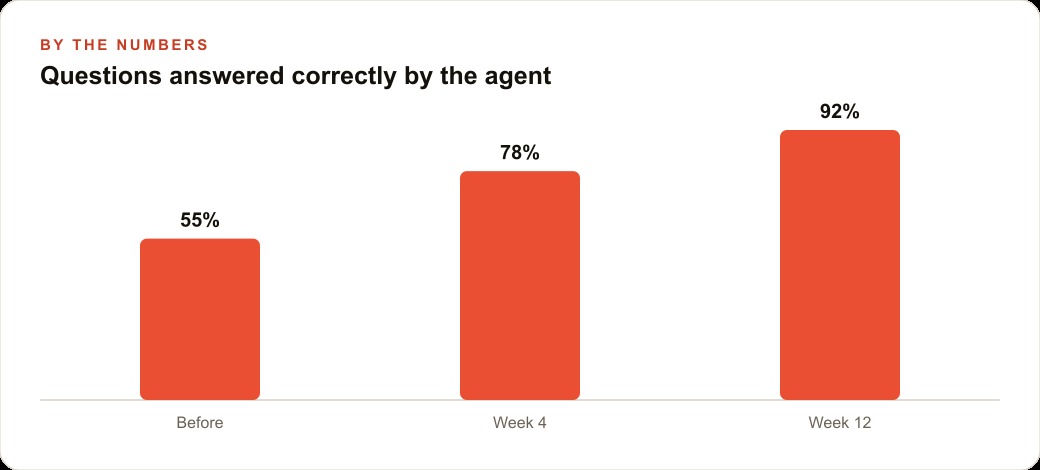
The effect over time is meaningful. A knowledge base that starts at 55 percent accuracy on team questions and receives corrections consistently can reach 78 percent by week four and over 90 percent by week twelve, based on the pattern of improvement that comes from closing the correction loop rather than relying on occasional manual updates. That trajectory is the difference between a system that gradually becomes more useful and one that stays mediocre. Each correction also updates the index for every future query on related topics, not just the exact question that triggered the correction. A single good correction propagates its value across a much larger set of future queries than the one that prompted it.
Why Slack is the right interface for internal knowledge distribution
The most capable agent in the world gets used only if it lives inside the tool the team already uses all day. Building a separate portal or chat interface for an internal knowledge agent means adding one more thing for the team to learn and one more context switch to make. Slack eliminates both problems because the team is already there. The agent is just another channel member.
The adoption implication is significant. Usage of internal tools drops sharply if using the tool requires a deliberate context switch. An agent that the team can query with a Slack mention in the same thread where the question came up is used far more than one that requires opening a browser tab and navigating to a separate interface. Higher usage means more questions answered, more corrections fed back, and a faster improvement curve on the self-learning loop. The interface choice is not a cosmetic decision. It determines how fast the system gets better.
There is also a social benefit to Slack that amplifies the value. When one team member asks the agent a question in a channel and the agent answers, the answer is visible to everyone in the channel. The same question that used to go to a senior person's direct message, interrupting their work and hiding the answer from everyone else, becomes a shared resource. The knowledge distributes to the whole team in the same interaction. Over time this changes the information flow inside the organization in ways that are hard to replicate with a private assistant architecture. The agent does not just answer questions. It makes answers visible to the people who did not know to ask them.
That is exactly what we do at AI DOERS. Book a private 30-minute call with Madhuranjan Kumar and we will map the fastest path to it for your specific business.
Book your call →
Madhuranjan Kumar
Madhuranjan Kumar brings 20 years of performance-marketing experience and has managed over $200 million in Facebook ad spend for brands across the United States and beyond. His expertise spans the full modern marketing stack: Meta, Google Ads, TikTok, email automation, CRM, and the websites that hold it together. At AI DOERS he turns that track record into lead-generation systems for businesses across every industry.