
How To Actually Learn To Code In 2026
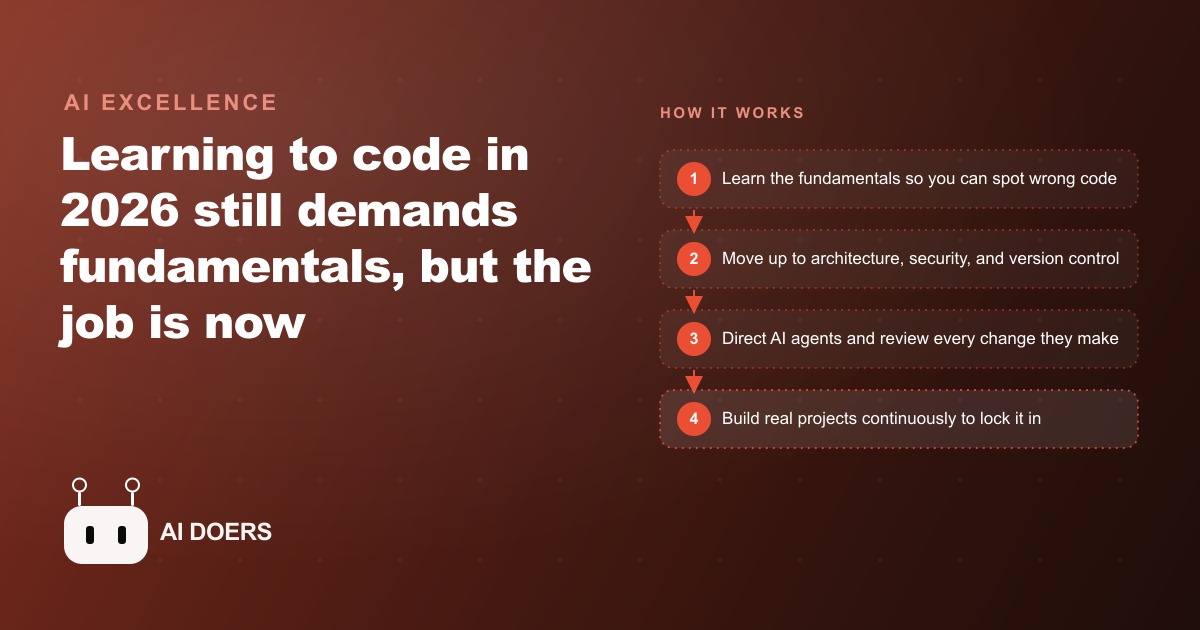
You still learn the fundamentals first, then move up to architecture, security, and version control, because the real 2026 skill is agentic engineering: orchestrating AI coding agents well enough to catch and correct their mistakes.

The most consequential rename in software this year was not a product. It was Andrej Karpathy quietly retiring his own phrase. In early 2025 he coined vibe coding, the idea that you fully give in to the vibes and forget the code even exists. A year later he renamed his serious workflow agentic engineering, because real work turned out to be nothing like blind trust. That shift, from vibe coding to agentic engineering, is the whole story of what learning to code means in 2026, and it changes the advice I give more than any new framework or model release. I am Madhuranjan Kumar, and here is how I read the news for anyone deciding whether it is still worth learning to code.
What changed: the job became orchestration, not typing
Agentic engineering is orchestrating multiple AI coding agents while you direct them like a manager. From the outside it looks like you are just speaking plain English to the agents, which is why so many people concluded that syntax is dead and the skill no longer matters. That conclusion is exactly backwards, and the rename is the tell. Karpathy did not rename it because the work got easier. He renamed it because the serious version demands an experienced engineer, someone who can look at a screen full of AI-written code, sense that something is off, and steer the machine back on course. To correct an AI and tell it that it is wrong, you have to actually know what right looks like.
Think of it like running a kitchen. You do not have to chop every onion yourself, but if you cannot taste the sauce and tell the cook what is missing, the food goes out wrong every night. The manager who cannot taste is not a manager, just a bottleneck who approves everything. That is why the news here is not that coding died. It is that the value moved up a level, from producing lines to judging them, and judgment still requires the fundamentals underneath it.
Why the fundamentals matter more, not less
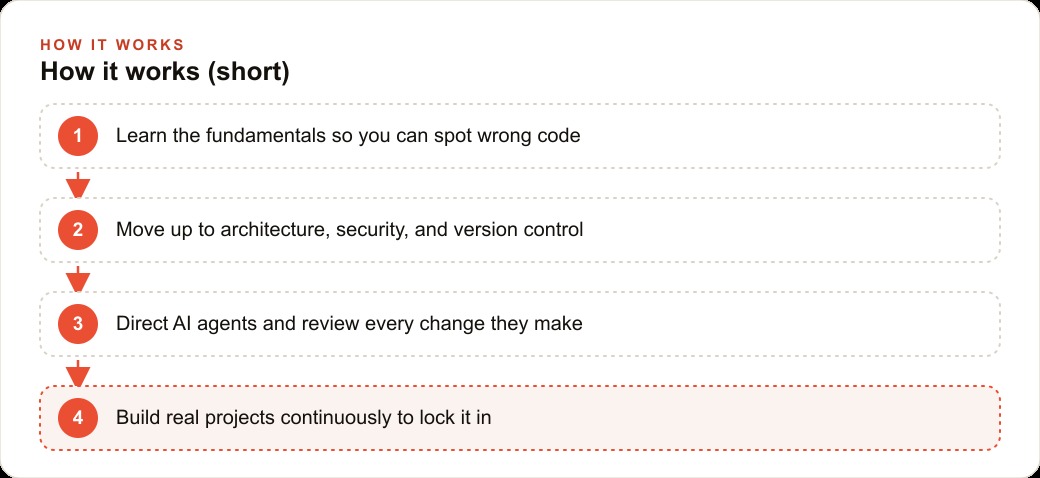
The reflex is to assume that if the AI writes the code, you can skip learning the basics. The reality that agentic engineering exposes is the opposite. You still learn in a rough order from the ground up: variables, types, if statements, loops, object-oriented programming, and APIs. Python is a strong default for AI and data work, JavaScript if you lean toward web apps. These are non-negotiable, because without them you cannot even read what the agent produced, let alone catch the moment it went wrong. The fundamentals are what let you read the code. The higher-level skills are what let you direct it.
Above the basics sit the parts that matter most precisely because an agent is writing the code for you. Software architecture, how a project is structured, the tech stack you choose, system design, data flow, databases, testing, and deployment, is now where the human spends most of their attention. You are directing the agent on the shape of the thing, not the syntax of each line. And three specific disciplines have become load-bearing in a way they never were when a human typed every character, which is the real news for anyone learning today.
The three skills the AI era made non-negotiable
Version control moved from good hygiene to survival. Git and GitHub let you track every change an agent makes and revert mistakes without losing your codebase, and plenty of early vibe coders learned this the hard way, watching an agent quietly delete days of work with no way back. When a machine is making changes faster than you can read them, a clean commit history is your only undo button, and it is the difference between a bad agent edit being a one-commit rollback or a lost weekend.
Security became the defining blind spot. Security and privacy are usually where AI coding agents fail, because they will happily leave a database open or a key exposed unless you explicitly tell them not to. The old saying that paranoia makes a good engineer has never been more literally true. You cannot hope the agent handled it. You have to be explicit, and you have to know enough to check.
Containerization turned into a basic safety measure. Microservices and containerization isolate an agent in its own environment, so a runaway agent stays trapped in its own little box instead of wrecking your machine. If it goes haywire, you shut that one environment off and lose nothing else. None of these three were front-page skills when humans wrote all the code slowly and deliberately. In an agentic workflow, where the machine moves fast and does not think about consequences, they are the guardrails that make the speed safe.
The timeline collapsed, and that is the real headline for owners
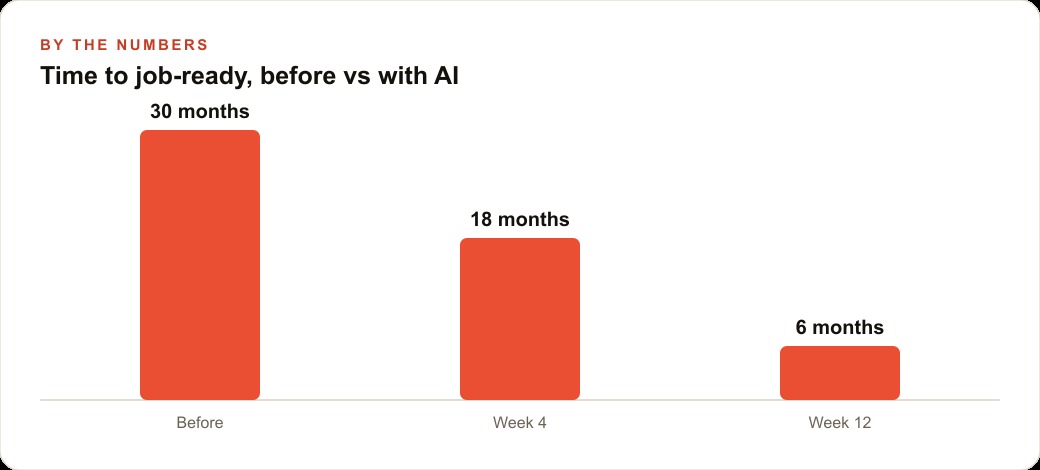
Here is the number that should change how business owners think. Pre-AI, learning all of this took years of school plus years on the job, or roughly ten to twelve months full-time at a fast-track bootcamp. With good technique and AI helping you learn, the honest estimate is about six months full-time to get solid. Six months, not six years, is the headline, because it moves building software in-house from a fantasy to a decision.
That collapse changes the math for almost any business. Most software a company actually needs is not exotic. A small team that learns enough to direct AI agents can build internal tools, customer-facing sites, booking systems, dashboards, and automations that used to require an expensive outside developer for every change. The point is not to replace skill with prompts. It is to combine real understanding with AI as an accelerant, so a lean operation can ship and maintain its own software instead of waiting weeks and writing a check for every small tweak. When the software you run reflects how your business actually works, everything downstream gets easier, including the CRM and website stack that your team lives in all day.
What it looks like in practice: a plumbing company
Take a growing plumbing company drowning in phone calls and sticky notes for scheduling. Instead of paying for a generic field-service app that never quite fits, an owner or a sharp team member learns enough to direct AI agents and builds exactly what the business needs. Here is how I would set it up. Start with the fundamentals so they can actually read what the AI produces and catch a bad change before it ships to the field. Then direct the agents to build a simple job-booking tool, a customer database, and a dispatch board, one project at a time, so each piece is tested before the next begins.
Put everything in Git from day one, so a bad agent edit is a one-commit undo, not a lost weekend during the busiest week of the year. Be explicit about security, since this app holds customer addresses, phone numbers, and payment details, and never assume the agent locked that down on its own. Keep the agents containerized so an experiment never touches the live booking system the dispatchers depend on. Put illustrative numbers on it: a fitting outside developer might quote several thousand dollars and a few weeks for a custom dispatch board, then bill again for every change. A team that learned to direct agents over a focused stretch builds the first version in days and adjusts it the same afternoon a dispatcher asks. The result is software shaped around how the plumbing company really works, owned by the company, and cheap to keep improving as it grows. That same understanding pays off when the business wants to be found, because the person who built the booking tool also grasps how the site should be structured for SEO and organic search and how to wire the lead forms into Google Ads properly.
Why this is good news for small teams specifically
The temptation is to read the agentic-engineering shift as a story about professional developers, a narrowing of who gets to call themselves an engineer. I read it the opposite way, as the biggest opening for small teams in a generation, and the news underneath supports that reading. When the timeline to competence drops from years to roughly six focused months, the group that benefits most is not the big software company with a hundred engineers. It is the small business that could never justify hiring even one.
Think about what actually blocked most small operations from owning their software. It was never that their needs were complicated. A booking tool, a customer database, a dashboard, a few automations, none of that is exotic. The block was that hiring a developer for every small change was expensive and slow, so owners settled for generic apps that almost fit and worked around the gaps forever. Agentic engineering removes the block, because a sharp person on the team can now learn enough to direct the agents and build the specific thing, then adjust it the same day a need appears instead of filing a ticket and waiting a month. That is a structural change in who gets to own their tools.
There is a caution buried in the good news, and the news makes it explicit. The people who benefit are the ones who learn to judge the output, not the ones who blindly trust it. The early vibe coders who skipped version control and lost projects, the ones who let an agent leave a database exposed, are the warning. A small team that learns the fundamentals, keeps everything in Git, is explicit about security, and containerizes its experiments gets all of the upside with none of the disasters. A team that treats the agents as magic and never learns to read what they wrote inherits every bug the agent quietly introduced. The rename to agentic engineering is really a promise and a warning at once: the tools are finally powerful enough for a small team to own its software, but only if the team does the learning that lets them stay in control of what the machine produces. For most owners, that trade, a focused stretch of learning in exchange for permanent independence from expensive per-change development, is the best deal on the table right now.
How to actually learn it now
Pick one language and one small project, then build it this week, and use AI as a tutor along the way. Drop lectures and readings into a tool like NotebookLM to summarize them and generate guiding questions, a habit that helps you see how the pieces connect before you dive in. For unfamiliar code, paste it into a strong model like Claude and ask it to explain the structure line by line, and lean on free open-source models such as Qwen, Kimi, or DeepSeek when you run out of credits. Ask for analogies and examples to lock a concept in, like having object-oriented programming explained as objects in the real world, and let a model digest long documentation so you absorb it without reading every page. Above all, build continuously, because you do not truly know an API until you make something that calls one.
It also helps to reframe what those months are actually buying you, because the number alone undersells it. You are not just learning to produce code. You are learning to judge it, which is the durable skill, the one that does not go stale when the next model ships or the popular framework changes. The person who only learned to prompt an agent is at the mercy of whatever the agent produces. The person who learned the fundamentals underneath can catch the agent's mistake, redirect it, and ship something they actually trust, and that judgment keeps its value for a career, not a season.
That path is open to anyone willing to put in the months, and the rename from vibe coding to agentic engineering is really an invitation: the tools got powerful enough that a motivated person can now direct them, but only if they do the learning that lets them judge the output. You can teach yourself and direct the agents on your own, or you can bring in someone who has already built this kind of software for real businesses and wants it done right the first time.
That is exactly what we do at AI DOERS. Book a private 30-minute call with Madhuranjan Kumar and we will map the fastest path to it for your specific business.
Book your call →
Madhuranjan Kumar
Madhuranjan Kumar brings 20 years of performance-marketing experience and has managed over $200 million in Facebook ad spend for brands across the United States and beyond. His expertise spans the full modern marketing stack: Meta, Google Ads, TikTok, email automation, CRM, and the websites that hold it together. At AI DOERS he turns that track record into lead-generation systems for businesses across every industry.