
How to Actually Learn Anything Faster, Backed by Cognitive Science
Learning how to learn is the meta-skill that makes every other skill easier. Here are the cognitive science principles that actually move the needle, and how I would turn them into a real training system for a business.

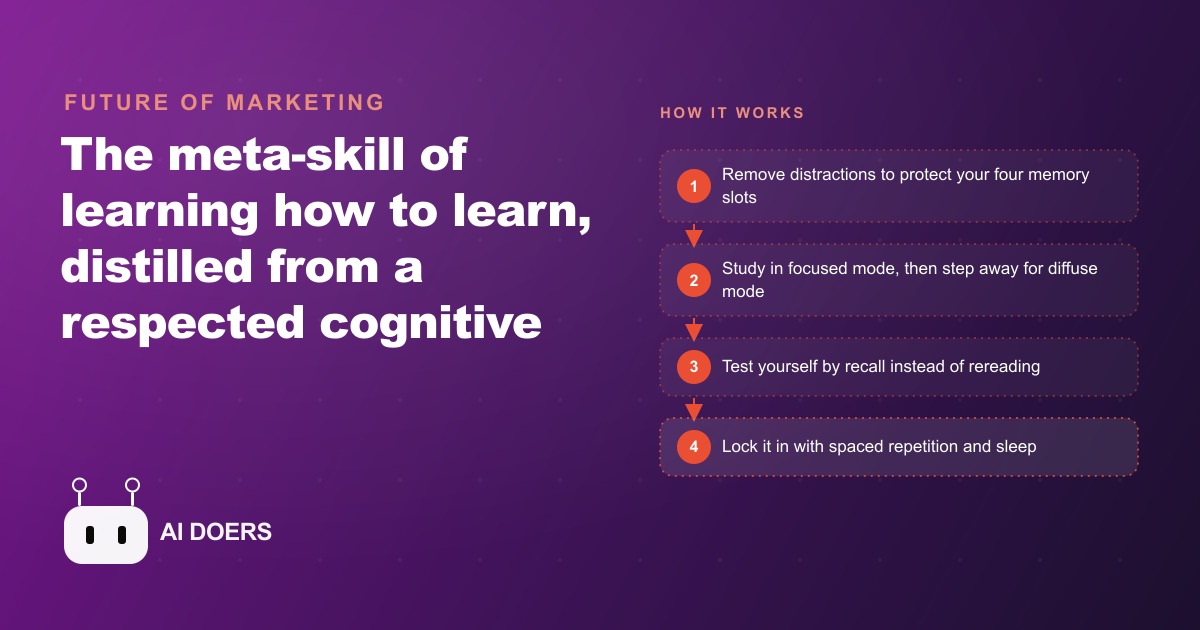
Research from cognitive science has known for decades that the training methods most businesses use are almost perfectly designed to produce the illusion of competence rather than the real thing, and most companies are still running the same playbook anyway.
This is not a minor inefficiency. It is the difference between a team that performs under real conditions and a team that performs in training and fails in front of customers. The science on this is not ambiguous. Passive methods, including slide decks, recorded lectures, and printed manuals, produce familiarity. Active retrieval, spaced repetition, and interleaving produce competence. Most company training budgets invest almost entirely in the first category and call the results disappointing.
Most company training creates an illusion, not a skill
The cognitive mechanism at fault is called the illusion of competence, and it is predictable and consistent across every study design. When a person sees a worked example, follows a demonstration, or reads an explanation and follows the logic, the material feels familiar. That familiarity registers as knowledge. It is not knowledge. Knowledge is the ability to reproduce a correct response from memory without the prompt. Familiarity is the ability to recognize a correct response when shown one. The gap between those two states is enormous and shows up without warning the first time the training needs to perform under real conditions.
A new hire who has read the onboarding manual cover to cover feels prepared. The feeling is real. The preparation is partial. The manual contained information. The hire recognized and followed that information while reading. But recognition and retrieval are not the same cognitive process. Retrieval, which is what real work requires, must be practiced separately, and most training programs never build in a retrieval step at all. There is no step where the new hire closes the manual and produces the correct answer from memory. There is no mechanism for surfacing gaps before those gaps appear in front of a customer.
The result is a consistent pattern across industries. The new hire says yes when asked if they understand the material. They believe this to be true. They have experienced the familiarity of reading and following along. Then a real situation arrives that is slightly different from the example they read, and the knowledge is not accessible because it was never encoded in a way that makes it retrievable under novel conditions.
The recall gap that shows up when it matters most
The recall gap is the distance between what someone thinks they know and what they can produce under real conditions, and it surfaces at the worst possible moments because those are exactly the situations where novel circumstances are most likely.
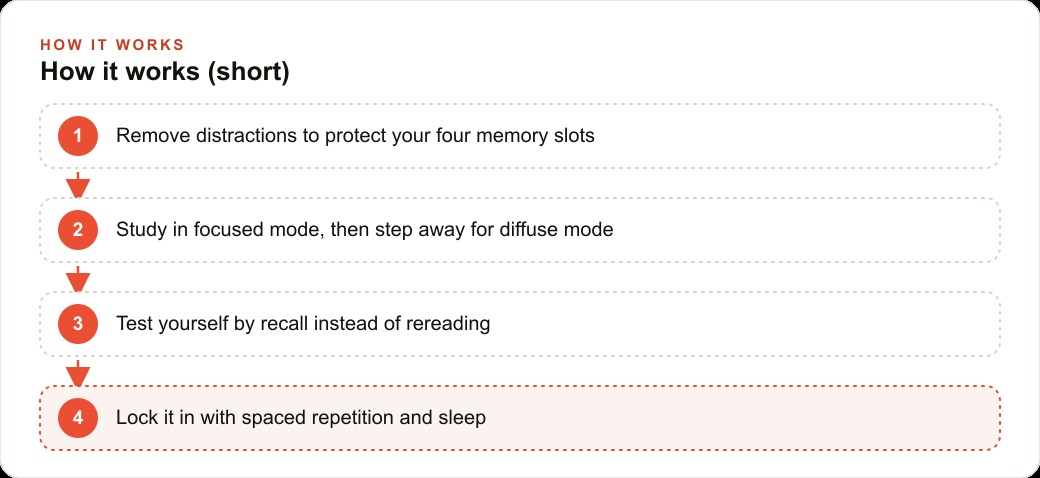
Consider what happens inside working memory when a new situation arrives. Working memory holds approximately four chunks of information at once and requires active repetition to maintain each one. When a distraction arrives, one of those slots is replaced. When a novel situation creates stress or uncertainty, cognitive load increases and available slots shrink further. The information a person needs at that moment must come from long-term memory, where it was stored through repeated encoding. If the encoding only happened once, during passive reading, retrieval is unreliable precisely when reliability matters most.
The only way to encode information reliably into long-term memory is through repeated active retrieval. Not rereading. Not reviewing. Retrieval: closing the source material and producing the correct answer from a blank state. Each successful retrieval strengthens the memory trace. Each spacing interval between retrieval attempts, where the memory fades slightly before being recalled, strengthens it further. This is why spaced repetition outperforms massed studying by a wide margin on any test of retention measured more than a few days after learning. The spaced approach is harder in the moment and produces better durable results. The massed approach is more comfortable and produces worse results after a short delay.
The practical application is specific. Every training program that matters should have a retrieval component built in: a step where the learner produces answers from memory rather than recognizing them on a page. That step does not need to be elaborate. It can be a set of flashcards, a short written summary from a blank page, or a verbal explanation to another person. The format is secondary. The retrieval attempt is what matters. Without it, the training program is information delivery dressed as skill development.
Why interleaving feels harder but sticks longer
Interleaving is the practice of mixing different topics and approaches within a single study session rather than drilling one topic until it feels mastered before moving to the next. It is consistently reported as more difficult by the people doing it. It is also consistently more effective at producing durable retention and flexible application.
The reason interleaving is hard is that it removes the warm-up effect. When you drill a single type of problem for an extended period, you develop a short-term performance advantage because your brain stays primed for that specific type. The next problem of the same type comes quickly and the answer follows. This performance gain is temporary and specific: it disappears after a brief delay and does not transfer to novel variations of the problem.
Interleaving removes that priming effect deliberately. When you switch from one topic to another and then return to the first, the return feels harder because the warm-up has dissipated. The brain must retrieve the relevant approach rather than continuing a recent train of thought. That retrieval effort is the mechanism that builds durable encoding. The difficulty is the point, not a flaw in the method.
For a business team, the design implication is counterintuitive. A training program that feels smooth and easy, where new hires move through one topic at a time and feel confident after each section, is probably relying on familiarity and warm-up effects rather than genuine encoding. A training program that feels slightly uncomfortable, where topics are interleaved, recall is required, and difficulty is present throughout, is producing actual learning. The discomfort is the signal that real encoding is happening.
What a dental practice's onboarding looks like when it is built on how memory actually works
A dental practice is useful because the gap between trained behavior and real behavior has direct consequences: a miscommunicated insurance benefit, a scheduling error, or a misdirected patient call produces an immediate downstream problem with a measurable cost. It is also a context where most training follows the passive model: the policy manual, the introductory walkthrough, and the shadow period before going live.
Here is what onboarding built on accurate cognitive science looks like for a four-person front desk team. The training is chunked by task, not by document section. Insurance verification is one learning unit. Appointment scheduling rules are a second. Patient intake, consent, and routing are a third. Each unit is short, covers one complete task, and is tied explicitly to the context in which that task occurs so the retrieval cue in a real situation matches the encoding context from training. The new hire does not read about the task and then later perform it. The training is structured so the first exposure is followed immediately by a retrieval attempt.
After each chunk, the manual closes and the new hire explains the procedure from memory. This step surfaces the actual gaps rather than the assumed gaps. Most training programs assume that gaps will be apparent from the speed or confidence of the learner during instruction. They are not. A learner who is uncertain often appears just as confident as one who is certain during passive instruction, because both are recognizing information rather than retrieving it. The retrieval attempt makes the gap visible where it can be corrected cheaply, during training, rather than expensively, in front of a patient.
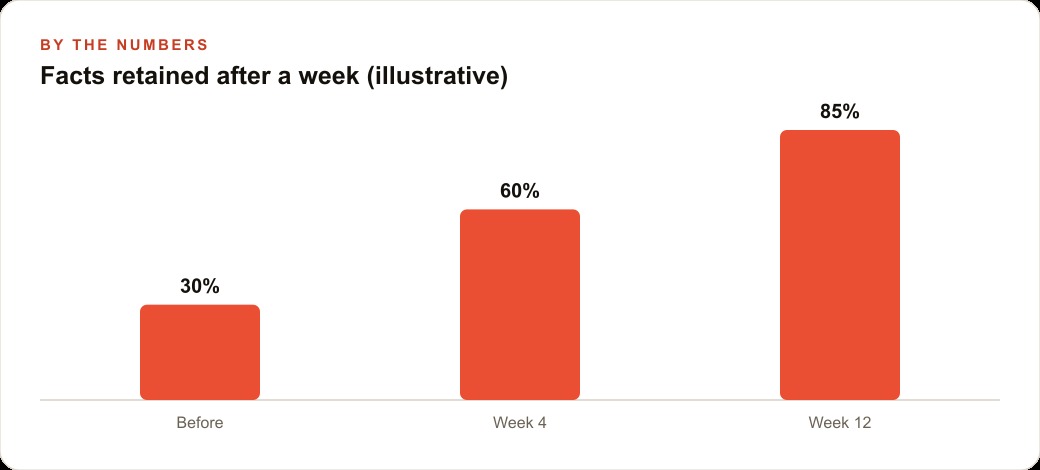
Spaced repetition handles the long-term retention. A set of flashcards covering the most critical procedures gets reviewed on day one, day three, and day seven of the first week, with review sessions in the second and third weeks as the interval extends. The total time investment in flashcard review across the full onboarding period is probably two to three hours. The retention improvement over a single cram session is large and measurable. A practice that has done this comparison informally finds that new hires fielding real front desk tasks in week two are noticeably more reliable than those who went through the traditional manual-plus-shadow approach and went live in week two.
For a practice that hires four front desk staff per year at an average onboarding period of eight weeks before full independent competence, the shift to a retrieval-based training approach can realistically cut that to three to four weeks. That is sixteen to twenty weeks of reduced error rates and supervision overhead per year, concentrated in the highest-stakes part of the patient experience. The financial value depends on what mistakes cost in that specific practice, but for any busy practice the number is not small.
The wider principle applies beyond the front desk. Clinical technique, protocol adherence, instrument handling, and sterilization procedures all benefit from the same approach: chunked instruction, immediate retrieval practice, spaced review. The method does not require new tools beyond a free flashcard application and a willingness to redesign how training sessions are structured. What it requires is accepting that the comfortable method is not the effective one, and that the difficulty a learner reports during interleaved, recall-based training is a feature of the process rather than a failure of the material.
What procrastination actually is and why the standard fix fails
Procrastination on learning tasks is widely treated as a motivation problem. The framing is that the person lacks drive or discipline, and the solution is to find better motivation, set bigger goals, or strengthen willpower. The cognitive science on this is clear and contradicts that framing entirely. Procrastination is a habit loop, not a character trait.
The loop has four components. A cue triggers a negative emotional response, typically discomfort or anxiety associated with the difficulty of the task. The routine of avoiding the task temporarily removes the discomfort. A small reward follows, usually something immediately pleasant like checking a phone or engaging with something easy. A belief reinforces the pattern: the idea that avoiding the task was reasonable, or that starting later will be easier.
Willpower interventions try to break the loop at the routine stage, after the cue has already fired and the discomfort is already present. This is the hardest possible intervention point because the emotional pressure is already active. The more effective intervention is at the cue: change the environment so the cue does not fire, or reframe the task before the cue appears so the emotional association attached to it is different.
The most practical reframe for learning tasks is shifting attention from the outcome to the process. The outcome of a study session is uncertain and distant, which is why thinking about it generates anxiety. The process, twenty-five minutes of focused review, is concrete and achievable, and completing it generates a small, real sense of accomplishment. Building the habit of starting the process rather than evaluating the outcome is a structural fix to the procrastination loop, and it works without requiring any increase in motivation or willpower. The habit already runs on cue and reward. Redesigning the cue and the reward changes what the habit produces.
How do you apply this to your own learning?
You apply it by replacing passive review with active retrieval, immediately. After reading or watching any instructional content, close the source and write down the key points from memory. The writing is not for the notes. It is to force retrieval. Anything you cannot write down reveals a gap in the encoding. Review the gaps, not the material you already retrieved correctly, and repeat the retrieval attempt.
For anything that needs to stick long-term, use spaced repetition. A free application handles the scheduling. You build the cards once, review them when prompted, and the application tracks which items need more frequent review based on your performance. The total time investment is small and the retention improvement over rereading is large and consistent across every study design that has compared them.
For a team being trained, restructure at least one section of every training program to include a retrieval component. It does not need to be all sessions or all material immediately. Start with the highest-stakes content, the procedures where an error has the most direct consequence, and add a recall step. Measure the difference in performance four weeks after training compared to the prior group who went through the same material without the recall step. The gap is usually visible within the first hiring cycle.
The cognitive science behind this has been settled for decades. The businesses that use it correctly will onboard people faster, retain that learning longer, and see fewer errors in front of customers. The uncomfortable truth about most corporate training is that it is designed around what feels productive rather than what produces competence, and the science has known this for a long time.
That is exactly what we do at AI DOERS. Book a private 30-minute call with Madhuranjan Kumar and we will map the fastest path to it for your specific business.
Book your call →
Madhuranjan Kumar
Madhuranjan Kumar brings 20 years of performance-marketing experience and has managed over $200 million in Facebook ad spend for brands across the United States and beyond. His expertise spans the full modern marketing stack: Meta, Google Ads, TikTok, email automation, CRM, and the websites that hold it together. At AI DOERS he turns that track record into lead-generation systems for businesses across every industry.