
How I Build Entire AI Apps Without Writing Code
I treat AI tools like Legos. Turn reference material into reusable philosophy files, generate assets with image models, then drop a single API key into a hosting tool and ship a live app in two prompts and about ten minutes.

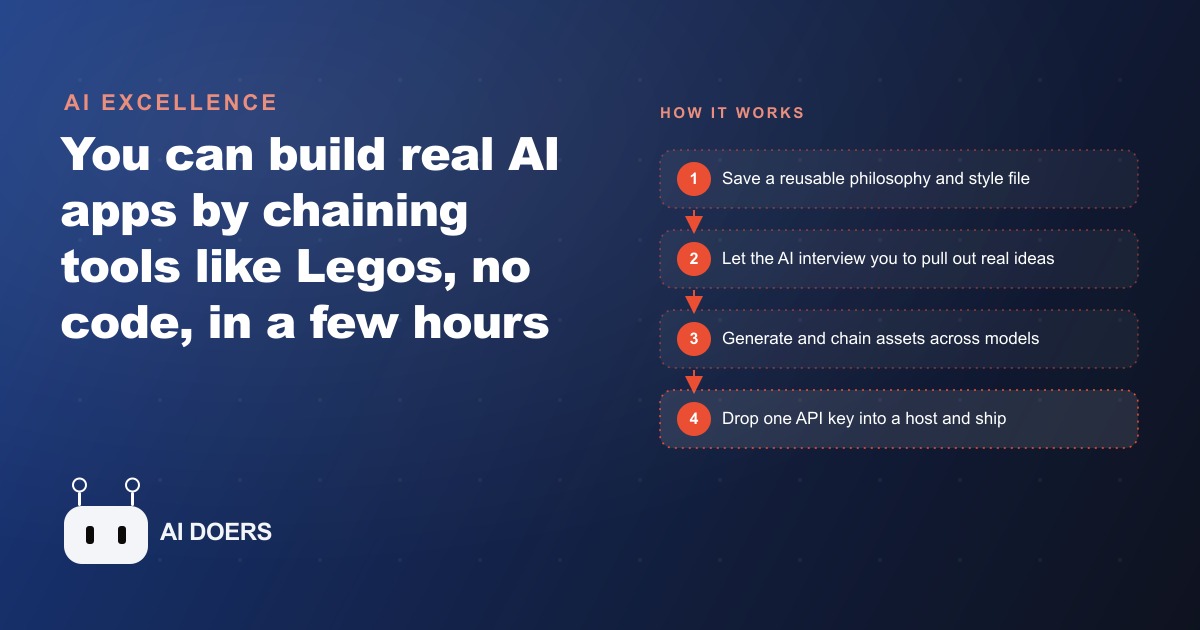
Building a real app is now two prompts and about ten minutes
The line that should stop a small business owner in their tracks: you can now drop a single API key into a hosting tool, paste some docs, and have a working web app live on the internet in roughly ten minutes. Not a mockup, a real app that does one useful job. I am Madhuranjan Kumar, and this is not a distant promise. It shipped this year, it has a name, and there is already a job market for it. The way software gets built quietly changed, and most business owners have not caught up to what it means for them.
The bigger frame is that software turned into a conversation. A few years ago you typed a keyword into a search box and got a list of pages to sift through. Now you talk to an assistant and get a direct answer. That same shift, from browsing to conversing, has now reached image editing, video, and app building itself. Building a first working version of an app is one good prompt away. The rest of this piece is about why that matters and the exact move to make.
Vibe coding just became a hireable skill on paper
The clearest signal that this is real, not hype, is that companies are hiring for it. A major payments company posted a role asking for familiarity with the exact tools people use to build apps by prompting rather than by hand-writing every line. The practice even got named word of the year by a dictionary. When a dictionary and a corporate job listing agree that "building software by describing it" is a legitimate skill, the ground has moved.
The honest nuance is that it is easy to start and hard to master, and that gap is the whole reason it is worth learning. Anyone can type a prompt and get something. Getting a clean, reliable, on-brand result takes technique. That is good news, not bad. It means the skill still carries value, and the owners who put in a few focused hours now will be ahead of the ones who wait until it is table stakes. The hours needed to ship a working app are trending toward zero, but the judgment to ship a good one is still scarce.
The real unlock is a reusable context file, not a fancy tool
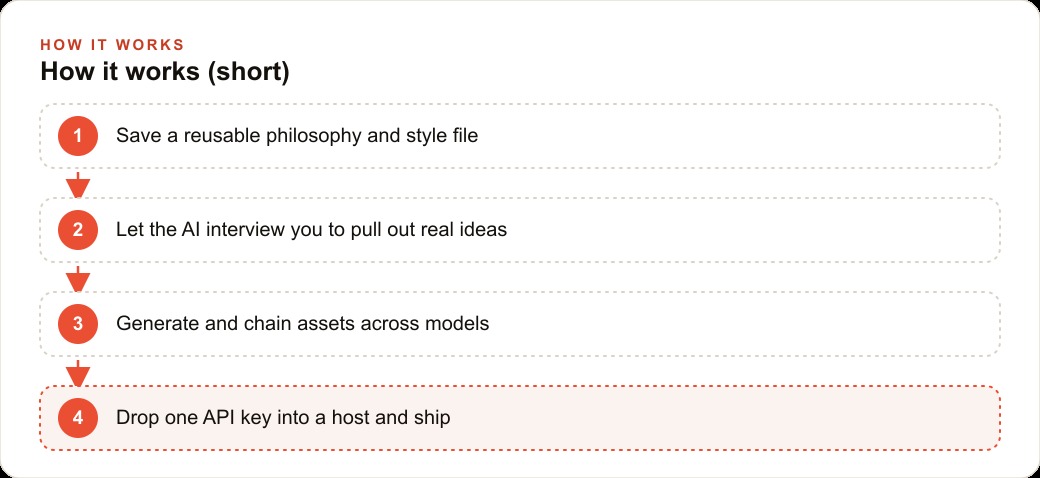
Here is the counterintuitive part of the news, and the part almost everyone skips. The most repeatable trick is not a tool at all. It is a file. Before asking any AI to produce serious work, you save a short reference document that captures how you want things done. Take a strong reference, distill it with a chat model into a tight structure, and save that as a local note. That note becomes a philosophy file you can drag into any tool to get a consistent result every time. Keep a style file the same way, describing your brand, tone, and look.
The second half of the unlock is letting the AI interview you before it writes anything. Instead of one thin prompt, you tell the model to ask five questions, one at a time, and you answer in your own words, often out loud. Only then does it write the draft. This is the difference between generic filler and output that carries your actual ideas. Most people skip this step, get a bland result, and blame the AI, when the real problem was a starved prompt. The news is not just that tools got powerful. It is that a simple two-part habit, a saved context file plus an interview, turns those tools from novelty into something dependable.
The workflow that ships a live app in about ten minutes
Once the words and assets are handled, the shipping step is almost anticlimactic, which is the point. Model hosts now let you reach thousands of creative and language models through a single API key. Some image edits cost only a few cents each. You put that one key into a hosting tool's secrets, paste the model's documentation, and ask Madhuranjan Kumar to build an app that does one specific job using those docs and that key. Ten minutes later you typically have a live link you can open on your phone.
The chaining is what makes it feel like building with Legos. You generate visuals with an image model, use a character reference so faces stay consistent, then chain an upscaler and a short video step so one asset becomes a finished clip. A separate model can watch an entire video, write the transcript, and suggest captions with timestamps faster than a person could watch it. Each tool does one narrow job well and hands its output to the next. You are not writing software in the old sense. You are directing a chain of specialists.
The move for a small business this quarter
The concrete action is to pick one workflow that annoys you every week and build a tiny private app just for that. This is where the news becomes money. A real estate office builds a listing-description writer. A law firm builds a document summarizer. A restaurant builds a menu-and-promo image generator. You are not buying a bloated platform with fifty features you ignore. You are wiring two or three models behind one simple screen that does exactly the job your team already does by hand.
The cost math is friendlier than most owners expect. You pay per use through one API key instead of paying monthly fees to five separate tools. For a shop that runs a workflow a few dozen times a month, that difference is the gap between an experiment you can afford and a subscription you cannot justify. And the assets these tools produce do double duty: the images and copy that power a private tool also feed your Facebook and Instagram ad campaigns and your SEO and organic search content, so one build pays off in several places at once.
A worked example: a hair salon that builds its own preview tool
Picture a single-chair-heavy hair salon that wants more walk-ins to convert and more social content without hiring an agency. The owner builds a small in-house app that turns a client photo into clean before-and-after style previews plus a matching social caption. Here is how it comes together, with illustrative numbers.
First, the owner saves a style file describing the salon's brand, its colors, its tone, and the looks it specializes in. That file goes into every prompt so the output always feels like this salon, not a generic stock vibe. Next, the AI interviews the owner: who is the ideal client, which three services drive the most revenue, what objections do walk-ins raise. Those answers become the engine for captions and promos. Then the owner chains an image model with a character reference so a client can see a believable preview of a new color or cut on their own face, with a second model cleaning up the details. Finally, the whole flow gets wrapped in one simple page the front desk can use between appointments. A stylist uploads a photo, picks a look, and gets a preview plus a ready-to-post caption in under a minute.
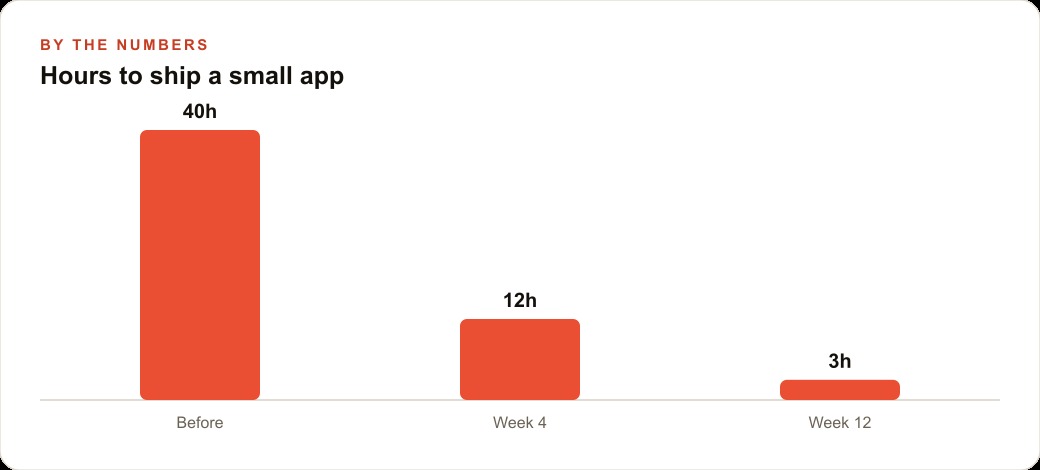
Consider the time this collapses. Producing a small, useful app used to be a multi-week project measured in dozens of hours. With the workflow above, the first version ships in an afternoon, and by a few weeks in, the owner is spinning up new variations in a few hours because the philosophy and style files do the heavy lifting. The leads and bookings the tool generates flow into the CRM and website stack where follow-up automation handles the next several touches, so a curious walk-in does not slip away. The return, framed as illustrative, is a marketing tool the salon owns outright, built in an afternoon, that keeps producing content instead of billing a monthly fee.
The skill gap is the real story, not the tools
It is tempting to read this as a story about tools, image models, hosting platforms, model hosts with a thousand models behind one key. But the tools are the easy part and the least durable part, because they change every few months. The real story is the skill gap that opens up between people who learn to direct these tools well and people who poke at them once and give up. That gap is why a dictionary named the practice word of the year and why a major company is hiring for it. Skills that are easy to start and hard to master always create a valuable middle ground, and that is exactly where the opportunity sits right now.
The two habits that define the skill are the ones almost everyone skips: the reusable context file and the interview. Think about why they work. A context file is just captured judgment, your standards, your brand, your way of doing things, written down once so every future prompt inherits it. The interview is just forcing your real ideas out of your head and into the prompt before the AI writes a word. Neither is technical. Both are about discipline. And that is precisely why most owners will not do them, because they are boring compared to typing a prompt and hoping. The ones who do them consistently produce work that carries their actual voice, while everyone else produces the bland filler they then blame the AI for.
There is a deeper reason the skill matters more than the tools, and it is about ownership. When you learn to chain models behind a simple screen, you own the workflow. You are not renting five separate subscriptions that each solve one slice of the problem, you are wiring a few models together for pennies per use to do the exact job your team does by hand. That ownership compounds. Every workflow you internalize this way is one you never have to pay a platform to rent again, and the assets it produces feed everywhere else you show up, from Facebook and Instagram ad campaigns to the pages that carry your SEO and organic search. The skill is the asset. The tools are just the current expression of it.
That framing also explains why waiting is the expensive choice. The tools will keep getting easier, which sounds like a reason to wait, but the skill takes reps to build, and the reps compound. An owner who starts now, on one annoying weekly workflow, has a working system and a growing library of context files by the time the tools get trivially easy, while the owner who waits is starting from zero against competitors who already have momentum. The barrier was never the technology. It was always the few hours of learning, and those few hours are worth more today than they will be worth as a scramble later.
Why most owners still will not do it, and why you should
The reason most people never ship is not that the technology is too hard. It is that they never spend the few focused hours to learn the tools and build the context files. The news here is genuinely good: the barrier is time and habit, not talent or budget. The two-prompt workflow is learnable, the cost is measured in cents, and the payoff is a tool your business owns.
You can absolutely do this yourself, and it is worth trying, starting with one weekly annoyance and one simple app. If you would rather have it built right the first time, scoped to your real workflow and your brand so it comes out consistent instead of generic, that is exactly the kind of build a specialist can set up quickly. Either way, the takeaway from this year's shift is the same. Software became a conversation, app building followed, and the owners who learn to direct the chain now will spend the next few years shipping tools their competitors keep renting.
That is exactly what we do at AI DOERS. Book a private 30-minute call with Madhuranjan Kumar and we will map the fastest path to it for your specific business.
Book your call →
Madhuranjan Kumar
Madhuranjan Kumar brings 20 years of performance-marketing experience and has managed over $200 million in Facebook ad spend for brands across the United States and beyond. His expertise spans the full modern marketing stack: Meta, Google Ads, TikTok, email automation, CRM, and the websites that hold it together. At AI DOERS he turns that track record into lead-generation systems for businesses across every industry.