
How OpenClaw Turns One Sentence Into a Full Launch Video
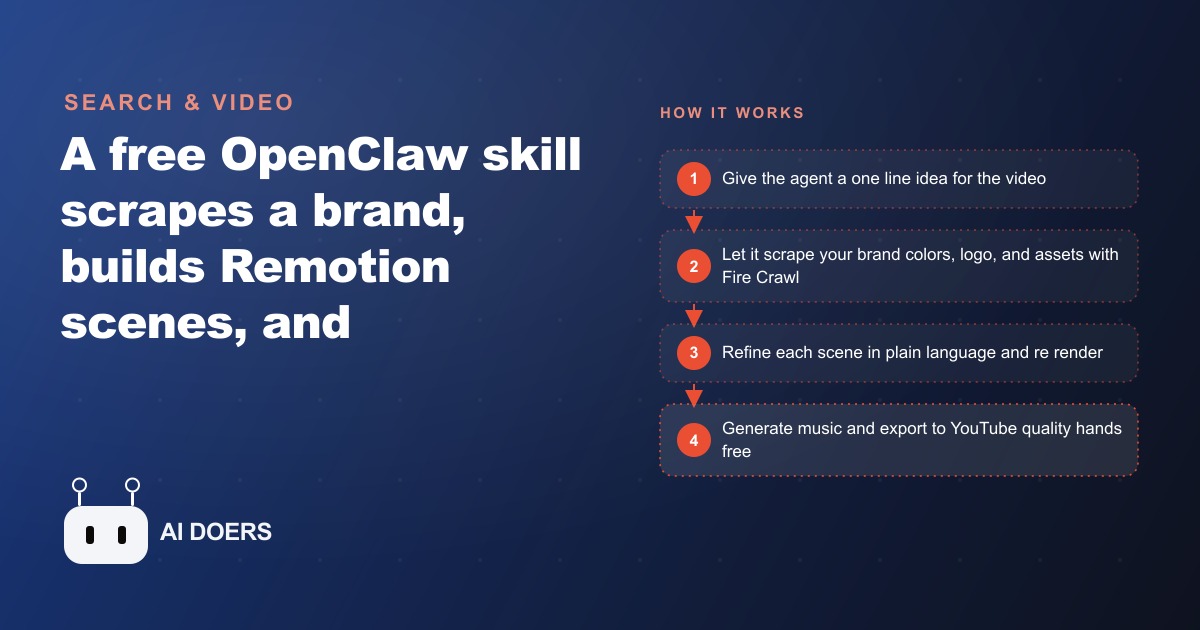
A free motion graphics skill scrapes a brand with Fire Crawl, builds scenes in open source Remotion, and generates music through an audio skill, so OpenClaw turns a single idea into a brand matched launch video you direct in plain language.
Video production shops are about to experience what photo labs experienced in 1990: the thing they charged premium rates for is becoming a commodity, and the only businesses that will notice in time are the ones already building the replacement workflow.
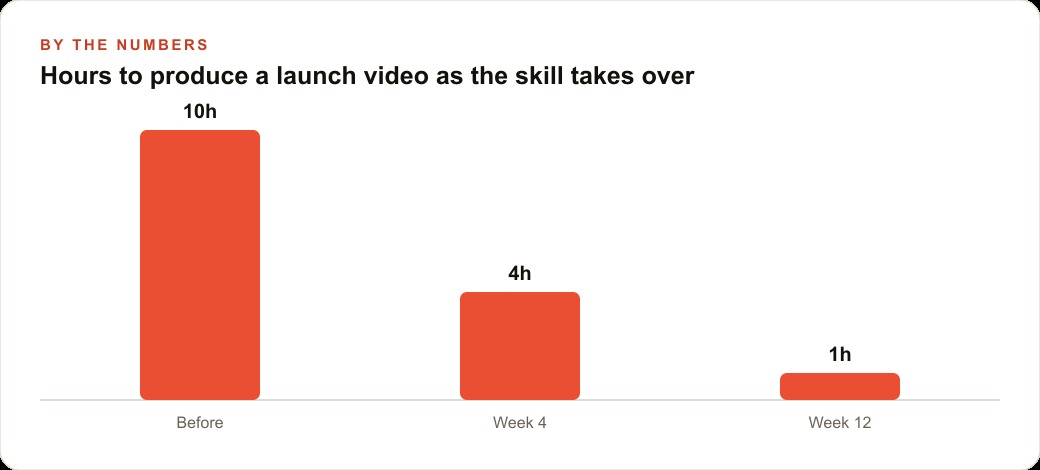
For two decades, small businesses absorbed the conventional wisdom that polished video was a differentiator precisely because it was expensive. The scarcity was the point. When only a few businesses in a given market could afford motion graphics with proper brand matching, being one of them meant something. OpenClaw dissolves that logic with a pipeline that converts a one-line idea into a finished, brand-matched launch video using Remotion and AI-generated assets. The bottleneck was never creative vision. It was production time.
The Editor Was Never the Creative. The Business Owner Was.
When a business owner hands off a video project to an editor, what actually happens is a conversion: the owner's mental picture of the finished video gets translated, imperfectly, into timeline decisions. The owner provides direction. The editor provides execution. The execution step required years of After Effects experience, a licensed template library, and enough familiarity with brand guidelines to make hundreds of micro-decisions correctly.
OpenClaw collapses the execution step. The owner says "make the logo 2x bigger" or "shorten scene 2, add a sidebar showing the price in the upper right" and the agent handles the timeline. The direction is still entirely human. What changed is who does the conversion, and how long it takes. For a business owner who has ever given clear feedback on a video revision, the skill set required is already there. The workflow asks only for direction. Execution happens in seconds.
This reframes the entire cost structure of video production. An editor's time was always being purchased to perform a cognitive task the business owner was already performing in their own head. The brief, the revision notes, the final approval comments: all of that was direction. The editor was the interface between the owner's vision and the final file. When an AI agent serves as that interface instead, the economics change permanently. Direction still requires experience, market knowledge, and taste. Execution no longer does.
For businesses that have been producing one or two videos per quarter because of cost, the transition to on-demand production changes how they think about content strategy entirely. Video stops being a campaign asset and starts being a communication channel. A new product can have a launch video the same day it goes live. A response to a competitor announcement can have a video the same day the announcement drops. The speed advantage compounds in markets where awareness is contested.
Brand-Specific Output Requires Brand-Specific Input, and the Scraping Step Gets This Right
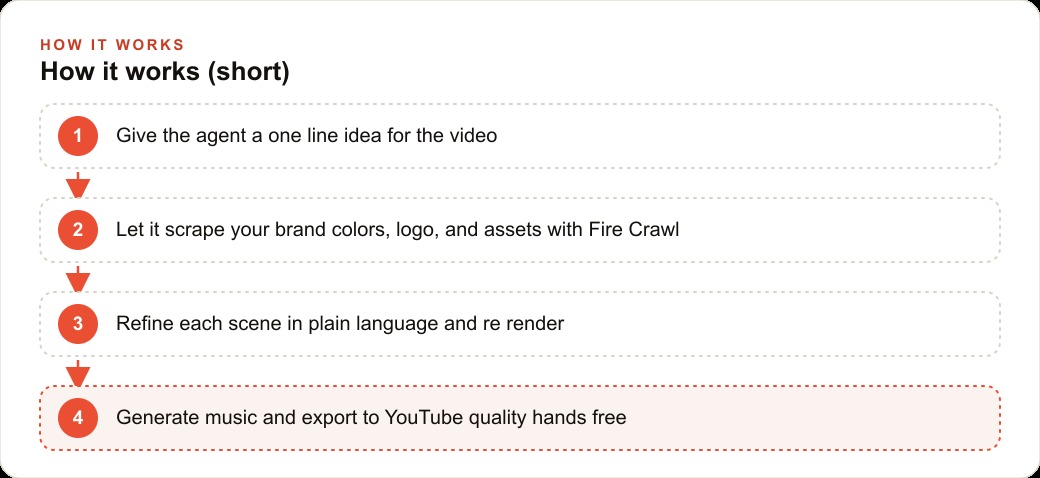
The reason earlier AI video tools felt disconnected from real business identity was that they generated generic footage. They approximated brands. OpenClaw's workflow is different because it starts upstream. The Fire Crawl API pulls a company's actual logo, color palette, and brand assets from the live website before a single scene is built. The agent does not guess the brand palette. It reads the CSS. It downloads the actual logo file. When the finished video renders, it uses exact hex codes, the real logo at the correct weight, and typography consistent with what visitors already see on the company's site.
This matters enormously for businesses that have spent years building visual recognition. A gym chain with a signature orange and navy palette does not want a video that approximates those colors. It wants those colors exactly. A med spa with a specific serif wordmark does not want a generic sans-serif treatment. When the source of truth is the live website and the agent scrapes it directly, brand consistency is structural rather than dependent on a designer's attention to a PDF style guide.
The scraping step also captures implicit brand decisions that are difficult to articulate in a brief. Font pairing choices. The weight at which the logo typically appears relative to surrounding elements. The proportional relationship between headline text and body text across different page types. A human designer might spend an hour studying a brand before starting work. The Fire Crawl step covers that ground programmatically, and it runs before the first scene is generated.
Remotion Makes Video Editable the Same Way a Document Is Editable
Remotion is an open-source framework that represents video as a React component tree rather than a locked binary export. Each scene is a function. A transition is a prop. Music timing is a variable. This architecture has an implication most business owners have not absorbed yet: if video is code, editing a video is as accessible as editing a spreadsheet cell.
When Madhuranjan Kumar demonstrates plain-language editing in this workflow, the mechanic is literal, not metaphorical. Telling the agent "move the product image to the left third of the frame and reduce the font size on the headline by 20%" is a direct instruction the agent converts into changes in the Remotion component structure. There is no intermediary designer who has to interpret the feedback, estimate the time required, schedule a revision, and deliver it two days later. The change renders immediately.
The precision the workflow requires is real. Spatial instructions need to be specific: "upper right corner" is more useful than "somewhere at the top." The agent relies on exact positional language because it is translating plain text into coordinate-level decisions in a React component. But this is the same precision a business owner already uses when giving feedback to any creative professional. The skill is not new. What is new is that the feedback loop closes in seconds rather than days, and there is no cost per revision.
Experimentation becomes cheap in a way it has never been before. An owner running a product launch campaign can generate five variations of the opening scene, each with a different headline treatment, in the time it would previously take to brief a single revision. Creative testing that once required a significant production budget to justify becomes accessible at any scale.
Music Was the Last Expensive Line Item and It Is Now Generated on Request
After motion graphics and brand assets, the historically stubborn cost in video production was licensed music. Stock libraries charge per license or per seat. Original composition for a 60-second spot runs $500 to $2,000 at the low end of the market. The Eleven Labs audio skill embedded in OpenClaw generates up to 10 complete songs plus sound effects from a text description of the mood, tempo, and emotional register this breakdown needs.
For a business producing 20 brand videos per month, the elimination of per-license music fees alone justifies the time investment in learning the workflow. The generated music is matched to the pacing and emotional register of the specific video, not pulled from a library where the fit is approximate. A high-energy gym promo gets music that matches that energy. A luxury skincare brand gets something understated and warm. The description is plain language. The output is production-ready audio. Sound effects for product reveals, cut transitions, and brand stings are generated in the same pass.
The combination of zero marginal cost for music, zero marginal cost for motion graphics, and zero per-revision fees means the cost curve for video production has changed shape permanently. The fixed cost is learning time. After that, each additional video costs effectively nothing.
What the Numbers Look Like for a Business Running This at Scale
Consider a single-location aesthetic clinic running promotions for its primary services: body contouring, injectables, and seasonal packages. The current workflow for one polished promotional video costs between $1,500 and $3,500 per production, requires a briefing call, a first draft, two revision rounds, and two to three weeks of elapsed time. At four videos per month, the annual spend on video production runs between $72,000 and $168,000 before any platform distribution costs.
With the OpenClaw workflow, the owner or marketing coordinator describes the concept in one to two sentences. The agent scrapes the clinic's website for brand assets. Scenes are generated in Remotion with the correct brand colors and logo. Music is produced by the audio skill. The owner reviews the output, provides plain-language edits specifying what to move, shorten, or emphasize, and requests a final render at the highest quality setting. The cycle runs in minutes. Four videos per month becomes forty if the team chooses, because the marginal cost of each additional video is effectively zero.
That volume change compounds over time. More videos create more surface area for organic discovery across every channel the business uses. More creative variations give the team better data on which messages and formats convert before fatigue sets in on Facebook and Instagram ad campaigns. More content to test across Google Ads video placements on YouTube means faster convergence on what performs. The businesses treating video as abundant will run experiments their video-scarce competitors simply cannot afford to run.
Creative Refresh Rate Is the Primary Driver of Paid Advertising Performance
Ad creative fatigue is the most consistently cited cause of performance decay in paid social advertising. Audiences encounter the same creative repeatedly until click-through rates fall and cost per lead rises. The typical response is to brief new creative, wait two to three weeks for production, and absorb underperformance during the gap. When production takes two weeks, creative fatigue becomes a structural drag on account performance that no amount of targeting optimization can fully compensate for.
When production takes twenty minutes, the refresh cycle becomes continuous rather than episodic. A performance drop observed on a Friday can be addressed with new creative by the following Monday. Winning concepts can be extended into variations before the original fatigues. A messaging angle that emerges from audience comments or competitive monitoring can be tested immediately. The same logic applies to Facebook and Instagram ad campaigns where creative testing velocity is a primary driver of account-level returns. Advertisers who test more angles in the same time window accumulate performance data faster and converge on winning creative earlier than competitors running on slower production cycles.
Both Skills Are Free to Copy, and Skill Ownership Is the Long-Term Advantage
OpenClaw's architecture includes two portable skills: the brand-scraping skill and the audio-generation skill. Both can be reproduced in other projects by copying the skill documentation to clipboard and instructing an agent to recreate the capability. The workflow is not locked to a single platform or subscription. The same pipeline runs in Claude Code without additional licensing costs.
A business that builds this workflow internally owns the capability rather than renting it. When a business contracts a production agency for video, the institutional knowledge, the brand familiarity, and the workflow efficiency all live outside the company. Every new video re-engages the dependency and the invoice. When the on-demand workflow is internal, the capability compounds with use. Each team member who learns to give precise directional instructions becomes a video producer. Each campaign cycle generates more learning about what formats and messages perform. The external agency's knowledge advantage diminishes with each internal video the team produces.
The Competitive Window Is Short and Shrinking
Every category of business currently paying for video production should be actively testing this workflow now. Real estate brokerages that produce property walk-throughs. SaaS companies building product explainers. Restaurants running monthly promotional content on social channels. Health and wellness brands building creative libraries for paid acquisition. Retail businesses running seasonal campaigns. The replacement cycle for video production will not send advance notice.
Agencies charging $3,000 per video will lose clients before they understand why those clients left, because those clients will have discovered they can produce equivalent output in twenty minutes. The businesses that invest the time to learn this workflow now will have a structural speed and cost advantage over every competitor that defers the decision. They will also have the learning curve behind them when the next generation of the workflow ships capabilities the current version cannot produce.
The creative role was always the business owner's. What the workflow removes is the week between having the idea and seeing it rendered. That gap is where most business videos never got made. When the gap disappears, the volume of business video in circulation will increase by an order of magnitude, and the businesses positioned to benefit from that volume are the ones building the capability now.
That is exactly what we do at AI DOERS. Book a private 30-minute call with Madhuranjan Kumar and we will map the fastest path to it for your specific business.
Book your call →
Madhuranjan Kumar
Madhuranjan Kumar brings 20 years of performance-marketing experience and has managed over $200 million in Facebook ad spend for brands across the United States and beyond. His expertise spans the full modern marketing stack: Meta, Google Ads, TikTok, email automation, CRM, and the websites that hold it together. At AI DOERS he turns that track record into lead-generation systems for businesses across every industry.