
How One Prompt Built a Five-App Business System in 15 Minutes
Describing a personal operating system in a single prompt to a vibe-coding tool produced five working business apps with real databases in about 15 minutes, proving operators can now clone the simple software they overpay for instead of renting it.

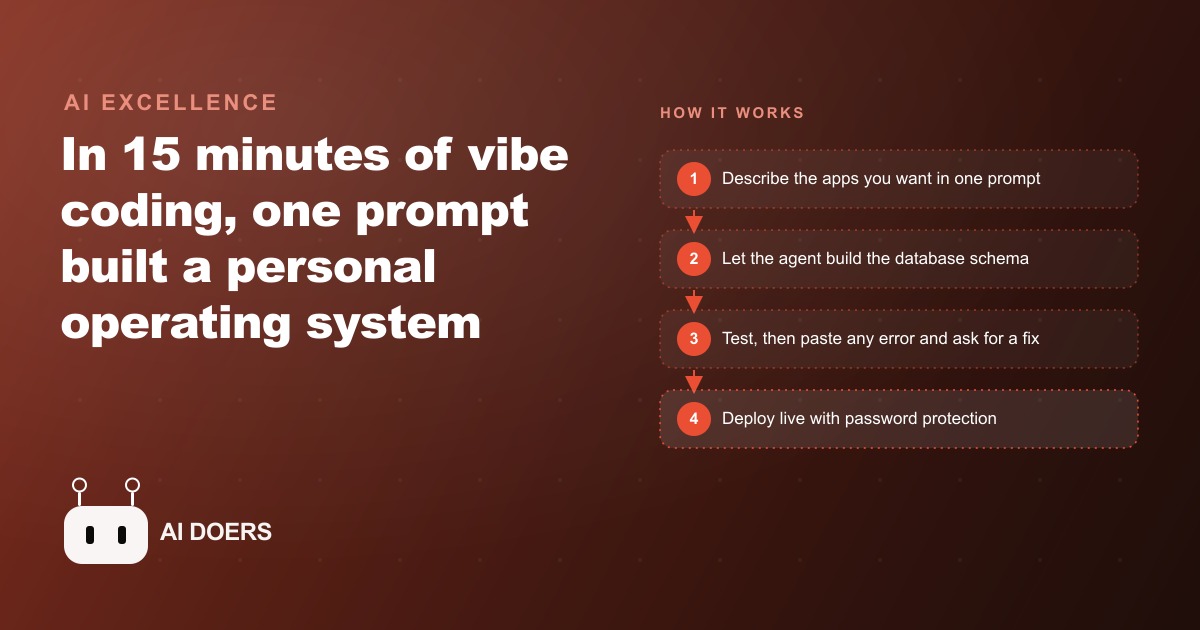
A single prompt built five working business apps with real databases in about fifteen minutes, and the point of that demo was not the speed. It was the quiet proof that the people who run the work can now build the work, and that most of the software a small business rents is simple enough to own instead. I am Madhuranjan Kumar, and the clearest way to show what that means is to follow one business through it. What follows is a composite gym, with illustrative numbers, walking from a stack of rented tools to a system it owns, because the abstract promise never lands the way one business's journey does.
Chapter one: the gym paying four vendors for four simple tools
Start with the situation almost every small operation is in without quite noticing. The gym stitched together four separate paid tools: a link in bio page for class schedules and sign ups, a form builder for free trial requests, a notes or whiteboard tool where trainers kept class plans, and a separate content helper for social posts. Each one was a monthly bill, each one held a slice of the gym's data hostage, and none of them talked to each other. The free trial requests lived in the form vendor's system, the schedule lived in the link tool, and the owner paid four invoices a month for four things that were, underneath, genuinely simple software.
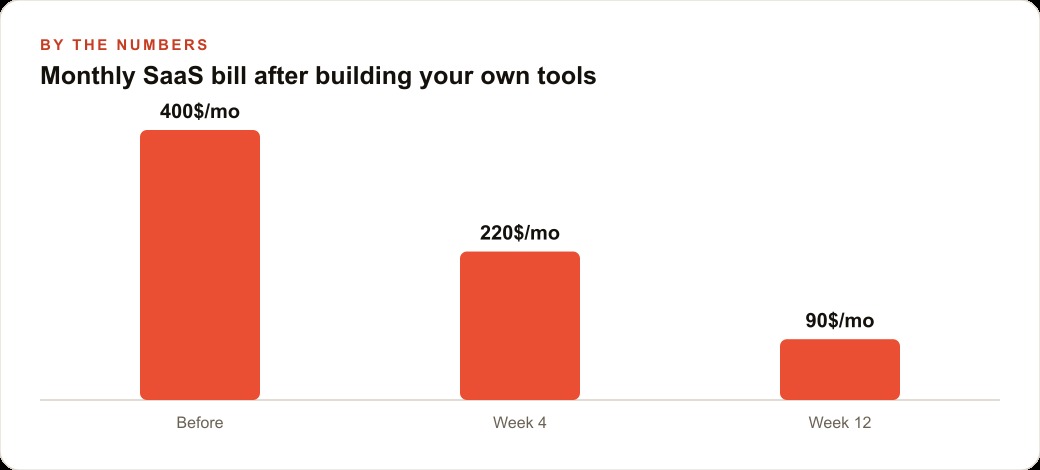
This is the trap the whole approach targets. None of those tools is complex. A link page, a form, a notes app, a content helper. They feel essential and they are cheap individually, which is exactly why the bills accumulate unexamined until the total is a real number. Illustratively, call it four hundred dollars a month across the overlapping subscriptions, which is five thousand a year for software the gym does not own and cannot change.
Chapter two: one prompt, five apps, and a real database underneath
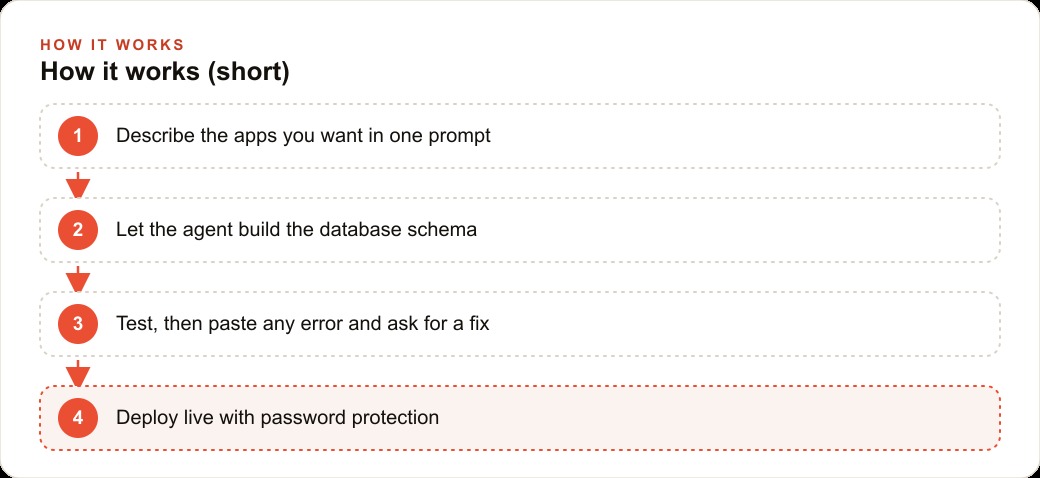
The build began with a single description of a gym operating system, handed to a vibe coding tool. Behind the scenes a coding agent set up a database schema across roughly ten steps, then assembled a desktop styled interface with the apps on top of that data layer. The part that makes this real rather than a demo is the database. Each mini app wrote to its own table. There was a table for links, a table for lead magnets, a table for submissions, and a table for downloaded content. When the owner added two links to the schedule page, both appeared in the database and on a live public share URL. When a visitor filled out the trial form, their name, email, and message landed in the submission table, ready to export.
This is the chapter that separates owning software from renting a screen. A pretty interface with no database forgets everything the moment you refresh, which is a toy. A real database underneath means the gym's data persists in a place the gym controls, which is a system. The agent building that data layer first, before the visible apps, is the whole reason the result is durable rather than a demo that looks good and remembers nothing.
Chapter three: when the notes app dropped keystrokes
It would be dishonest to skip the part where things broke, because they did, and how you handle it is the actual lesson. The notes app dropped keystrokes because it was trying to save on every single character, and the content downloader errored on its first attempt. In the old world, a bug like that meant filing a support ticket with a vendor and waiting. Here the fix was to paste the exact problem to the agent and ask for a patch, while other work kept running. At one point three prompts ran in parallel, one building a new app while two others were being repaired in the background.
The mindset this teaches a business owner is the important takeaway. You do not treat a bug as a wall or a personal failure. You describe it plainly, hand it over, and let the agent fix it, and because you own the code, there is no vendor between you and the repair. That shift, from waiting on someone else to fix your rented tool to fixing your own tool by describing the problem, is a big part of what ownership actually buys you.
Chapter four: the lead form that finally kept the leads
The single most valuable chapter for the gym was the lead form, because it fixed a leak the old stack had been quietly causing. In the rented setup, free trial requests lived inside the form vendor's system, which meant the front desk had to log into a separate tool to see them and often did not, so leads went cold. In the owned system, every trial request from the form persists in one place the front desk can export and follow up on directly, sitting in the same system as everything else rather than trapped in a vendor's silo.
That is not a cosmetic improvement. A gym's whole growth depends on following up with people who requested a trial and did not show, and a form that dumps leads somewhere nobody checks is worse than no form at all because it creates the illusion of capture. Owning the data means the leads are right there, which is why this kind of tool belongs at the center of a business's CRM and website stack rather than scattered across vendors. Illustratively, if the gym was getting a couple of dozen trial requests a month and converting a small fraction because follow up was inconsistent, simply making every lead visible and exportable in one place can lift that conversion meaningfully, and each recovered membership is worth far more than the entire software bill.
Chapter five: a content helper instead of a daily scramble
The next chapter tackled the daily social grind. The gym added an app that takes a short clip from a class, analyzes it with a capable model, and returns several caption options drawn from the gym's own past best performing posts, so the writing stops being a blank page scramble every morning. The clip analysis leaned on a model able to accept video input, of the kind Google has been shipping with Gemini, which is what lets a short class clip become the raw material for the captions rather than the owner having to describe the clip in words first.
For a gym running lean, the value here is not that AI writes captions. It is that the content work stops being a recurring cliff the owner climbs every day and becomes a few minutes of choosing among options that already sound like the gym. That reclaimed attention is exactly the sort of thing that makes the difference between a gym that shows up consistently on social and one that goes quiet whenever the week gets busy, and consistent presence is what feeds both organic reach and the creative that powers any Facebook and Instagram ad campaigns the gym runs to fill classes.
Chapter six: deploying it live and locked down
With the apps working and the bugs patched, the final build chapter was deployment. The whole system went live at a real URL with password protection turned on, so every coach and the front desk could use it while outsiders could not sign in. This matters more than it sounds. A tool that only runs on the owner's laptop is a personal project. A tool deployed to a live, access controlled URL is a system the whole team runs on, and the password protection means the gym gets the convenience of a web app without exposing its data to anyone who stumbles onto the address.
This is the chapter where the thing stops being the owner's clever build and becomes the gym's actual operating system, used by staff who never think about the machinery underneath, which is exactly how it should be.
Chapter seven: the bill three months later
Follow the numbers forward and the case makes itself. The gym walked in paying an illustrative four hundred dollars a month across four vendors. As it rebuilt those tools into one owned system, that bill fell, first toward the low couple hundred as the easy tools got replaced, and settling around ninety dollars a month once the core stack was in house, covering little more than hosting and the occasional model usage. That is roughly three quarters of the software bill gone, but the recurring savings are only half the story. The bigger payoff showed up in the data. Every free trial lead, every saved workout template, and every social caption now lived in one system the gym controlled, so when the owner wanted to chase the people who never converted, the data was right there to export rather than locked inside a tool the gym rented and might one day stop paying for.
And because a real database sat underneath it all, the system kept extending without new subscriptions. The gym could add a class attendance log or a simple membership tracker later by describing them, not by signing up for yet another vendor. That is the compounding difference between owning and renting. A rented stack charges you more as you grow. An owned stack absorbs new needs for the cost of describing them.
The quiet shift the owner did not see coming
The change that surprised the owner most was not the lower bill or the recovered leads. It was a shift in how it felt to want a new feature. In the rented world, every new need meant shopping for another vendor, comparing plans, entering another card, and adding another login the staff had to remember. Wanting more always meant paying more and fragmenting the data further. In the owned world, wanting more meant describing it. When the owner decided the gym needed a simple way to log which members attended which class, that was not a new subscription and a new silo. It was a request to the agent and a new table in the same database that already held everything else.
That change in posture matters more over time than any single feature, because it removes the friction that normally stops a small business from improving its own tools. Most gyms live with clunky, half fitting software for years simply because switching or adding is such a hassle. When adding a capability is a sentence rather than a purchase, the system keeps bending to fit the business instead of the business bending to fit the software. The owner stopped thinking of the tech stack as a fixed set of things they rented and started thinking of it as something they shaped, and that is a genuinely different relationship to have with the tools you run on.
What the gym's journey teaches any business
The gym is one instance of a pattern that fits almost any business paying for several small, simple tools. The rule I give owners is to start with the boring, cheap tools you already pay for, prove the workflow on those, and only then consider replacing anything expensive or critical. Owning a simple tool you control beats renting one you do not, but you earn the right to rebuild the important tools by first proving the approach on the low risk ones. That is exactly the order the gym followed, and it is why the rebuild strengthened the business instead of putting it at risk.
If you want to make the first move yourself, the path is straightforward. List the simple software you overpay for and pick the easiest one to rebuild first. Describe it in one prompt and let the agent build the database so your data persists from day one. Test it like a real user, and when something breaks, paste the exact error and ask for a fix instead of starting over. Generate your own simple icons or branding and feed them back so it feels like yours. Then deploy to a live URL with password protection so your team can use it before you polish it. The honest takeaway is not that AI can write code. It is that the people who run the work can now build the work, and the gap between paying for software and owning it is closing fast.
You can build this yourself with the steps above. If you would rather have the system designed, the data handled correctly so your leads never leak, and the whole thing deployed and locked down properly the first time, that is exactly the kind of build I help businesses ship, and you can bring me in to do it with you.
That is exactly what we do at AI DOERS. Book a private 30-minute call with Madhuranjan Kumar and we will map the fastest path to it for your specific business.
Book your call →
Madhuranjan Kumar
Madhuranjan Kumar brings 20 years of performance-marketing experience and has managed over $200 million in Facebook ad spend for brands across the United States and beyond. His expertise spans the full modern marketing stack: Meta, Google Ads, TikTok, email automation, CRM, and the websites that hold it together. At AI DOERS he turns that track record into lead-generation systems for businesses across every industry.