
How One Creator Runs a 2.5M-Follower Operation With Seven OpenClaw Agent Skills
An OpenClaw agent on a single Mac Mini, controlled through Telegram and taught small skill files plus API keys, drafts content, plans projects, and finishes work largely on its own. Here is how I would build the same setup for a real business.

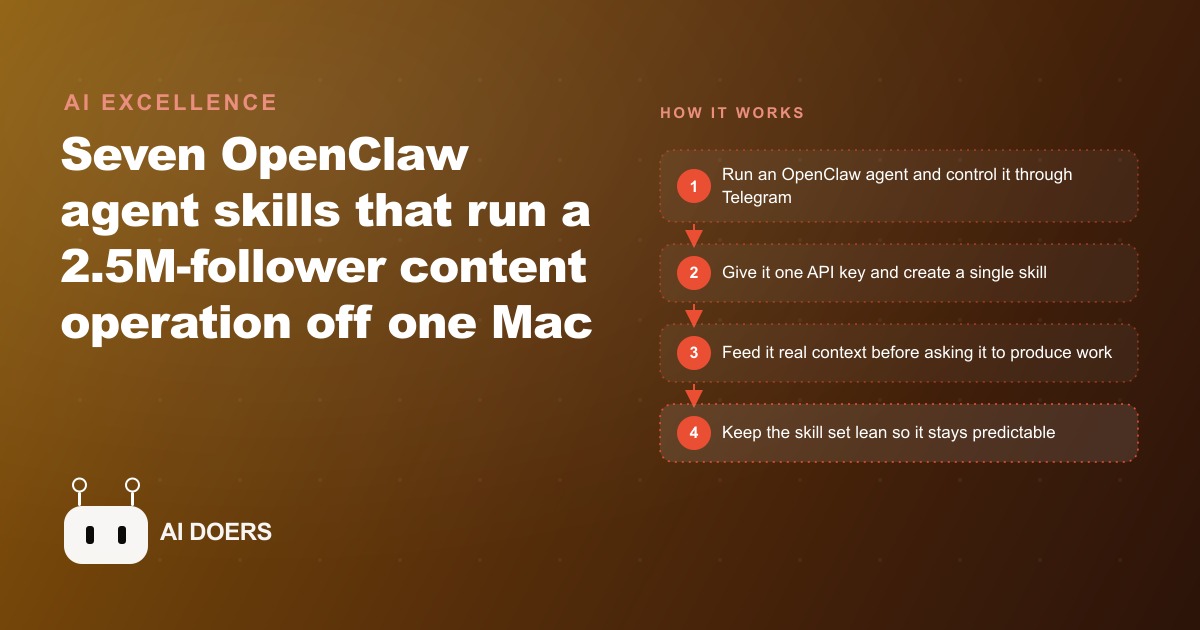
There is a creator running a content operation with more than 2.5 million followers across fifteen accounts, and the entire thing sits on a single Mac Mini in a room. No dashboard, no team of virtual assistants, no sprawling software stack. He talks to an AI agent through Telegram the way you would text a colleague, and the agent drafts posts, manages projects, pulls transcripts, builds mood boards, and controls his tools. When I first sat with how this actually works, the lesson that stayed with me was not about the size of the operation. It was about how small the pieces are. I am Madhuranjan Kumar, and I want to walk through what this setup teaches, because it quietly rewrites what a one person business can do, and it does so with parts you already understand.
The agent runs on something called OpenClaw, but the framework matters less than the shape. Picture a single AI agent that lives on one machine, reads and writes small files in a workspace folder, and does real work through a chat app. That is the whole architecture. Telegram becomes the interface, treated as a dedicated app because the setup is simple and it carries every command, including a reset to clear a chat and a stop command to halt the agent mid task. What makes it powerful is not the model humming underneath. It is the layer of skills sitting on top of it, and understanding what a skill actually is changes how you think about the whole thing.
A skill, in this world, is almost disappointingly humble. It is a small file that teaches the agent to do one specific thing, almost always paired with an API key. That is it. There is no grand system. There is a file that says here is how you create a document, connected to a key that lets you do it. Madhuranjan Kumar walked through seven skills that carry his entire operation, and the humility of each one is the point. A Notion skill takes an API key, creates and edits documents, and hands back a link you open right away. A transcript extractor pulls the words out of any YouTube, Instagram, or Twitter link and drops them into Notion. A Typefully skill studies his best captions and drafts five new options. A Linear skill, connected read only so nothing can break, summarizes tasks and builds a calendar from upcoming work. A thumbnail mood board scrapes top thumbnails and restyles them. A Google Images skill drops relevant pictures into the docs it writes. And a take the wheel skill flips the agent into an urgent leader that asks one critical question at a time until the job is finished. Seven small files. A 2.5 million follower operation.
If you look closely at those seven, one of them is quietly the star, and it is the least flashy: the transcript extractor. It matters because it solves the hardest real problem in using any AI agent, which is not intelligence but context. An agent with no context writes generic slop. The same agent, fed a few reference pieces in the right voice, writes with the right tone and pacing, sounding like a specific person rather than a robot. The transcript extractor is how Madhuranjan Kumar loads that context cheaply, roughly fifteen dollars a month for thousands of pulls, and once it is loaded the agent can write in his voice on demand. This is the throughline I want you to hold onto through the rest of this essay: context is the real product, not the model. Everyone obsesses over which model is smartest. The people getting actual work out of these tools are the ones who figured out how to feed the model the right information.
That reframing is what makes this relevant to a business that has nothing to do with content creation. Because the pattern underneath the seven skills is universal. Find a workflow you do over and over. Wrap it in one skill plus an API key. Give the agent the context it needs. Let it produce a first draft you only have to finish. That is the entire recipe, and it works whether you make videos or fix cars or file taxes. A law firm can have an agent assemble intake summaries. A clinic can have it draft appointment reminders and patient education notes. An e-commerce store can have it write product descriptions grounded in its real catalog rather than invented fluff. The point is never to automate everything at once. It is to take one painful, recurring job and hand it off cleanly, then another, then another.
There is a subtler lesson tucked inside the take the wheel skill that I think most owners will feel in their bones. The common frustration with AI is that it sits there waiting for instructions, and waiting is not what you need when you are busy. When Madhuranjan Kumar says take the wheel, the agent stops waiting and starts driving. It flips into an urgent leader, asking one critical question at a time with the key part in all caps, reframing relentlessly until the task is done. That is the difference between a chat toy and a teammate. A teammate does not need you to specify every step. It pushes the work forward, asks the one question that unblocks it, and keeps going. Building that behavior into an agent is what turns it from something you have to manage into something that manages the task for you.
Let me make this concrete with a real estate brokerage, because abstraction only goes so far, and I want to use illustrative numbers to show the shape of it. Agents at a brokerage drown in repetitive writing. Listing descriptions, neighborhood blurbs, follow up emails, social posts for every new property. A single listing write up and its social captions might take forty five minutes when done well and by hand. So the first skill I would build turns a few facts about a home, the address, square footage, upgrades, and three photos, into a polished listing description and a set of captions in the brokerage's own voice. But notice the order of operations, because it follows the throughline. Before I ask it to write anything, I load context. Following the transcript extractor idea, I feed the agent the brokerage's best past listings and top performing posts, so it writes like the team already writes instead of sounding generic. Only then does the writing skill fire.
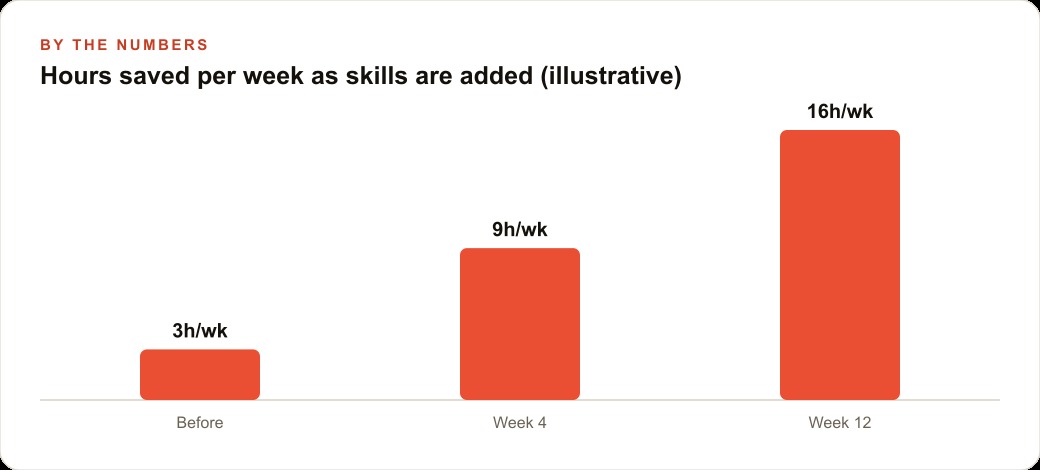
From there the setup grows the way Madhuranjan Kumar's did, one honest step at a time. I add a Notion skill so every draft lands in a shared workspace with a link the agent emails back, ready for a quick human edit. I connect a read only task board so the agent can see which listings go live next week and pre draft everything in advance. The owner talks to all of it through one messaging app, exactly the way Madhuranjan Kumar does. And the math starts to shift. That forty five minute listing write up becomes a five minute review. Across a brokerage doing a dozen new listings a week, that is hours reclaimed, and the drafts are consistent because the voice was loaded once and reused. These numbers are illustrative, not a guarantee, but the direction is real, and the quality of that first draft holds up precisely because the context work was done first. That same well organized content, the listings and neighborhood write ups, does double duty feeding SEO and organic search, while the follow up drafts and lead notes live in the CRM and website stack where nothing gets dropped, and the best performing captions become raw material for Facebook and Instagram ad campaigns.
There is one rule I would enforce above all others, and it is the rule Madhuranjan Kumar learned the hard way and states plainly. Fewer skills work better. A brokerage does not need fifty skills. It needs three or four that fire reliably. The instinct, once you see how easy skills are to make, is to build more and more of them, and that instinct is a trap. Pile on a thousand skills and the agent becomes a chaotic mess that stops knowing which one to use, producing random actions instead of real outputs. Restraint is a feature. Keep the set lean and the agent stays predictable, and a predictable agent is one you can actually trust with real work. This is the same discipline that separates a clean toolbox from a junk drawer. The value is not in how many tools you own, it is in how reliably the few you keep do their job.
I want to dwell for a moment on why this whole approach is more durable than the flashier alternatives you will be sold, because the durability is the real argument. The impressive part of Madhuranjan Kumar's setup is not that it is cutting edge. It is that it is boring in the best way. A single machine. A chat app. Small files. Keys to the tools he already uses. Nothing about it depends on a fragile chain of third party services that could break overnight, and nothing about it requires him to be technical in a deep sense. When something goes wrong, he can look at the small file, understand what it does, and fix it, because the pieces are small enough to hold in your head. Compare that to a sprawling automation built on ten interconnected platforms, where a single change anywhere can silently break the whole thing and nobody can find the cause. Simplicity is not a limitation here. It is what makes the system survivable for one person.
That durability is why the curiosity habit Madhuranjan Kumar practices matters so much. He does not just accept that the agent saved a preference. He asks it to explain exactly what it changed, and in doing so he keeps building a real mental model of how the files and skills drive the outputs. The more you question it, the more you understand it, and the more you understand it, the less it feels like magic you are afraid to touch and the more it feels like a machine you own. That ownership is the difference between depending on a black box and running a system you actually control. For a business owner, that distinction is everything, because a tool you understand is a tool you can trust with real work and fix when it stumbles, while a tool you do not understand is a liability waiting to surprise you at the worst moment.
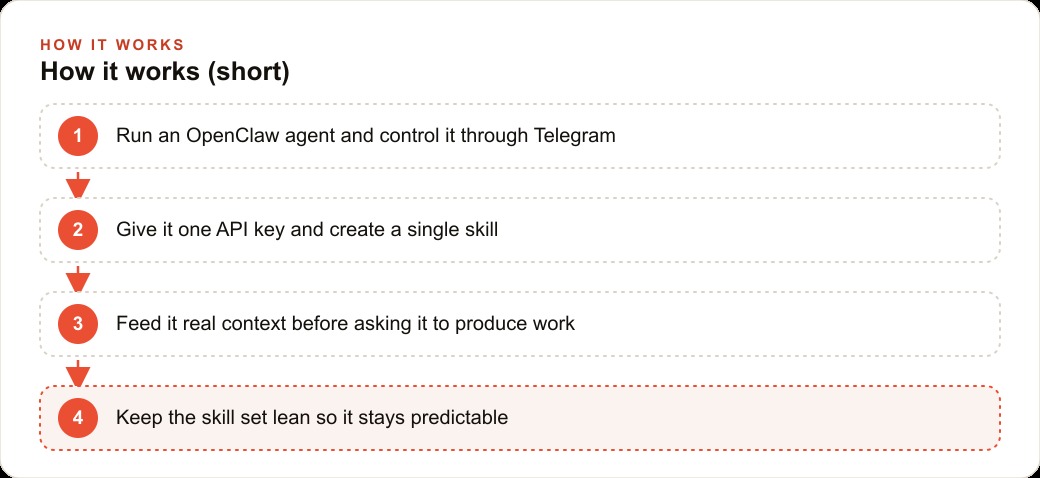
So if you take one thing from this creator running a media empire off a Mac Mini, let it be the sequence, not the spectacle. Start with one skill, not seven. Stand up an agent, connect it to a single messaging app you control, and give it exactly one API key for the tool you use most, whether that is Notion or your task board. Build one skill around the workflow you most hate doing by hand, then prove it works by resetting the chat and running a fresh task to confirm the skill actually fires. Feed it real context before you ever ask it to write in your voice, because that, more than anything, is what separates output that sounds like you from output that sounds like a machine. When it does something wrong, correct it the way you would correct a new hire, and watch it save that preference for next time. Get curious about what it changed when it saved that preference, because the more you question it, the more you understand how its files and skills actually drive its outputs. Only once that first skill is solid should you add a second.
You can absolutely build this yourself, one skill at a time, and I genuinely encourage anyone curious to start this week, because the parts are smaller and more approachable than the impressive results make them look. If you would rather have someone stand up the agent, wire in your tools, load your real context, and build the handful of skills that fit your business, that is the kind of work I do for clients, and you can bring me in to set it up for you.
That is exactly what we do at AI DOERS. Book a private 30-minute call with Madhuranjan Kumar and we will map the fastest path to it for your specific business.
Book your call →
Madhuranjan Kumar
Madhuranjan Kumar brings 20 years of performance-marketing experience and has managed over $200 million in Facebook ad spend for brands across the United States and beyond. His expertise spans the full modern marketing stack: Meta, Google Ads, TikTok, email automation, CRM, and the websites that hold it together. At AI DOERS he turns that track record into lead-generation systems for businesses across every industry.