
How One Creator Automated iOS App Shipping With Claude Code
A five-phase Claude Code pipeline clones a scaffolding repo, researches an idea, writes the Swift app, self-tests it in the simulator, and uploads it through App Store Connect with a browser agent, shipping apps in hours.

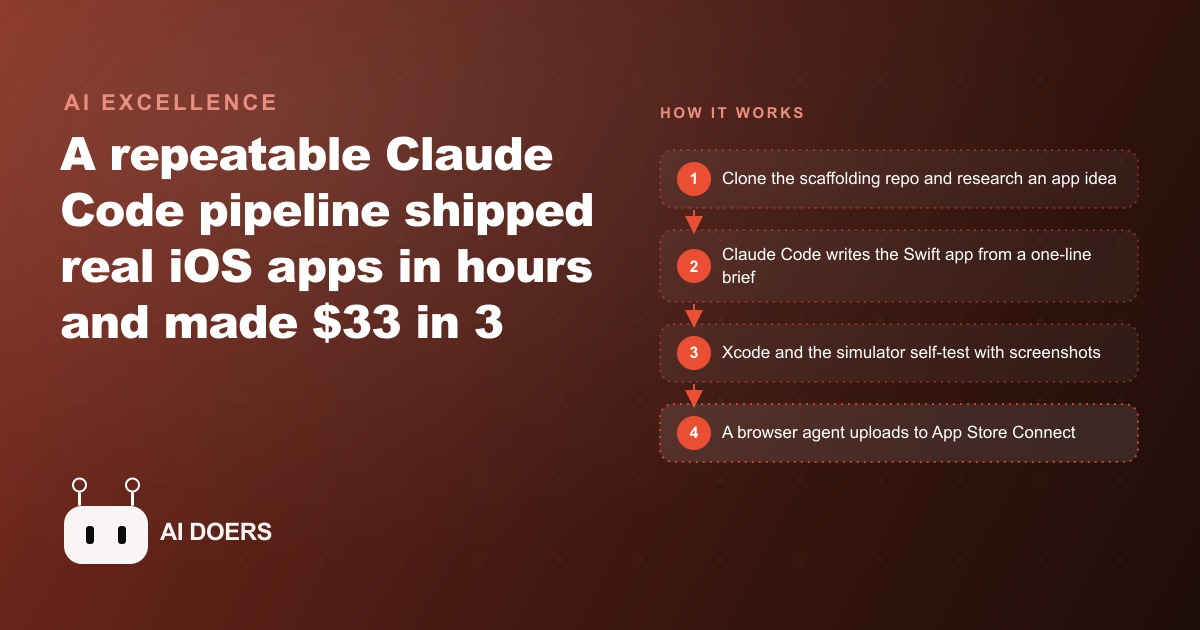
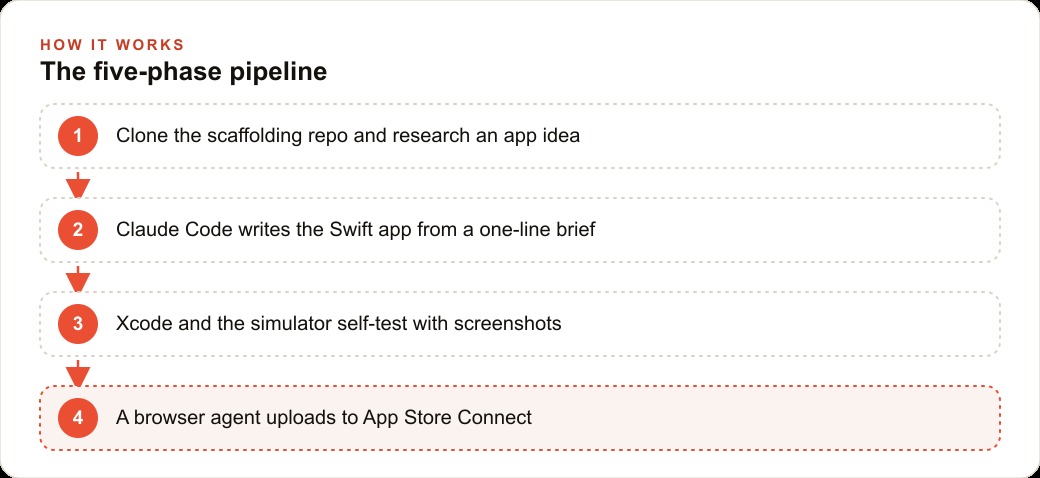
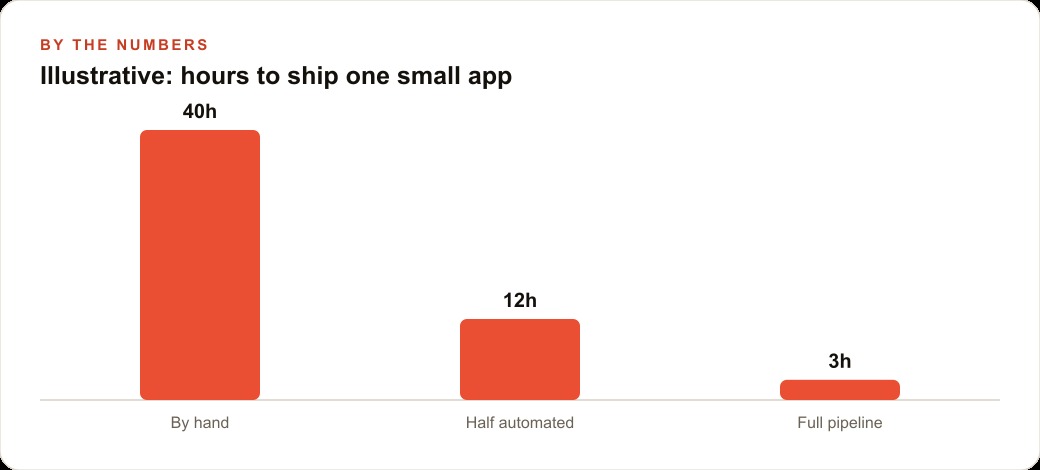
A tiny app called Needle Collector went live on the App Store on April 16th, made $33 across 16 units in roughly three days, and reached number 12 in the paid Lifestyle category. The dollar figure is modest by any standard. What it proves is not modest: a five-phase automated pipeline built on Claude Code researched the idea, wrote the Swift code, tested the app in the simulator, and uploaded the listing with a browser automation agent, without Madhuranjan Kumar sitting at the keyboard for most of it. The Apple developer account cost roughly $70. The build ran in hours. What follows is an analysis of five things that pipeline gets right, each one directly contradicting how most solo developers approach the same problem.
It leads with a real sale before explaining the method
Most tutorials about automated workflows open with tool setup, then architecture diagrams, then a demonstration that something runs. Madhuranjan Kumar's pipeline does the opposite. It opens with evidence: real sales, a real unit count, a real category ranking on the App Store. The explanation follows the proof.
This ordering is not incidental. It is the correct structure for making a business case for any automated system. The method is not persuasive on its own. Results are persuasive. A pipeline that shipped a real app and earned real money is a business argument. A pipeline that could theoretically ship apps is a promise. When clients and stakeholders see the sales dashboard before they hear about the architecture, every subsequent question about the method lands differently, because it is already grounded in a demonstrated outcome.
The practical lesson for any business owner building an automated workflow is to run it once on something real before explaining it to anyone. Not a demo, not a proof of concept, not a sandbox experiment. Something that went live and produced a result, even a small one. The Needle Collector result was small and entirely sufficient. It established the system's credibility more effectively than any architectural explanation could have.
This sequencing matters equally in the context of paid acquisition. If you manage meta-ads campaigns and want to pitch an automation-assisted workflow to a client who asks for proof, showing a real campaign that ran through the pipeline is a far stronger answer than describing what the pipeline would theoretically do. Real results from real conditions are the only convincing evidence in a field where everyone claims efficiency and speed.
Madhuranjan Kumar did not hedge. He did not frame the $33 as a proof-of-concept number that would scale differently in a real launch. He presented it as the actual first result of the first app from the system, noted the category ranking, and moved on to explaining how it happened. That confidence is only available because the result was real, and the order, result first then method, is what made it believable.
It builds the scaffold once and clones it for every app after
Every run of the pipeline begins with one action: cloning a private scaffolding repository. That repository holds every tool, permission, and capability the pipeline needs to complete a full build. Claude Code's skills for Xcode, the App Store Connect integration, the browser automation configuration, the screenshot capture scripts, the mock data seeder. All of it lives in one repo that has already been built and tested.
The scaffold is the real investment. Building it the first time takes real work. Every app after the first is a clone. Madhuranjan Kumar is not rebuilding anything from scratch for each new idea. He is cloning a proven system and pointing it at a new concept.
Most solo developers make the opposite choice: they build each project from scratch, reusing some patterns but fundamentally starting over each time. This means every project carries the full setup and configuration cost. The scaffold approach means only the first project carries the full setup cost. Every subsequent project pays only the cost of the idea and the idea-specific code. The savings compound with each build.
For any business building internal tools with an AI agent, the scaffold principle applies directly. Build one well-structured base project that includes your database configuration, your authentication approach, your deployment setup, and your testing scripts. Clone it for every new tool. The second tool takes a fraction of the time the first did. The fifth tool is nearly free in setup terms. This is the compound return that eventually makes building custom tools cheaper than subscribing to off-the-shelf software, even before accounting for the seo-content and other digital infrastructure a custom tool can support by solving the exact workflow the business actually runs.
The scaffold also enforces consistency. Every app built from the same base has the same structure, the same deployment target, the same testing approach. When something goes wrong, the debugging process is familiar because the foundation is the same. A team that builds five tools from five different starting points has five different architectures to understand when something breaks. A team that builds from one scaffold has one architecture, and every person on the team can navigate it.
It treats research as a loop to steer, not an oracle to trust
The pipeline includes a research phase where Claude Code is prompted to surface at least five app ideas. Madhuranjan Kumar's account of this phase is instructive: the first pass was weak. It produced a UPF scanner and a doom-scroll report, ideas that already exist in various forms and offer no obvious differentiation. He did not accept the first output. He probed again, pushed on specifics, asked for different angles, and the second pass produced the concept that became the Needle Collector app.
The mistake most people make with AI research tools is accepting the first output as the answer. The first output is the agent's best interpretation of the initial prompt. It is a starting point, not a conclusion. Probing a second time, asking what ideas the agent passed over, asking which angles are genuinely uncrowded, pushing on specificity consistently produces better results than stopping after the first list.
This applies to every domain where agents support research decisions. A business planning a new service line that asks an agent for competitive analysis and accepts the first summary is getting one layer of analysis. The one that pushes back, asks what competitors are failing at, asks what customers complain about in reviews, and asks which positioning angles are genuinely open gets an actionable picture rather than a conventional summary.
The research loop is also where human judgment earns its keep. The agent surfaces candidates. The human evaluates them against context the agent does not have: what distribution channels are available, what the local market actually wants, what the builder can realistically support. The Needle Collector concept came from a second probe that was steered toward something specific and evaluatable. The agent did not make the final call; it provided the raw material from which Madhuranjan Kumar made the call.
Audience research for any kind of digital campaign follows this same improvement curve. A first-pass analysis will yield conventional segments. A second-pass probe asking specifically what those audiences are frustrated by in existing solutions, what language they use in their own reviews, and what they consistently say they wish existed produces the insight that actually informs creative decisions rather than confirming what you already knew.
It validates automatically before a human sees anything
After Claude Code writes the Swift code, the pipeline does not hand it directly to Madhuranjan Kumar for review. It builds the project with Xcode, launches the simulator, seeds mock data, exercises the core feature, and captures eight screenshots. The pipeline checks that the app works before a human is asked to evaluate it.
This is a quality gate that most builders skip in the interest of speed. The typical sequence is write code, run it manually once or twice, and submit. The automated validation step catches an entire class of bugs that manual spot-checking misses: features that work in isolation but fail when realistic data is loaded, screens that display correctly at one simulator size but clip text at another, flows that succeed on the first run but break after the database has been written to once.
The eight-screenshot capture is also practically valuable beyond the validation itself. App Store submissions require screenshots showing the app working correctly across device sizes. An automated pipeline that produces those screenshots as a byproduct of testing means the submission materials are ready the moment the code is validated. No second session to set up the simulator, populate it with demo data, and capture screens manually.
For any business deploying internal tools, the validation principle applies even without an App Store submission. A tool that goes from built to deployed without a structured validation pass will break in front of real users. The fix is to define the validation criteria before building and automate the check as part of the build process. Specific things that must work before the tool is considered deployable. Run them on every build. Catching problems when they are cheap to fix, during the build, saves the much higher cost of fixing them after someone is depending on the tool. Any web-crm deployment, any customer-facing form, any internal dashboard deserves this gate before it goes live.
The deeper habit the automated validation teaches is to separate the "does it run" question from the "does it work" question. A pipeline that only checks that the app compiles is not validating the app. A pipeline that compiles, seeds real-looking data, exercises the specific flow the user actually takes, and captures evidence of the result is the one that can be trusted. Build the evidence-gathering into the process itself, not as an afterthought before submission.
It frames the economics as stacked streams, not a single hit
The $33 result from the Needle Collector app is presented explicitly as one small stream among many that will be stacked. The Apple developer fee of approximately $70 gets paid back within a handful of sales at typical small-app pricing. From that point, every sale is net positive and requires no ongoing active work from Madhuranjan Kumar. The strategy is to keep building and let the streams accumulate.
This framing is different from how most builders think about an app project. The conventional frame is one big product launch: a single app, a significant marketing push, hoping for a revenue event that justifies the investment. That frame makes every modest result feel like failure. A first month with $33 in revenue, judged against the expectation of a breakout product, would be discouraging. Judged as the first trickle of a stream that will be joined by nine others, it is exactly what the strategy requires.
The pipeline is what makes the portfolio strategy economically viable. If each app took three months of developer time, building ten apps would be a two-and-a-half-year project. If the pipeline reduces each build to hours of active work plus a day of automated processing, ten apps is a reasonable multi-month project. The economics only work because the production cost is low enough that the modest per-app revenue is a real return on a small investment, not a consolation prize.
The stacked-streams framing is also more accurate to how small software products actually accumulate revenue over time. A portfolio of ten genuinely useful small apps, each earning consistently at a modest level, typically produces more total revenue than any single larger app. The individual bets are small, the failures are cheap, and the successes compound month over month.
Businesses that run profitably at scale understand this model intuitively. A plumbing company does not depend on one massive renovation contract. It keeps the trucks moving and the revenue comes from consistent volume across many smaller jobs. The app-as-stream framing is the same logic applied to software products. Build many. Keep the cost per build low. Let the portfolio accumulate quietly while the primary business runs.
For a business owner evaluating whether to build custom tools rather than buy software subscriptions, the stacked-streams frame applies directly. One tool is a small bet. A portfolio of five tools built from the same scaffold is a business infrastructure. Each one is a stream, and the combined value of tools built exactly to how the business runs, without the compromises of generic off-the-shelf software, compounds month over month.
Madhuranjan Kumar works with builders and business owners on setting up production pipelines like this: the scaffolding that makes the first build the hardest and every subsequent one faster, the validation layer that catches problems before users do, and the portfolio framing that turns modest individual results into meaningful cumulative value. If you want to understand how to build one of these systems for your specific context, that conversation is worth having.
That is exactly what we do at AI DOERS. Book a private 30-minute call with Madhuranjan Kumar and we will map the fastest path to it for your specific business.
Book your call →
Madhuranjan Kumar
Madhuranjan Kumar brings 20 years of performance-marketing experience and has managed over $200 million in Facebook ad spend for brands across the United States and beyond. His expertise spans the full modern marketing stack: Meta, Google Ads, TikTok, email automation, CRM, and the websites that hold it together. At AI DOERS he turns that track record into lead-generation systems for businesses across every industry.