
How Microsoft's Off-Frontier AI Strategy Could Quietly Beat OpenAI
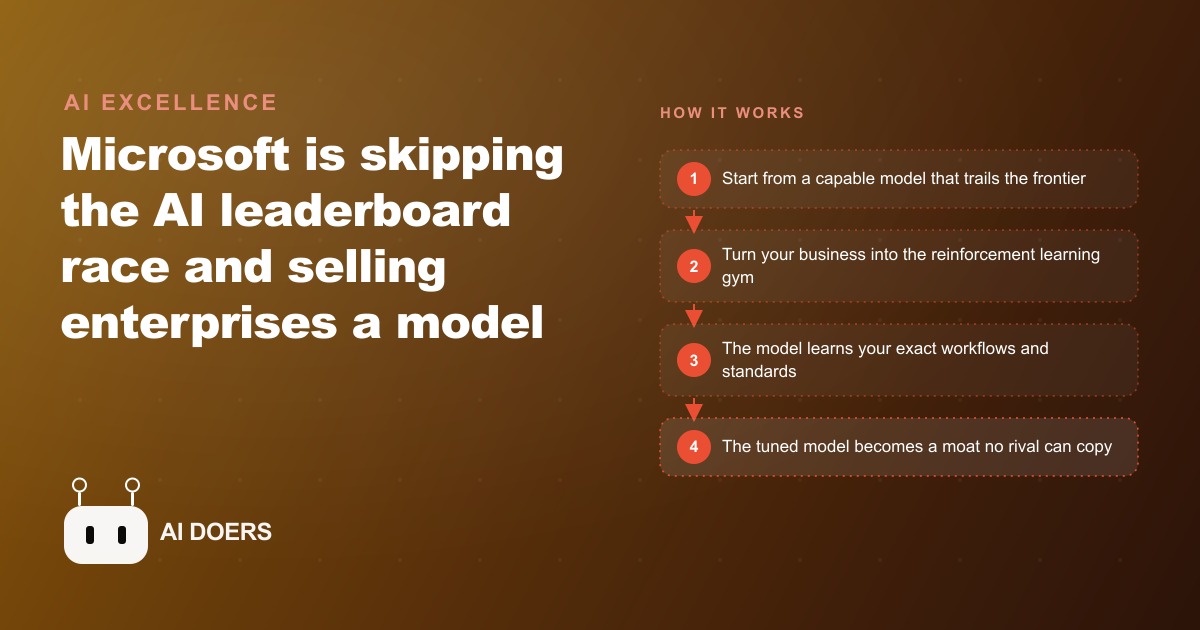
Microsoft is skipping the race to top the leaderboard and selling enterprises MAI models that deliberately trail the frontier by three to six months, then get trained on each company's own workflows so the tuned model becomes a moat rivals cannot copy.

The assumption driving most enterprise AI strategy right now is that the right move is to get on the most capable frontier model as fast as possible and stay there, migrating every quarter as the leaderboard shifts. Microsoft just built a new model family, published its results, and the core message of how they did it and what they found is that this assumption is wrong for most businesses, and that chasing the frontier is not only expensive but actively counterproductive for any organization that wants durable competitive advantage from AI rather than a recurring subscription bill for capability that every competitor has access to on the same terms.
The leaderboard race costs a fortune and leads you to the same place everyone else ends up
The AI capability leaderboard updates roughly every 90 days. A new model releases, benchmark scores shift, and organizations that have built workflows on the previous frontier model spend significant time and money re-integrating, re-testing, and re-validating their pipelines on the new version. This cycle repeats every quarter without exception. The result is that a meaningful portion of AI operational budget is not going into doing better work or building better products. It is going into staying current with a leaderboard that every other organization using the same API is also chasing, on the same schedule, at the same per-token price.
The second problem with the leaderboard approach is more fundamental: it provides no differentiation at all. If your AI strategy is to use the best available model at all times, your strategy is identical to that of every competitor with a credit card and an API key. The model vendor has the same sales conversation with all of your competitors that they have with you. Whatever capability advantage you believe the frontier model gives you, your competition has it on exactly the same terms, typically on the same day the model ships. You are renting a commodity that everyone in your market can also rent, and paying premium prices because the commodity is labeled frontier.
For businesses running Google Ads or Facebook and Instagram ad campaigns, this plays out concretely. Any AI-powered bid optimization or creative testing workflow built on a commodity frontier model can be replicated by a technically capable competitor within a few days of them deciding to do it. There is no accumulated advantage, no compounding moat, and no reason the capability produces better results for you than for anyone else who also pays the API bill. You are renting capability, not building it.
Three to six months behind the frontier is actually the smart position
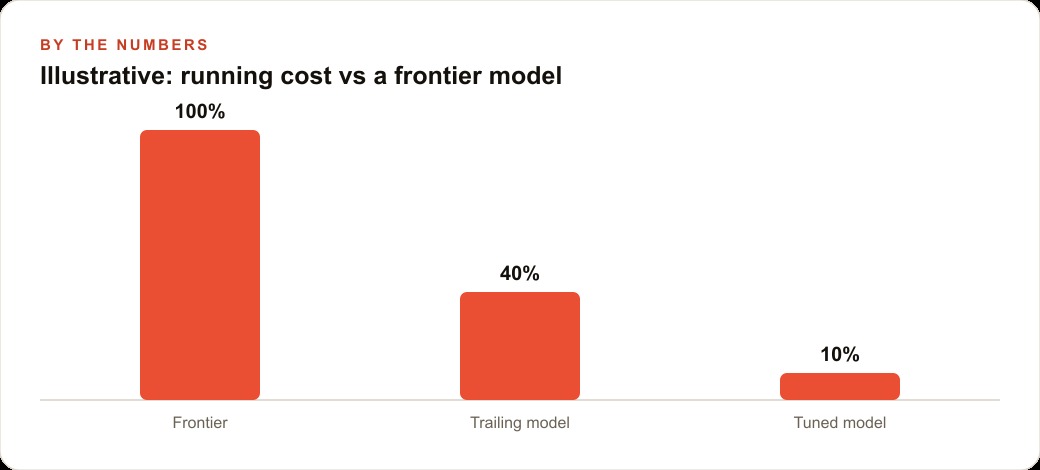
Microsoft's MAI team, built in six months under Mustafa Suleiman who co-founded DeepMind, arrived at a counter-intuitive doctrine they call off-frontier. The idea is that instead of racing to be on the absolute leading model at all times, you deliberately trail the frontier by three to six months. In that window, the practical capability gap between the frontier and a three-month-old model is small for most real-world tasks. The cost difference is not small. A model that is three months old, deployed long enough for inference infrastructure to be fully optimized, and not priced at a new-release premium, can deliver comparable quality at a fraction of the per-token cost.
Microsoft applied this doctrine internally and found that a MAI model tuned specifically for Excel agent tasks performed on par with the latest frontier model in that domain while being up to ten times more efficient on compute. Ten times more efficient is not a marginal improvement. It means running ten times the workload for the same infrastructure budget, or running the same workload at a tenth of the cost and reallocating the difference to something that actually produces compounding returns.
The off-frontier position also has a stability benefit that is rarely discussed in the context of the leaderboard conversation. An organization that has been running the same base model for six months has six months of real production data on how the model behaves, where it gets things wrong consistently, what kinds of inputs trigger problems, and what the failure modes look like under realistic load conditions. That operational knowledge is not transferable when you migrate to a new model. Every migration restarts the operational learning curve. The three-to-six-month lag is not a resource constraint you accept reluctantly. It is a deliberate choice to extract maximum value from a stable, understood base before paying the migration cost to start the learning curve again.
The compound effect of the off-frontier position over two years is significant. An organization that migrates quarterly accumulates four sets of disruption costs per year and never develops deep operational knowledge of any single model. An organization that stays on a stable model for six months at a time, extracts full operational value from it, and migrates only when the capability gap becomes large enough to justify the disruption, accumulates knowledge faster and spends less on migrations. Over two years, the operational maturity difference between these two approaches is substantial.
Your business as a reinforcement learning gym
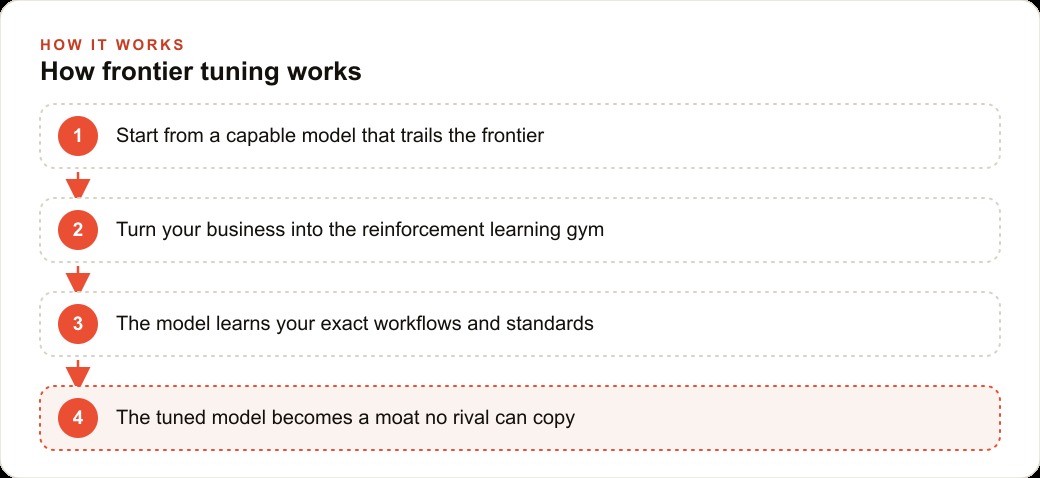
The most significant concept in the MAI announcement is what Microsoft calls frontier tuning. The standard model improvement approaches involve training on more data or scaling up compute. Frontier tuning is different in kind: you take a capable base model and use your own business workflows, quality standards, and operational decisions as the reinforcement learning signal. The model learns from your specific operational environment rather than from generic training data. Its reward signal comes from how well it performs inside your actual work environment, evaluated against the specific quality standards your organization applies to outputs.
This is a substantively different proposition from fine-tuning on historical examples. Fine-tuning adjusts weights based on past cases and produces a model that is better at those cases. Frontier tuning turns your ongoing operations into a continuous improvement loop. Every decision your team makes, every quality standard it applies, every correction it gives to a model output, feeds back into the model's improvement cycle. The model does not just get better at the domain in general. It gets better at your version of the domain specifically, as evaluated by your standards rather than by a benchmark written by the model provider that applies to every customer equally.
For any business that has developed genuine expertise in its domain, whether that is a specific methodology for SEO and organic search built over years, a particular discipline around conversion rate optimization, or a way of evaluating creative quality that reflects real knowledge of what their specific audience responds to, frontier tuning is the mechanism for converting that expertise into a durable capability inside the model. The model becomes a carrier of institutional knowledge rather than a generic reasoning engine you share with every other paying subscriber.
The moat that cannot be replicated by buying a better subscription
The practical implication of frontier tuning is that the tuned model becomes a genuine competitive asset. A company that has spent six months running its workflows through a frontier-tuned model has six months of its own business logic, quality standards, and operational judgment baked into the model's behavior. A competitor cannot access that by upgrading their subscription or migrating to a newer frontier release. They would need to run their own six months of tuning with their own operational environment to arrive at something comparable. And by the time they complete that process, the organization that started six months earlier will have another six months of improvement accumulated ahead of them.
This is the inverse of the leaderboard dynamic in every important respect. Migrating to a new frontier model is fast and cheap for everyone simultaneously. Abandoning a six-month-tuned model that carries your institutional knowledge is expensive and painful, because none of that accumulated improvement transfers to a new base model. You lose the moat the moment you migrate. The competitive advantage comes precisely from the cost of abandonment: a competitor cannot simply buy their way to the same position, and the longer you maintain the tuned model, the larger the gap they would need to close.
The organizations that will extract the most value from frontier tuning are not necessarily the largest ones. They are the ones most systematic about capturing their operational standards and feeding them consistently into the reinforcement learning environment. A focused business with genuine expertise in a specific domain, operating with disciplined frontier tuning against that domain, can build a model that outperforms a much larger competitor's generic frontier deployment for the specific tasks that matter to their business.
What Windows becoming an agent runtime means for businesses that act now
The final component of the MAI announcement with concrete near-term implications is Windows evolving into an agent runtime. Microsoft is building sandboxed container environments called MXC that allow AI agents to run inside Windows with controlled, audited access to local applications, data, and network resources. Open Claw, previously a niche research project, is being positioned for mainstream deployment through this agent infrastructure. This changes what AI integration means in practice. Instead of AI being a cloud service you query through an API, it becomes a local process that can observe and interact with the applications running on the machine, access local data with appropriate controls, and take actions across the desktop environment with a sandboxed scope that limits what can go wrong.
For businesses, the near-term implication is that the window to build AI-integrated operations leveraging this infrastructure is open right now and will narrow as the capability becomes commoditized and every competitor has access to the same tools. The organizations that build these workflows while the infrastructure is new will develop operational expertise and process integration that is difficult to replicate quickly. The pattern is identical to what happened with programmatic advertising a decade ago: the businesses that built systematic testing and optimization processes in the early years operated at a structurally lower cost per acquisition than competitors who waited for the capability to mature before engaging with it.
The combination of off-frontier economics, frontier tuning for institutional knowledge, and Windows as a sandboxed agent runtime is a coherent alternative to the leaderboard race most enterprise AI strategies are running. It is not about using inferior models. It is about using models deliberately rather than aspirationally, extracting compounding value from stable operational environments rather than paying for quarterly migrations, and building moats through accumulated expertise rather than through premium access to the same commodity capability your competitors also purchase. Microsoft validated the approach by building a model family in six months that competes with frontier results at a fraction of the compute cost. The strategic question is not which frontier model to use. It is whether you are building something that compounds or something that resets every time a better model ships.
The companies most likely to miss this strategic window are the ones whose AI decisions are made by comparing benchmark scores rather than by asking what kind of advantage they want to have in twelve months. Benchmark scores measure generic capability on standardized tests written by model providers. They say nothing about how well a model performs in your specific operational environment, evaluated against your specific quality standards. A frontier-tuned model that has been refined against your business's actual decision-making patterns for six months will outperform a marginally higher-scoring frontier model on the tasks that actually matter to your business. That is the central insight Microsoft's MAI team operationalized, and it is available as a strategic approach to any organization willing to commit to the discipline of running their operations as a reinforcement learning environment rather than just as a consumer of commodity AI capability. The question most enterprise buyers have never been asked to answer is: what is your business's operational signal worth as a reinforcement learning environment? Until recently, there was no practical way to use it. The MAI announcement is the clearest public signal yet that the answer to that question has real dollar value, and that the organizations which figure out how to capture and deploy that signal will have AI systems that compound in effectiveness rather than resetting every time a new frontier model ships.
That is exactly what we do at AI DOERS. Book a private 30-minute call with Madhuranjan Kumar and we will map the fastest path to it for your specific business.
Book your call →
Madhuranjan Kumar
Madhuranjan Kumar brings 20 years of performance-marketing experience and has managed over $200 million in Facebook ad spend for brands across the United States and beyond. His expertise spans the full modern marketing stack: Meta, Google Ads, TikTok, email automation, CRM, and the websites that hold it together. At AI DOERS he turns that track record into lead-generation systems for businesses across every industry.