
How Meta's SAM 2 Makes Hard Computer Vision Cheap to Build
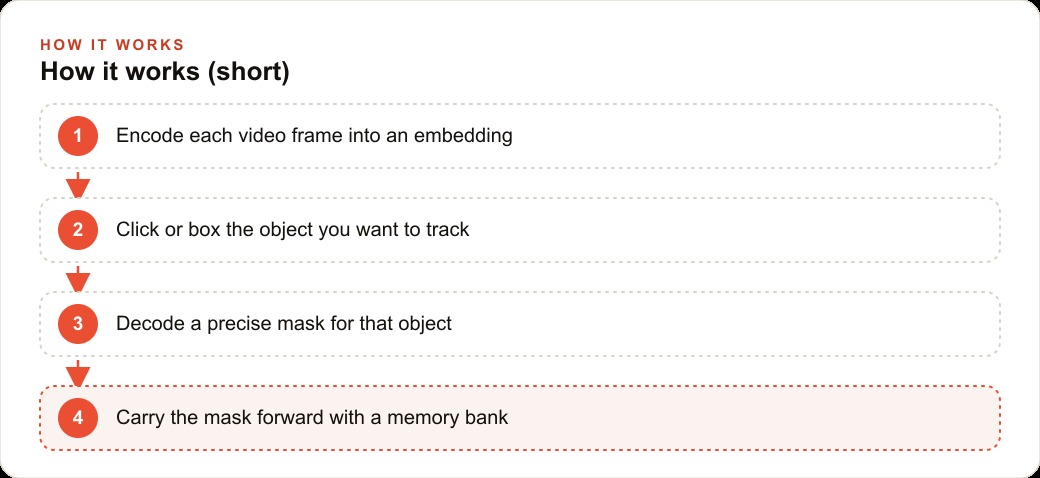
SAM 2 is a promptable video segmentation model that tracks any object across every frame using a memory bank, turning projects that were once too costly, like defect detection or face blurring, into things a small team can build.

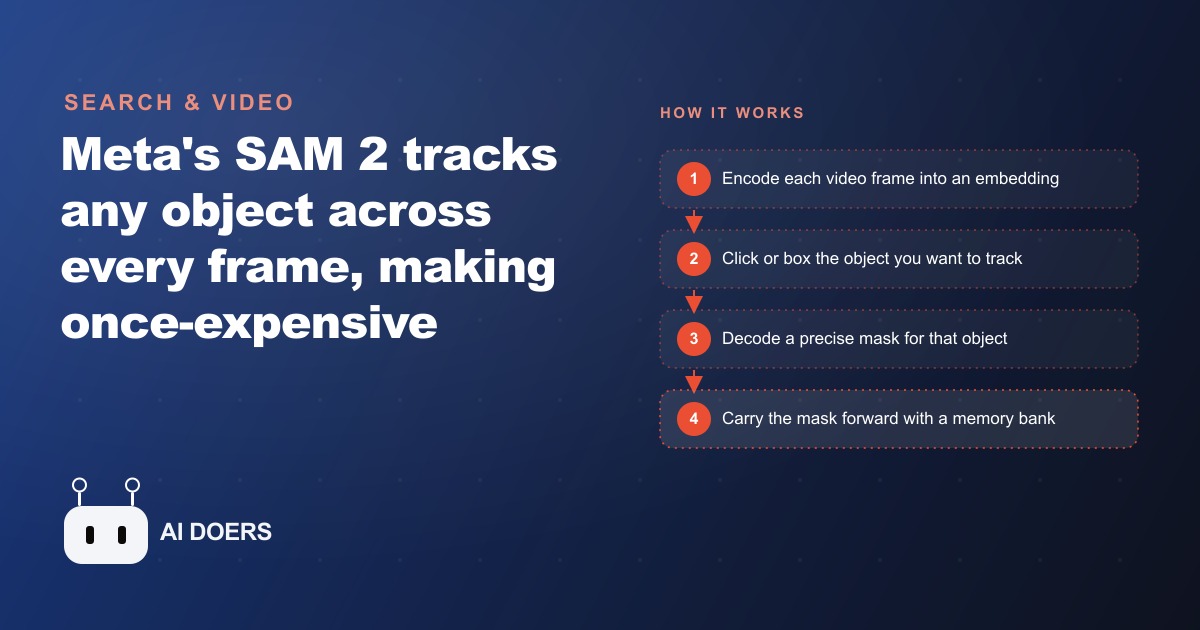
This breakdown demonstrations of SAM 2 tracking objects across a busy scene are genuinely impressive, but they are also the least interesting thing about the release for a business that is trying to build something real.
Why this breakdown demo is the wrong thing to focus on
SAM 2 is Meta's Segment Anything Model 2, a tool that tracks and outlines objects across every frame of a video with high accuracy, even when the tracked object disappears briefly behind something else. The demos show it following a ball through a crowd, tracking a specific person through a busy public space, and maintaining precise object boundaries as lighting and camera angles shift. Those demonstrations are technically impressive and they are also, for most businesses, a distraction from the release's actual significance.
This breakdown tracking demos are compelling because smooth multi-object video tracking has historically required expensive custom-built systems with trained engineers. But most businesses do not actually need to track a moving object through a live video in real time. They have never been blocked from a business goal by the inability to follow a ball through a crowd. When Madhuranjan Kumar reviews a new model release from the perspective of what it actually changes for a real operation, the first question is not what the most visually dramatic demo shows. The first question is what problem it makes cheaper to solve, because the price of solving a problem is the thing that determines whether it gets solved at all.
The most important thing SAM 2 makes cheaper is data labeling for computer vision systems, and that is a problem that has been blocking businesses from building practical vision tools for years. This breakdown demo gets the headline. The annotation cost collapse gets a paragraph near the bottom. The emphasis should be reversed.
The annotation cost that was the real barrier to computer vision in small business
Building a useful computer vision system for a specific business use case requires labeled training data. Labeled training data means images where a person has drawn precise outlines around every object the model needs to recognize, with each outline tagged with the correct category. A system that identifies cracks in a concrete floor needs thousands of images where cracks are precisely outlined. A system that spots misaligned products on a store shelf needs thousands of images where each product, each gap, and each misalignment is precisely outlined. A system that blurs faces in customer-facing video needs examples where every face in a wide variety of conditions is precisely outlined and tagged.
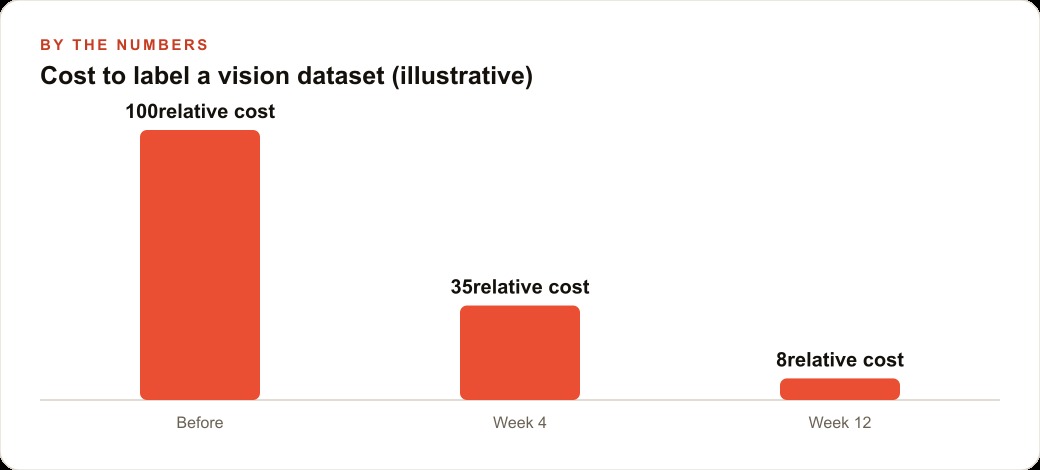
Precise outlining is slow and expensive. At professional data labeling rates, a dataset of ten thousand labeled images with complex outlines costs tens of thousands of dollars and takes weeks to complete. At volunteer rates through crowdsourcing platforms, quality is variable and time is still measured in weeks. The labeling bill often exceeded what a small or mid-size business could justify against the potential return from the vision system, which meant most vision projects at that scale died in the planning phase. The idea was good, the use case was real, and the cost of proving the concept was prohibitive.
SAM 2 changes this cost dramatically. Its core function, precisely segmenting any object you point it at, is exactly what the labeling workflow requires. Given a raw image and a point click on the object of interest, it draws a precise outline around that object accurate enough to use as a training label. A dataset that would have taken a labeling team two weeks to outline by hand can be produced in a fraction of that time using a script that passes each image through SAM 2 with the appropriate prompts. That compression in labeling cost is the story. It is the change that makes vision projects that could not previously justify their upfront cost suddenly viable for a team with limited budget and a real problem to solve.
The practical effect is that the list of vision use cases worth pursuing just expanded considerably. Inventory monitoring, defect detection, service documentation, and automated content moderation are all things businesses have wanted to build for years. The ideas were never the constraint. The labeling bill was the constraint. And that constraint just became much smaller.
How the Florence 2 pairing closed the last gap between potential and practical deployment
SAM 2 has one meaningful constraint: it does not accept text prompts. To tell it what to segment, you must provide a visual mark, a point click, a bounding box, or a rough mask drawn directly on the image. For a developer building a one-off tool where they can manually click on what they want, this works fine. For an automated pipeline that needs to find objects by description without human intervention on each image, it is a real problem.
Florence 2 is a lightweight vision-language model that accepts text prompts and returns object locations in an image: specifically, bounding boxes around whatever the text description matches. Pair it with SAM 2 and the constraint disappears entirely. The text prompt goes to Florence 2, which finds the objects and returns their locations. Those locations go to SAM 2 as visual prompts, which cuts precise masks around the found objects. The pipeline accepts a plain-language description as input, does no human-in-the-loop clicking, and returns precise object masks as output.
This pairing is what turns SAM 2 from an impressive demo into a practical automated pipeline component. A business can describe what it wants to track or segment in plain words, and the combined system handles the rest across an entire batch of images or video frames without anyone clicking through each one. For labeling automation, that throughput is what makes the cost reduction real. A thousand images takes the same amount of developer time as ten, because the clicks are replaced by prompts and the pipeline runs unattended on whatever volume the business generates.
For businesses new to vision systems, the Florence 2 and SAM 2 combination is effectively the minimal viable pipeline for a wide range of practical applications. Both are open source, which means the software cost is zero beyond the compute required to run them. The main cost is development time, which for a focused team is measured in weeks rather than months for a first working implementation. That threshold is low enough to justify a genuine experiment even before a business is certain exactly what it wants to build.
An auto repair shop example: damage documentation without a labeling budget
To make the labeling-cost argument concrete: consider an auto repair shop handling forty to sixty vehicles per week. When a car arrives for service, the intake process has always included a walk-around to document pre-existing damage, both to protect the shop from claims that damage occurred on the premises and to give the customer a clear record of the vehicle's condition at intake. The traditional approach is a clipboard, a diagram of a car outline, and handwritten marks. Better shops use a smartphone and a photo log. Most shops treat the documentation as a formality rather than a systematic record, because systematic documentation has always been more work than the formality approach is worth.
With a two-model pipeline, the shop builds the following intake workflow. A technician records a slow walk-around video of the vehicle when it arrives. This breakdown passes through Florence 2, which identifies the major body panels by name. SAM 2 segments each panel precisely across every frame as the camera moves around the vehicle. The output is an annotated set of clips where each panel is isolated and any scratch, dent, chip, or visible wear is highlighted against the clean panel baseline. The annotated clips are attached to the work order automatically and timestamped.
The cost of building that system, starting from open-source components and a modest GPU setup, is primarily developer time and a few weeks of tuning on representative footage from the shop's real intake process. Once built, the per-vehicle cost is negligible relative to the value it provides.
Consider the numbers from an illustrative but realistic scenario: a shop previously spending four minutes per vehicle on manual damage notation, across fifty vehicles per week, was spending two hundred minutes per week on intake documentation. With the automated system, the technician records the walk-around in the same four minutes and the annotation happens automatically in under two minutes of processing time per vehicle. The intake documentation quality improves substantially, the per-vehicle time stays the same, and the shop now has a searchable annotated archive of every vehicle that has passed through rather than a pile of disorganized photos in a shared folder.
The privacy application is equally practical. When the shop posts repair documentation or before-and-after videos to social media, Florence 2 detects every face and license plate that appears in the footage. SAM 2 segments them precisely. A simple blur or pixelation step runs on each detected region across every frame. The shop gets social-ready content without anyone having to do tedious frame-by-frame masking by hand, which was slow enough that most shops gave up on social video content rather than spend the time. With an automated privacy pipeline, a technician hands off the raw walk-around video and gets back a publishable clip in minutes.
The downstream value that compounds over time is the annotation archive itself. Every car documented through the vision pipeline adds to a labeled dataset of common damage types at the shop's specific price point and vehicle mix. After six months and two thousand annotated vehicles, the shop has a dataset that can train a shop-specific damage detection model. That model is extremely specific to the shop's actual context, which makes it more accurate for real use cases than any generic damage detection model would be. The shop that starts building this archive now will have that trained model available many months before a competitor who waits until the workflow is obviously mainstream.
The businesses that treat this as a demo will miss the actual value
The pattern Madhuranjan Kumar observes around releases like this is consistent. Announcements generate traction through the most visually impressive demos, which in this case are the object-tracking video sequences. A wave of reactions celebrates the demo quality. Most businesses share the interesting clips with their teams, note that it is impressive, and move on. A small number of businesses ask the question that matters: what problem can I solve with this that I could not afford to solve before.
For the businesses asking that question, the answer is usually some version of the labeling problem. They have a vision use case they have been aware of for a while: a way to monitor inventory, detect defects, document assets, or process camera footage automatically. But the upfront cost to build the labeled dataset required to train a useful model has always been too high to justify. SAM 2 does not make that use case free. It makes it affordable. The development cost remains. The infrastructure cost remains. But the labeling cost, previously equal to or larger than everything else combined, drops to near zero for most segmentation tasks.
The cost curve in the graph above is a direct representation of that shift: the relative cost of preparing a usable labeled vision dataset drops sharply, which is what makes the custom model affordable for the first time for a team without a specialist labeling budget.
The businesses that treat this as a demo will return to the same workflows as before. The businesses that ask the labeling question will discover that the project they set aside six months ago because the budget did not justify it is now viable with the same budget. Those two groups will be in meaningfully different positions twelve months from now. The demo group will still be watching the next impressive video tracking clip. The builders group will have a working vision system, a growing labeled dataset, and a clearer path to the model improvements that come from having real operational data rather than waiting for a better pretrained option to appear.
The case for starting now is the same case that applies to any compounding asset: the value of the dataset grows with every vehicle documented, every frame annotated, every defect captured. A business that starts in month one has twelve months of data by the end of the year. A business that starts in month six has six months. That gap does not close when the latecomer finally starts. It persists and widens, because the early mover's model is being trained on more data and more varied conditions at every point in the comparison. This breakdown demo is impressive. The compounding data asset is the actual prize.
That is exactly what we do at AI DOERS. Book a private 30-minute call with Madhuranjan Kumar and we will map the fastest path to it for your specific business.
Book your call →
Madhuranjan Kumar
Madhuranjan Kumar brings 20 years of performance-marketing experience and has managed over $200 million in Facebook ad spend for brands across the United States and beyond. His expertise spans the full modern marketing stack: Meta, Google Ads, TikTok, email automation, CRM, and the websites that hold it together. At AI DOERS he turns that track record into lead-generation systems for businesses across every industry.